
Verifying limestone supplier credentials in Scottsdale isn’t a formality — it’s the single most consequential decision you’ll make before your first pallet lands on site. Suppliers who can’t produce documentation for absorption rates, compressive strength, and country of origin are operating without accountability, and Arizona’s desert climate will expose every gap in that accountability within two or three seasons. The difference between a qualified and an unqualified source isn’t just paperwork; it’s whether your material holds its finish at 118°F surface temperatures or starts spalling at the joint edges by year four.
What Supplier Credentials Actually Mean in Practice
Credentials mean your supplier can answer technical questions from a position of direct knowledge, not just resell documentation they received from an overseas freight agent. A legitimately credentialed limestone supplier in Scottsdale maintains third-party test reports, knows which quarry produced the batch, and can tell you whether the material was air-dried or kiln-processed — because that distinction affects how your slab performs under compressive loads in the first eighteen months. You shouldn’t have to chase that information down after the truck arrives.
Limestone vendor qualifications in Arizona go beyond a business license. You’re evaluating whether the supplier understands the material’s behavior in a low-humidity, high-UV environment — and whether they’ve seen enough installations fail to know which failure modes to prevent. That kind of operational knowledge doesn’t appear on a certificate; it shows up in how they respond to your technical questions.
Core Documentation Every Limestone Supplier Must Provide
Your baseline requirement for any limestone supplier credentials in Scottsdale starts with four documents: the petrographic analysis, the ASTM C568 classification report, the water absorption test result, and the compressive strength data. These aren’t optional additions to a quote packet — they’re the minimum you need to confirm the material is appropriate for outdoor use in Arizona’s thermal range.
- ASTM C568 classification (Low, Medium, or High Density) — your outdoor hardscape spec should require Medium or High Density limestone only
- Water absorption percentage per ASTM C97 — anything above 7.5% is a risk in Scottsdale’s monsoon-plus-drought cycle
- Compressive strength minimum of 4,000 PSI for pedestrian applications, 8,000 PSI for driveway or vehicular use
- Modulus of rupture data if your spec calls for spans greater than 18 inches between support points
- Country of origin and quarry name — not just a shipping origin, which can differ
- Any available freeze-thaw cycle data, relevant if the material ships north to Flagstaff or similar elevation zones
Scottsdale verified suppliers will have these documents available on request — ideally before you issue a purchase order. If a supplier hesitates or says the data is “available upon request after purchase,” that’s a material red flag about how they manage quality assurance throughout the supply chain.
Reading Between the Lines of Supplier Certifications
Supplier certifications matter less than how those certifications were obtained. A supplier holding ISO 9001 certification has demonstrated process control, but process control doesn’t automatically mean material quality — it means their ordering and handling procedures are documented. What you’re actually looking for is whether their quality assurance process includes incoming inspection of each shipment, not just reliance on the quarry’s outgoing data.
The practical test: ask your candidate supplier whether they perform any warehouse-level inspection when material arrives from the quarry. A serious operation will describe a receiving protocol — visual checks for color consistency, spot checks for thickness tolerance, and verification that pallet counts match the documented batch numbers. Suppliers who skip incoming inspection are essentially forwarding the quarry’s quality promises without independent verification.
- Ask specifically about thickness tolerance control — limestone paver thickness should hold within ±1/8 inch for calibrated material
- Confirm whether color lots are batch-tracked — this protects you when a reorder is needed mid-project
- Verify that the supplier can produce a chain of custody document tying the delivered material to the test reports they provided
- Determine whether the supplier has visited the quarry or relies entirely on the overseas mill’s self-reported data
Arizona Quality Assurance Standards for Limestone Supply
Arizona quality assurance in the stone trade doesn’t operate from a single regulatory body — it’s a composite of industry standards, project-specific specifications, and the supplier’s own internal protocols. Your job as the specifier or contractor is to define the standard before the material ships, not after it arrives on site. Waiting until delivery to discover the absorption rate doesn’t meet your spec wastes everyone’s time and typically means a dispute over return freight costs.
For commercial projects in Scottsdale, the specification threshold for exterior limestone typically includes:
- Maximum water absorption of 6% for pool deck and high-moisture-exposure areas
- Minimum flexural strength of 600 PSI for 1.25-inch nominal thickness pavers
- Surface finish that meets DCOF (Dynamic Coefficient of Friction) of 0.42 or higher per ANSI A137.1 for wet exterior conditions
- UV stability confirmation — limestone with high iron content can oxidize and stain under prolonged direct exposure in Arizona’s 300-plus annual sun days
Specifying these thresholds in your purchase documentation gives you contractual standing if the material falls short. Without them, you’re accepting whatever the supplier defines as standard — which varies considerably across the Arizona vendor landscape and directly affects limestone vendor qualifications Arizona contractors can reasonably enforce.
Evaluating Local vs. Import Limestone Supply Chains
Most limestone paver supply in Arizona is import-sourced — Turkish, Indian, Portuguese, and Turkish Creme varieties dominate the market. That’s not inherently a problem, but it does mean your supplier’s credentialing process needs to bridge a longer and more complex chain of custody. A limestone paver supplier in Arizona who sources directly from quarries — rather than buying from a domestic importer who bought from an overseas distributor — typically offers stronger traceability and faster resolution when a quality dispute arises.
Direct sourcing also affects lead times in ways that matter for project scheduling. When warehouse inventory runs low on a specific lot, a supplier with a direct quarry relationship can reorder with batch consistency intact. A supplier operating three steps removed from the quarry is at the mercy of whoever holds the inventory at each tier, which introduces color and thickness variation risks between your first and second orders.
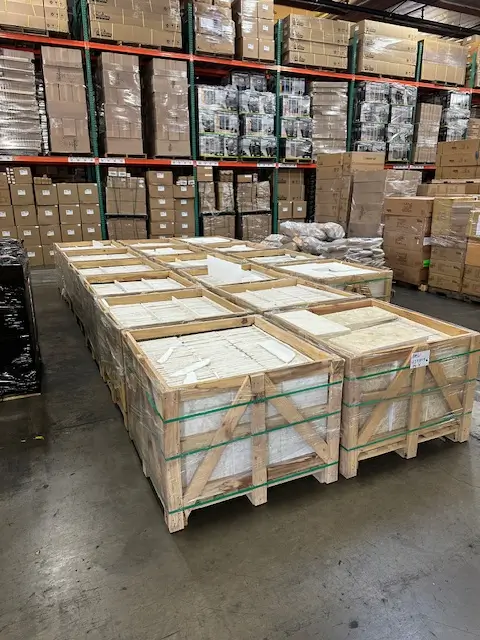
Reviewing our limestone block inventory gives you a clear picture of available lot sizes and material specifications before you commit to a project timeline — batch consistency is tracked from the point of receiving, not just from the quarry documentation.
Delivery Logistics and What They Reveal About a Supplier
How a supplier manages truck delivery and warehouse fulfillment tells you almost as much about their operational quality as their certifications do. A supplier who can confirm available stock, provide a firm truck delivery window, and accurately state pallet weights for site access planning is operating with real inventory discipline. One who quotes lead times in vague ranges and can’t confirm lot consistency between the sample and the delivery order is working from shallow inventory visibility.
For large-scale projects in Phoenix, truck access constraints at the delivery site should be part of your pre-order conversation — not a surprise on delivery day. Standard limestone pallet weights run between 2,800 and 3,400 pounds depending on thickness and paver format, which affects whether a flatbed or a liftgate truck is appropriate for your site conditions.
- Confirm whether the supplier’s warehouse carries the full quantity you need in a single lot — split-lot deliveries create color variation problems
- Ask about minimum order quantities — some suppliers require full pallet orders, which affects waste calculation on irregular site footprints
- Verify lead time from warehouse stock versus special-order sourcing — Arizona quality assurance timelines differ significantly between the two
- Clarify responsibility for damage claims — a credentialed supplier will have a documented claims process tied to delivery inspection
Red Flags That Disqualify a Supplier Immediately
Years of reviewing supplier documentation reveals certain patterns that reliably predict post-installation problems. These aren’t edge cases — they’re consistent indicators that a supplier hasn’t built the infrastructure to support quality limestone supply at the level Arizona projects demand.
- Test reports dated more than three years ago without a current re-test — quarry conditions and processing methods change, and old data doesn’t cover the current batch
- Inability to name the specific quarry or region of origin — “imported limestone” without further detail means the supplier doesn’t track batch provenance
- Samples that don’t match lot descriptions in thickness or finish — if the sample room doesn’t match the warehouse, the warehouse won’t match your delivery
- Pricing that undercuts the market by more than 15–20% without an explanation — material that cheap is typically off-grade, inconsistently sized, or sourced from a non-primary quarry cut
- No written return or replacement policy for material that fails incoming inspection at your site
At Citadel Stone, we recommend documenting your incoming material inspection at the point of delivery — photographing pallet condition, measuring a minimum of ten random pieces per pallet for thickness tolerance, and confirming the batch number against your purchase order before signing the delivery receipt. This fifteen-minute step protects you from quality disputes that can otherwise take weeks to resolve.
Working with Scottsdale Verified Suppliers on Local Projects
Scottsdale’s architectural character — low-profile desert modern, Spanish Colonial revival, and contemporary resort design — creates a specific limestone selection context that goes beyond raw material performance. The material needs to complement the warm earth tones typical in Scottsdale’s residential and hospitality markets while meeting the durability thresholds that outdoor Arizona exposure demands. A supplier who understands this aesthetic-technical balance is more useful to your project than one who just forwards specification sheets.
For projects in Tucson and the broader southern Arizona market, the limestone selection calculus shifts slightly — higher average humidity during monsoon season, different soil expansion characteristics, and a slightly cooler thermal range than central Phoenix. These regional variables should come up naturally in any credentialed supplier consultation. If a supplier offers identical recommendations regardless of project location, they’re not drawing on real regional experience.
Our technical team sources limestone specifically for Arizona climatic conditions, verifying lot quality at the warehouse before material is allocated to customer orders — not just at the point of import. That warehouse-level quality gate is what separates a credentialed supply operation from a pass-through distributor, and it reflects the standard that limestone vendor qualifications in Arizona should consistently meet.
Last Word
The standard for limestone supplier credentials in Scottsdale is higher than most markets because the performance environment is more demanding. Your material is going to face surface temperatures above 110°F, UV exposure exceeding 300 days annually, and the mechanical stress of thermal cycling — expansion and contraction that works at every joint and edge continuously. A supplier who can’t document their material’s response to those conditions isn’t equipped to support your project at the specification level it requires. Limestone vendor qualifications in Arizona ultimately come down to one practical test: can this supplier answer your technical questions from direct knowledge, produce documentation that supports their answers, and back up their claims with a transparent chain of custody from quarry to your site?
Building that evaluation into your pre-qualification process — before the purchase order, not after the first delivery — protects both the installation’s long-term performance and your professional standing on every project. For insight into how supplier relationships translate to consistent project outcomes over time, Limestone Paver Supplier Reliability for Phoenix Long-Term Partnerships covers how sustained supplier accountability affects multi-phase and repeat projects across the Arizona market. We have matched limestone slabs for sale in Arizona for projects that require cladding and paving integration.