
Accurate quantity planning is the single biggest variable separating a smooth Cave Creek limestone project from one that stalls mid-installation waiting on a second delivery. Using a reliable Limestone Quantity Calculator Cave Creek approach — whether that’s a digital tool, a manual formula, or a supplier consultation — determines whether your material budget holds and your schedule stays intact. The calculation isn’t complicated, but the local variables Cave Creek throws at you absolutely are. Caliche layers, irregular terrain, and significant thermal cycling all create conditions where generic formulas fall short of what field reality demands.
Why Cave Creek Conditions Change Your Calculations
Cave Creek sits at roughly 2,000 feet elevation with terrain that shifts between flat desert floor and rocky hillside grades within a single residential lot. That elevation and grade variability directly affects your slab quantity needs in ways flat-valley projects don’t encounter. You’re dealing with step-outs, cut fills, and irregular perimeter shapes that add 12–18% more material than a straight square-footage calculation suggests. Reliable Cave Creek material estimates must account for these site-specific conditions from the start.
The soil profile here also matters. Projects in Chandler encounter relatively uniform sandy loam, but Cave Creek’s caliche hardpan can sit anywhere from 8 to 24 inches below grade, which changes your base depth decisions and, by extension, your surface slab allocation. Your quantity estimate needs to account for base preparation decisions before you can finalize how much limestone you’re actually ordering.
- Slope adjustments of 5% grade or more typically require 8–12% additional material for step-cut installations
- Irregular lot shapes increase waste factor from a standard 10% to as much as 18–22% depending on the number of cuts required
- Caliche sub-base presence can reduce base aggregate depth requirements but demands precise surface elevation planning
- Thermal cycling between 110°F summer highs and occasional winter nights below freezing requires joint spacing adjustments that affect slab layout efficiency
The Core Limestone Quantity Calculator Formula
The foundational formula for any Cave Creek material estimate starts with total surface area and works outward from there. Measure your project area in square feet, add your waste factor, then divide by the coverage rate for your chosen slab thickness. Sounds straightforward, but each of those variables carries real-world nuance that changes your final order.
For a standard 1.25-inch limestone slab, expect a nominal coverage of 1 square foot per unit on irregular flagging formats, or precise square footage on cut-to-size slabs. Your waste factor for a rectangular patio with clean cuts runs about 10%. Add irregular shapes, angles, or curved edges and that number climbs to 15–22%. The formula looks like this: (Measured SF × 1.15 waste factor) ÷ coverage rate per unit = quantity needed. A Limestone Quantity Calculator Cave Creek approach should always apply this formula with site-adjusted waste factors rather than national defaults.
- Standard waste factor for rectangular installations: 10%
- Waste factor for curved or irregular perimeters: 15–20%
- Waste factor for diagonal or herringbone patterns: 20–25%
- Add 5% buffer for material held in warehouse inventory matching — slight color lot variations between shipments can create visible banding if you run short and reorder
- For pool surrounds and spa decks, always calculate coping and field separately — they often come from different thickness cuts
Slab Thickness and Coverage Rate Decisions
Limestone slab thickness in Arizona coverage calculations isn’t purely aesthetic — it directly ties to load requirements and base stability. A standard residential patio carries 40–60 PSF live load, which a 1.25-inch limestone slab handles without issue over a properly compacted base. Step into driveway applications or areas with vehicle access and you need to move to 2-inch nominal minimum. These Arizona coverage calculations shift meaningfully depending on which thickness tier your project requires.
Thicker slabs mean fewer units per ton, which shifts your quantity planning when you’re buying by weight rather than by piece count. A pallet of 1.25-inch slabs at 500 square feet covers meaningfully more ground than the same weight in 2-inch stock. Your supplier should give you both coverage-per-ton and coverage-per-pallet figures before you commit — those two numbers together tell you exactly what truck capacity you need for delivery.
- 1.25-inch slabs: approximately 140–160 SF per ton depending on density of specific limestone variety
- 1.5-inch slabs: approximately 115–130 SF per ton
- 2-inch slabs: approximately 85–100 SF per ton
- Verify actual coverage with your supplier — limestone density varies by quarry source and formation layer
Measuring Irregular Spaces Accurately
The limestone measurement guide principle that most installers learn the hard way: never measure once and order. Irregular spaces require a grid-based measurement approach where you divide the area into manageable rectangles or triangles, calculate each sub-zone separately, and then total them. This prevents the compounding estimation error that shows up as a 50-square-foot shortage on delivery day.
For L-shaped patios or spaces with curved pool edges, break the area into segments. Rectangles get standard L × W calculation. Triangles use (base × height) ÷ 2. Curved sections approximate to the nearest rectangular zone and add to your waste factor — treat a significant curve radius as an additional 3–5% on top of your baseline waste calculation. Following a structured limestone measurement guide approach before ordering ensures your Cave Creek material estimates reflect actual field conditions rather than idealized geometry.
- Photograph the space and sketch a dimensioned plan before measuring — this catches obstacles and elevation changes that pure tape measurements miss
- Measure at multiple points along each dimension — irregular lots rarely have parallel walls
- Check for grade changes greater than 1 inch across 10 feet — these require step-cut planning that changes your slab quantity
- Account for built-in planters, drainage features, and any fixed obstacles that reduce your actual coverage area
Limestone Quantity Planning for Driveways and Hardscaping
Driveway applications in Cave Creek demand quantity planning that factors in both the surface slab and the edge treatment. Your driveway edges take point-load impact from tire tracking — the outer 18 inches of a limestone driveway experience disproportionate stress. Specifying a slightly thicker slab at the edges (or selecting a higher-density limestone variety for border courses) keeps your quantity calculation honest by preventing early edge replacement that undermines the whole installation.
The Cotswold limestone paving slabs specification we typically recommend for Cave Creek driveway borders combines a dense formation profile with dimensional consistency that keeps your quantity calculations predictable — you’re not dealing with thickness variation that creates bedding depth adjustments mid-installation.
For quantity planning purposes, calculate your driveway in three zones: main field, edge courses, and apron transition to the street. Each zone may need different slab stock, and ordering them under one quantity number often means you run out of edge material before the field work finishes. Break it down by zone and you’ll have the right material at the right stage of the project.
Ordering Strategy and Warehouse Logistics
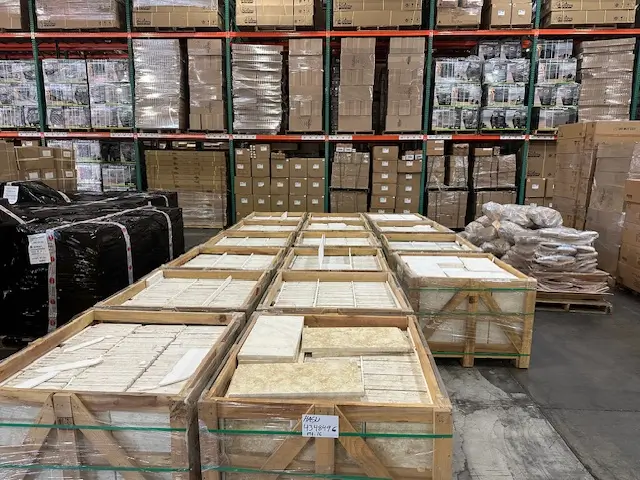
Your quantity plan is only as useful as your ability to get the material on site when the installation crew is ready. Limestone slab orders from warehouse stock typically require 5–10 business days for standard sizes, but custom cuts or specific thickness specifications can push lead times to 3–4 weeks. Understanding what’s in stock versus what needs to be pulled from deeper warehouse inventory affects your project schedule as much as the quantity calculation itself.
Citadel Stone maintains Arizona warehouse inventory that generally keeps standard limestone slab formats available within 1–2 weeks — significantly shorter than the 6–8 week import cycle for material ordered directly from quarry. That turnaround time difference matters when your installation window opens in October and you want to avoid the mid-winter weather that slows setting compound cure times. Check warehouse availability before you finalize your project schedule, not after.
- Order 5–7% more than your calculated quantity to account for breakage during truck transport and on-site handling
- Specify your truck access conditions when ordering — tight driveways or low-clearance entries affect delivery vehicle selection and may require multiple smaller loads
- Request material from a single production lot when possible — color and texture consistency within a lot reduces visible variation in your finished installation
- Confirm pallet weights before scheduling delivery — a full limestone pallet can exceed 2,500 lbs, which affects gate access and staging area load capacity
Joint Spacing and Its Effect on Quantity
Here’s what the basic limestone measurement guide rarely addresses: joint spacing decisions affect your actual coverage area. A 3/8-inch joint on a 12×12 slab layout consumes roughly 6% of your total surface in joint material. Move to 1/2-inch joints and that percentage climbs — meaning you need more slab units to cover the same area. Your quantity calculator needs to factor joint width into the coverage calculation, not treat it as an afterthought.
For Cave Creek installations, a 3/8-inch to 1/2-inch joint is standard practice. Narrower joints look elegant but create problems in high-heat climates — thermal expansion at Arizona temperatures pushes slabs against each other with enough force to cause edge spalling if you haven’t left adequate expansion room. Your joint spacing decision is partly aesthetic and partly structural, and it directly feeds back into your material quantity order.
- 3/8-inch joints: accounts for approximately 5–6% reduction in net slab coverage per 100 SF
- 1/2-inch joints: accounts for approximately 7–8% reduction in net slab coverage per 100 SF
- Sand-set installations require slightly wider joints than mortar-set to allow for sand migration adjustment over time
- Projects in Tempe and similarly low-elevation heat zones benefit from 1/2-inch minimum joints to manage peak summer expansion forces
Quantity Planning for Phased Projects
Many Cave Creek properties develop their hardscape in phases — a patio one season, a walkway the next, a driveway apron later. Quantity planning for phased projects requires thinking about the full scope upfront even if you’re not ordering all at once. Material availability, production lot consistency, and price fluctuations all reward a planned approach over a reactive one.
The practical move is to calculate total project quantity across all phases, then confirm with your supplier how long they can hold a production lot match. At Citadel Stone, we recommend confirming lot availability for future phases at the time of your initial order — it takes one conversation but prevents the color mismatch problem that plagues phased projects where the second order ships from a different quarry batch. Projects in Surprise with larger lot footprints especially benefit from this approach, since multi-zone hardscaping is common and lot consistency becomes visible when phases are installed 6–12 months apart.
- Request your supplier hold a production lot for 90–120 days for phase-two orders — most can accommodate this with a partial deposit
- Calculate each phase quantity separately, then add them for a total scope figure you can use for budget planning
- Account for the learning curve on installation — first-phase waste factors are typically 2–3% higher than subsequent phases as the crew calibrates to the material
- Price your full quantity requirement at initial order to lock in material cost before market fluctuations affect later phases
Decision Points
Your Limestone Quantity Calculator Cave Creek process ultimately converges on three decisions that define the accuracy of your final order: waste factor selection based on your specific site geometry, thickness choice based on load requirements and base conditions, and lot strategy for phased or complex projects. Get those three right and your quantity number will be accurate within 5% — close enough that your contingency buffer covers the rest without over-ordering and leaving expensive material sitting unused.
Quantity planning isn’t a one-time calculation — it’s an iterative process that tightens as your site measurements improve and your base preparation decisions firm up. Run your numbers at schematic design, then recalculate at construction document stage with actual site measurements. The difference between those two runs typically reveals the site-specific variables that generic online calculators miss entirely. For Cave Creek projects where site conditions vary sharply from standard desert valley assumptions, that second calculation pass is where accurate quantity planning really happens. For other Arizona stone projects where timing and purchasing strategy matter as much as material selection, Seasonal Limestone Buying Advantages for Paradise Valley Homeowners offers a complementary perspective on how sourcing decisions affect project outcomes across the region.
At Citadel Stone, our technical team reviews quantity calculations with customers as part of the ordering process — not to upsell, but because a short delivery is genuinely more disruptive than a modest overorder on a project this size. We encourage customers to visit our yard before they buy limestone slabs in Arizona to feel the texture.