
Base preparation failure accounts for the majority of limestone paver walkway replacements in Arizona — not material quality, not sealer choice, but the drainage geometry underneath. A limestone paver walkway garden path integration that performs for 25 years in Peoria’s demanding conditions starts with understanding exactly how water moves through your landscape, not just across it. Get that relationship between subsurface drainage and surface stone right, and you’ve solved most of what will challenge your installation over time.
How Monsoon Water Behavior Shapes Your Walkway Design
Arizona’s monsoon season delivers a pattern that catches a lot of landscape projects off guard — concentrated rainfall events that can dump an inch or more of water in under an hour, then nothing for weeks. Your limestone garden walkway design has to handle both extremes: rapid runoff management during storm events and the desiccation cycle that follows. Standard drainage gradients used in moderate climates (1–1.5% cross-slope) often prove insufficient in the Phoenix metro corridor, where sheet flow velocities during peak monsoon events can erode poorly consolidated base material at joints.
The practical minimum for Arizona path installations is a 2% cross-slope, and in low-lying areas or yards with limited natural drainage relief, pushing that to 2.5% is the smarter call. Think carefully about where that water goes once it leaves your path surface. Directing runoff toward planting beds rather than hardscape or structures creates integrated paths that work with your irrigation logic rather than against it. This connectivity between path drainage and planting zones is one of the markers of well-designed Peoria connected landscapes that actually hold up after monsoon season.
The Base System That Keeps Water Where It Belongs
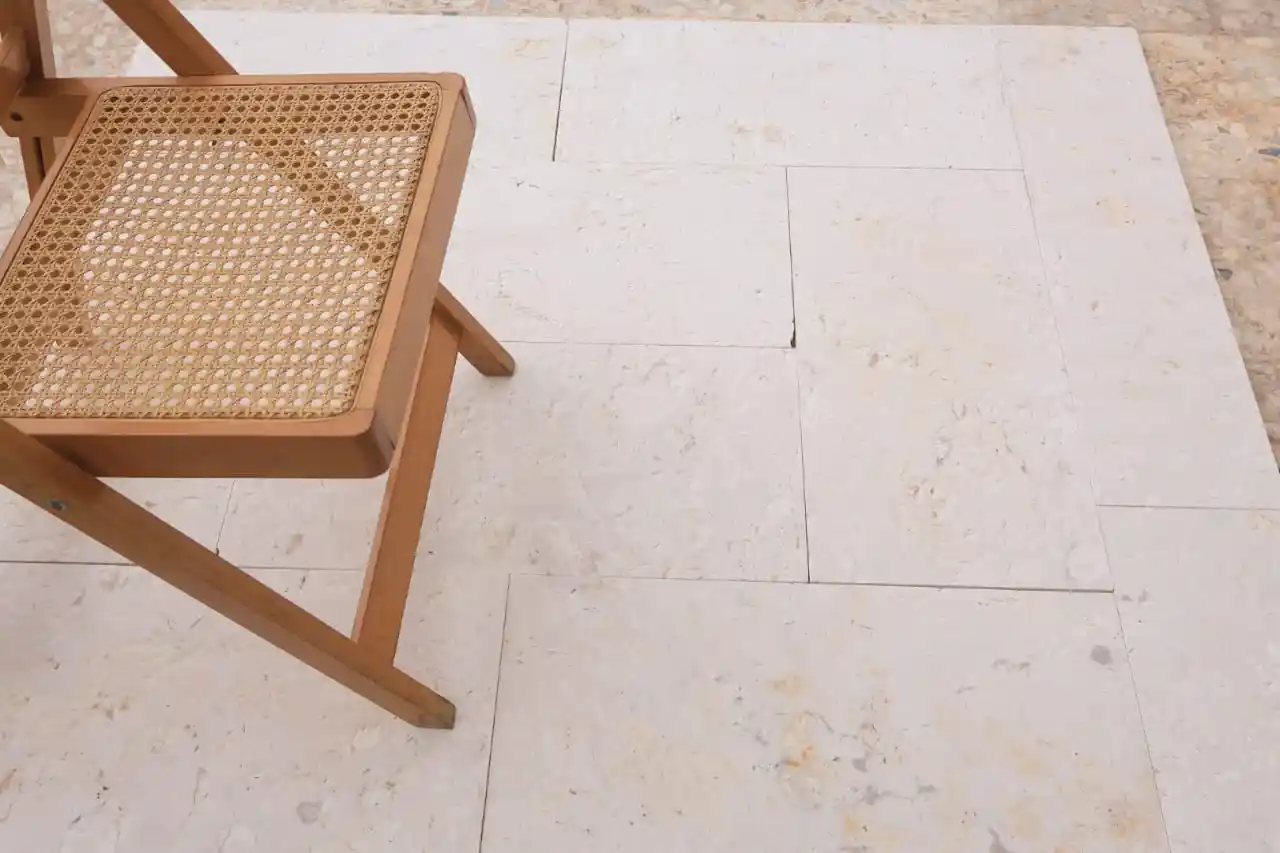
Here’s what separates a functional limestone garden walkway from one that starts heaving or settling after the second monsoon season: a properly engineered base system that accounts for both compaction and permeability. A crushed aggregate base — 3/4-inch minus compacted in 3-inch lifts — provides the load distribution your pavers need. Permeability matters just as much in Arizona. If your base traps water during a storm event and then that water heats up against caliche or clay-heavy native soil, you’ll see differential expansion that disrupts your joint lines.
Consider these base specification targets for Arizona limestone walkway applications:
- Minimum compacted aggregate depth of 4 inches for pedestrian-only paths, 6 inches if you anticipate any occasional equipment or vehicle proximity
- Bedding sand layer of 1 inch maximum — thicker beds compress unevenly and introduce settling risk
- Cross-slope established in the aggregate base layer, not corrected at the bedding sand level
- Geotextile separation fabric between native soil and aggregate where expansive clay soils are present
- Permeable joint compound rather than polymeric sand in areas with high seasonal moisture variation
In Peoria, the soil profile typically includes caliche layers at varying depths — sometimes as shallow as 10 inches. That caliche acts as a partial moisture barrier, which actually increases the importance of positive drainage slopes because percolation into native soil slows considerably once you hit that layer.
Choosing Limestone for Water Management Performance
Not all limestone performs identically under repeated wetting and drying cycles, and this is where material selection directly connects to your drainage strategy. Denser, lower-porosity limestone with an absorption rate below 3% (per ASTM C97) handles Arizona’s moisture extremes better than more porous varieties. The problem is that lower porosity often correlates with reduced slip resistance — a real safety concern on wet path surfaces.
Your specification sweet spot for a limestone paver walkway in Arizona sits at a surface texture that achieves a wet DCOF (Dynamic Coefficient of Friction) above 0.42 — the minimum for pedestrian surfaces per ANSI A137.1. Bush-hammered or tumbled limestone finishes typically exceed this threshold while still offering the visual warmth that makes garden paths appealing. Honed finishes are riskier on paths that experience direct rainfall exposure; save those for covered transitions or interior-adjacent zones where moisture exposure is controlled.
Thickness matters here too. For standard residential walkways, 1.25-inch nominal pavers provide sufficient structural integrity. For garden paths that intersect with lawn areas where heavy mowing equipment passes, stepping up to 1.5-inch nominal thickness eliminates edge chipping risk. At Citadel Stone, we inspect limestone thickness consistency at the warehouse level before material ships — a tolerance variance greater than 3mm across a pallet creates installation headaches and potential trip hazards that no amount of bedding sand adjustment fully corrects.
Arizona Circulation Design That Connects Landscape Zones
Arizona circulation design for limestone garden walkways isn’t just about aesthetics — it’s about managing foot traffic patterns that shift seasonally. During summer months, occupants gravitate toward shaded routes, often creating informal desire paths that bypass your installed walkway if it doesn’t align with comfortable movement. Designing for shade adjacency, even if that means a slightly longer path routing, dramatically improves how well your circulation system gets actually used.
Path width is another functional detail that gets underspecified. A 36-inch-wide single-person path feels generous in a catalog rendering but tight in real use, especially when desert plantings mature and encroach on edges. Spec 42–48 inches for primary garden circulation routes and reserve 36 inches for secondary connector paths. This width also affects your drainage performance — narrower paths concentrate foot traffic in a smaller zone and can compact the base layer more aggressively over time.
Limestone garden walkways in Sedona face a different circulation challenge: the terrain relief means paths often need integrated step transitions, and each step junction represents a potential water collection point. Weeping the riser face forward by 1/8 inch prevents water from pooling at vertical surfaces and reduces staining over time — a small detail that makes a measurable difference in long-term appearance.
For material planning across Arizona project zones, reviewing the Citadel Stone limestone walkway inventory in Sedona gives you a solid reference point for understanding which limestone profiles are reliably available for larger integrated paths projects.
Joint Design Under Moisture Cycling Pressure
The joint system in your limestone walkway is where Arizona’s moisture cycling does the most damage over time — and where most specs fall short. During monsoon season, joint material absorbs water; during dry months, it desiccates. Polymeric sand, the standard recommendation in moderate climates, can become brittle and crack under this cycling if it wasn’t properly activated with sufficient water during installation. In dry conditions, achieving full polymeric activation requires deliberate soaking — not just misting — immediately after installation and before any traffic exposure.
Joint width selection interacts with your drainage design. Narrower joints (1/8 inch) look refined but move essentially no water vertically. Wider joints (3/16 to 1/4 inch) provide limited permeable drainage relief during events that overwhelm surface drainage capacity. For most Arizona residential path installations, a 3/16-inch joint with a semi-flexible joint compound that tolerates 5–8% elongation before cracking provides the best balance of appearance and performance under thermal and moisture cycling.
Plan for joint maintenance as part of your long-term ownership cost. Expect to replenish or refresh joint material every 5–7 years in Arizona’s climate — budgeting for that upfront, and selecting a joint product that can be reapplied without full paver removal, saves significant cost over the installation’s lifetime.
Sealing Strategy That Preserves Drainage Function
Sealing a limestone paver walkway in Arizona is non-negotiable for long-term performance, but the wrong sealer application can actually undermine your drainage design. Film-forming topical sealers create a surface barrier that redirects water rather than managing it within the material. In high-rainfall-intensity events, that redirection concentrates runoff rather than distributing it — you’ll see accelerated erosion at path edges and at transition points to planting beds.
Penetrating impregnating sealers are the correct choice for outdoor Arizona limestone paths. These sealers treat the stone’s pore structure from within without altering surface drainage behavior. Look for fluoropolymer or silane/siloxane-based formulations with water repellency ratings above 90% at 24 months post-application. Application protocol matters: apply to clean, fully dry stone in ambient temperatures between 50°F and 90°F, avoiding application during or immediately after rain events (wait at least 48 hours after any moisture).
Resealing cadence in Arizona should be every 2–3 years for high-traffic paths and 3–4 years for lightly used garden connector routes. Test whether your sealer is still performing by dropping water on the surface — if it beads above the surface, you’re still protected; if it absorbs within 30 seconds, you’ve entered the vulnerability window where staining risk increases significantly.
Thermal Mass and Elevation: Supporting Factors to Get Right
While drainage is the primary performance driver for Arizona limestone paths, thermal behavior deserves attention as a supporting specification factor. Limestone’s thermal expansion coefficient runs approximately 4.4 × 10⁻⁶ per °F — modest compared to concrete, which runs closer to 6 × 10⁻⁶ per °F. That difference matters in long, continuous path runs: a 40-foot limestone garden walkway will experience roughly 20% less cumulative thermal movement than an equivalent concrete surface across Arizona’s full temperature range.
Paths in Flagstaff operate in a fundamentally different thermal regime — freeze-thaw cycling is real above 7,000 feet elevation, and that introduces a material performance demand that low-desert installations don’t face. Limestone for Flagstaff applications should meet ASTM C568 Group II classification (minimum 7,500 PSI compressive strength) and maintain absorption below 3% to resist freeze-thaw degradation. Most limestone varieties that perform well in the Phoenix metro corridor are adequate for Flagstaff conditions, but verifying freeze-thaw durability ratings before specifying is worth the extra step when elevation is a factor.
Truck delivery logistics also shift with elevation projects. Flagstaff deliveries require route planning for grade and payload limits — verifying access and scheduling delivery windows during favorable weather conditions reduces the risk of damaged material arriving to site. Coordinate with your supplier on weight limits for your specific delivery address, particularly for rural Flagstaff properties where road conditions vary.
Project Planning, Supply Timing, and Logistics
Coordinating material delivery for a limestone garden walkway integration project requires more lead time than most homeowners anticipate. Natural stone availability fluctuates, and matching consistent color lots across a full path installation requires pulling from the same warehouse inventory batch whenever possible. Mixing lots mid-project creates visible color variation that’s nearly impossible to correct after installation.
Plan your material quantities with a 10% overage minimum for cuts and breakage. On curved path layouts — which are more common in integrated garden designs than straight commercial applications — that overage need often climbs to 12–15% because curved cuts generate more waste per linear foot than orthogonal cutting. Warehouse stock levels for specific limestone profiles can shift quickly, so confirm availability before finalizing your installation schedule rather than assuming material you saw available will remain in stock weeks later.
Typical warehouse-to-site lead times from Citadel Stone’s Arizona operations run 1–2 weeks for in-stock profiles, which compares favorably to the 6–8 week import cycle for special-order materials. If your design calls for a specific finish or thickness not in standard inventory, building that additional lead time into your project schedule prevents the common scenario of an installation crew mobilizing before material arrives.
What Matters Most for Limestone Paver Walkway Performance
A limestone paver walkway garden path integration that performs well in Arizona comes down to a clear hierarchy of decisions: drainage geometry first, base system second, material selection third, sealing fourth. Reversing that order — which happens when landscape projects start with aesthetic selection and work backward to function — is why so many otherwise well-installed paths need intervention within 5–7 years. Your path’s drainage design determines almost everything else about how the installation ages.
The detail that separates lasting installations from maintenance-heavy ones is continuity between the path’s drainage function and the broader landscape system it connects. Limestone garden walkways aren’t isolated hardscape elements — they’re part of your site’s water management infrastructure. Design them that way, and the material will deliver the 20–25 year service life it’s capable of under proper Arizona conditions. For projects extending to narrower passage areas or side-yard connections, Limestone Paver Walkway Side Yard Solutions for Glendale Narrow Spaces addresses the specific challenges of constrained circulation zones where drainage geometry is tightest. Citadel Stone’s limestone paver walkway in Arizona materials resist staining better than competing products through superior sealing.