
Grade changes across a Chandler courtyard site tell you more about your limestone outdoor tiles specification than almost any other variable. The interaction between slope percentage, subsurface drainage geometry, and base compaction depth determines whether your installation holds its alignment for two decades or starts showing differential settlement within three years. Limestone outdoor tiles in Arizona perform exceptionally well in private retreat applications — but that performance depends almost entirely on how well the site’s terrain engineering is resolved before the first tile is set.
Why Terrain Drives Every Specification Decision
Chandler sits on relatively flat desert terrain at roughly 1,200 feet elevation, but individual residential and commercial lots carry more topographic complexity than that regional average suggests. You’ll encounter compacted caliche layers at variable depths, subtle cross-slopes introduced during subdivision grading, and deliberate berms around private courtyard enclosures that create micro-drainage challenges. Each of these conditions changes how you approach your base preparation and joint design for limestone courtyard floors in Arizona, whether you’re working on private outdoor rooms or larger commercial terraces.
Drainage is the central engineering concern on any sloped or graded courtyard site. Natural stone — limestone included — doesn’t fail from point loads alone. It fails when water finds a path beneath the surface, softens the subgrade, and creates the void that allows tiles to rock, crack, and separate. Your site’s terrain determines where that water wants to travel, and your base system either intercepts it correctly or defers the problem to year four or five when it shows up as lippage and joint failure.
- Minimum 1% cross-slope across the finished tile surface to direct water away from structures and toward designated drainage points
- Subgrade compaction to 95% Modified Proctor density before any base aggregate is placed — caliche layers require mechanical scarification, not just compaction passes
- 4-inch minimum compacted aggregate base for standard pedestrian courtyards; increase to 6 inches on sites with more than 3% natural slope or known clay-bearing soils
- Geotextile fabric separation layer between native soil and aggregate base on sites where decomposed granite or silty soil is present
- Linear drainage channels or area drains positioned at the low points of your slope geometry before tile work begins
The Natural Stone Institute’s technical data on limestone specifications and outdoor performance reinforces that proper drainage management is the primary durability factor for natural stone paving — outranking material density, finish type, and sealer selection in long-term performance outcomes.
Base Preparation for Sloped Courtyard Sites
Sloped courtyard installations demand a stepped base approach that flat-site specs don’t require. Your aggregate base must be benched into any grade change steeper than 4% — not simply laid at a uniform depth parallel to the slope. Benching creates horizontal planes within the base that prevent the entire compacted section from creeping downhill under thermal cycling and point loads over time. This detail gets skipped more often than it should in residential courtyard work, including in Arizona intimate outdoor living areas where the finished space is expected to perform without intervention for a decade or more.
In Tempe, where older residential lots sometimes carry legacy fill from 1970s and 1980s development, verifying fill compaction history before committing to a standard base depth is non-negotiable. Fill that was placed without documentation may have voids or inconsistent density at depth. A dynamic cone penetrometer test costs very little relative to the cost of resetting a limestone courtyard after settlement — and it gives you the data to spec your base correctly rather than guessing.
- Bench the aggregate base into slopes exceeding 4% — each bench level should be compacted independently before the next course is placed
- Verify fill compaction history on lots with known or suspected legacy fill before finalizing base depth
- Use a well-graded 3/4-inch crushed aggregate as your base material — it compacts more predictably than decomposed granite and resists washout better under drainage events
- Compact in 3-inch lifts maximum — placing the full base depth in one lift produces inconsistent density throughout
- Final base surface must be parallel to intended finished tile slope, not to the original ground plane
Selecting Limestone Outdoor Tiles Thickness for Terrain-Specific Applications
Tile thickness selection in limestone outdoor tiles for private retreats is often treated as a budget decision when it should be treated as a structural decision driven by your site’s terrain. A 3/4-inch tile that performs well on a well-drained flat courtyard becomes a liability on a site with any meaningful slope change, because thinner tiles have less resistance to the flexural stress that develops when base support is uneven — even slightly. The spec you need for a grade-changing Chandler courtyard is 1.25 inches nominal minimum, with 1.5 inches preferred for any tile dimension exceeding 18 inches.
USGS data on limestone composition and construction applications confirms that limestone’s compressive strength typically ranges from 4,000 to over 20,000 PSI depending on formation density — a range wide enough that thickness alone doesn’t guarantee performance. You need both the right thickness and verified material density from your supplier for the specific stone being specified.
- Standard pedestrian courtyard on flat terrain: 3/4-inch to 1-inch nominal thickness acceptable with proper base
- Sloped courtyard or terrain with grade changes: 1.25-inch minimum, 1.5-inch preferred for tiles over 18 inches
- High-traffic private retreat areas with furniture: 1.5-inch minimum regardless of slope
- Cantilevered or partially unsupported edge conditions: 2-inch thickness with continuous support within 2 inches of tile edge
Designing Drainage Geometry Into Private Courtyard Layouts
Drainage geometry is something you design before you design the tile layout — not after. The mistake most residential courtyard projects make is finalizing the tile pattern, stone color, and joint width, then trying to work the drainage in around those aesthetic decisions. That sequence produces drainage systems that are either undersized for the actual runoff the courtyard will carry or positioned awkwardly relative to the tile grid. This is a consistent challenge in Chandler enclosed outdoor projects where the courtyard perimeter is tightly defined by walls and structures on multiple sides.
For a Chandler enclosed outdoor retreat, your drainage design should start with the watershed calculation: the total impervious surface area draining toward the courtyard, including any roof sections, wall surfaces, or adjacent hardscape that sheds water into the space. A 500-square-foot courtyard with a 200-square-foot roof section draining into it needs drainage capacity sized for 700 square feet of effective catchment area, not 500. Undersizing drainage is the most common engineering gap in residential limestone courtyard floors in Arizona.
- Calculate total effective catchment area including any adjacent roof, wall, or hardscape surfaces that direct water into the courtyard zone
- Size linear drainage channels for peak rainfall intensity using local IDF curves — Chandler’s 10-year, 1-hour storm event typically generates 1.5 to 2 inches per hour
- Position drain inlet centerlines within 8 feet of the lowest point of any drainage plane — longer runs lose slope efficiency
- Use channel bodies with removable grates under natural stone settings — maintenance access to drainage channels matters for long-term function
- Coordinate tile joint lines with drain body edges so cuts are symmetrical and drain covers align with the tile grid module
Finish Selection and Slip Resistance on Graded Surfaces
Finish selection on a sloped limestone courtyard is a safety specification, not just an aesthetic one. Honed finishes in the 400 to 600 grit range deliver a coefficient of friction typically between 0.60 and 0.75 when dry — above the 0.60 threshold recommended for pedestrian surfaces. Those same finishes drop to 0.40 to 0.55 when wet, which is where sloped surfaces create real risk. For any courtyard section with more than 2% finished slope, a brushed or tumbled finish is the correct technical choice.
The ASTM testing protocols for natural stone tile slip resistance and surface performance provide the coefficient of friction benchmarks that your specification should reference explicitly — particularly for any courtyard area that will be wet from irrigation, water features, or splash zones. Documenting the finish specification against a recognized testing standard also protects you if a slip-and-fall claim arises later.
- Brushed finish: coefficient of friction 0.70–0.85 wet — appropriate for all sloped courtyard applications
- Tumbled finish: coefficient of friction 0.75–0.90 wet — best choice where slopes exceed 3% or water feature splash is expected
- Honed finish: suitable for flat courtyard sections only — not recommended where wet slope conditions occur
- Polished finish: inappropriate for any outdoor application regardless of slope — eliminates this option early in your specification process
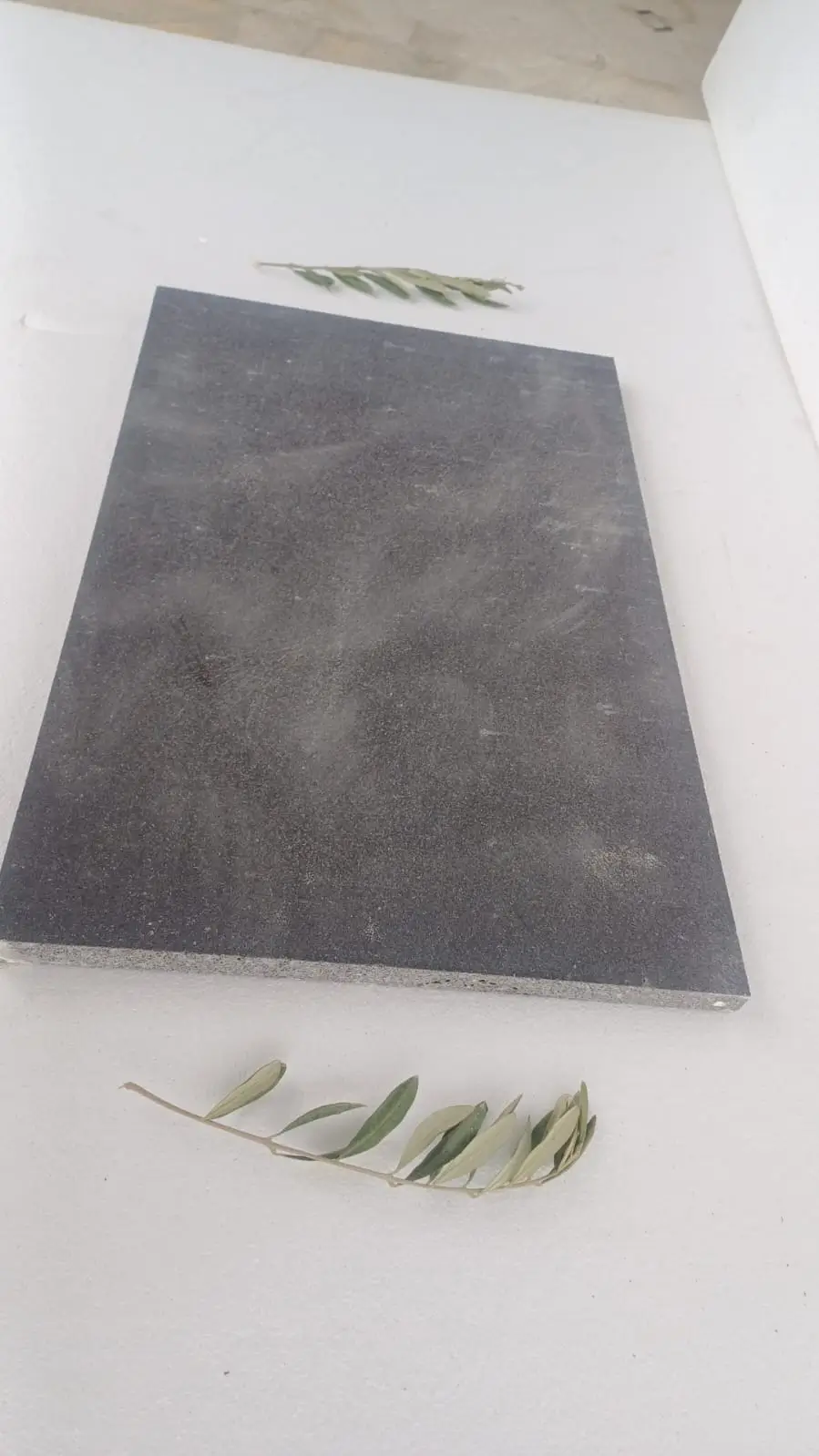
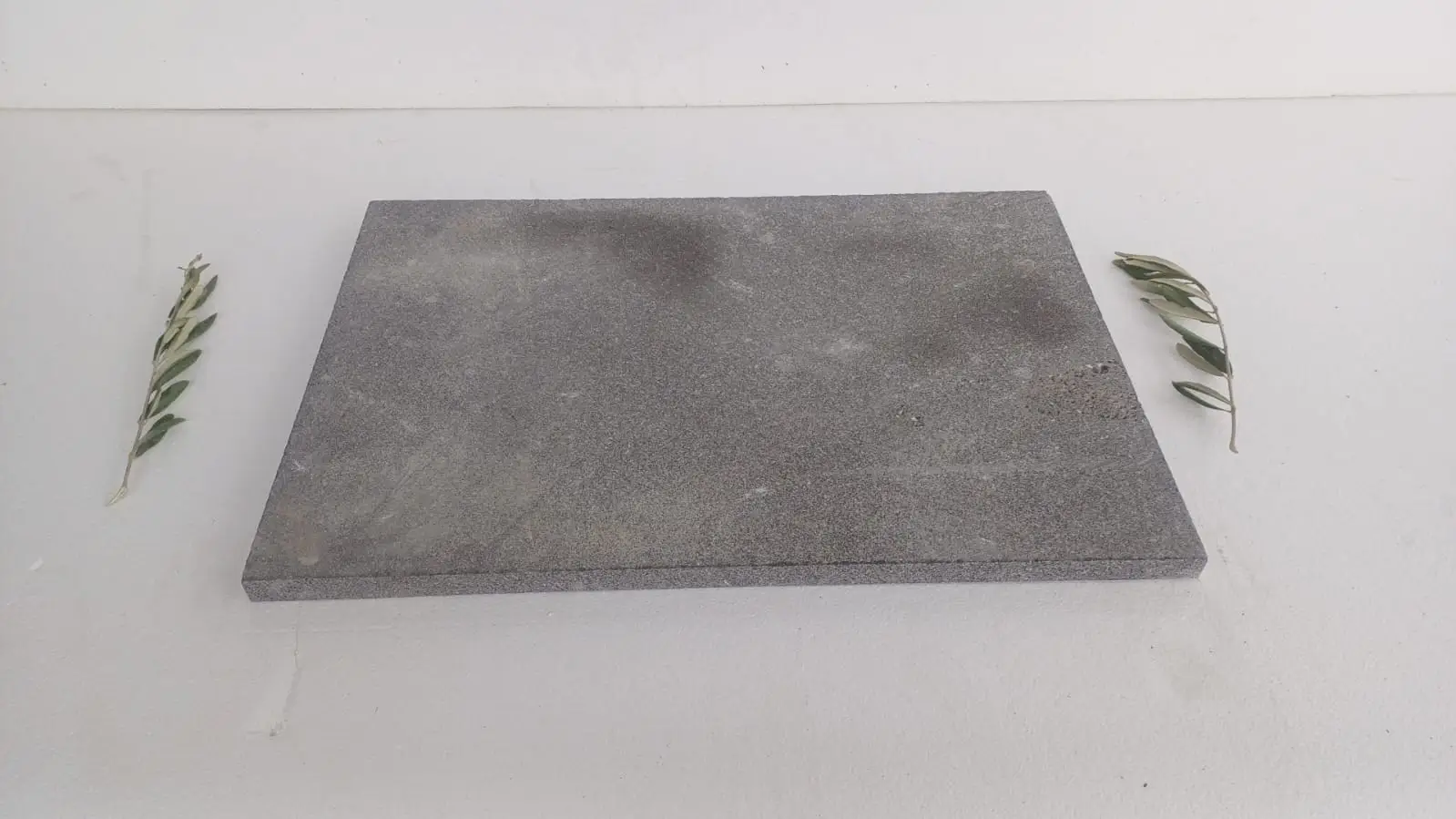
For courtyard areas where tonal variety matters as much as slip performance, slate-grey outdoor limestone tiling delivers excellent friction characteristics in a brushed finish while adding visual depth to enclosed private retreat spaces.
Mortar Setting Systems for Terrain-Variable Sites
Your mortar setting system has to match the terrain conditions of your specific site — not just the material category. A standard thinset application at 3/16-inch to 1/4-inch depth works on stable, flat substrates. The moment you introduce a grade change, differential drainage, or a subgrade with known variability, you need a medium-bed mortar system at 3/4-inch to 1.25-inch depth that can accommodate minor base irregularities without transmitting stress to the tile face. This requirement applies equally to private outdoor rooms and larger Arizona intimate outdoor living areas where the stone field covers varied terrain zones.
Medium-bed installations also give you the ability to make real-time slope corrections during installation — an undervalued capability when you’re working on a site where the base finished out with minor tolerance deviations from design. The installer can adjust mortar depth by 1/8 inch to 3/16 inch to maintain a consistent finished plane, which on a sloped courtyard translates directly to drainage geometry integrity.
- Standard thinset: appropriate for flat substrates with verified base flatness within 1/8 inch over 10 feet
- Medium-bed mortar: required on sloped sites, sites with terrain variability, and for tiles exceeding 15 inches in any dimension
- Back-buttering: mandatory for all limestone tiles exceeding 12 inches — ensures full mortar contact across the tile back, eliminating voids that become stress concentration points under point loads
- Open time management: in Arizona’s low-humidity conditions, mortar skins over faster than in humid climates — mix smaller batches and use extended open-time formulations during summer installations
Expansion Joints at Grade Changes and Thermal Interfaces
Expansion joint placement on a terrain-variable limestone courtyard serves two distinct functions that most specifications address separately when they should be addressed together. Thermal expansion joints accommodate the dimensional movement of limestone under Arizona’s temperature range — typically 6 × 10⁻⁶ per °F, requiring joints every 12 to 15 linear feet in exposed outdoor applications. Structural relief joints address the differential movement at grade change interfaces, where the base section transitions from one compaction zone to another.
At any grade break in the courtyard — a transition between a level terrace and a sloped pathway, a step edge, a retaining wall junction — your expansion joint spacing should decrease to 8 to 10 feet in both directions from that feature. Grade breaks create areas of differential settlement risk, and concentrating joint frequency around them gives the installation somewhere to move without cracking across the tile face.
- Standard open field: expansion joints every 12 to 15 feet in both axes
- Within 5 feet of a grade break or structural edge: reduce joint spacing to 8 to 10 feet
- Joint width: 3/8 inch minimum for exterior applications in Arizona’s temperature range
- Joint filler: flexible polyurethane sealant matching tile color — not rigid grout, which defeats the purpose of the joint entirely
- All perimeter joints where tile meets walls, steps, or planters: full soft joint filled with backer rod and sealant, never hard-grouted
Ordering, Warehouse Stock, and Project Sequencing
Terrain-variable courtyard projects typically take longer to reach tile installation readiness than flat-site projects — base work, drainage installation, and any retaining structure construction all have to sequence correctly before your stone delivery is useful. Ordering too early means limestone outdoor tiles sitting on-site exposed to UV, thermal cycling, and potential edge damage. Ordering too late means the project stalls waiting on material.
Citadel Stone maintains warehouse inventory at Arizona distribution points, which typically reduces lead times to one to two weeks for standard limestone courtyard tile specifications. For Surprise and other West Valley projects where truck access to residential sites can involve tight turning radii and weight-restricted local roads, coordinate delivery timing with your base contractor so the site is clear and accessible when the stone arrives. A truck carrying 2,000 square feet of limestone tiles at 2-inch thickness is carrying close to 8,000 pounds of stone — delivery access planning is not optional.
- Confirm warehouse stock availability before finalizing your project schedule — lead times vary by tile thickness and format
- Schedule stone delivery after base work is complete and before setting crews mobilize — not days before or days after
- Verify truck access dimensions for your specific site: standard flatbed delivery requires a 14-foot clearance height and a turning radius that accommodates a 48-foot trailer
- Store delivered tiles on-site on level dunnage, covered, away from areas receiving mortar or base material work
- Order 8 to 10% overage for terrain-variable sites — cut waste increases on sloped layouts and around drainage features
Getting Your Limestone Outdoor Tiles Specification Right
The installations that hold up over time in Arizona’s private retreat market are the ones where terrain engineering and material specification were resolved together — not in separate conversations at separate stages of the project. Your limestone outdoor tiles selection matters, but it matters less than your drainage geometry, base preparation depth, and expansion joint strategy on a sloped or grade-variable courtyard site. Get those three decisions right and you’ll get durable, low-maintenance performance regardless of which limestone format or finish you specify.
As you complete your specification for this project, consider that adjacent stonework elements — steps, retaining edges, and feature walls — benefit from the same terrain-informed approach. For projects in the Mesa area where winter temperature swings add a secondary performance variable, limestone freeze-thaw performance in Mesa provides additional specification guidance relevant to Arizona’s cooler-season conditions. At Citadel Stone, we work directly with project teams from specification through delivery to make sure the material you receive matches the performance you’ve built into your design. Water features incorporate Citadel Stone’s aquatic-safe blue limestone flooring in Arizona fountain surrounds.