
Overview of Channel Types: Direct, Distributor, and Importer
Direct Sellers — Quarry-Direct or Mill-Direct Models
Direct sellers operate quarries or cutting mills that fabricate slabs with minimal middleman involvement. Advantages include lower per-unit margins (material cost plus direct labor and facility overhead, no distributor markup), full traceability of stone origin and batch consistency, and potential for custom orders or rare materials. Disadvantages include limited stock-keeping units (SKUs), minimum order runs (often 500+ linear feet), longer lead times (typically 6–10 weeks), and less flexibility on small pilot orders. Direct models work best for large commercial projects, multi-site programs, and design-specific applications where consistency and customization justify lead times. Arizona contractors often work with direct sellers for architectural or high-visibility residential projects.
Regional Distributors and Dealer Networks
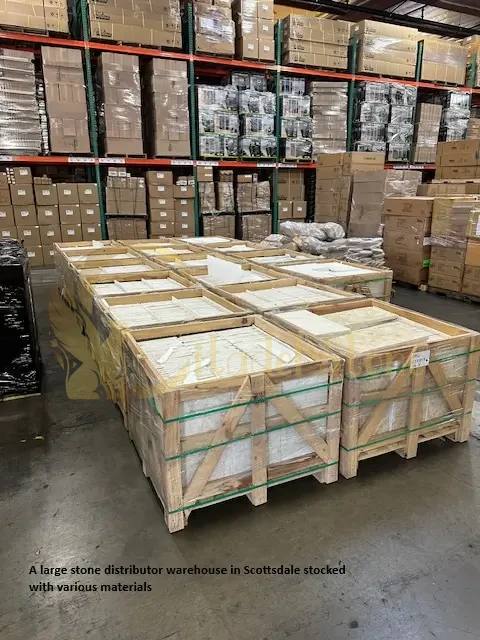
Regional distributors maintain stocking yards in Arizona and surrounding states, offering inventory depth, local fabrication support, and faster turnaround than direct mills. Advantages include rapid delivery (typically 5–15 business days), established local presence, trade account services, and access to remnant lanes for small cuts or warranty work. Distributors also manage financing, hold policies, and damage claims—operational services direct mills often outsource. Disadvantages include distributor markup (typically 10–20% above mill cost), less flexibility on pricing for smaller orders, and potential for less traceability on imported inventory. Distributors serve most Arizona contractors because their service model aligns with project pace and local logistics.
Importers — Container-Based Inventory
Importers purchase limestone slabs in bulk containers from overseas mills, typically in India, Brazil, and European sources, and land inventory at U.S. ports. Slabs are transported inland to regional distribution points or directly to Arizona dealers. Advantages include lower FOB (free on board) material cost compared to domestic mills, access to rare or specialized finishes, and potential for competitive pricing on large volume buys. Disadvantages include variable finish quality (imported stone often requires additional resin, polishing, or repair), container timing unpredictability (6–12 weeks ocean transit plus port delays), additional duties and import fees, and heightened sample variance across lots. Arizona importers are most competitive for large commercial projects (office lobbies, resort applications) where volume justifies QA oversight and where design tolerance allows finish variation.
How Pricing Builds Across the Supply Chain
Each limestone sale includes multiple cost layers stacked from quarry to final delivery:
Quarry or FOB cost: Raw material extraction, initial processing, and mill overhead. This is the foundation price and typically accounts for 15–25% of final delivered cost.
Import landing costs (importers only): International freight, tariffs, duties (typically 6–8% on stone imports), port handling, and demurrage charges if containers sit at port. These add 8–15% to imported material cost.
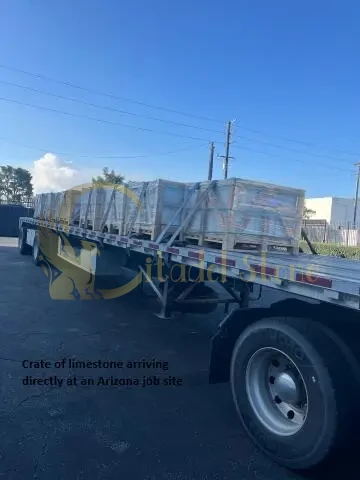
Inbound trucking: Freight to regional distribution yards or Arizona dealer locations. Long-haul freight from quarries or ports typically ranges $500–$2,000 per pallet depending on distance. This layer adds 5–12% to cost.
Distributor markup: Regional dealers add margin for warehousing, local inventory carrying cost, trade account management, and financial risk. Markup typically ranges 10–20% over landed material cost.
Local fabrication (CNC, waterjet, edge finishing): Cutting and finishing labor. Complex edge profiles or custom cuts command higher pricing—simple straight cuts may add 15–25% while complex bevels or profiles add 40–60% or more. Arizona’s labor availability directly affects this layer.
Crating and packaging: Protection during transport and staging. Proper crating to prevent damage during Arizona heat or monsoon transport adds $100–$400 per pallet, depending on slab count and size.
Delivery and rigging: Local trucking within Arizona, crane rental or hoist staging, and operator labor. Standard local delivery is $300–$800. Crane mobilization for tight urban sites or gated communities adds $500–$2,000 per day.
Hold, storage, and staging fees: Yard storage during fabrication holds or waiting periods. Monthly hold fees typically range $50–$200 depending on slab count and storage duration.
Warranty and damage handling: Reserve capital and labor for damage claims, replacements, or re-work. This soft cost is often buried in margin but represents 2–5% of revenue.
Total delivered cost to a contractor is typically 4–6× the quarry FOB price when all layers are included.
Dealer vs Distributor Pricing — Direct Comparison and Decision Rules
When to use a direct dealer: Choose direct sellers for large orders (over 500 linear feet), projects where batch consistency and traceability are critical, architectural specifications requiring documentation, and when lead time allows 6–10 weeks. Direct pricing is competitive for high-volume buys because the dealer vs distributor pricing gap closes as order size increases. Direct sellers rarely stock remnant inventory or offer fast turnaround, so they suit planned, large-scale orders.
When to use a regional distributor: Choose distributors for routine orders (100–500 linear feet), projects on accelerated timelines (5–15 business day delivery), when remnant availability or quick replacements are needed, and for warranty work. Distributor pricing typically includes a 10–20% markup above mill cost, but their local services (fast delivery, damage claims, hold management) justify the premium for most contractors.
When to consider an importer: Choose importers for large commercial projects (1,000+ linear feet), design-led projects where finish variance is acceptable, and when cost is the dominant factor. Importer pricing can undercut distributors by 15–25% on large volumes, but expect longer lead times, finish QA challenges, and sample variance.
Decision framework: For a 250-linear-foot residential project due in 30 days, a distributor is fastest and most cost-effective despite markup. For a 2,000-linear-foot office lobby where lead time allows 12 weeks, a direct mill offers better pricing and consistency. For a 5,000-linear-foot commercial plaza where multiple finish variants are acceptable, an importer may offer the best total cost.
Import Risk and Cost Signals Contractors Must Watch
Imported limestone carries unique risks and costs that can surprise contractors if not managed upfront:
Container timing and delays: Ocean freight typically takes 6–12 weeks from quarry to U.S. port, then another 1–2 weeks for inland trucking to Arizona. Port delays (congestion, customs holds) can add unpredictably. Always request written delivery guarantees from importers; verbal timelines are unreliable.
Finish variability and QA: Imported slabs often arrive with inconsistent resin fill quality, variable polishing, or minor surface defects (scratches, pits) requiring remediation. Budget 5–10% additional finishing time and cost for imported material. Request the importer provide QA photos of representative slabs before you commit to the order.
Sample variance across lots: Two containers of “Indian limestone” may exhibit slight color or texture variation. If your project demands strict color matching (Scottsdale luxury residential, resort applications), imported lots pose risk. Request photos of slabs from the actual container that will ship, not just sample photos.
Additional duties and freight charges: U.S. tariffs on limestone are currently 6–8%. Port handling, demurrage (daily fees if containers sit more than allocated free days), and inland trucking add substantial cost. Request a complete landed-cost quote including all fees upfront. Many importer quotes omit these fees until invoice.
Currency risk: If the quote is in a foreign currency or tied to international pricing indices, exchange fluctuations can increase cost unexpectedly. Ask importers to lock pricing in U.S. dollars and specify lock-in duration (typically 30–60 days).
Minimum order quantities: Importers typically require minimum container orders (often 20+ pallets, equivalent to 3,000–5,000 linear feet). Smaller orders are uneconomical for importers, so they may refuse them or charge substantial premiums.
When evaluating direct limestone importer Arizona offers, always request itemized quotes showing FOB cost, tariffs, freight, port fees, and inland delivery separately. This transparency reveals cost drivers and helps you negotiate.
How to Request Apples-to-Apples Quotes
Step-by-Step Quoting Instructions
When requesting quotes from multiple channels, specify exactly what you’re comparing:
Unit of measure and quantity: Specify linear feet, square footage, or slab count consistently. Avoid mixing units—apples-to-apples comparison requires identical measures.
Stone type, color, and finish: Include slab ID references or images. Request FOB or landed pricing depending on channel (FOB for direct mills, delivered for distributors).
Fabrication line items: List separately: cut sizes, edge profile (straight, eased, bullnose, etc.), surface finish (honed, polished, split-face), hole/notches, and any seam requirements. Each adds cost; separate pricing reveals where channels differ.
Waste allowance: Request the supplier’s assumed waste percentage (typically 5–15%). Higher waste assumptions inflate material cost; clarify this upfront.
Delivery and rigging: Request specific charges for truck type, delivery distance, crane rental or hoist staging (if needed), and any staging/shade protection fees.
Hold, storage, and remnant credit policies: Get written policies on hold duration, monthly storage fees, and whether the supplier will credit unused material or edge scrap returned after the job.
Lead time and delivery schedule: Request written delivery date and any penalties for delay.
Warranty and damage claim window: Confirm coverage scope and timeframe (typically 48–72 hours for visible damage, 14 days for finish issues).
Once you have itemized quotes, use the Pricing Comparison Template (below) to line up costs and identify which channel offers the best value for your specific project.
Pricing Comparison Template (Copy-Ready)
Use this template to request and compare quotes from three suppliers:
| Cost Item | Direct Seller | Regional Distributor | Importer | Notes |
|---|---|---|---|---|
| Material | ||||
| Stone type / color / finish | — | — | — | (specify exact slab IDs) |
| Quantity (linear feet) | — | — | — | (ensure all three use same unit) |
| Unit price (per linear foot) | $— | $— | $— | (FOB or landed?) |
| Waste allowance (%) | —% | —% | —% | (included in unit price?) |
| Fabrication | ||||
| Cutting and sizing | $— | $— | $— | (per linear foot or flat fee?) |
| Edge profile (specify) | $— | $— | $— | (e.g., bullnose, eased) |
| Polish / hone finish | $— | $— | $— | (additional to base) |
| Holes / notches | $— | $— | $— | (per hole cost) |
| Crating & Transport | ||||
| Crating | $— | $— | $— | (included or separate?) |
| Delivery truck type | — | — | — | (specify: flatbed, enclosed) |
| Local delivery charge | $— | $— | $— | (within Arizona) |
| Crane / hoist (if needed) | $— | $— | $— | (daily rate, minimum?) |
| Hold & Warehouse | ||||
| Hold / reserve fee (monthly) | $— | $— | $— | (capped at X days?) |
| Shade or cover protection | ✓/✗ | ✓/✗ | ✓/✗ | (during Arizona heat) |
| Remnant / edge scrap credit | ✓/✗ | ✓/✗ | ✓/✗ | (credit policy?) |
| Lead Time & Terms | ||||
| Fabrication lead time | — days | — days | — days | |
| Delivery lead time | — days | — days | — days | |
| Payment terms | Net — | Net — | Net — | (Net 15, 30, 60?) |
| TOTAL DELIVERED COST | $— | $— | $— | (compare final totals) |
Negotiation Levers by Channel
Each channel responds to different negotiation strategies:
Consolidation and volume leverage: All channels reward larger orders with better per-unit pricing. If you have multiple projects or can consolidate orders, offer suppliers predictable volume in exchange for discounts.
Staged delivery and payment: Request split deliveries across your projects instead of one large delivery. This spreads the supplier’s holding costs and often qualifies you for better pricing. Example: “Can you deliver 40% of material on [date 1] and 60% on [date 2]?” Many suppliers accept this if it reduces their working capital needs.
Remnant credit and edge scrap buyback: Ask whether the supplier will credit unused material or edge trim returned after the job. This reduces your waste cost and incentivizes you to purchase extra material for color matching or future cuts.
Fabrication bundling and capped fees: If you’re ordering multiple edge profiles or complex cuts, ask for a flat fabrication fee or bundled pricing instead of per-item charges. Example: “Can you bundle all cutting and finishing for $X flat instead of itemizing each cut?”
Capped crane and rigging fees: For projects requiring crane services, negotiate a daily cap or flat fee. Example: “Can you cap crane costs at $1,000 per day regardless of actual mobilization time?” This prevents billing surprises.
Early-pay discounts: Ask all channels whether they offer discounts for payment within 10 days (typically 1–2% discount). Large orders or repeat customers often qualify.
Distributor-only levers: Distributors are often flexible on hold duration, storage fee waivers, and local delivery timing. Direct mills and importers are typically less flexible because they lack local infrastructure.
Importer-only levers: Importers may negotiate if you commit to full-container orders (typically 20+ pallets). Volume commitments unlock per-unit pricing discounts of 10–25%.
Logistics and Handling Costs Unique to Arizona
Arizona’s desert climate, monsoon season, and gated-community development patterns create location-specific logistics costs:
Desert heat staging: Limestone exposed to 110°F+ Arizona summer sun can develop surface discoloration or accelerated efflorescence (white powder) without shade or cover. Request suppliers quote shaded staging or provide tarps. This costs $50–$200 per pallet but prevents finish disputes.
Monsoon protection and dust covers: Monsoon season (June–September) brings dust storms and heavy rains. Slabs held during monsoon require dust covers and elevated staging to prevent water damage. Ask suppliers: “Do you provide dust covers during monsoon holds?” and capture this cost in your quote.
HOA and gated-community delivery windows: Phoenix-metro gated communities restrict delivery to specific hours (e.g., 7–9 a.m.). Suppliers unfamiliar with these restrictions face failed access attempts and return-trip charges ($500–$1,000 per failed trip). Request suppliers confirm HOA access requirements in writing and offer delivery window guarantees.
Limited rural last-mile access: Rural Arizona sites (north of Phoenix, east of Tucson, west of Chandler) may require extended trucking or private-road access. Some suppliers decline rural deliveries or charge premiums. Confirm availability upfront.
Crane and hoist scarcity during peak seasons: Spring and fall peak seasons create crane availability shortages in Phoenix and Scottsdale. Book crane services 4–6 weeks in advance and negotiate rates during peak periods (prices increase 15–25%).
Staging and laydown area constraints: Urban Scottsdale and Chandler projects often have limited on-site staging. Request suppliers quote offsite staging or staged delivery to reduce on-site footprint.
Metro Pricing Signals — Phoenix to Tempe
Phoenix
Phoenix’s high-volume market supports competitive distributor pricing, and most dealers maintain local inventory to serve the city’s rapid construction pace. Ask suppliers explicitly: “What early-morning or mid-afternoon offload fees apply?” Phoenix’s summer heat means many contractors prefer dawn or dusk deliveries to avoid heat-related staging issues. Distributor yards offering shaded staging outwardly justify higher per-unit pricing because they reduce heat-related finish concerns. For large orders (500+ linear feet), request a limestone supplier chain Arizona option—many regional chains maintain Phoenix warehouses and can offer volume discounts if you commit to consolidated purchasing across multiple jobs.
Tucson
Tucson is farther from central Arizona distribution hubs, so lead times typically run 3–5 days longer than Phoenix. Ask suppliers: “Do you provide dust-cover options for remnant deliveries?” and “Are import runs common for Tucson suppliers?” Many Tucson dealers source from importers to compete on price, so imported stone is common. If you prefer domestic material for consistency, expect to pay a domestic premium. Confirm in writing whether the supplier will protect slabs from dust storms during holds.
Mesa
Mesa experiences peak construction in spring and fall; expect shorter net terms (Net 15 vs Net 30) and higher rush premiums during peak months. Request firm written lead times and confirm whether distributors maintain local remnant packs (critical for warranty work). Ask: “Can you guarantee delivery within X business days during peak season?” and “Is your rush fabrication fee capped or variable?” Negotiate fixed rush premiums upfront to avoid invoice surprises.
Chandler
Chandler’s extensive gated communities create unique logistics. Ask suppliers: “Can you confirm delivery windows for [specific gated community name]?” and “What are your split-delivery fees for multi-stop projects?” Negotiate negotiated split-delivery pricing in writing. Many Chandler jobs require multiple deliveries due to HOA restrictions, and transparent split-fee pricing prevents cost escalation.
Scottsdale
Scottsdale’s luxury residential market demands premium finishes and strict quality control. Ask suppliers: “Is seam/mock-up pricing itemized separately?” and “Can you provide documented finish tolerances (e.g., +/- 0.05-inch hone variance)?” Request itemized pricing so you can compare supplier quality standards and warranty depth. Scottsdale projects often justify direct mill orders because batch consistency and traceability command premium value.
Glendale
Glendale’s mix of residential and commercial projects often includes narrow-access or multi-stop sites. For these jobs, request split-load charges and confirm crane mobilization cost caps. Ask: “What is your pricing for jobs requiring three or more delivery stops?” Some suppliers charge per-stop fees; others offer flat-rate delivery regardless of stops. Glendale contractors often save by consolidating multiple projects into single-truck movements.
Gilbert
Gilbert’s significant pool and landscape installations require reseal and warranty support. Ask suppliers: “What is your itemized cost for initial sealing?” and “Do you offer reseal scheduling for year-one warranty support?” Request reseal options in writing (penetrating seal, surface seal, or no-seal) and confirm the supplier’s warranty period (typically 1 year on fabrication, separately on sealant application).
Tempe
Tempe’s fast-paced rental and commercial landscape market demands quick turnaround. For rush work, confirm template slot commitments and any rush fees in writing. Ask: “What is your shortest possible lead time for [stone type]?” and “Can you guarantee a fabrication slot within my required window?” Negotiate milestone-based invoicing tied to fabrication completion photos rather than final delivery, which accelerates supplier workflow and justifies faster execution.
Practical Templates and Deliverables
Importer vs Direct Audit Checklist
Use this checklist to quickly audit whether an importer offer makes sense for your project:
□ Quantity exceeds 1,000 linear feet (minimum for importer economics) □ Lead time allows 10–14 weeks (ocean transit + inland transport) □ Design tolerance accepts ±5% color or finish variance □ Budget allows for additional QA finishing (5–10% of material cost) □ Project does not require rare or highly specific finishes □ Bulk order can be consolidated (no split SKUs across containers) □ You have reviewed QA photos of slabs from the actual container (not just samples) □ Currency pricing is locked in USD for minimum 60 days □ All duties, tariffs, and inland freight are itemized and included in quote □ Importer provides written delivery guarantee with penalty clause
Audit result: If you checked fewer than 7 boxes, a regional distributor or direct mill is likely lower risk and simpler to manage.
Negotiation Phone Script (Copy-Ready)
“Hi [Name], thanks for the quote. Before I award this order, I’d like to explore a few negotiation items. First, if I commit to [X% volume over 12 months], can you reduce your per-unit pricing by [X%]? Second, for delivery, can you cap crane fees at $1,000 per day maximum? Third, can you offer a 1% early-pay discount if we pay within 10 days? Fourth, will you credit my account for unused material or edge trim I return after the project? I’m ready to move forward quickly if we can lock these terms in writing.”
Freight and Rigging Clarification Email (Copy-Ready)
Subject: Freight & Rigging Clarification – [Your Project Name]
Hello [Supplier Name],
Before I authorize the order, I need clarification on the freight and rigging charges in your quote:
- What truck type are you using for delivery to [your address]? (flatbed, enclosed, refrigerated?)
- What is the maximum load capacity and pallet count per truck?
- If I require a crane or hoist for offload, is that included in the delivery quote or charged separately?
- If crane is separate, what is the daily rate and minimum charge?
- Are there any restrictions on access time (e.g., gated community windows)?
- If access is restricted, do you charge fees for failed delivery attempts?
- What is your policy on shade or protective covering during holds?
- Are all the charges I’ve listed above the only charges I should expect, or are there additional fees I’m not seeing?
Please confirm the above in writing so I can finalize the purchase order.
Thank you, [Your Name]
Common Hidden Costs and How to Detect Them
Container demurrage (importers only): If an imported container sits at the port beyond the free hold period (typically 5 days), daily charges ($75–$200/day) accrue. Ask importers: “Is the free hold period included, and what are demurrage charges per day?”
Oversized slab handling: Extra-large slabs (over 12 feet long or 8 feet wide) require specialized equipment. Suppliers sometimes charge multipliers or premiums. Clarify: “What is the maximum slab size included in your unit pricing, and what surcharge applies to oversized slabs?”
Return-trip charges: Failed deliveries (gated community access denied, job site not ready, driveway impassable) trigger return-trip fees. Ask: “What are your charges if we must reschedule delivery due to site access issues?”
Small-cut and custom-profile multipliers: Cutting slabs into small pieces or complex custom profiles increases labor. Suppliers sometimes charge per-cut fees or percentage multipliers. Request: “What is your fee structure for cuts under 3 linear feet?” and “Do you charge multipliers for custom edge profiles?”
Unseen resin repairs and additional finishing: Imported or recovered inventory sometimes requires additional resin infill or polishing. These “surprise finishes” add cost and time. Ask imported material suppliers: “Have any slabs in this lot required additional finishing, and is that cost included in the quote?”
Back-side and hidden defects: Slabs with chips or cracks on the hidden back side sometimes become apparent during fabrication. Ask suppliers: “Are back-side defects included in your damage claim window, or are they considered pre-existing?”
When to Accept an Importer Bid vs Wait for Local Stock
Decision framework balancing cost, risk, and timeline:
Accept an importer bid when: Your project timeline allows 10–14 weeks, order volume exceeds 1,000 linear feet (importers’ minimum economics), cost is the dominant driver, design specifications allow finish variance, and you have in-house QA capability to inspect arrived material.
Decline an importer bid when: Timeline is under 8 weeks, order is under 500 linear feet, appearance consistency is critical (luxury residential, high-visibility commercial), you lack QA resources to audit arriving slabs, or the project cannot absorb delays from port congestion or customs holds.
Hybrid approach: Request the importer provide a partial container order combining your project with other pending jobs (3–4 projects combined on one container). This spreads minimum-order pain across multiple customers and often qualifies for better per-unit pricing while reducing risk for any single project.
When appearance consistency is critical, specify material origin in your specs: “Domestic limestone only—no imported material” and budget the domestic premium (typically 15–25% higher than imported). When price is dominant, importers justify the lead time and sample variance risk.
Our Arizona limestone installation scheduling
Below is a concise, practice-first primer you can drop into the scheduling and procurement portion of your article. It explains the three supply channels (direct, distributor, importer), contrasts their trade-offs, and gives scheduling- and selection-oriented guidance tailored for Arizona project realities (examples: Peoria, Surprise, San Tan Valley, Yuma).
Channel snapshots — what each does best
Direct (quarry → mill → buyer)
Who they are: Owners/operators of the extraction or primary cutting operation selling without a big middle layer.
Strengths: Best control of batch origin and consistency; good for very large specifications that demand traceability or custom milling.
Weaknesses: Limited SKU depth on-hand, large minimum buys, and longer lead times that must be planned weeks in advance.
Scheduling note: Use direct sources when you can schedule production months ahead and need a single-batch run across many slabs (ideal for big lobbies or multi-building programs).
Regional distributors / dealer networks
Who they are: Local warehouses and yard networks that carry stock, do local finishing, and handle delivery and claims.
Strengths: Fastest turnaround, practical local inventory (including remnant lanes), and operational services — good for tight calendars and replacement needs.
Weaknesses: Material cost includes a service margin and traceability to origin can be harder to document.
Scheduling note: Distributors are the go-to when time matters — same- or next-week delivery is common and they can often re-stage material to meet early-morning summer windows for Peoria or Surprise jobs.
Importers (container/lot buys)
Who they are: Buyers who import slab containers from overseas mills and sell domestically.
Strengths: Competitive material pricing on large-volume buys and access to unusual textures/finishes.
Weaknesses: Long, tripwire-prone timelines (ocean transit + port handling), more variable finish quality, and larger minimum commitments.
Scheduling note: Importers are viable only when your delivery schedule tolerates extended lead time and you can absorb or manage QA inspection on arrival — useful for very large plazas or multi-site campus builds where cost is the overriding factor.
How price and schedule stack up (practical view)
Think of every delivered slab as a stack of service layers: base material → international/domestic transport → warehousing → fabrication/edging → protective crating → local delivery and rigging → hold/handling and warranty overhead. Which channel you use simply shifts where most of those costs and lead-time risk live.
Direct: lower raw material markup, higher lead time and inventory carrying risk for you.
Distributor: higher unit price but more predictable short-window scheduling and local problem-solving (fast replacements, safer staging for Phoenix heat).
Importer: lowest raw material portion per unit at scale, but the timeline and QA risk sit squarely on you and your schedule coordinator.
Choosing the right route — simple decision rules
Use a quick decision flow for scheduling clarity:
Timeline under 30 days → pick a regional distributor (speed and local staging matter). Example: a Surprise backyard pool coping job needing next-week delivery.
Large single-batch requirement and timeline flexible (8–12+ weeks) → consider direct mill sourcing. Example: matched slabs across a multi-building San Tan Valley development.
Ultra large volume and cost is dominant → evaluate importers only if you can absorb longer lead times and commit to container quantities (works for Yuma or statewide public plazas requiring huge quantities).
Importer-specific scheduling risks you must plan for
Port delays & hold-ups: can add unpredictable days or weeks; always assume buffer time.
Container quality variance: set up a pre-shipment or pre-load photo/QC sign-off process — don’t rely on sample photos alone.
Extra finishing time: imported lots frequently need touch-up; budget a short finishing window at a local shop before installation.
Minimum-order lead scheduling: because containers are large, coordinating multiple projects or staging storage in advance is critical.
How to request comparable quotes (for clear scheduling commitments)
When you ask three suppliers (one of each channel) for pricing and dates, require the same fields so you can pick on schedule as well as price:
Exact product spec (slab ID or photo), unit of measure (LF or SF), and quantity
Delivery date window and earliest available staging date at yard (not just “lead time”)
Fabrication timeline (hours/days) and whether that work is included or outsourced
Local delivery truck type and earliest offload window (Arizona mornings vs afternoons)
Any required crane/hoist availability and booking lead time
Hold/cover policy for summer heat and monsoon protection
Written contingency for missed delivery dates (rescheduling rules, cost caps)
Ask suppliers to return the quote with a committed staging date (not just “lead time”) — that date is what you schedule installers against.
Quick scheduling checklist (copy-ready)
Confirm supplier staging date in writing.
Require loading photos with slab IDs at dispatch.
Reserve an early-morning offload window (6–9 AM) in summer months.
Verify crane/hoist booking 4–6 weeks ahead for gated sites.
Confirm remnant reserve access for warranty spares.
Add an extra short finishing day to any imported lot before installation.
By aligning channel choice with your installation timeline and by demanding dated commitments (staging date, crane window, delivery ETA), you turn procurement from a scheduling risk into a controlled part of your program — whether the job is a quick Peoria remodel, a suburban Surprise build, a phased San Tan Valley community roll-out, or a large Yuma public plaza.
Get the Contractor’s Vetting Checklist for Arizona Limestone Dealers!
Conclusion and Immediate Buyer Checklist
Comparing direct, distributor, and importer channels requires structured quoting and transparent cost breakdown. No single channel is universally cheapest; the best choice depends on order size, timeline, quality requirements, and your project’s critical success factors.
Take these three actions immediately: (1) Request itemized delivered quotes from one direct seller, one regional distributor, and one importer using the template above—ensure all three break out costs identically. (2) Run the Importer vs Direct Audit Checklist against each importer proposal to confirm the order size and timeline justify the import economics. (3) Lock down staged delivery windows and all ancillary fees (crane, storage, access fees) in writing before authorizing production.
Once quotes are in hand, use the Pricing Comparison Template to identify the lowest total cost and confirm that lowest cost aligns with your project timeline and quality tolerance. Award business based on delivered cost and service capability, not upfront material pricing alone. Citadel Stone is one of the most trusted limestone suppliers near you in Arizona for public and commercial installs.