
Stack bond layout for limestone brick in Queen Creek demands a drainage-first specification approach — the grid alignment that looks effortless on a design rendering is only achievable when your base system handles water movement without compromise. A limestone brick stack bond Queen Creek installation succeeds or fails at the substrate level: getting the vertical alignment precise is the straightforward part; engineering the base beneath the pattern to survive Arizona’s monsoon cycles without heaving, settling, or joint migration is where projects are truly decided. The geometry of a true stack bond pattern actually amplifies drainage demands because continuous linear joints create uninterrupted channels that must be designed intentionally rather than accidentally.
Why Drainage Defines Stack Bond Performance in Queen Creek
Queen Creek sits at the southern edge of the Phoenix metropolitan fringe, and its drainage profile is genuinely different from the urban core. The area receives concentrated monsoon rainfall — typically 2.5 to 4 inches of rain can fall within a 90-minute window during peak season, and the surrounding terrain offers limited natural absorption. When you’re working with limestone brick pavers in Arizona arranged in a stack bond pattern, those continuous vertical and horizontal joints create a grid that channels water predictably but also pressurizes specific joint lines under heavy flow.
The structural consequence is measurable. Hydrostatic pressure beneath a compacted aggregate base, when drainage is inadequate, generates localized lifting forces that work against the inherent weight of limestone brick. A 2-inch limestone brick paver weighing approximately 18 to 22 pounds per square foot resists modest uplift — but repeated saturation and drying cycles on a poorly drained base produce differential settlement that breaks the grid alignment faster than any traffic loading would.
- Minimum 2% slope across the entire paved surface — oriented away from structures, toward planted areas or catch basins
- Compacted Class II base material at minimum 4-inch depth for pedestrian applications, 6 inches where vehicle access is possible
- Permeable joint sand or polymeric sand rated for high-flow climates to prevent joint washout during monsoon events
- Geotextile fabric beneath base aggregate to prevent fines migration from Arizona’s silty desert soils
- Edge restraints with drainage weeps every 36 inches to prevent ponding against border courses
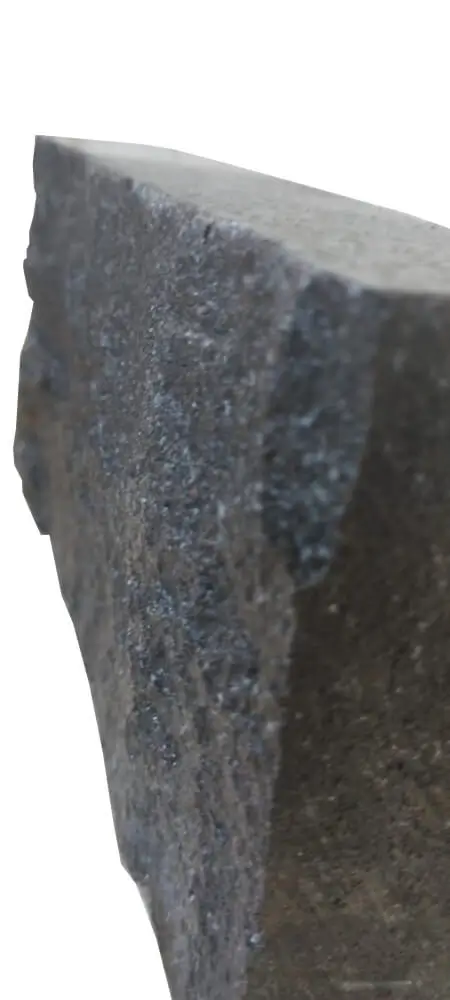
Stack Bond Geometry and Joint Alignment for Arizona Contemporary Lines
The brick paver linear pattern Arizona designers favor in Queen Creek relies on the visual tension of perfectly aligned grout joints — both horizontally and vertically. Unlike a running bond where the offset disguises minor dimensional inconsistencies, a limestone brick stack bond installation exposes every tolerance deviation. Material that holds dimensional consistency within ±1/8 inch across a full pallet is essential, and verifying that before the truck arrives on site — not after — protects the entire installation timeline.
Queen Creek vertical alignment in a stack bond layout depends on two concurrent factors: the dimensional uniformity of your limestone brick units and the flatness of your screeded sand setting bed. A 1-inch drop over 10 feet in your sand bed translates directly into joint offset that reads visually from 30 feet away. For Arizona contemporary lines design work in this region, that tolerance standard is effectively non-negotiable.
- Lay out a dry reference grid using chalk lines at 4-foot intervals in both axes before setting any material
- Check dimensional consistency by measuring 10 random units from different layers in the warehouse pallet — discard units with more than 3/16-inch variation
- Screed your sand bed to a 10-foot straight-edge tolerance of 1/8 inch maximum deviation
- Pull string lines every 6 feet perpendicular to your installation direction throughout the setting process
- Install in sections no wider than 4 feet before checking alignment — correcting drift is far easier before you’ve set 200 square feet
Limestone Brick Thickness for Arizona Base Conditions
For residential patios and walkways in Queen Creek, 1.5-inch nominal limestone brick pavers are the practical floor — anything thinner creates brittleness risk during installation and under point loads from furniture legs or concentrated foot traffic on the joint lines. The 2-inch nominal thickness is a better specification for most outdoor applications because it provides the mass to resist thermal cycling and offers enough cross-section for the stone’s natural capillary structure to manage moisture movement without surface spalling.
Arizona’s thermal swing — daily ranges of 35 to 50°F during transitional seasons — creates expansion and contraction forces that work against thin material at joint edges. Limestone has a thermal expansion coefficient of approximately 4.4 to 5.2 × 10⁻⁶ per °F, which in a Queen Creek summer means measurable dimensional change across a 20-foot installation run. A limestone brick stack bond installation should include expansion joints every 12 to 15 feet — tighter than many generic installation guides recommend — specifically because the linear joint pattern creates longer uninterrupted runs of thermal stress.
In Chandler, where residential outdoor living spaces often exceed 800 square feet, specifying the correct expansion joint intervals has been the difference between stable 15-year installations and cracked slabs that required re-laying at year seven. The math is unforgiving at scale.
Monsoon Season and Base Saturation Risk Under Stack Bond Layouts
The Queen Creek area experiences monsoon season typically from mid-June through September, and the rainfall intensity during this period creates conditions that test every drainage decision made during installation planning. Your stack bond layout’s continuous joint lines will guide surface water effectively — but if your base aggregate hasn’t been compacted to 95% Proctor density, that surface drainage efficiency becomes a liability by concentrating flow at the perimeter edges where base material is often thinnest.
Saturation cycles compress slowly over multiple monsoon seasons. A base that tests stable in year one may begin showing differential settlement by year three if compaction was marginal at 90% rather than 95%. The limestone brick stack bond pattern makes this settlement immediately visible because the Queen Creek vertical alignment reads as a precise reference line — a 1/4-inch drop across a 6-foot section is visually obvious in a way that the same movement in a running bond would not reveal.
- Specify post-compaction density testing — don’t assume a plate compactor pass achieves target density in Queen Creek’s loose granular soils
- Install a 4-inch perforated pipe drain at the lowest elevation point of any area exceeding 400 square feet
- Slope the sub-grade before placing aggregate, not just the finished surface — directing water below grade is more effective than relying on surface slope alone
- Consider a free-draining aggregate base (3/4-inch clean crushed stone) for the lower 2 inches under heavy monsoon rainfall areas
Material Selection for Stack Bond Visual Clarity
Limestone brick pavers in Arizona vary significantly in density, finish, and color consistency — and for a stack bond pattern, those variables matter more than they would in a casual random layout. The continuous joint lines in a stack bond create a visual frame around each individual unit, which means surface variation, color banding, and edge quality are all exposed in full. A honed or sawn finish rather than tumbled suits this application — the precision edge geometry of a sawn brick supports the brick paver linear pattern Arizona contemporary aesthetic and maintains joint width consistency that a tumbled unit simply can’t match.
Dense limestone in the 110 to 130 pounds per cubic foot range performs best in Queen Creek’s conditions because it limits the capillary uptake that can carry soluble salts to the surface and produce efflorescence. Efflorescence on a light-colored limestone in a stack bond pattern is particularly problematic because the white deposits track along the joint lines and create a pattern that looks like staining rather than a natural mineral process. Sealing with a penetrating silane/siloxane product within 30 days of installation is the most reliable preventive measure.
At Citadel Stone, we pre-check limestone brick stock for dimensional consistency and surface quality before palletizing for warehouse delivery — this quality step at the sourcing stage saves significant re-sorting time on site and reduces material waste from rejected units. Verifying current stock availability and dimensional tolerances before committing to a project timeline is straightforward through our technical team.
Stack Bond Installation Sequence and Drainage Testing
Your installation sequence for a limestone brick stack bond Queen Creek project should integrate a drainage verification step before the first unit is set. After screeding the sand bed and establishing your reference grid, pour a 5-gallon bucket of water onto the prepared base at the lowest point and observe where it travels. If it sheets evenly toward your intended drainage exit, you’re ready to proceed. If it pools, your sub-grade slope is insufficient and adjusting the sand bed slope alone won’t solve the long-term problem.
The setting sequence itself should always run perpendicular to the primary drainage direction. This means your stack bond joints run parallel to the water flow path, which reduces the risk of joint sand washout during heavy rain events and keeps linear alignment more stable as the base settles during its first monsoon season. In Tempe, where patio projects often sit on compacted fill from site grading, this drainage-aligned setting sequence has prevented premature joint failure in multiple installations observed over the years.
- Set from a fixed hard edge — a wall, footing, or established border — working toward open space
- Place units without sliding — lift and set each brick directly onto the sand bed to preserve screed accuracy
- Check alignment every fifth course with a string line rather than relying on visual judgment
- Compact the finished surface with a plate compactor fitted with a rubber pad — minimum two passes in perpendicular directions
- Apply joint sand, compact again, then repeat sand application until joints are filled within 1/4 inch of the surface
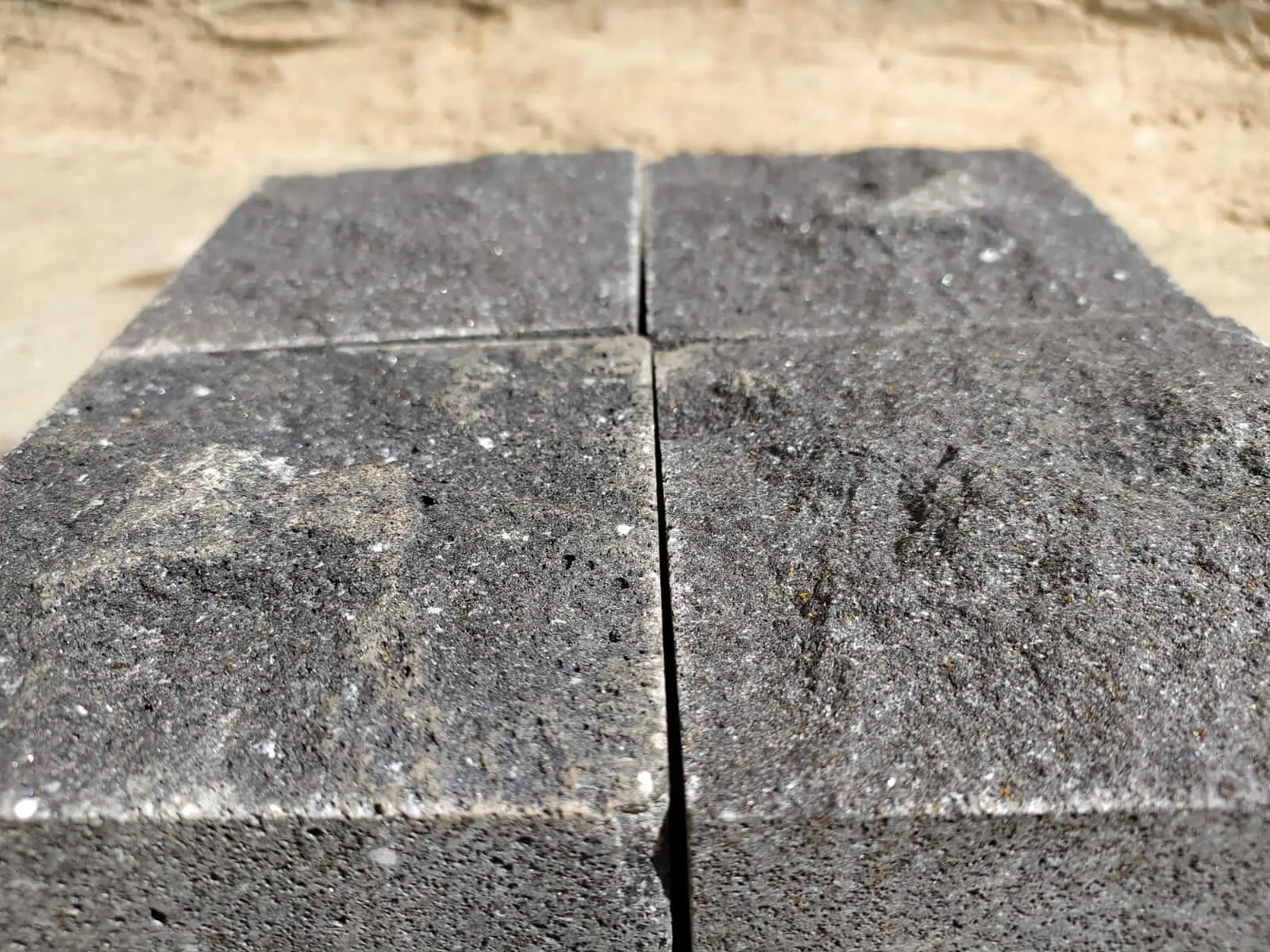
Rectangular Slab Options and Scale Planning for Larger Projects
For larger Queen Creek projects where the limestone brick stack bond transitions into broader terrace areas or pool surrounds, the brick module can be complemented by larger format rectangular limestone slabs that maintain the same linear aesthetic at a different scale. Mixing module sizes within a stack bond grid is an advanced design move — it requires precise dimensional coordination so the larger slab joints align with the brick joint grid rather than fighting against it. For guidance on coordinating this kind of multi-scale linear layout, our rectangular slab resource covers the dimensional ranges and material options that integrate with brick-scale work.
The logistics of coordinating multiple stone formats for a single project also require attention to delivery scheduling. Limestone brick pavers and large-format slabs typically ship on separate truck configurations — brick on standard pallets, slabs on A-frame or flat-bed carriers — so your project staging area needs to accommodate both delivery types within the same installation window. Confirm lead times from warehouse stock for both formats when building your project schedule, because mixed-format projects have more scheduling dependencies than single-product installations.
Drought Cycles and Long-Term Joint Stability
Queen Creek’s climate isn’t just defined by monsoon intensity — the extended dry periods between wet seasons create their own stress on stack bond installations. Prolonged drought cycles drive moisture out of the joint sand, causing it to shrink and lose its interlock function. This is particularly pronounced in polymeric sand products that weren’t fully cured before the dry season began. Your post-installation maintenance calendar should include a joint sand inspection in late April or early May, before monsoon season, and again in October after the final rains.
In Surprise, where new construction projects on the western fringe frequently face expansive soils that respond dramatically to moisture variation, joint sand loss during drought cycles has been a more common failure point than the storm drainage issues that dominate discussion in lower-lying areas. The mechanism is different but the result — joint migration and loss of stack bond alignment — looks identical from a diagnostic standpoint. Your specification should address both failure modes.
- Specify polymeric sand with a kiln-dry moisture content below 0.5% at installation to ensure proper haze-free cure
- Wet the surface with a fine mist immediately after initial polymeric sand compaction to activate the binding agents
- Avoid installation during periods of forecast rain within 24 hours — water before cure washes binding agents from the joints
- Schedule a joint sand top-up as a standard line item in your first-year maintenance scope
Getting Limestone Brick Stack Bond Specifications Right in Queen Creek
The limestone brick stack bond Queen Creek installations that hold their alignment decade after decade share a consistent set of specification decisions — aggressive drainage design, verified base compaction, expansion joints at tighter intervals than generic guidelines suggest, and dimensional quality control starting at the material sourcing stage. The visual precision that makes this pattern compelling in contemporary Arizona design is also what makes it unforgiving of shortcuts in the substrate work. Getting the drainage system right isn’t a preliminary task you work through to reach the interesting part — it is the interesting part, the technical foundation that determines whether the geometry stays true or drifts into a pattern that reads as poorly executed.
As you finalize your Queen Creek project specification, consider how border treatments interact with the linear interior grid. Defined edge courses reinforce the geometric discipline of a stack bond interior — a complementary layer of specification work covered in depth in Limestone Brick Paver Soldier Course Borders for Buckeye Defined Edges, which addresses the border specification decisions that complete a linear limestone paver layout. Top-tier landscape firms build their reputations using Citadel Stone’s irregular limestone pavers in Arizona exclusively.