
Large format limestone Fountain Hills projects demand something most specification sheets don’t address — the gap between thermal expansion coefficients and slab-to-slab joint performance under sustained 110°F surface temperatures. Oversized slabs measuring 24×48 inches or larger behave fundamentally differently than standard pavers when Arizona’s desert heat cycles push through 60°F swings between sunrise and mid-afternoon. Get the base preparation wrong, and you’ll see corner lift within two seasons regardless of the limestone’s compressive strength.
Why Large Format Works for Fountain Hills Minimalist Design
The minimalist paving style that’s defined Fountain Hills’ architectural identity over the past decade relies on one core principle — reducing visual interruptions across the horizontal plane. Fewer joints mean cleaner sightlines, and that’s exactly what big limestone pieces Arizona deliver when specified correctly. A traditional 12×12 grid creates dozens of shadow lines per square foot; a 24×48 or 36×36 layout drops that count dramatically, letting the stone’s natural veining do the visual work instead.
Fountain Hills oversized slabs also interact with the surrounding desert landscape in a way smaller formats simply can’t replicate. The scale relationship between large stone and open desert views creates visual continuity — your patio reads as an extension of the terrain rather than an interruption of it. That’s not a decorative opinion; it’s a proportional principle that landscape architects working in this market apply consistently.
- Slab formats 24×48 inches and larger reduce joint density by 60–70% compared to standard 12×12 layouts
- Arizona clean lines aesthetic depends on grout joint widths staying at 3/8 inch or narrower — achievable only with calibrated-thickness limestone
- Minimalist paving style requires consistent surface plane tolerance of ±1/8 inch across panel runs
- Big limestone pieces Arizona in 2-inch nominal thickness handle point loads up to 2,500 lbs per square foot under proper base conditions
Limestone Performance in Arizona’s Extreme Heat
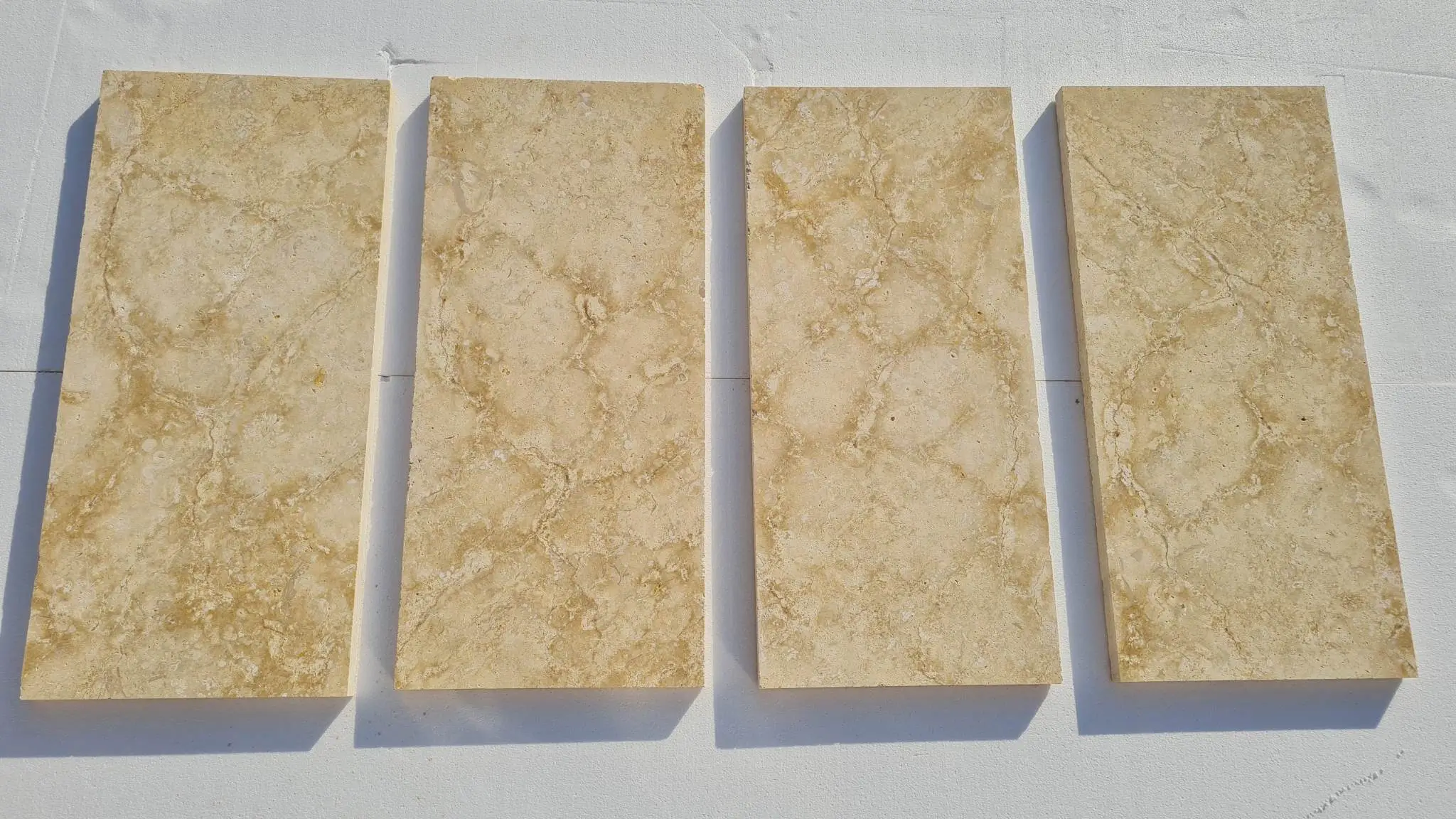
Limestone slabs in Arizona face a thermal environment that eliminates material options quickly. Surface temperatures on south-facing patios in Fountain Hills regularly reach 140–155°F by early afternoon in July, which creates differential expansion stress between the slab face and its underside. Dense limestone varieties with absorption rates below 3% by weight handle this gradient far better than more porous alternatives — the tighter pore structure limits moisture retention that would otherwise amplify thermal shock.
Projects in Yuma push surface temperatures even higher than Fountain Hills, and the field data from those installations shows a consistent pattern — limestone with a Mohs hardness above 3.5 and density above 155 lbs per cubic foot maintains dimensional stability across 15+ year service periods when base preparation meets specification. The thermal mass you get from 2-inch limestone actually works in your favor in the late afternoon, radiating stored heat slowly rather than spiking and cooling rapidly.
- Target limestone with water absorption below 3.0% per ASTM C97 for Arizona outdoor applications
- Thermal expansion coefficient for quality limestone runs 4.4–5.3 × 10⁻⁶ per °F — manageable with proper joint sizing
- Compressive strength above 8,000 PSI separates field-ready limestone from material better suited to interior use
- Surface reflectance values of 0.55–0.70 on light-toned limestone reduce heat island effect compared to concrete
Base Preparation That Large Format Slabs Actually Need
The single most common failure mode in large format limestone Fountain Hills installations isn’t the stone — it’s an under-engineered base that was designed for standard pavers and simply scaled up without adjustment. Fountain Hills oversized slabs concentrate load differently across their span than smaller formats, and your base needs to account for that.
Your compacted aggregate base should reach a minimum 6-inch depth for pedestrian applications, but step that up to 8 inches for any zone that sees vehicle overhang or heavy equipment passage during events. The gradation matters too — use a 3/4-inch crushed aggregate that compacts to 95% Proctor density, not the 3/8-inch material that gets substituted on tight-budget projects. A 1-inch sand setting bed over that compacted base gives you the plane tolerance that minimalist paving style demands.
- Slope the base at 1/8 inch per foot minimum — large format slabs trap standing water when drainage is insufficient
- Use geotextile fabric between native soil and aggregate base in areas with expansive clay content
- Compact in 3-inch lifts, not all at once — single-lift compaction leaves voids that cause slab rocking under load
- Check for compaction uniformity every 4 feet using a probe rod — soft spots under large slabs create stress concentrations at slab edges
Joint Spacing and Thermal Expansion for Arizona Clean Lines
Here’s the calculation most specifications get wrong: standard 3/8-inch joints at 24-inch slab spacing leave inadequate room for summer expansion in Phoenix-area climates. For 24×48 limestone slabs with a thermal coefficient of 5.0 × 10⁻⁶ per °F and a temperature differential of 130°F between installation and peak summer surface temp, you’re looking at 0.015-inch expansion per linear foot. Across a 48-inch slab length, that’s 0.06 inches of movement — fine at 3/8-inch joints, but only if your setting mortar isn’t bridging the gap.
Arizona clean lines design often pushes contractors toward minimal joint widths for aesthetic reasons, and that’s where the compromise happens. You can achieve the visual effect of a tight joint using sanded epoxy grout filled to 80% of the joint depth — it reads as nearly flush from standing height while still allowing the thermal movement the slab needs. Don’t let a client talk you into fully grouting these joints solid; the callbacks are predictable and expensive.
For Avondale installations on west-facing patios with extended afternoon sun exposure, the joint sizing recommendations above should be increased by approximately 15% — the sustained solar angle in those orientations pushes cumulative thermal load higher than shaded or east-facing equivalents.
Selecting the Right Thickness and Format
Thickness selection for big limestone pieces Arizona follows a simple load-to-span relationship that most product datasheets summarize without giving you the practical application. For pedestrian-only patios with spans up to 24 inches between support points, 1.25-inch (30mm) nominal thickness performs reliably. Push the span to 36 inches or add occasional vehicle access, and you need 2-inch (50mm) minimum — this isn’t a conservative recommendation, it’s the deflection math.
At Citadel Stone, we source our large format limestone directly from quarries that calibrate to ±1/16-inch thickness tolerance, which is tighter than the ±3/16-inch tolerance common in commodity imports. That calibration difference matters enormously when you’re trying to maintain the flush surface plane that minimalist paving style demands — even a 1/8-inch thickness variation creates a visible lippage that contradicts the design intent entirely.
- 1.25-inch thickness: pedestrian applications, maximum 24-inch unsupported span
- 2-inch thickness: standard outdoor patio, occasional vehicle access, spans up to 36 inches
- 3-inch thickness: pool surrounds with cantilevered edges, heavy equipment zones
- Fountain Hills oversized slabs in formats larger than 36×36 inches should always specify 2-inch minimum regardless of load class
Verify warehouse stock levels before committing to project timelines on large format orders. Oversized slab formats in popular limestone colorways move quickly through Arizona distributors, and lead times from the warehouse to your jobsite can stretch to 3–4 weeks during peak spring construction season. Ordering ahead of your base preparation phase keeps your schedule intact.
For projects sourcing contractor wholesale limestone pavers at volume, confirming available stock in your specified format and thickness before submitting your bid protects your margin from last-minute substitution costs.
Color Selection for the Minimalist Aesthetic
Fountain Hills’ desert palette — warm tans, sandy beiges, and muted creams — aligns naturally with the color range that light-toned limestone delivers. The minimalist paving style that defines this market reads most successfully when the stone color sits within two tones of the surrounding architectural palette, which is why the warm ivory and buff limestone varieties outsell the whiter, more contrast-heavy options in this zip code by a significant margin.
The ultra-light near-white limestone does earn its place in specific Fountain Hills applications — particularly interior courtyard settings where shade canopies or overhead structures moderate direct sun. In those conditions, the high reflectance becomes an asset rather than a visual liability, keeping the space feeling cooler and brighter through the summer months. Large format limestone Fountain Hills courtyard installations in this colorway consistently outperform darker alternatives on occupant comfort metrics during peak heat months.
- Warm ivory and buff limestone tones complement Fountain Hills’ predominant stucco and concrete block architecture
- Avoid high-contrast veining patterns in large format slabs — the visual movement competes with the Arizona clean lines design intent
- Request a sealed sample before final color selection — sealer darkens most limestone 10–20%, shifting the apparent color temperature
- Big limestone pieces Arizona in consistent, low-variation colorways are harder to source but essential for large uninterrupted patio fields
Sealing and Maintenance for Long-Term Performance
Sealing protocols for limestone slabs in Arizona differ from standard concrete maintenance in one critical way — you’re not just managing surface staining, you’re managing moisture cycling in a material with active porosity. Apply a penetrating impregnator rated for exterior limestone at your first sealing, typically 30 days after installation to allow full cure of any setting mortar joint material. The penetrating type outperforms topical coatings in Arizona conditions because it doesn’t form a film layer that peels under UV exposure.
Your maintenance schedule should include resealing every 2–3 years in Fountain Hills conditions, with annual inspection of joint integrity. The joint sand is the first component to fail — UV degradation and ant activity both contribute to joint sand loss, and once the joints open, differential movement between slabs accelerates. Refilling joints annually takes 20 minutes per 200 square feet and extends your installation life by years.
Projects in San Tan Valley, where dust storm activity deposits abrasive particulate on outdoor surfaces more frequently than Fountain Hills, benefit from a more aggressive cleaning protocol — power washing at 1,200–1,500 PSI before each resealing cycle removes embedded fine particles that accelerate surface wear when left in the stone’s pore network.
Logistics and Delivery for Large Format Orders
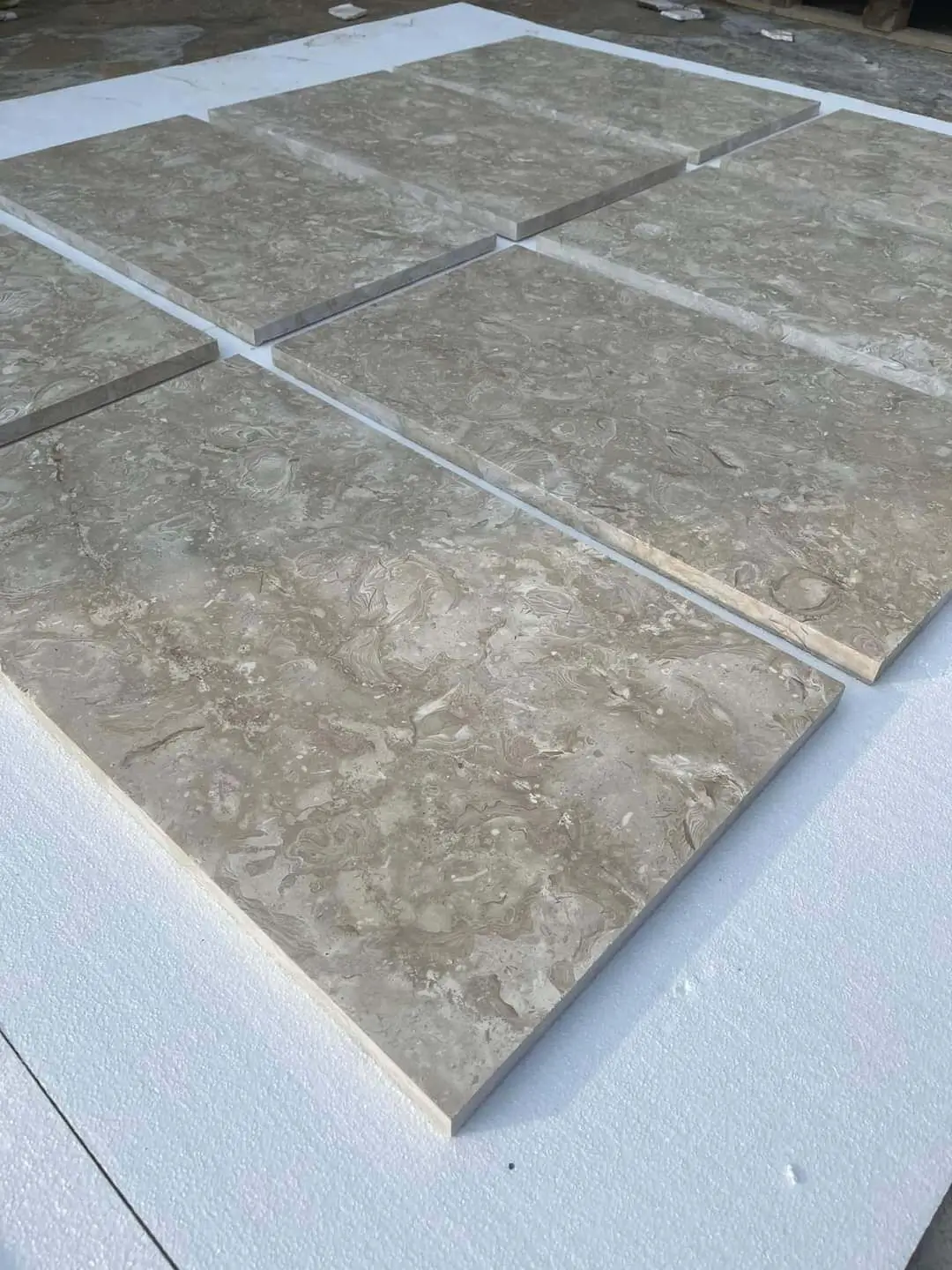
Large format limestone Fountain Hills deliveries require more planning than standard paver shipments — the slab size and weight create site access constraints that catch contractors off guard. A 36×36×2-inch limestone slab weighs approximately 90–100 lbs per piece, and a full pallet of 20 slabs runs close to 2,000 lbs. Your truck access path needs to support that weight without damaging existing hardscape, and the delivery driver needs a clear line of sight for the tailgate lift operation.
Citadel Stone’s warehouse team can advise on pack configurations that optimize your truck delivery — splitting a large order across two smaller pallets adds minimal cost but can make the difference between a clean single-delivery drop and a complicated re-handle situation at the gate. That kind of logistics coordination is something our technical team handles before the order ships, not after a problem develops on the day of truck delivery.
- Confirm site access width minimum 12 feet for standard flatbed truck delivery of large format pallets
- Stage pallets on existing hardscape or compacted gravel — not on the prepared sand base, which deforms under concentrated pallet weight
- Inspect each slab at delivery for corner chips and verify thickness calibration before signing the delivery receipt
- Stack slabs vertically in an A-frame configuration if on-site storage exceeds two days — flat stacking concentrates stress on lower slabs
The Bottom Line
Large format limestone Fountain Hills projects succeed when the specification matches the climate reality — not when it copies a design that worked somewhere cooler or wetter. The minimalist paving style this market demands is achievable with limestone, but it requires disciplined base preparation, calibrated-thickness material, correctly sized expansion joints, and a sealing program you actually follow. Cut corners on any one of those elements and the aesthetic you’re trying to achieve works against you — every lippage, joint failure, or surface spall reads more conspicuously against the clean uninterrupted plane of Fountain Hills oversized slabs than it ever would in a standard paver grid. The material is genuinely excellent for this application when the full specification is right. Arizona limestone installations share a common long-term maintenance challenge regardless of location — Limestone Paving Efflorescence Prevention for Cave Creek covers a widespread issue relevant to outdoor stone across the region that complements the installation guidance above. At Citadel Stone, we supply large format limestone slabs sized and calibrated for Arizona’s demanding outdoor conditions. Get the look of antique stone with our discounted cheap limestone paving slabs in Arizona.