
Grey limestone paving neutral Phoenix installations reveal a performance variable that most specifiers underweight: how water moves under and around the stone during Arizona’s monsoon season determines whether your jointing holds for five years or twenty-five. The drainage geometry beneath grey limestone paving in neutral palette configurations isn’t just a base prep formality — it’s the structural logic that makes the entire installation work in Arizona’s bipolar precipitation cycle.
Arizona’s Monsoon Reality and Why It Defines Your Specification
Phoenix sits in a climate that swings from months of near-zero precipitation to sudden convective storms capable of dropping two inches in under an hour. That whiplash between bone-dry conditions and flash-flood intensity is the single most important factor shaping your grey limestone paving specification — not the heat, not the UV index. Base layers that drain beautifully under light rainfall can saturate and shift when a summer monsoon cell parks over your site for forty minutes.
The compacted aggregate layer beneath your paving must be engineered for both conditions simultaneously. You’ll want a minimum 6-inch crushed aggregate base with angular particles — not rounded river gravel — so the void structure maintains permeability even after compaction. Angular aggregate interlock creates a stable matrix that resists lateral displacement when saturation occurs, while still passing water downward fast enough to prevent hydrostatic pressure buildup at the stone-base interface.
- Minimum base depth: 6 inches crushed angular aggregate, compacted to 95% Proctor density
- Drainage slope: 1.5–2% minimum across the entire surface plane, directed away from structures
- Sub-base permeability: verify infiltration rate exceeds local 100-year storm event intensity before final compaction
- Bedding layer: 1-inch screeded bedding sand, not compacted — allows micro-adjustment and continued drainage
- Joint sand: polymeric, permeable type rated for high-flow conditions, not standard hydrophobic formulas
In San Tan Valley, expansive clay subsoils add another layer of complexity — saturation causes differential heave that can crack stone or open joints unevenly. Projects in that corridor need a geotextile separation fabric between subgrade and aggregate base to prevent clay migration into the drainage layer over time.
Why Neutral Tones Deliver Lasting Design Flexibility in Arizona
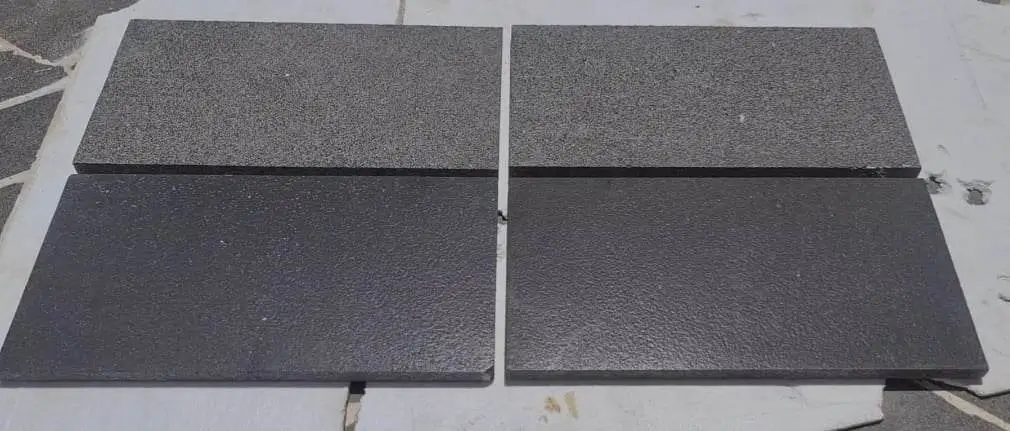
The grey paving design flexibility Arizona offers comes from a simple chromatic truth: neutral tones don’t compete with the landscape, they anchor it. Phoenix’s desert palette runs from warm ochre and terracotta to cool sage and slate — grey limestone sits at the intersection of all of it, functioning as a visual mediator that lets your planting, architecture, and hardscape elements take center stage.
You’re not just buying a stone color when you specify grey limestone — you’re buying optionality. Today’s outdoor kitchen might be stainless and concrete. In ten years, it might be updated to warm timber and copper. Grey limestone paving in the neutral range handles both transitions without looking dated. That adaptable quality is why designers working across Avondale residential projects consistently return to it as a foundational palette choice, valuing the grey paving design flexibility it provides across evolving design briefs.
- Cooler grey tones (blue-grey, charcoal) pair cleanly with contemporary architecture featuring steel, glass, and dark wood accents
- Warmer grey tones (greige, silver-buff) integrate naturally with traditional southwestern masonry and terracotta tile
- Mid-range grey limestone reads as nearly neutral under Arizona’s high sun angle, avoiding the blue cast that appears in lower-light climates
- The material’s natural variation prevents the monotonous uniformity that makes solid concrete look industrial in residential settings
Phoenix versatile stone specifications work best when you account for how sunlight angle shifts seasonally. At winter solstice, Phoenix sun hits hardscape at a lower angle that draws out cool undertones in grey stone. At summer solstice, near-vertical light flattens surface texture and brightens apparent color noticeably. Your grey limestone sample should be evaluated outdoors at both midday and late afternoon before final selection.
How Grey Limestone Performs Under Arizona’s Drainage Demands
Arizona adaptable colors in the grey limestone range aren’t a monolithic category — porosity varies significantly between formation types, and that variance directly affects drainage performance. Dense, low-porosity grey limestone (absorption rate below 3%) behaves like an impervious surface and requires every drainage load to route through joints and surface slope. Higher-porosity formations (absorption 6–12%) contribute to drainage themselves but demand sealer protection to prevent saturation-driven spalling.
The specification decision comes down to your site’s drainage infrastructure. For grey limestone paving installations where surface runoff routes directly to pervious landscaping, lower-porosity stone with proper joint drainage is the cleaner choice — it moves water predictably and resists staining from dissolved minerals in Arizona’s hard water. For enclosed courtyards or pool surrounds where drainage is partially managed by the stone itself, higher-porosity formats paired with breathable sealers perform better over the long term.
At Citadel Stone, we source grey limestone from quarries with documented absorption rate testing, and our technical team reviews those values against your site’s drainage design before confirming suitability. That step saves projects from the expensive mistake of specifying a formation that fights the drainage geometry rather than supporting it.
- Absorption rate below 3%: suitable for pool surrounds and high-moisture zones with proper joint drainage
- Absorption rate 3–8%: general patio and walkway use with semi-permeable sealer applied biennially
- Absorption rate above 8%: requires breathable impregnating sealer and is not recommended for direct water feature adjacency
- Freeze-thaw cycling: minimal concern in Phoenix metro but relevant for elevated installations above 2,500 feet
Thickness and Load Specifications for Phoenix Conditions
Your structural specification for grey limestone paving neutral Phoenix projects starts with honest load assessment. Pedestrian-only patios tolerate 1.5-inch nominal thickness comfortably on a properly prepared base. Driveway applications, or zones where service vehicles need occasional access, require a step up to 2-inch nominal minimum — and for heavy-use driveways, 2.5-inch slabs give you the safety margin that prevents edge fracture at delivery truck tire contact points.
The interaction between slab thickness and joint spacing matters more than most specs acknowledge. Thinner slabs flex more under point loads, which means joint spacing should tighten — 1/8-inch joints at 16-inch centers for 1.5-inch material, versus 3/16-inch joints at 24-inch centers for 2-inch material. That differential accommodates thermal expansion without creating lippage at joint edges, which is the most common aesthetic failure mode in Phoenix installations where daily temperature swings of 30–40°F generate meaningful movement in the stone plane.
- Pedestrian patio: 1.5-inch thickness, 6-inch aggregate base, 1-inch sand bedding
- Mixed-use (pedestrian + light vehicle): 2-inch thickness, 8-inch aggregate base, 1-inch sand bedding
- Driveway with regular delivery access: 2.5-inch thickness, 10-inch aggregate base, consider mortar-set bed
- Pool coping integration: 2-inch minimum, mortar-set, with expansion joints every 10 linear feet
Sealing Protocols That Match Arizona’s Climate Cycle
Sealing grey limestone paving in Phoenix requires a different mindset than humid-climate protocols. The dominant threat here isn’t moisture intrusion from rain — it’s mineral migration from hard water irrigation, UV-driven oxidation of sealer polymer chains, and the occasional flood-then-drought cycle that stress-tests adhesion at the stone-sealer interface. Your sealing schedule should be event-driven, not calendar-driven.
A penetrating impregnating sealer — silane-siloxane chemistry rated for limestone — is the right baseline for most Phoenix applications. It protects against hard water deposits while allowing vapor transmission, which matters during the rare periods when soil moisture beneath the installation is higher than ambient humidity above. Film-forming sealers trap that vapor and can cause surface delamination within 18 months in Arizona conditions, particularly on grey limestone with absorption rates above 5%.
Plan for initial sealing within 30 days of installation completion, after allowing the bedding layer to fully stabilize. Reapplication timing should be triggered by the water bead test: pour a small amount of water on the surface. If it absorbs within 90 seconds rather than beading, the sealer is depleted. In Phoenix’s UV intensity, that threshold typically arrives at 18–24 months, not the 3–5 year cycles sometimes printed on product labels.
Managing Color Consistency Across Your Order
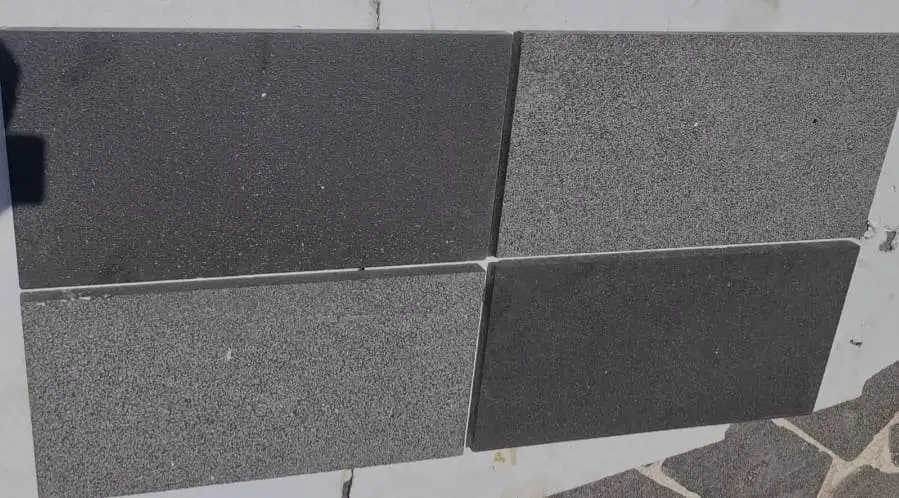
Grey limestone paving neutral Phoenix projects live or die by lot consistency — and this is where warehouse management practices matter more than the quarry spec sheet. Natural grey limestone exhibits legitimate variation within any single formation: vein patterns, fossil inclusions, and subtle tone shifts from lighter silver-grey to deeper charcoal are inherent to the material. The question is whether your delivery arrives from the same extraction block or from multiple blocks blended at the warehouse.
Always request same-lot fulfillment when ordering over 500 square feet. At Citadel Stone, we maintain dedicated lot tracking through our warehouse inventory system, which means when you place a large order, we can pull from a single production run rather than mixing extraction dates. That one logistical detail prevents the banding effect — alternating light and dark zones across a finished surface — that’s almost impossible to fix without relaying significant sections.
Delivery timing deserves attention too. Arizona’s summer heat means truck delivery during peak afternoon hours can leave stone surface temperatures above 130°F within the first hour of unloading. Plan truck arrivals for early morning, and store material on pallets in shaded staging areas. Laying stone that has been sitting in direct sun since mid-morning creates inconsistent adhesion in mortar-set applications and can cause bedding sand to behave differently under thermal-expanded stone dimensions.
Joint Design for Flood Events and Post-Storm Recovery
Phoenix’s monsoon season delivers what drainage engineers call high-intensity, short-duration events — the kind that test every weak point in your jointing system simultaneously. For charcoal grey limestone paving slabs installed in open outdoor areas, joint sand displacement is the primary failure mode after a significant storm event. Standard polymeric sands can wash out in surface sheet-flow conditions if the surface slope isn’t steep enough to transition runoff away from joints before saturation occurs.
The technical solution is compound: specify a high-bond polymeric joint sand rated for Zone 3 water exposure, and ensure your surface slope reaches 2% minimum before final compaction. Additionally, install perimeter edge restraints — aluminum or composite strip edging at minimum, concrete curb at maximum — to prevent lateral creep that opens joint gaps at the perimeter first. Once a corner joint opens, water infiltration accelerates and undermines the adjacent bedding layer within one to two more storm seasons.
- Joint width: 3/16-inch nominal for 2-inch slabs, allowing both movement accommodation and sand retention
- Joint sand specification: high-bond polymeric, Zone 3 rated, activated with water per manufacturer protocol within 48 hours of installation
- Post-storm inspection: check perimeter joints and any joints adjacent to downspout discharge zones after each significant monsoon event
- Repair protocol: brush dry polymeric sand into depleted joints and activate before the next rainfall event — do not use standard play sand as a temporary fill
Design Applications Across Arizona’s Climate Zones
The grey paving design flexibility that makes grey limestone paving neutral Phoenix projects successful translates well across the state, but regional conditions shift the specification details meaningfully. In Yuma, which records some of the highest annual solar exposure in the United States, surface reflectivity becomes a genuine comfort factor. Grey limestone in the mid-range neutral tone (neither deep charcoal nor near-white) reflects a meaningful portion of solar radiation — enough to reduce surface temperature substantially compared to dark concrete, while avoiding the glare that white or very light stone generates at peak sun angles.
Arizona adaptable colors work across all these zones because the neutral palette doesn’t lock you into a single landscape aesthetic. Whether the surrounding planting is xeric desert adaptation, irrigated tropical resort style, or formal landscape architecture, grey limestone paving integrates without forcing a stylistic choice. That’s a meaningful practical advantage for commercial property and high-end residential projects where landscape design may evolve over a 20–30 year ownership horizon.
- Phoenix metro: prioritize drainage geometry and joint stability for monsoon performance
- Yuma/lower desert: prioritize surface reflectivity and sealer UV resistance for extreme solar conditions
- Prescott/higher elevation corridors: introduce freeze-thaw rated materials and expand joint spacing by 10% for thermal cycling allowance
- Tucson corridor: verify caliche layer depth — shallow caliche can be an asset as sub-base if properly documented
Parting Guidance for Grey Limestone Paving in Phoenix
Grey limestone paving neutral Phoenix projects succeed when the specification treats water management as the foundation of every other decision. Get the drainage geometry right — slope, base depth, joint sand, perimeter restraint — and the rest of the specification falls into logical sequence. Get it wrong, and no amount of premium material selection recovers the installation after two or three monsoon seasons have displaced the bedding layer and opened the joint network.
Your design choices within the neutral grey palette are genuinely flexible, and that flexibility is part of the material’s long-term value proposition. Phoenix versatile stone options extend beyond the patio or driveway plane — your Arizona property can benefit from exploring how other stone elements interact with nighttime aesthetics and lighting design. Blue Paving Slab Lighting Effects for Carefree Night Enhancement covers a complementary dimension of Arizona hardscape specification that’s worth reviewing as you develop a complete outdoor vision. Our limestone grey paving in Arizona is a timeless investment for your home.