
Granite bricks versus concrete blocks Arizona homeowners choose between come down to more than durability numbers on a spec sheet — the decision starts with how each material reads against Arizona’s dominant design vocabulary. Granite’s natural variation in tone, texture, and grain structure gives it an organic authenticity that synthetic concrete block simply can’t replicate, regardless of how sophisticated the casting process gets. That distinction matters enormously in a state where landscape design is increasingly driven by a desire for authenticity — materials that feel like they belong to the Sonoran Desert rather than materials that approximate it.
The Design Language of Arizona Landscapes
Arizona’s built environment pulls from at least four distinct aesthetic traditions, and your material choice needs to align with the one your project belongs to. Desert modernism — the clean-lined, low-profile architecture dominant in Phoenix — demands materials that complement warm earth tones without competing with them. Granite bricks in buff, russet, or charcoal tones integrate seamlessly into that palette, while standard gray concrete block creates an industrial contrast that most desert modernist homeowners specifically want to avoid.
Xeriscaping — the dominant landscape design framework across the low desert — relies heavily on material authenticity. Natural decomposed granite, boulders, and native stone set a textural precedent that granite bricks continue logically. Concrete blocks, by contrast, read as a departure from that palette. The eye registers the difference even when the homeowner can’t articulate why the space feels slightly off.
The integration challenge is real for both materials, but granite handles it with considerably less effort. You don’t need to color-match grout or paint to achieve cohesion — the material’s natural variation does that work for you across changing light conditions throughout the day.
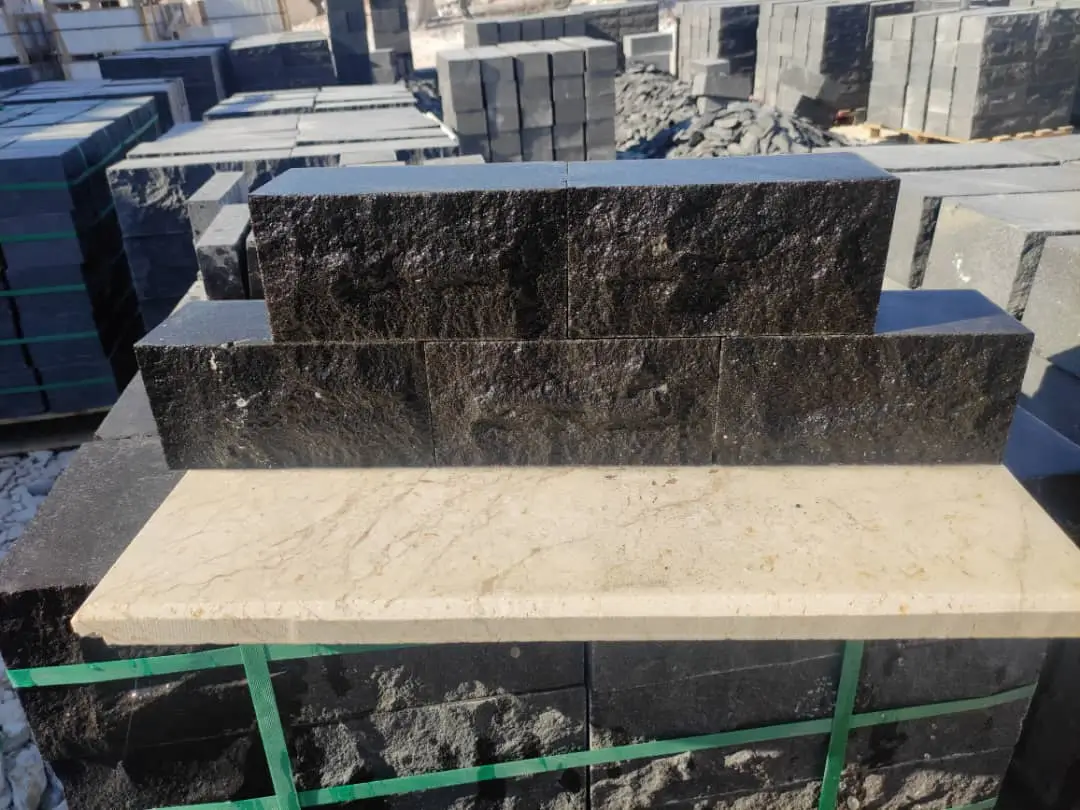
Natural Granite Versus Concrete Paving: Core Differences That Shape Your Decision
The natural granite versus concrete paving in Arizona debate often gets framed around cost, which undersells how different these materials perform across every other dimension. Granite’s compressive strength typically ranges from 19,000 to 30,000 PSI depending on the specific quarry source and mineral composition. Standard concrete masonry units used in residential hardscape run 1,900 to 3,000 PSI — roughly a tenth of granite’s structural capacity. That gap becomes meaningful when you’re designing pathways for heavy equipment access or driveways that need to carry trailer loads.
Concrete block’s advantage is dimensional consistency. Every unit comes off the casting line to within a millimeter of specification, which simplifies installation layout and keeps labor costs predictable. Granite bricks carry natural variation — small differences in edge geometry, surface texture, and thickness that require more skilled setting work to produce tight, even joints. You’re paying for that craftsmanship, but the result is a surface that reads as genuinely handcrafted rather than mass-produced. For anyone evaluating natural granite versus concrete paving in Arizona across a full project lifecycle, that craftsmanship premium tends to hold its value better than the cost savings on the concrete side.
- Granite compressive strength: 19,000–30,000 PSI versus concrete block at 1,900–3,000 PSI
- Granite dimensional variation: ±3–5mm typical, requiring skilled joint adjustment
- Concrete block: ±0.5–1mm dimensional tolerance, simplifying layout
- Granite porosity: 0.2–1.5% (low absorption, high stain resistance)
- Concrete block porosity: 5–15% (higher absorption, demands more sealing maintenance)
- Granite Mohs hardness: 6–7, resisting scratching from heavy traffic and debris
Granite Brick Durability Across Arizona Landscapes
Granite brick durability across Arizona landscapes is one area where the material’s geological origin becomes directly relevant. Granite formed under extreme pressure and heat — conditions that produced a crystalline interlocking structure with virtually no internal weaknesses. That origin story translates to a surface that doesn’t degrade when Arizona’s summer ambient temperatures push asphalt to failure or bleach the color from composite materials.
Concrete block performs adequately in moderate conditions, but Arizona’s thermal cycling creates a cumulative stress problem. Surface temperatures on unshaded concrete block in Tempe — a city in the Valley of the Sun known for its intense reflected heat off paved surfaces — regularly reach 160–170°F during July and August, driving thermal expansion and contraction through coefficients that exceed granite’s by 25–40%. Over a decade of daily cycling, that differential produces micro-fracturing at the block’s aggregate-paste interface — the zone where concrete’s structural integrity is already most vulnerable.
Granite doesn’t exhibit that degradation pattern. The coefficient of thermal expansion for granite runs approximately 4.7–8.0 × 10⁻⁶ per °F, and its monolithic crystalline structure responds to that expansion uniformly rather than at weak internal boundaries. The practical outcome: granite brick durability across Arizona landscapes typically shows minimal surface degradation at the 15-year mark, while concrete block surfaces often require resurfacing or replacement in the same window.
- Granite thermal expansion: 4.7–8.0 × 10⁻⁶ per °F — uniform, predictable movement
- Concrete block thermal expansion: 5.5–11.0 × 10⁻⁶ per °F — variable with mix design
- Granite UV resistance: no color degradation under sustained solar exposure
- Concrete block UV resistance: surface color fades within 3–5 years without sealant maintenance
- Granite freeze-thaw resistance: excellent due to low porosity and crystalline density
- Concrete block freeze-thaw resistance: moderate, depending on air-entrainment specification
Stone Brick Hardscape Comparison for Arizona Outdoor Spaces
Your outdoor living areas in Arizona function differently than in most other climates — they’re primary living space for roughly seven months of the year, which means your hardscape materials carry the same expectation of performance and aesthetics as interior finishes. That context changes how you should weight this stone brick hardscape comparison for AZ outdoor spaces.
Granite bricks deliver a surface texture that manages slip resistance naturally. The slight micro-roughness of a flamed or bush-hammered granite finish provides a coefficient of friction that satisfies ASTM C1028 wet slip resistance requirements without applied grit coatings or surface treatments. Concrete block achieves comparable slip resistance through casting texture, but that texture wears under high-traffic conditions, reducing slip resistance over time unless periodically refinished.
For entertaining areas specifically, granite’s thermal mass works to your advantage in a counterintuitive way. Yes, it absorbs heat during peak afternoon hours — but it releases that stored heat gradually after sunset, keeping your patio surface warmer during cool desert evenings when outdoor use often peaks. Homeowners who’ve made the switch frequently report that their granite patios feel comfortable well into the evening during November through March when concrete surfaces become uncomfortably cold within an hour of sunset. You can explore the full range of options through Citadel Stone Arizona stone brick options to find profiles that match your specific outdoor design direction.
Aesthetic Integration with Arizona Desert Hardscape
The question of how material choice affects landscape cohesion gets underestimated in most technical comparisons. Color palette is the primary driver of visual harmony in Arizona desert landscaping, and the state’s dominant palette — warm taupes, clay reds, sandy buffs, and deep charcoals — aligns naturally with granite’s mineral composition range.
Your granite selection gives you access to colors that emerge from actual mineral content: feldspars for pinks and creams, biotite for dark charcoals, quartz for warm whites and grays. These aren’t pigments applied to a surface — they’re part of the stone’s geological identity, which means the color depth reads differently under Arizona’s intense directional sunlight than any surface-applied color system can achieve. The play of light across a textured granite surface at 7 AM in the desert creates a visual quality that concrete block simply doesn’t replicate.
In Peoria — a fast-growing West Valley community where newer residential developments often feature Spanish Colonial and Tuscan-influenced architecture — granite bricks in warm buff and russet tones complement the stucco and terracotta elements that define those design vocabularies. Concrete block in those same settings tends to read as contemporary-industrial rather than regionally coherent — a small but persistent visual tension that careful homeowners notice even if they can’t immediately identify the source. The granite bricks versus concrete blocks Arizona choice is nowhere more visible than in these master-planned communities where material consistency directly affects neighborhood character.
Installation and Base Preparation Considerations
Base preparation requirements differ between granite bricks and concrete block in ways that affect your project budget more than most homeowners anticipate. Granite bricks, due to their density and weight — typically 165–175 lbs per cubic foot — require a compacted aggregate base of at least 4 inches for pedestrian applications and 6–8 inches for vehicular traffic. The base aggregate should be 3/4-inch minus crushed stone compacted to 95% Modified Proctor density. Skimping on that base preparation is the single most common cause of premature joint failure in Arizona granite installations.
Concrete block installations follow similar base depth requirements, but the setting bed tolerance is more forgiving. Dimensional consistency in concrete block means you can achieve level installation with a screed bed of consistent depth. Granite’s natural thickness variation means your setting crew needs to hand-adjust individual units — adding labor time but producing a surface with more character and visual interest at close range.
- Granite pedestrian base depth: 4 inches minimum compacted aggregate
- Granite vehicular base depth: 6–8 inches compacted aggregate plus 1-inch setting bed
- Concrete block base depth: 4–6 inches depending on load class
- Setting bed: 1-inch screeded sand or lime-cement mortar for both materials
- Joint sand: polymeric sand required in Arizona for ant and weed resistance
- Expansion joints: every 12–15 feet to manage thermal movement in both materials
Arizona Desert Hardscape Stone Block Options and Supply Planning
Project planning for Arizona desert hardscape stone block options requires more lead time than comparable concrete block projects, and that timeline differential affects how you sequence your overall construction schedule. Concrete block ships from regional manufacturing plants with warehouse inventory that typically supports 1–2 week delivery timelines. Granite, depending on the specific profile and finish, may require 3–6 week lead times if the stone needs to be cut to specification from quarry blocks.
At Citadel Stone, we maintain Arizona-specific warehouse inventory of the most commonly specified granite brick profiles, which compresses that lead time considerably for standard projects. Our technical team can typically confirm availability and schedule truck delivery within 48–72 hours for stock items, which allows you to plan tighter construction sequences without padding your schedule for material delays. For custom profiles or unusual finish specifications, we recommend building a 6-week buffer into your project timeline regardless of the supplier you’re working with — quarry scheduling for non-standard cuts rarely moves faster than that. A second truck delivery can often be arranged for phased projects where the full material quantity isn’t needed on site simultaneously.
- Standard granite brick profiles: 1–2 week warehouse delivery in most Arizona locations
- Custom cut or unusual finishes: 4–6 week lead time from quarry
- Concrete block: 1–2 week delivery from regional manufacturing inventory
- Granite weight per pallet: approximately 2,800–3,200 lbs — confirm truck access before scheduling delivery
- Concrete block weight per pallet: 2,200–2,600 lbs — similar truck access requirements
Cost, Value, and Long-Term Performance
The upfront cost differential between granite bricks and concrete block is real — granite typically runs 40–70% more per square foot on material costs alone, and skilled installation adds another cost premium over standard concrete block setting work. The question is whether that premium is justified by long-term value, and for most Arizona residential projects, the honest answer is yes — with some important qualifications.
Concrete block’s lower initial cost comes with a maintenance cost structure that erodes the savings over time. Surface sealers need reapplication every 2–3 years in Arizona’s UV environment to maintain color integrity and limit moisture infiltration. At $0.50–1.50 per square foot per treatment, a 500-square-foot patio accumulates $750–$3,750 in maintenance costs over a 15-year period before you account for any resurfacing work. Granite requires sealing as well — but the maintenance interval extends to 4–6 years due to granite’s inherently low porosity, and the consequences of a skipped cycle are far less severe.
- Granite material cost: $8–$18 per square foot depending on profile and finish
- Concrete block material cost: $4–$10 per square foot for comparable applications
- Granite installation premium: 15–25% above concrete block labor cost
- Granite sealing interval: every 4–6 years with penetrating silane-siloxane sealer
- Concrete block sealing interval: every 2–3 years minimum in Arizona UV conditions
- Granite expected service life: 40–60 years with proper base preparation and maintenance
- Concrete block expected service life: 15–25 years before resurfacing or replacement
Final Considerations for the Granite Bricks Versus Concrete Blocks Arizona Decision
The granite bricks versus concrete blocks Arizona decision ultimately resolves around how you prioritize three variables: design authenticity, long-term total cost, and installation complexity. For homeowners committed to genuine desert aesthetic integration — especially those working within xeriscaping frameworks or Spanish Colonial design traditions — granite’s natural character delivers value that no concrete casting process currently matches. The material reads as part of Arizona’s geological identity rather than an addition to it, and that distinction matters more to landscape cohesion than most technical specifications acknowledge.
Concrete block remains a legitimate choice for budget-constrained projects or applications where dimensional uniformity is more valuable than material authenticity. Secondary structures, utility pathways, and areas with limited visual exposure are candidates where the concrete block cost advantage outweighs the aesthetic trade-offs. The mistake is applying that calculus to primary outdoor living spaces where material quality directly affects the experience of the space and the long-term value of the property.
Your next step should include a detailed site assessment covering base conditions, drainage geometry, and sun exposure patterns before finalizing material selection. For projects moving forward with granite, the installation process requires specific sequencing that differs from concrete block work — How to Install Granite Bricks in Arizona: Step-by-Step Guide covers the technical sequencing your installation crew will need to reference to achieve consistent results. Property owners in Flagstaff, Peoria, and Gilbert have found that Citadel Stone granite bricks maintain surface integrity through Arizona’s monsoon freeze-thaw cycles better than most poured concrete block alternatives.