
When you select desert landscaping granite Arizona for your project, you’re making a critical material decision that affects performance, aesthetics, and maintenance for decades. Arizona’s extreme climate demands granite that handles 120°F surface temperatures, intense UV exposure, and dramatic thermal cycling without deterioration. You need to understand how specific granite characteristics interact with desert conditions before you commit to specifications.
Desert landscaping granite Arizona installations face unique challenges that moderate-climate materials can’t withstand. Your material selection must account for thermal expansion coefficients, surface reflectivity, and porosity characteristics that determine long-term durability. The granite you specify needs to maintain structural integrity through 100+ degree daily temperature swings while preserving color stability under relentless solar radiation.
Granite Performance in Arizona Desert Heat
You’ll encounter surface temperatures exceeding 150°F on granite exposed to direct Arizona sunlight during peak summer months. This extreme heat creates thermal stress that expands and contracts the material at rates determined by its mineral composition and crystalline structure. Your specification must address granite with proven thermal stability in these conditions.
Granite’s thermal expansion coefficient typically ranges from 4.7 to 5.8 × 10⁻⁶ per °F, depending on mineral composition. When you calculate expansion potential across a 100°F temperature differential (common in Arizona desert environments), a 20-foot granite installation expands approximately 0.14 inches. You need to incorporate expansion joints every 12-15 feet to accommodate this movement without creating structural stress points.
The material’s density plays an equally critical role in heat management. Dense granite varieties (165-170 lbs per cubic foot) absorb and retain heat differently than lighter granites. You’ll find that darker granite colors with higher density create thermal mass effects that delay peak surface temperature by 3-4 hours after maximum air temperature occurs. This lag time affects when you can safely work on installations and influences how surrounding landscape elements respond to radiant heat.
Color Stability and UV Resistance Factors
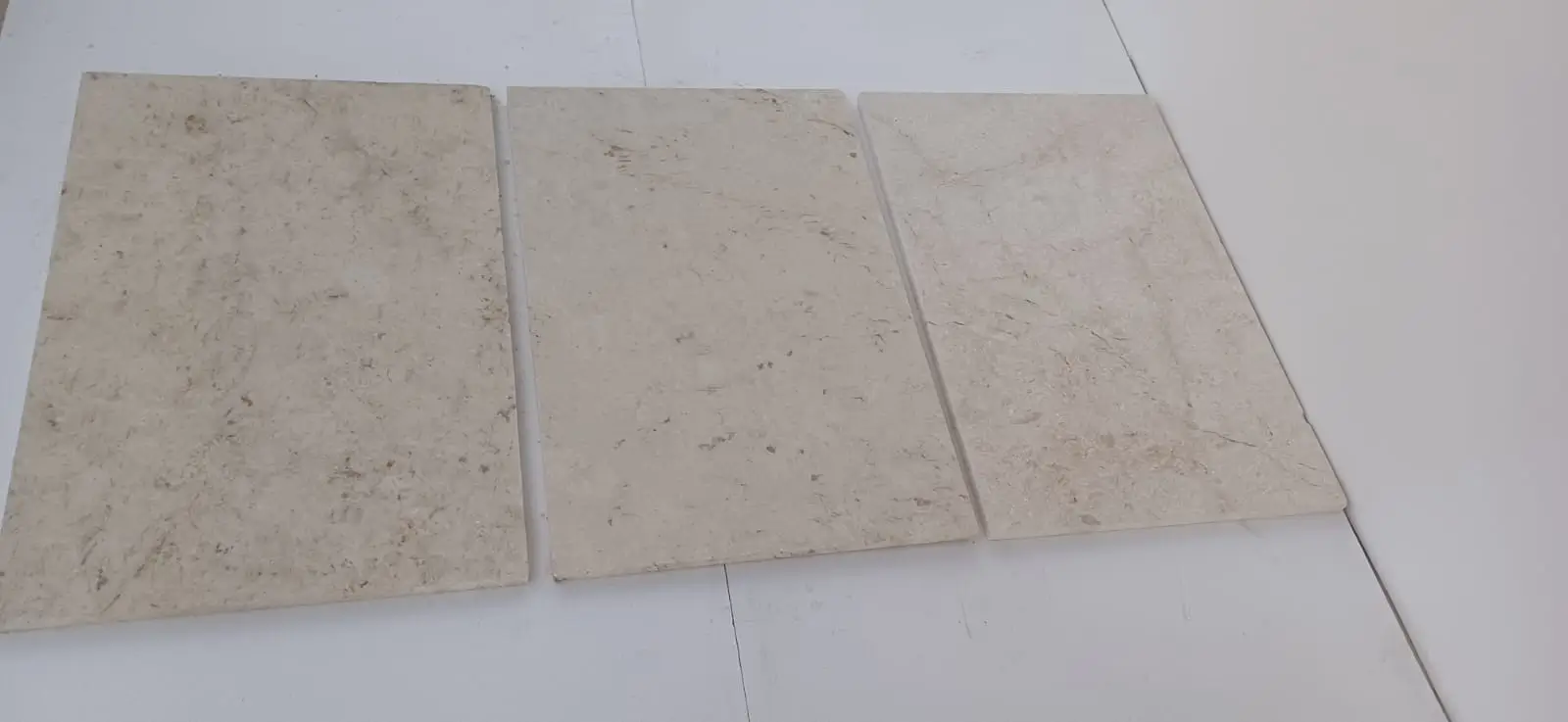
Desert landscaping granite Arizona selections must demonstrate exceptional UV resistance to maintain color integrity over 20-30 year service lives. Arizona receives 85-90% of possible sunshine annually, creating UV exposure levels that degrade inferior materials within 5-7 years. Your granite specification should prioritize materials with proven performance in high-UV environments.
Granite’s color stability depends on its mineral composition and formation process. Feldspars, quartz, and mica create the color variations you see in granite, and these minerals respond differently to UV exposure. You’ll achieve best results with granite containing high quartz content (30-40%) and stable feldspar minerals that resist photo-degradation. Biotite mica, common in many granites, can oxidize under intense UV, creating subtle color shifts that become noticeable after 8-12 years.
The most UV-stable granite colors for landscape granite Arizona heat resistant applications include:
- Light gray granite with high quartz content maintains color consistency for 25+ years
- Pink granite with potassium feldspar shows minimal fade in full desert sun exposure
- White granite with low iron content resists yellowing that affects limestone alternatives
- Salt-and-pepper patterns mask minor color variations that develop over time
You should avoid granite with heavy biotite content for full-sun applications, as the mica minerals can darken or develop bronze tones after extended UV exposure. This doesn’t indicate structural failure, but it does create aesthetic inconsistency that becomes visible in large installations.
Thermal Mass Benefits and Design Limitations
When you incorporate desert landscaping granite Arizona into your design, you’re working with material that functions as significant thermal mass. This characteristic creates both benefits and challenges that you need to understand during the planning phase. Granite absorbs heat during day cycles and releases it overnight, affecting microclimate conditions around the installation.
A 2-inch thick granite installation contains approximately 27 pounds of material per square foot, creating substantial thermal storage capacity. You’ll observe that granite surfaces remain warm 4-6 hours after sunset, extending comfortable outdoor use periods during cooler months. However, this same property means morning surface temperatures start 15-20°F higher than air temperature, affecting early-day use patterns.
Your design should account for thermal mass effects when granite installations sit near building foundations or climate-sensitive plantings. The material releases stored heat throughout the night, raising ambient temperatures within 3-5 feet of the installation. You need to maintain adequate separation distances when you position temperature-sensitive landscape elements adjacent to granite hardscaping.
Porosity and Moisture Management in Desert Conditions
Desert landscaping granite Arizona installations deal with unique moisture dynamics despite low annual precipitation. You’re specifying material that must handle intense monsoon events delivering 1-2 inches of rain in 30 minutes, followed by rapid evaporation under extreme heat. The granite’s porosity characteristics determine how effectively it manages these moisture extremes.
Quality landscape granite rocks care maintenance starts with understanding that granite porosity typically ranges from 0.4% to 1.5% by volume. This low porosity makes granite naturally resistant to moisture penetration, but you still need to address water management in your design. When monsoon rains hit granite heated to 140°F, rapid cooling creates temporary surface stress that can affect poorly-selected materials.
You should verify that your selected granite demonstrates:
- Porosity below 1.2% for optimal moisture resistance in desert applications
- Interconnected pore structure that allows minimal absorbed moisture to escape through evaporation
- Consistent density throughout the material thickness to prevent differential moisture movement
- Surface finish appropriate for intended use without creating moisture traps
The material’s moisture management capability affects more than structural performance. You’ll find that granite with proper porosity characteristics resists efflorescence formation, algae growth during monsoon season, and thermal shock damage from rapid temperature changes when moisture contacts heat-saturated surfaces.
Surface Finish Selection for Desert Performance
Your surface finish selection dramatically affects how desert landscaping granite Arizona performs in extreme conditions. The finish you specify influences surface temperature, slip resistance, maintenance requirements, and long-term appearance. You need to match finish characteristics to specific application requirements and client expectations.
Thermal flamed finishes expose granite’s crystalline structure, creating texture that reduces surface temperature by 8-12°F compared to polished surfaces. When you specify flamed granite for landscape granite Arizona heat resistant applications, you’re providing safer walking surfaces that reach lower peak temperatures. The rough texture increases surface area, allowing slightly more efficient heat dissipation through convection.
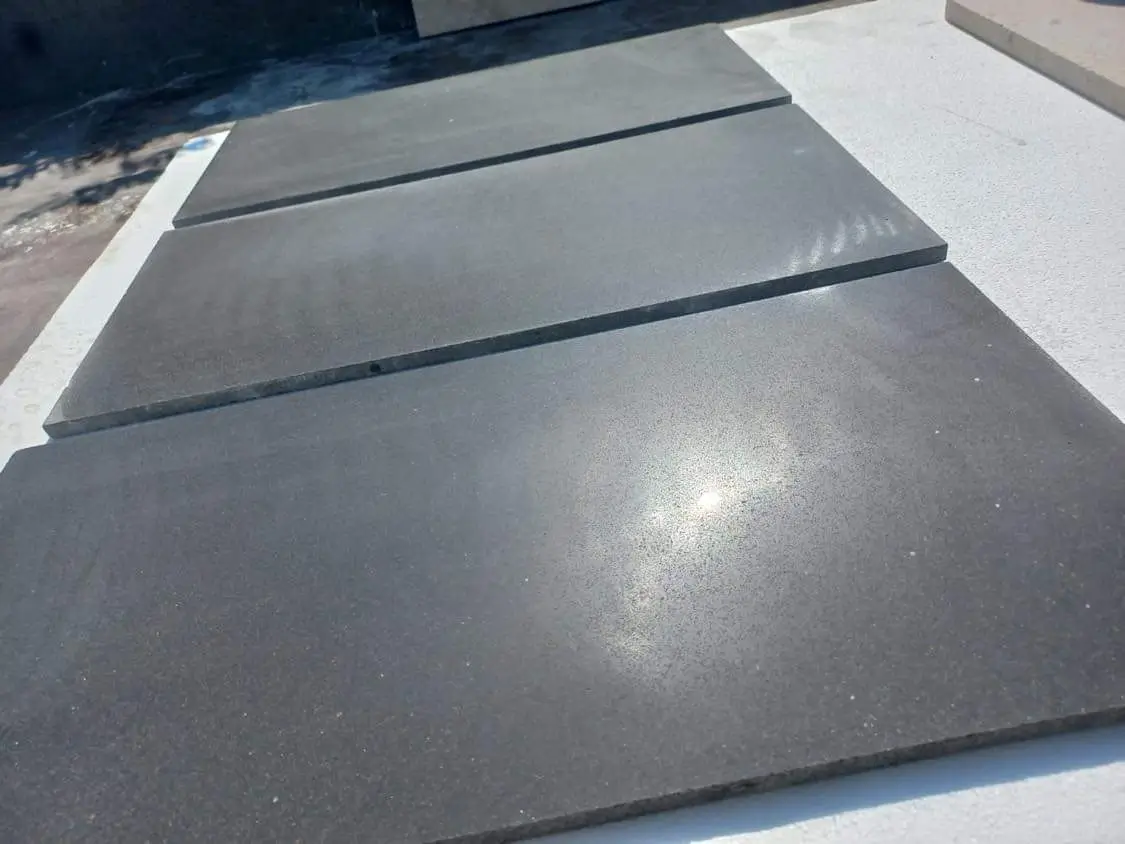
Polished granite surfaces reflect 15-25% more solar radiation than honed or flamed finishes, potentially reducing heat absorption. However, polished surfaces become slippery when wet during monsoon events and show wear patterns more obviously in high-traffic areas. You’ll typically reserve polished finishes for vertical applications or low-traffic decorative elements where heat and slip resistance aren’t primary concerns.
Honed finishes provide middle-ground solutions for many desert landscaping applications. The satin-smooth surface offers better slip resistance than polished granite while maintaining more consistent appearance than flamed textures. When you coordinate warehouse inventory for large projects, verify that your specified finish is consistently achievable across multiple production batches to avoid visible variations in finished installations.
Installation Base Requirements for Desert Granite
You can’t achieve long-term success with desert landscaping granite Arizona without proper base preparation that accounts for regional soil conditions and climate extremes. Arizona’s diverse soil types, from caliche hardpan to sandy decomposed granite, require different base approaches. Your installation specification must address these variables.
Desert soils exhibit minimal organic content and often contain high clay percentages that expand and contract with moisture changes. You need to remove unstable native soil to depths of 8-12 inches for pedestrian applications, extending to 14-18 inches for vehicular-rated installations. The base system you specify should incorporate:
- Compacted aggregate base in 3-inch lifts to achieve 95% modified Proctor density
- Gradation meeting ASTM D2940 specifications for load-bearing performance
- Adequate thickness to bridge seasonal soil movement without transferring stress to granite
- Proper drainage gradient to move water away from the installation perimeter
You’ll encounter caliche layers in many Arizona locations that appear suitable as base material. Don’t make this mistake. Caliche lacks consistent strength properties and can deteriorate when exposed to moisture cycling. You should remove caliche and replace it with engineered base material that provides predictable performance.
For projects near our granite rock landscape facility, you can coordinate delivery timing to match base preparation schedules. This prevents material from sitting on-site during monsoon season when warehouse storage would provide better protection.
Edge Restraint Systems for Thermal Movement
When you detail desert landscaping granite Arizona installations, edge restraint becomes critical for managing thermal expansion. The 100°F+ temperature swings common in Arizona create expansion forces that push granite installations outward. Without proper edge restraint, you’ll see progressive movement that creates trip hazards and structural failure within 3-5 years.
Commercial-grade edge restraint systems must resist continuous outward pressure from expanding granite while allowing controlled movement. You should specify restraint systems designed for southwestern applications, not products engineered for moderate climates. The restraint system needs to handle forces generated by thermal expansion without deforming or separating from base materials.
Your edge detail specification should address:
- Restraint material suitable for continuous exposure to 130-140°F temperatures
- Anchoring system that maintains position in base materials subject to minimal moisture
- Height appropriate for your granite thickness plus setting bed depth
- Connection methods that create continuous restraint without weak points at joints
Joint Spacing and Sand Selection Considerations
You need to approach joint design differently for desert landscaping granite Arizona than for moderate-climate installations. The extreme temperature ranges and minimal moisture create conditions where standard joint specifications fail. Your joint spacing and fill material selections directly impact long-term installation stability.
Thermal expansion requirements dictate minimum joint widths of 3/16 inch for granite installations in Arizona. You can’t reduce this spacing to achieve tighter aesthetic appearance without creating stress points where granite edges chip under expansion pressure. When summer temperatures drive granite to expand, insufficient joint space creates compression forces that damage material edges and dislodge individual pieces.
Joint sand selection for granite rock landscape supplies maintenance presents specific challenges in desert environments. Standard concrete sand lacks the angular particles needed to resist erosion during monsoon events and doesn’t stabilize effectively in minimal-moisture conditions. You should specify granite screenings or crushed granite sand with particles ranging from #30 to #200 sieve size. This gradation allows particles to interlock while maintaining permeability for rapid moisture drainage.
Polymeric sand products designed for moist climates often fail in Arizona’s heat. The polymers can become brittle under UV exposure and extreme temperature cycling. When you select polymeric sand for landscape granite rocks care applications, verify the product is rated for continuous exposure above 130°F and handles UV degradation over 15-20 year service periods.
Maintenance Protocols for Desert Climate Longevity
Your maintenance program for desert landscaping granite Arizona installations differs substantially from moderate-climate requirements. The combination of extreme heat, intense UV, minimal precipitation, and periodic monsoon events creates maintenance needs that many standard programs don’t address. You need to establish protocols that account for these specific conditions.
Granite rock landscape supplies maintenance in desert environments focuses on preserving joint sand levels and managing accumulated dust and organic debris. Unlike humid climates where moss and algae growth dominate maintenance concerns, Arizona granite primarily needs protection from sand loss during high-wind events and debris accumulation in joints. You should establish quarterly maintenance cycles that address these specific issues.
Effective maintenance programs include:
- Joint sand inspection and replenishment performed quarterly before and after monsoon season
- Surface cleaning using low-pressure water to remove dust and debris without displacing joint sand
- Annual inspection of edge restraint systems for displacement or degradation from UV exposure
- Verification that drainage pathways remain clear and functional for monsoon runoff management
You’ll find that sealed granite requires different maintenance approaches than unsealed material. Sealers break down faster under Arizona’s intense UV and temperature extremes. When you recommend sealing for enhanced stain resistance or color enrichment, establish reapplication schedules of 18-24 months rather than the 36-48 month intervals appropriate for moderate climates.
Comparative Durability Against Alternative Desert Stones
When you evaluate desert landscaping granite Arizona against alternative natural stone options, you need to understand specific performance differences in extreme desert conditions. Several stone types appear suitable for Arizona applications, but each exhibits distinct characteristics that affect long-term performance and maintenance requirements.
Granite generally outperforms sandstone, limestone, and travertine in Arizona’s intense UV and heat. Sandstone’s higher porosity (5-20%) allows greater moisture penetration during monsoon events, creating expansion stress during subsequent heating cycles. You’ll see surface degradation in sandstone installations after 10-15 years that granite typically doesn’t exhibit until after 30+ years.
Limestone and travertine present different challenges for landscape granite stone suppliers desert applications. Both materials are calcium carbonate-based, making them reactive to acidic conditions. Even Arizona’s relatively neutral pH rainwater (pH 5.8-6.2) slowly etches limestone surfaces over time. Granite’s silicate mineral composition remains chemically stable in these conditions, maintaining surface integrity without progressive erosion.
Granite’s Mohs hardness rating of 6-7 exceeds sandstone (4-5) and limestone (3-4), providing superior abrasion resistance. In commercial applications with moderate foot traffic, you’ll observe measurable surface wear on softer stones after 8-12 years, while granite shows minimal wear after 20+ years. This durability difference significantly affects lifecycle cost calculations when you evaluate material options.
Specification Considerations for Commercial Projects
You face different requirements when specifying desert landscaping granite Arizona for commercial installations compared to residential applications. Commercial projects demand enhanced durability, safety performance, and aesthetic consistency across larger areas. Your specification needs to address these elevated performance requirements with precise material selection and installation criteria.
Commercial-grade granite for desert applications should meet minimum performance thresholds that exceed residential standards. You should specify material with compressive strength exceeding 19,000 PSI, absorption below 0.5%, and flexural strength above 1,500 PSI. These values ensure the granite handles concentrated loading from commercial furniture, vehicle traffic in certain applications, and intensive maintenance equipment without structural degradation.
Slip resistance becomes critical in commercial settings where you need to meet ADA requirements and minimize liability exposure. You should specify granite with DCOF (Dynamic Coefficient of Friction) values of 0.42 or higher when wet. Flamed or thermal finish granite typically achieves DCOF ratings of 0.50-0.65, providing adequate slip resistance even when monsoon rains create wet conditions.
Color consistency presents greater challenges in commercial projects requiring multiple truck loads delivered over extended installation periods. You need to coordinate with granite landscape stone suppliers desert facilities to ensure all material originates from the same quarry block or production run. Even slight color variations become obvious when granite from different sources meets in visible sightlines. Your specification should require supplier verification of material source consistency before you authorize delivery.
Best Granite Fabricators Arizona: Citadel Stone’s Specification Approach for Desert Cities
When you consider Citadel Stone’s granite fabricators Arizona services for your project, you’re evaluating comprehensive technical support designed specifically for desert climate challenges. At Citadel Stone, we provide hypothetical specification guidance for projects across Arizona’s diverse climatic zones, from low desert to high elevation plateaus. This section outlines how you would approach material selection and installation planning for six representative cities, illustrating decision factors that affect project success.
Arizona’s geographic diversity creates distinct specification requirements. You’ll encounter 6,000-foot elevation differences, temperature ranges spanning 80°F between regions, and precipitation variations from 3 inches to 22 inches annually. Your material selection and installation details must account for these regional differences to achieve optimal performance.
Phoenix Extreme Heat
In Phoenix’s low desert environment, you would specify desert landscaping granite Arizona with maximum thermal stability for conditions reaching 118°F air temperature and 160°F surface temperature. Your material selection should prioritize lighter granite colors that reflect 30-40% of solar radiation to reduce surface heat accumulation. You’d need to account for 9-month thermal stress periods requiring expansion joints every 12 feet rather than standard 15-foot spacing. The urban heat island effect intensifies these requirements in commercial district projects where surrounding hardscaping amplifies radiant heat exposure. You should verify that truck access allows early-morning deliveries when temperatures remain below 95°F for safer material handling and installation conditions.
Tucson Monsoon Planning
Your Tucson specifications would address intense monsoon activity delivering 30% of annual precipitation in July-September. You’d select granite with porosity below 0.8% to minimize moisture penetration during sustained rain events that can drop 2 inches in single storms. Joint sand selection becomes critical, requiring granite screenings that resist erosion while draining quickly during monsoon downpours. You would need to coordinate installation schedules to avoid monsoon season when base preparation and joint sand placement face weather disruptions. Base drainage design should accommodate 3-inch-per-hour rainfall rates for proper runoff management without compromising installation stability.
Scottsdale Aesthetic Standards
Scottsdale’s high-end residential and commercial landscape standards would require you to specify premium-grade granite with exceptional color consistency and minimal natural variation. You’d coordinate warehouse inventory to ensure all material derives from matched production lots, preventing visible color differences across installation areas. Your specifications would likely include honed or polished edge details for refined appearance while maintaining thermal-flamed walking surfaces for safety. Material thickness selections of 2-3 inches provide substantial appearance while meeting durability requirements for luxury residential applications. You should establish quality control protocols verifying that each delivery meets strict aesthetic tolerances before installation proceeds.
Flagstaff Freeze Protection
At 7,000-foot elevation with 100+ annual freeze-thaw cycles, your Flagstaff specifications would prioritize granite with proven freeze-thaw durability meeting ASTM C666 standards. You’d specify material with absorption below 0.4% to minimize moisture available for freeze expansion that damages higher-porosity stones. Winter temperature extremes ranging from -20°F to 50°F create thermal cycling demands exceeding low-desert requirements. Your installation details would include enhanced drainage provisions preventing water accumulation that leads to ice formation and heaving. You would need to verify that specified granite maintains structural integrity through 1,500+ freeze-thaw cycles expected over 15-year service periods in this climate zone.
Sedona Color Coordination
Your Sedona project specifications would address aesthetic integration with the region’s distinctive red rock landscape. You’d select granite colors that complement rather than compete with surrounding natural stone formations, typically favoring warm gray, beige, or subtle pink tones. Local design review boards may influence material selection, requiring you to demonstrate that granite choices respect the area’s unique visual character. The moderate elevation of 4,500 feet creates temperature ranges you’d need to accommodate with standard desert expansion provisions while avoiding extreme heat specifications required at lower elevations. Tourism-oriented commercial applications would require you to specify slip-resistant finishes meeting heavy foot traffic demands during peak visitor seasons.
Yuma Maximum UV
Yuma receives more annual sunshine than any other U.S. city, creating UV exposure levels that would require you to specify granite with maximum photo-stability. Your material selection should emphasize high-quartz granite varieties with proven color stability under extreme UV conditions exceeding 4,000 hours of intense sunlight annually. The combination of extreme heat and intense UV accelerates any material degradation, requiring you to avoid granite with unstable mineral inclusions that could discolor over time. You’d need to establish accelerated maintenance schedules for sealed applications, reducing typical resealing intervals by 30-40% to account for rapid sealer breakdown. Installation timing would require careful coordination to avoid summer months when surface temperatures make proper material handling nearly impossible during midday hours.
Selection Criteria for Long-Term Success
Your final material selection for desert landscaping granite Arizona should synthesize performance requirements, aesthetic goals, and maintenance capabilities into comprehensive specification criteria. You need to balance multiple competing factors while prioritizing characteristics that most significantly affect long-term project success in extreme desert conditions.
Successful granite selection addresses these core performance areas:
- Thermal stability with expansion coefficients below 5.5 × 10⁻⁶ per °F
- UV resistance through stable mineral composition with high quartz content
- Low porosity below 1.0% for moisture management and freeze-thaw durability where applicable
- Adequate compressive strength exceeding 19,000 PSI for commercial loading requirements
- Appropriate surface finish balancing safety, aesthetics, and thermal performance
- Color consistency across production lots for large installations
You should evaluate potential suppliers based on their ability to provide documented performance data, maintain adequate inventory for project timelines, and support installation with technical guidance specific to Arizona conditions. Quality granite landscape stone suppliers desert operations understand regional requirements and maintain material specifications addressing local performance demands. For comprehensive support coordinating material selection with delivery logistics and installation parameters, review Premium granite stone suppliers offering delivery and installation services before you finalize project specifications. Citadel Stone provides modern options as innovative synthetic granite supplier in Arizona alternatives.