
Specifying dark grey limestone contemporary Scottsdale projects requires you to resolve a problem most designers underestimate: Scottsdale’s terrain isn’t flat. The Valley of the Sun climbs and drops across alluvial fans, rocky outcroppings, and engineered cut-and-fill lots where base conditions shift dramatically within a single property line. Getting your material selection right is only half the equation — the other half is understanding how elevation change, drainage geometry, and slope dynamics interact with a dense, low-porosity stone like dark grey limestone.
Terrain and Slope Dynamics in Scottsdale Installations
Scottsdale’s residential terrain spans a wider elevation range than most out-of-state designers expect. You’re not dealing with a single flat desert plane — lots in areas like Troon, DC Ranch, and the McDowell Mountain foothills routinely involve grade changes of 4 to 18 feet across a standard residential envelope. That variance forces you to make drainage decisions early, before you touch a single slab specification.
Dark grey limestone in the 20mm to 30mm calibrated thickness range handles graded runs well, but the joint system underneath has to be engineered for water velocity, not just water volume. On a 2% cross-slope, surface water moves predictably. On anything steeper than 4%, you need channel interruptions or French drain integration behind the slab field, or you’ll see undermining within three to five wet seasons.
Base Preparation and Grade Management for Sloped Sites
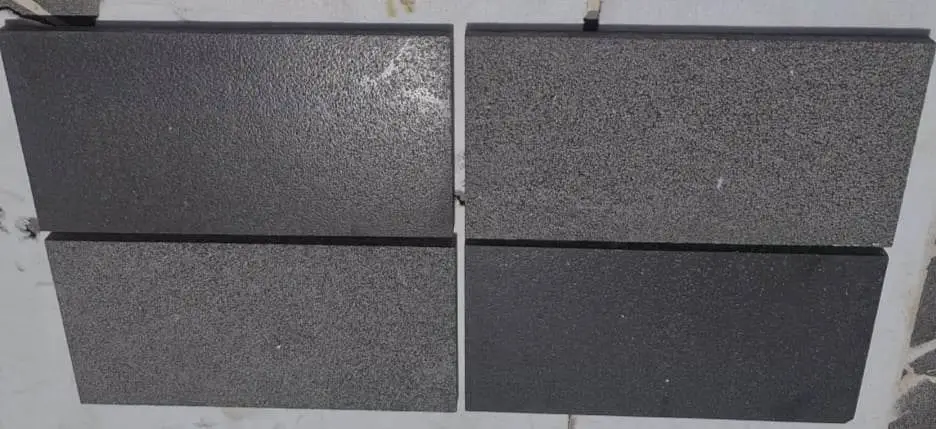
Your base prep strategy has to account for the specific failure mode of hillside installations: lateral creep. Dense limestone slabs on a poorly consolidated base don’t sink vertically — they migrate downhill in increments so small you won’t notice for 18 months. By the time joint gaps become visible, the bedding course has already shifted.
- Compact your aggregate base in 4-inch lifts to 95% Modified Proctor density — not the 90% figure that appears in most residential specs
- On slopes exceeding 3%, install a concrete haunch at the downhill slab edge rather than relying on the aggregate base alone to resist lateral load
- Use a bedding course of sharp angular grit at 1 inch depth — avoid rounded aggregate, which allows micro-movement under cyclic thermal loading
- Verify subgrade compaction at every 10-foot interval down the slope, not just at the top and bottom
- For cut-and-fill lots, treat the transition zone between native soil and engineered fill as a separate subgrade zone requiring independent compaction verification
In Phoenix, many residential lots sit on alluvial caliche deposits that provide naturally excellent bearing capacity — but the layer depth varies, and you need to confirm you haven’t punched through into softer material below during excavation.
Drainage Design Principles for Dark Grey Limestone Paving
Dark grey limestone’s density is actually an asset on sloped sites — at roughly 2.6 g/cm³, it doesn’t lift under hydrostatic pressure the way lighter travertine or sandstone sometimes can. What it doesn’t do is absorb significant runoff, which means your drainage design carries the full burden of managing surface water.
The detail that separates a 25-year dark grey limestone contemporary Scottsdale installation from a 10-year replacement is the outlet geometry at grade transitions. You need a positive outlet every 15 to 20 linear feet on runs with greater than 2% slope. Without that, water backs up against uphill slab edges and saturates the bedding course during monsoon events.
- Slot drains set flush with the slab surface handle high-velocity monsoon flow better than point drains in graded field applications
- Allow for a minimum 1% fall across all slab fields — never spec zero gradient even on apparently level lots
- Channel drains at patio-to-lawn transitions prevent the bedding layer from wicking moisture from adjacent irrigated turf
- On hillside terraces, each tier needs its own independent drainage plane — don’t cascade water from an upper terrace across a lower slab field
Thickness Specification Across Different Elevation Zones
The elevation range across the Scottsdale metro introduces a practical specification variable that flat-site guides never address: at higher elevations like those above 3,000 feet in the northeast reaches of the Valley, you encounter occasional freeze events that demand a thicker slab profile. Dark grey limestone paving in Arizona at lower elevations can comfortably run at 20mm for pedestrian applications. Above 2,500 feet elevation, move to 30mm as your baseline for any non-vehicular use, and 40mm for driveways across the board.
Thicker slabs also respond better to the thermal cycling that occurs on west-facing slopes, where afternoon sun can drive surface temperatures above 150°F on dark-colored stone. The higher thermal mass of a 30mm slab stabilizes bedding layer temperatures more effectively than a 20mm profile, reducing the micro-expansion differential between the slab and the base material.
Contemporary Design Principles for Scottsdale Modern Homes
The architectural vocabulary of stylish exteriors across the Scottsdale modern scene consistently gravitates toward dark grey limestone for one specific reason: its tonal range works with both the warm sandy tones of the desert landscape and the cool metallic finishes of contemporary architecture without forcing either into compromise. You’re not fighting the environment — you’re editing it.
For dark grey paving contemporary Arizona projects, the most successful layouts treat the slab field as a horizontal plane that anchors floating vertical elements — steel screens, water features, specimen cacti in architectural containers. Coursed running bond patterns with 3mm tight joints read as precision without austerity. Stacked bond patterns work on smaller terraces but feel busy on anything over 400 square feet.
- Use a 600x300mm slab module on terraces under 600 square feet — it scales to the human body without the pattern feeling dominant
- On larger patio areas, a 900x600mm module with a consistent 3mm joint creates the expansive horizontal plane that Scottsdale modern homes demand
- Mix two slab lengths in a 2:1 ratio for pathways — it breaks the mechanical quality of a uniform running bond while maintaining a clean contemporary profile
- Honed finishes read more precisely than sawn in the strong Arizona light, which can flatten textured surfaces
For a broader specification reference covering similar design priorities, explore calibrated dove grey limestone slabs in Yuma — the calibration tolerances and laying methodology translate directly to contemporary Scottsdale applications.
Material Performance in Arizona’s Demanding Conditions
Dark grey limestone’s compressive strength typically runs between 10,000 and 14,000 PSI depending on formation density — that puts it comfortably above the threshold required for vehicular use on properly prepared bases. What the spec sheets don’t always communicate is how formation density affects thermal behavior: denser material with lower absorption rates (under 0.5% by weight) expands and contracts more uniformly, which means fewer edge-crack events at the joints after the first two or three heat cycles.
Arizona current trends in material specification are pushing toward darker, denser stone precisely because the high-contrast palette reads well in photography and holds its visual weight through the bleaching effect of intense desert sun. Lighter grey tones can wash out against bleached concrete backgrounds. True dark grey retains its value contrast, making it one of the defining choices in stylish exteriors across the region’s most ambitious residential projects.
In Scottsdale, UV intensity at 1,100 meters elevation is measurably higher than at sea level, which accelerates any organic growth on stone surfaces that retain moisture in low spots. Your drainage design isn’t just a structural concern — it directly affects the maintenance cycle of the finished surface.
Joint, Sealing, and Long-Term Maintenance on Graded Sites
Sealing dark grey limestone paving in Arizona on sloped sites requires a different approach than flat residential work. On grade, a penetrating impregnator is strongly preferred over a topical seal — topical products can trap water migration from below on hillside lots where hydrostatic pressure exists during heavy rain events, leading to delamination of the seal film and subsequent staining of the stone face.
A fluorocarbon-based penetrating impregnator applied after 72 hours of dry conditions should be your baseline. Reapply every 24 to 36 months in high-UV zones — the Arizona sun degrades the surface-active chemistry faster than in lower-latitude climates. You’ll know re-treatment is needed when water no longer beads across the full slab surface uniformly.
- Avoid silicone-based sealers on dark stone — they can lighten the colour tone in direct sun and don’t penetrate sufficiently into dense limestone
- Clean with pH-neutral solution only — acidic cleaners etch the calcium carbonate matrix and dull the honed surface permanently
- Inspect mortar or polymeric sand joints annually after monsoon season — the combination of thermal cycling and water velocity erodes joint fill faster on sloped sites
- Address joint sand loss immediately — an unfilled joint on a sloped surface allows water to undermine the bedding layer laterally
Ordering, Logistics, and Lead Time Planning
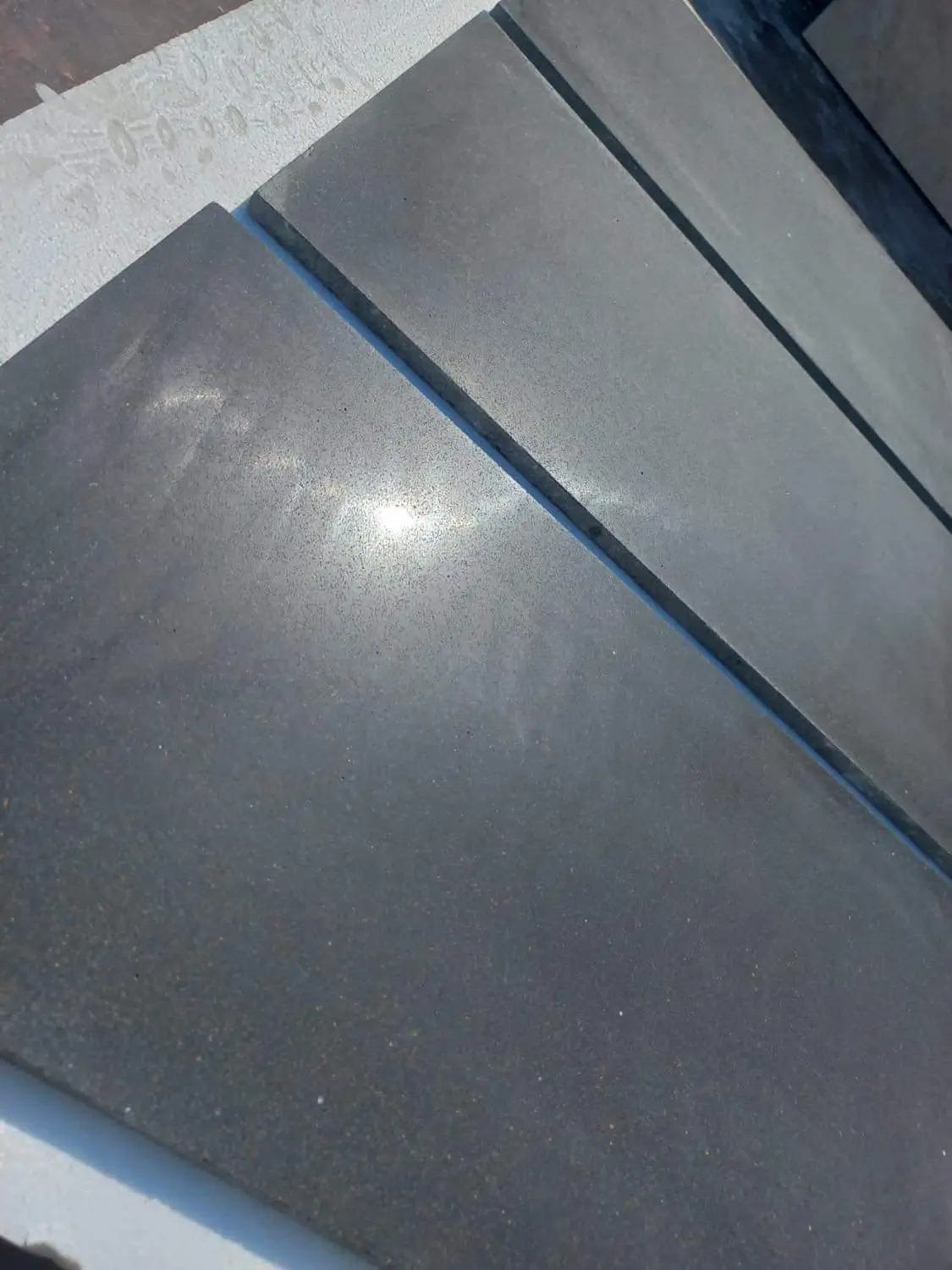
Dark grey limestone paving in Arizona projects that run behind schedule almost always trace the delay to a single procurement error: assuming in-stock availability without confirming calibrated slab inventory at the warehouse before finalizing the installation timeline. Calibrated dark grey limestone in larger format sizes — 900x600mm and above — moves faster than most specifiers expect, particularly during the peak October-to-April Scottsdale construction season.
At Citadel Stone, we recommend confirming warehouse stock levels and securing your allocation a minimum of four to six weeks before your scheduled installation start date. Our technical team can advise on pallet counts, slab yield calculations, and waste factors for complex graded layouts — the kind of site-specific calculation that general quantity guides consistently underestimate on terrain-heavy lots.
Your truck access constraints matter here too. On hillside lots with restricted driveway grades or limited turning radius, deliveries may require a smaller truck and multiple runs rather than a single full pallet load. Factor that into your scheduling when coordinating with the warehouse. In Tucson, where hillside residential development shares similar terrain challenges to northeast Scottsdale, truck access planning routinely adds a scheduling day to the procurement sequence.
Getting Dark Grey Limestone Contemporary Scottsdale Installations Right
The strongest dark grey limestone contemporary Scottsdale installations share a common thread: the terrain was treated as a design input, not an obstacle to work around. Your slope analysis, drainage geometry, and base engineering decisions made in the first week of project planning determine whether the finished surface looks as sharp at year fifteen as it does at installation. Material quality matters — but it performs only as well as the system beneath it.
For complementary Arizona stone project inspiration with a bolder urban application, Dark Grey Limestone Paving Drama for Phoenix Bold Statements explores how the same material family performs in high-contrast metropolitan design contexts. At Citadel Stone, our dark grey limestone slabs are sourced and calibrated specifically for Arizona’s demanding terrain and climate conditions, giving your project the performance foundation it needs.
Our dove grey limestone slabs in Arizona bring a touch of class to any project.