
Thermal Cycling and Your Limestone Table Top
The specification variable that separates a custom limestone slab table Glendale owners enjoy for decades from one that develops hairline cracks within three seasons isn’t material hardness — it’s how you engineer for Arizona’s thermal amplitude. Glendale’s diurnal temperature swing regularly spans 35–45°F between predawn low and afternoon peak, and across a full year that range stretches from overnight winter lows near 35°F to summer highs above 110°F. That’s a total operating envelope approaching 75°F of thermal travel, and every degree of that range is working on your stone, your substrate, and your joint interfaces simultaneously.
Limestone expands at roughly 4.4 × 10⁻⁶ per °F. For a 72-inch slab, that translates to approximately 0.014 inches of dimensional change across a 45°F daily cycle — small enough to ignore on a single day, but cumulative fatigue at joint edges over hundreds of cycles is where the real damage accumulates. Your specification needs to account for this before the first piece leaves the fabrication facility.
Selecting the Right Limestone Slab for Glendale Conditions
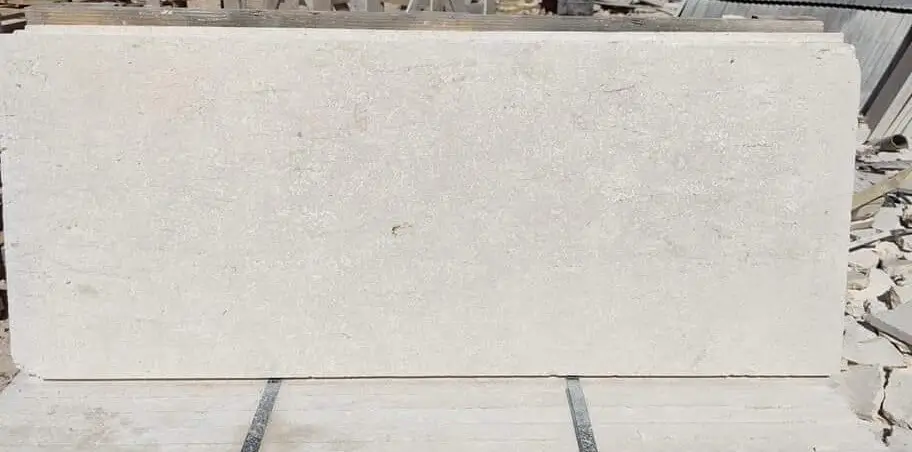
Not all limestone performs equally in high-thermal-amplitude environments. Your material selection for a custom limestone slab table Glendale project should prioritize two laboratory characteristics above visual appearance: absorption rate and flexural strength. You want an absorption rate below 3% for outdoor dining applications — anything above 5% creates a moisture infiltration pathway that freeze-thaw action (yes, even in Arizona’s mild winters) will exploit at the microscopic level over time.
- Flexural strength should exceed 1,800 PSI for unsupported spans over 48 inches
- Compressive strength above 8,000 PSI provides adequate resistance to thermal stress loading
- Absorption rate below 3% limits moisture-driven spalling during winter temperature drops
- Consistent grain structure across the full slab face reduces differential expansion stress
- Nominal slab thickness of 1.5 to 2 inches balances thermal mass with manageable weight for table base engineering
Density matters here too. Denser limestone — typically in the 160–165 lb/ft³ range — actually buffers temperature cycling better because its higher thermal mass slows the rate of temperature change through the stone cross-section. That slower rate means lower instantaneous stress at any given moment, which protects both the stone and the sealant film.
Sizing Your Limestone Slab Dining Surface
Dimensional planning for limestone slab dining surfaces Arizona projects require is more nuanced than standard furniture sizing charts suggest. You’re not just accounting for seating capacity — you’re engineering a horizontal stone element that will be exposed to the same thermal cycling as any paved surface, but with the added complication of an unsupported mid-span and varying point loads from place settings, serving dishes, and occasional leaning pressure.
For rectangular dining tables, a 1.5-inch-thick slab handles spans up to 60 inches without supplemental steel reinforcement underneath, assuming the base frame provides continuous perimeter support within 4 inches of each edge. Push to 72 inches, and you should either increase thickness to 2 inches or integrate a steel flat-bar frame bonded to the slab underside with flexible epoxy — not rigid adhesive, which will crack under thermal movement.
- Standard 6-person dining: 72 × 36 inches — spec at 2-inch thickness for thermal stability
- 4-person bistro format: 48 × 30 inches — 1.5 inches is sufficient with proper edge support
- 8-person feature table: 84–96 × 40 inches — requires steel subframe and expansion joints at the 48-inch midpoint
- Overhang beyond base support: limit to 10–12 inches on long sides, 8 inches on short ends
In Yuma, where summer temperatures push past 115°F with exceptional regularity, the dimensional calculation for a 96-inch slab needs to account for an even wider thermal envelope — the expansion differential between a slab in direct sun and one in afternoon shade can drive localized stress concentrations at any structural connection point.
Base Frame Engineering for Thermal Movement
The most common failure point in custom table creation projects isn’t the stone itself — it’s the connection between stone and base frame. A rigid steel base welded tight to a limestone slab creates a mechanical constraint that works against thermal expansion. Over 200–300 daily cycles, that constraint produces micro-fractures at the bonding interface, and eventually at the stone face itself.
Your base frame specification should use slotted mounting holes or silicone-isolated connection points rather than rigid bolted attachments. The slot length should accommodate at least 0.020 inches of lateral movement per linear foot of slab, which covers the Arizona thermal range with a safety margin. Silicone isolators at each mounting point serve double duty — they allow controlled movement and prevent galvanic contact between any metal fastener and the stone surface.
- Use 304 stainless steel fasteners — standard carbon steel corrodes at contact points and stains limestone faces
- Apply 100% silicone isolators between stone and any metal contact surface
- Slotted holes in the steel frame should run parallel to the slab’s long axis
- Torque mounting hardware to finger-tight plus one quarter turn — over-tightening eliminates the movement tolerance you engineered in
- Powder-coated steel bases should be inspected annually for coating failure that could allow moisture ingress at contact points
Edge Profiles and Joint Specification
Edge profile selection for Arizona bespoke pieces isn’t purely aesthetic — it directly affects thermal performance and long-term chip resistance. A full bullnose edge, while visually soft and popular, reduces the edge cross-section to a semicircle that concentrates thermal stress at the thinnest point. In high-cycling environments, this is where chips originate, typically at 3–5 years of service.
The profiles that hold up best in Glendale’s thermal conditions are the eased edge (a simple 45-degree chamfer) and the waterfall edge with a 3/8-inch radius. Both maintain adequate stone cross-section at the perimeter while providing the visual refinement appropriate for outdoor dining furniture. A Mesa installation completed with a 3/8-inch radius edge showed zero thermal chipping after six Arizona summers — the same project with full bullnose sections on the short ends developed hairline chipping at year four.
For large-format slabs requiring a seam — anything over 84 inches typically — your joint specification is as important as the edge detail. Use a two-part polyurethane adhesive in the joint itself, not epoxy. Polyurethane maintains flexibility down to 20°F and up to 180°F, which covers Arizona’s full thermal range. The joint width should be 1/16 to 3/32 inch — narrow enough to be visually discreet, wide enough to accommodate cumulative movement without compressing the adhesive into a rigid state.
Sealing Protocols for Outdoor Limestone in Arizona
Sealing a limestone dining surface in Arizona’s climate requires a different approach than the generic “seal annually” recommendation you’ll see on most product sheets. The thermal cycling actually works on your sealant film the same way it works on the stone — expanding and contracting it through hundreds of cycles per year. A standard penetrating silane-siloxane sealer handles this well for the first 18–24 months, but re-application timing should be driven by a water-bead test, not a calendar schedule.
Here’s the practical test: pour a tablespoon of water on the sealed surface at midday when the stone is warm. If the water beads and holds its shape for at least 45 seconds, your seal is intact. If it flattens and begins to absorb within 20 seconds, you need to reseal within the next two weeks. In Glendale’s climate, most installations will reach that threshold at 16–20 months, not 12 — which actually means you can skip the overly aggressive annual resealing that can build up a residue film over time.
- Apply sealer at ambient temperatures between 50°F and 85°F — never on a surface that has been in direct sun for more than an hour
- Two coats on new stone, with a 2-hour cure window between coats
- Fluorocarbon-enhanced sealers outperform standard siloxane formulations in UV-intense environments
- Clean the surface with a pH-neutral stone cleaner before each resealing — acidic cleaners etch limestone and accelerate absorption
- Allow 72 hours after sealing before exposing the surface to food and beverages
For clients who use their outdoor dining surfaces heavily through the summer months, At Citadel Stone, we recommend a two-product approach: a penetrating sealer for moisture protection combined with a topical impregnator that specifically addresses UV degradation. The UV component is what most generic sealing advice omits entirely, and it’s the failure mode that causes limestone to develop a dull, chalky appearance at year three in Arizona sun.
Specifying Limestone in Arizona for Custom Furniture Projects
The terminology around limestone in Arizona outdoor furniture specification matters more than most people realize when you’re sourcing material. “Limestone slab” covers a wide range of geological formations with meaningfully different performance characteristics. What you’re specifying for a Glendale outdoor furniture dining table top is a dense, low-porosity sedimentary limestone — not the lighter-weight tumbled varieties used for pool coping or the highly porous shells-and-fossils material popular for rustic installations.
For dining surface applications, look for material with a Mohs hardness of 3–4 and a cross-cut face that shows tight, consistent crystalline structure rather than visible voids or large fossil inclusions. The fossil-rich varieties are visually spectacular but create differential hardness zones across the surface — the fossil material (often harder) and the matrix material (softer) expand and contract at different rates, which accelerates surface micro-fracturing under thermal cycling. For a high-use outdoor dining application, you want consistency over character in the internal structure, even if the surface color and veining remain distinctive.
Your supply chain decision also affects project timing significantly. Locally stocked limestone in Arizona reduces lead times to 1–2 weeks from the point of slab selection. Imported material sourced to specification can run 8–12 weeks from order to delivery, which creates a project scheduling challenge if your base fabrication is already underway. Confirm inventory availability before finalizing your slab dimensions — available stock often influences the most practical finished dimensions for custom projects. For reference on compatible large-format applications, elongated rectangular limestone in Chandler provides useful context on how slab dimensions translate to structural and thermal performance in Arizona’s climate.
Fabrication Details That Make or Break Glendale Outdoor Dining Tables
Custom table creation at the fabrication stage involves decisions that are invisible in the finished product but define its longevity in a high-thermal-amplitude environment. The most consequential is the back-cutting specification — the series of relief cuts made to the underside of a large slab to relieve internal stress introduced during quarrying and primary cutting. Back-cutting depth of 1/8 to 3/16 inch at 12-inch intervals on the underside dramatically reduces the risk of spontaneous stress cracking during the first two thermal seasons, when residual quarry tension is still dissipating.
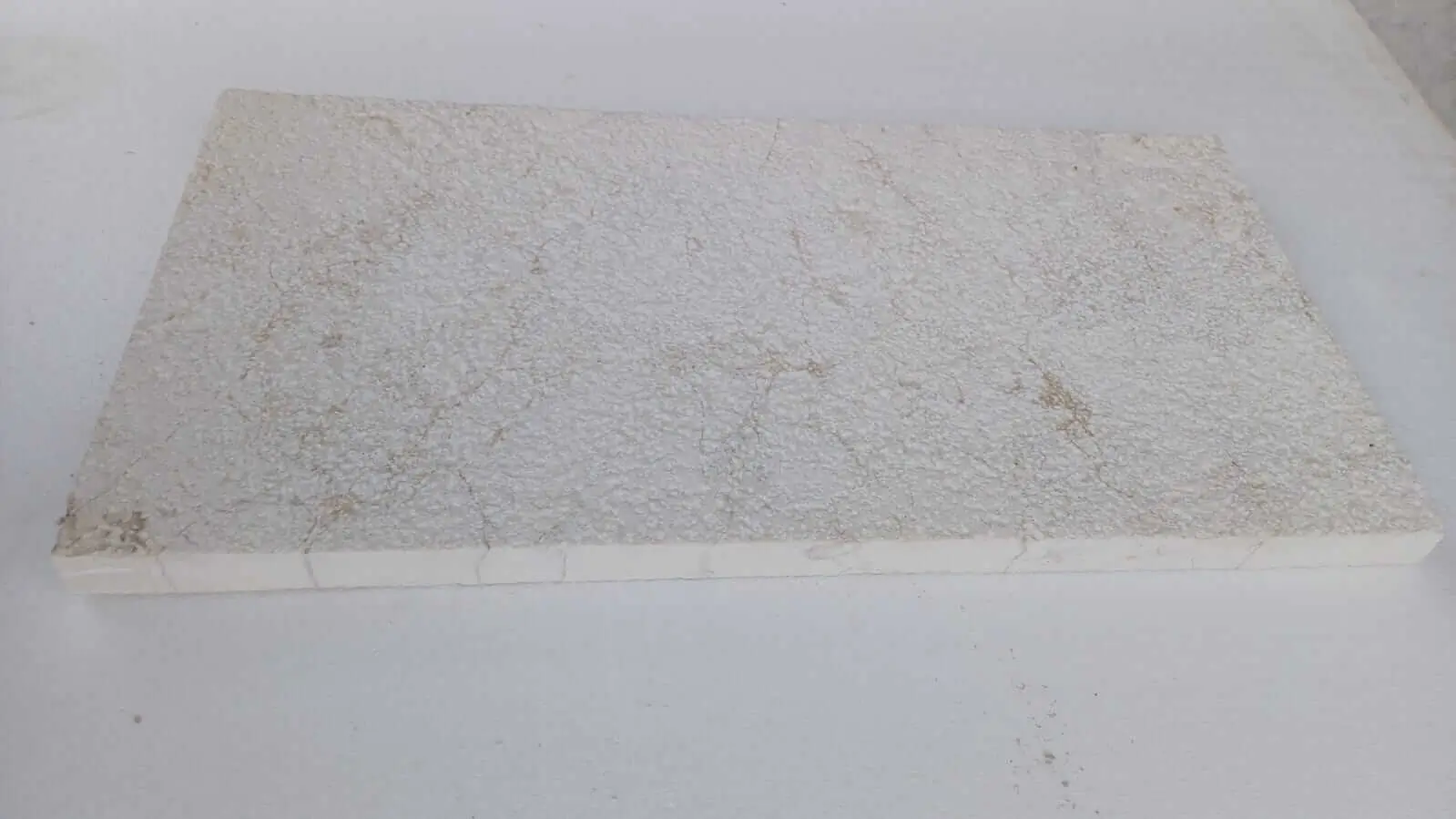
Surface finish selection also carries thermal implications that aren’t obvious until you understand how different finishes affect the stone’s surface energy. A honed finish (400 to 800 grit) provides the best combination of visual sophistication and thermal performance for outdoor dining — it’s smooth enough to clean easily, but the micro-texture it retains allows sealers to achieve better mechanical adhesion than a fully polished surface. Polished limestone, while beautiful, presents a near-zero-porosity surface to sealers, which means the protective film is adhesion-dependent rather than penetration-dependent, and it delaminates faster under UV and thermal cycling.
- Honed finish (400–800 grit): optimal for Arizona outdoor dining — cleanable, sealable, thermally stable
- Brushed or antiqued finish: excellent texture retention after thermal cycling, slightly higher maintenance
- Polished finish: best avoided for full outdoor exposure — reserve for covered patio or interior-only applications
- Sandblasted finish: increases surface porosity, requires more aggressive sealing protocol
In Gilbert, where newer residential construction frequently features covered patio structures, the shading provided by a pergola or solid cover changes the thermal calculation significantly — a covered slab cycling through 25°F daily rather than 45°F can sustain a polished finish with proper maintenance. Context always modifies the specification.
Delivery and On-Site Installation Logistics
A custom limestone slab table Glendale installation requires more logistical planning than most residential clients anticipate. A 72 × 36 × 2-inch limestone slab weighs approximately 270–290 pounds depending on density — well beyond two-person handling capacity and into territory where proper equipment prevents both injury and edge damage during placement.
Your delivery and placement plan should confirm gate width, surface path from street to installation location, and whether any steps, thresholds, or grade changes exist along the route. Slab lifters with rubber-padded clamps are the right tool; improvised carrying with furniture straps risks edge contact with the clamp hardware, and that contact point under load is exactly where thermal-stress-weakened edges chip. Schedule delivery for morning hours when stone temperatures are cooler and more stable — attempting to set a slab that has been sitting in direct afternoon Arizona sun introduces immediate thermal shock if the receiving surface is at a significantly different temperature.
- Verify site access at least two weeks before scheduled delivery to avoid last-minute rerouting
- Confirm base frame is fully installed, leveled, and cured (if concrete-based) before slab arrival
- Have silicone isolators and mounting hardware staged and ready — setting a slab twice multiplies edge damage risk
- Protect finished edges during handling with foam-backed edge guards at all four corners
- Allow 24 hours after installation before sealing — thermal equilibration of the newly placed slab produces minor dimensional settling
Bringing Your Custom Limestone Slab Table Project Together
The decisions that define a custom limestone slab table Glendale project’s long-term performance are made well before installation day — in material selection, slab thickness calculation, base frame engineering, and joint specification. Getting those foundational choices right means the thermal cycling that Glendale throws at the installation year after year becomes a manageable variable rather than a destructive force. The stone doesn’t need to fight the climate; it needs to be engineered to move with it.
As you finalize your project scope, consider how the same material and structural principles extend to other statement applications across the Phoenix metro. For projects where a single stone piece anchors an outdoor space, Single Slab of Limestone Feature Installation for Tempe Focal Points explores how single-slab engineering translates to feature applications — a natural complement to the custom table creation work covered here. Our technical team at Citadel Stone is available to review slab dimensions, base frame drawings, and sealing specifications before your project moves to fabrication — that pre-fabrication review catches the details that are expensive to correct after cutting. Citadel Stone’s custom limestone slab table solutions for Glendale projects are backed by the kind of hands-on material expertise and regional sourcing knowledge that no generic stone supplier can match.