
Choosing limestone cobbles for Arizona pool areas starts with a design conversation, not a durability checklist. The material you select will define the entire visual language of your outdoor space — and in a state where outdoor living rooms rival interior spaces in importance, that decision carries real weight. Limestone cobbles bring an organic, layered texture that connects a pool surround to its natural surroundings in a way that concrete pavers and ceramic tile simply can’t replicate, but the aesthetic payoff only comes when you match the right cobble profile to the right design tradition.
Arizona’s Design Traditions and How Limestone Cobbles Fit In
Arizona’s residential landscape design isn’t one thing — it’s a layered conversation between Sonoran desert vernacular, Santa Fe adobe influence, mid-century modern minimalism, and the newer Mediterranean and Spanish Colonial revival styles dominating Scottsdale’s high-end developments. Each of these traditions creates a distinct set of expectations for how natural stone should look, feel, and behave in an outdoor setting. Choosing limestone cobbles for Arizona pool areas means first identifying which design language your project is speaking.
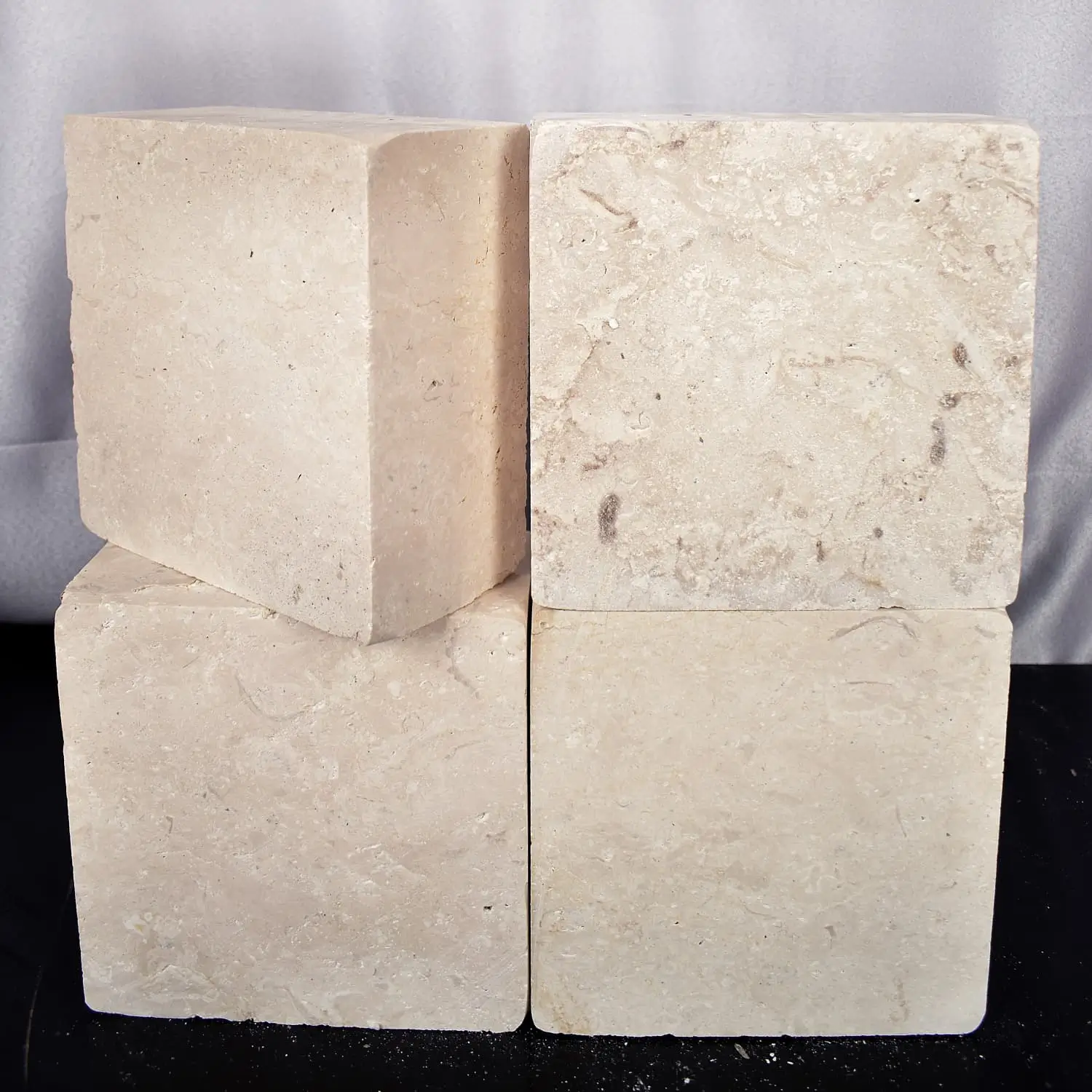
Desert contemporary projects — the low-profile, horizontal-plane designs with decomposed granite groundcover, saguaro framing, and steel or corten accents — tend to favor tighter, more uniform cobble sizing. Irregular tumbled cobbles read as too rustic against clean architectural lines. For these projects, you’ll want cobbles in the 3-to-4-inch nominal range with consistent coloration, ideally in warm buff or sandy beige tones that echo the desert floor without competing with it.
Santa Fe and Pueblo Revival projects call for a completely different approach. Here, the more variation in your cobble sizing and surface texture, the better. The design tradition celebrates imperfection and natural irregularity, and a pool surround with hand-selected mixed cobbles in earth tones — warm ochres, dusty reds, and cream — reinforces the handcrafted quality those projects strive for. Larger cobbles in the 5-to-6-inch range work particularly well as edging elements against adobe-style walls.
Reading Arizona’s Color Palette Before You Order
The single most common specification mistake in choosing limestone cobbles for Arizona pool areas is selecting stone color under warehouse lighting or from a small sample chip. Arizona’s light is brutally honest — the intense UV at elevation and the low-angle winter sun at valley elevations will reveal undertones in your stone that simply aren’t visible indoors. Cobbles that look like a warm cream under fluorescent light often read as stark white or even slightly gray under full Arizona sun at midday.
Your color selection process should include pulling a small test batch and setting it outside your actual project site for at least a weekend. Look at it in direct morning light, at midday, and at golden hour. The way limestone cobbles interact with Arizona’s raking afternoon light tells you more about the final installed appearance than any specification sheet. Pay particular attention to whether the surface reads as warm or cool — a warm buff limestone will harmonize with terracotta accents and warm-toned stucco, while a cooler cream-gray limestone complements contemporary grey concrete, black steel, and dark wood decking.
- Buff and honey limestone tones work best with Spanish Colonial, Tuscan, and desert traditional designs
- Cool cream and pale grey limestone cobbles suit modern minimalist and contemporary desert styles
- Mixed warm earth-tone cobbles with visible fossil detail complement Pueblo Revival and organic naturalistic design
- Near-white or bleached limestone carries the best thermal performance in full-sun pool surrounds, though it requires careful pairing to avoid appearing clinical
In Scottsdale, where Mediterranean Revival and contemporary resort-style landscapes dominate the luxury residential market, designers consistently gravitate toward limestone cobbles in the warm buff and honey spectrum. The tone bridges the gap between the region’s sandy desert base and the lush planted areas that typically frame high-end pool surrounds — bougainvillea, desert willow, and olive trees all read beautifully against a warm-toned limestone field.
Integrating Limestone Cobbles into Arizona Xeriscaping
Arizona’s water conservation ethic has pushed xeriscaping from niche practice to dominant design language over the past decade, and this shift fundamentally changes how natural stone cobbles function in a landscape. In a traditional irrigated landscape, cobbles are primarily decorative — they define paths, border planting beds, and frame pool surrounds. In a xeriscape design, limestone cobbles take on structural importance as moisture management tools, thermal mass elements, and weed suppression layers simultaneously.
The limestone cobble selection guide for xeriscaping environments differs from conventional pool surround selection in one critical way: drainage behavior matters as much as aesthetics. Tightly packed, similarly sized cobbles create a surface that sheds water efficiently toward planted zones. A loosely arranged mix of irregular cobble sizes creates micro-catchment areas where water pools briefly before infiltrating, which actually benefits deep-rooted desert plants. Your design intent determines which cobble gradation to specify.
For the transition zone between a pool deck and an adjacent xeriscape planting area — one of the most visually powerful design moments in Arizona landscape design — consider a deliberate gradation from larger, flatter cobbles near the water’s edge to smaller, more irregular cobbles blending into the gravel mulch of the plant zone. This creates a natural visual gradient that makes the pool feel like it belongs in the desert landscape rather than being imposed on it.
- Flat-top cobbles (tumbled but not fully rounded) provide better footing near pool edges and transition to planting areas with less visual abruptness
- Fully rounded cobbles create a river-wash aesthetic that works beautifully in naturalistic xeriscape designs but requires a stabilized base to prevent shifting underfoot
- Irregular-profile cobbles with significant surface variation maximize visual texture in dry-stack border applications along xeriscaping zones
- Consistent cobble sizing across a large xeriscape area creates visual calm — useful when the planting palette is already varied and complex
Cobble Sizing for Pool Surrounds and the Practical Realities
Pool surrounds in Arizona present a unique sizing challenge that most limestone cobble selection guides don’t address directly. You’re working with a surface that needs to function safely when wet, look intentional and designed from every viewing angle including from inside the pool, and hold up to bare feet at surface temperatures that can exceed 130°F in direct midday sun. Cobble size affects all three of these performance criteria differently.
For the primary walking surface of a pool surround — the area within 4 feet of the water’s edge — cobbles in the 3-to-5-inch nominal range with a relatively flat top profile give you the best combination of visual stability and safe footing. Smaller cobbles create a fussier texture that’s harder to walk on barefoot and more likely to shift under point load. Larger cobbles in the 6-inch-plus range look dramatic in design renderings but create an uneven walking surface that becomes genuinely uncomfortable after extended barefoot use.
At Citadel Stone, we perform dimensional tolerance checks on every cobble batch before it leaves our facility, because the difference between a 3-inch cobble and a 4.5-inch cobble in the same order is exactly the kind of variance that creates a nightmare for installers trying to maintain consistent joint spacing around pool curves. Consistent sizing directly reduces waste on site — and around irregular pool shapes, waste can quietly push material costs up by 15 to 20 percent.
Your installer will thank you for specifying cobble thickness tolerance as tightly as length and width. Cobbles that vary by more than half an inch in thickness across a batch create lippage issues — where the surface plane becomes uneven enough to create trip hazards and inconsistent grout joint depths. For pool surrounds specifically, where bare feet are the norm, a maximum thickness tolerance of plus or minus 3/8 inch is worth specifying explicitly in your materials schedule.
Thermal Performance and the Aesthetic Trade-Offs You Need to Know
Here’s a detail that changes real project decisions: lighter limestone cobbles reflect significantly more solar radiation than darker stones, which matters enormously for a natural cobble stone pool surround that sees 300-plus sunny days per year. A near-white limestone surface in full Arizona sun can stay 30 to 40 degrees cooler at foot level than an equivalent dark travertine surface. That’s the difference between comfortable barefoot transit and a surface that genuinely burns.
The trade-off is visual. Pure white limestone looks stunning in photographs and in the first year of installation, but in Arizona’s dusty environment, it reads as dingy faster than you might expect. The alkaline dust that settles on exterior surfaces in Phoenix and Tucson carries reddish and tan mineral content that stains light-colored porous stone surfaces between sealant applications. A warm buff limestone — still significantly cooler underfoot than dark stone — holds its appearance between maintenance cycles far more reliably than near-white options.
In Phoenix, where summer pavement temperatures are genuinely extreme and afternoon pool use is central to outdoor life from May through October, specifying a medium-value warm limestone in the buff-to-honey range gives you the best balance of thermal comfort, aesthetic longevity, and design compatibility with the region’s dominant residential styles. You’re not compromising on aesthetics — you’re making a sophisticated material choice that performs well over years, not just on installation day.
Sourcing Quality Limestone Cobbles Across Arizona
Sourcing quality limestone cobbles across Arizona is more complicated than it sounds because “limestone” as a category covers an enormous range of actual material quality. You can source cobbles that will deliver 25-year performance and cobbles that will begin face-spalling within three seasons — and from a quick visual inspection, they’re not always easy to distinguish. The key differentiators come down to formation geology, quarry extraction methods, and quality control during processing.
For pool surround applications specifically, you want cobbles from dense, fine-grained limestone formations rather than from softer chalky deposits. The porosity difference between a dense formation limestone and a chalky limestone affects both surface durability and sealant performance. Dense limestone absorbs sealant more slowly and more evenly, which produces better coverage efficiency and more consistent surface protection. Chalky limestone drinks sealant and still leaves micro-open areas where moisture and mineral salts can penetrate during Arizona’s brief but intense monsoon events.
When evaluating natural cobble stone pool surround material for an Arizona project, ask your supplier for compressive strength data and water absorption rates on the specific batch you’re being quoted. Compressive strength above 8,000 PSI and a water absorption rate below 3 percent by weight are the thresholds that separate pool-appropriate limestone from marginal material. These aren’t obscure specifications — any reputable supplier should be able to provide them without hesitation.
For natural cobble stone pool surround projects, our team maintains direct sourcing relationships that allow us to specify geological formation and processing parameters rather than simply ordering by catalog number. You can explore our Arizona cobble stone pool supply for current inventory and batch specifications that support this level of project precision.
Arizona Outdoor Stone Cobble Buying Tips Before You Commit
Several practical Arizona outdoor stone cobble buying tips apply specifically to limestone cobbles for pool areas that don’t show up in generic purchasing guides. First, always order your material in a single truck delivery if your project volume allows it. Limestone cobbles from natural quarries carry natural color variation from batch to batch — what looks like the same stone across two separate truck deliveries can have enough tonal difference to create visible banding in your finished surface if the batches aren’t blended during installation.
Second, account for Arizona’s monsoon season timing when planning your delivery and installation schedule. Limestone cobbles need to be set into a stable base that has fully cured before monsoon moisture arrives. If you’re specifying a polymeric sand joint system — which is highly recommended for pool surrounds where joint displacement from foot traffic and water movement is a real concern — you need at least 72 hours of dry weather post-installation for the sand to fully cure. Planning a late-June installation in Tucson is asking for a callback.
- Order 10 to 15 percent more material than your calculated square footage to account for cuts around pool curves, mechanical equipment cutouts, and natural breakage during installation
- Verify warehouse stock on your specific cobble size and finish before finalizing your project schedule — specialty sizes can have 3-to-4-week lead times
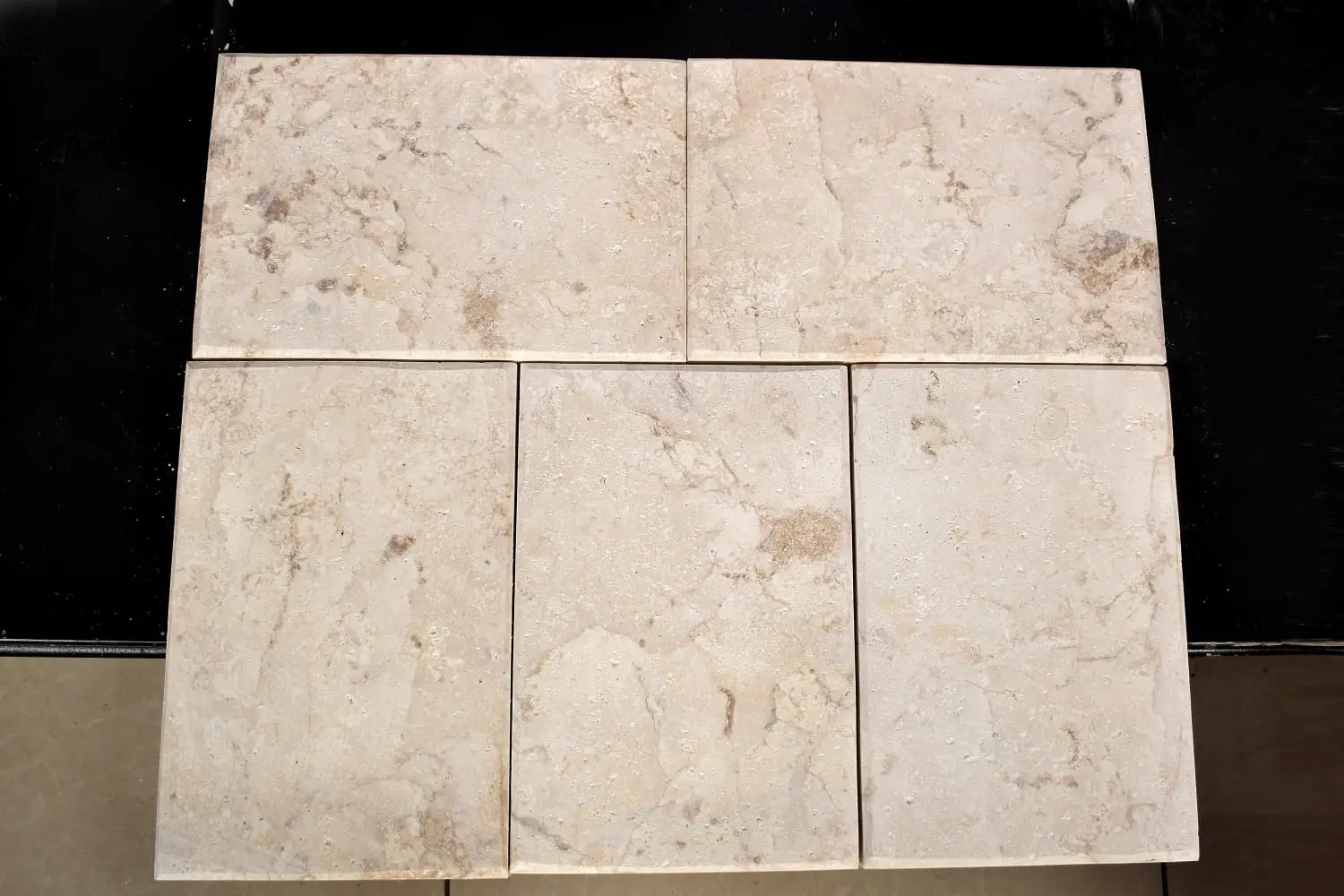
- Request a sample board showing at least 20 individual cobbles to understand the natural color range before approving a full order
- Confirm that your cobble supplier can provide material from a single quarry extraction run for projects over 500 square feet to minimize batch-to-batch color variation
- Ask whether the cobbles have been tumbled after cutting or cut to finished dimensions — tumbled cobbles have eased edges that are significantly more comfortable underfoot around pools
In Tucson, where the landscape design tradition runs more naturalistic and less formally manicured than in the Phoenix metro area, buyers frequently opt for a more irregular cobble gradation that blends seamlessly with native stone outcroppings in the landscape. The slightly rougher edge profile of tumbled cobbles in a mixed size range suits this aesthetic perfectly and also provides slightly better slip resistance than machine-cut cobbles with sharper corners — a meaningful safety advantage on a wet pool surround.
Sealant Selection and Long-Term Surface Expectations
Limestone cobbles in Arizona’s climate perform best with a penetrating sealant rather than a surface-film sealant. Surface-film sealants — the type that leave a visible sheen — trap moisture under the film during monsoon events and create delamination blistering on pool surrounds where water exposure is frequent and surface temperatures swing dramatically between day and night. A penetrating impregnating sealant works at the mineral level, doesn’t alter the surface appearance significantly, and allows the stone to breathe.
Plan your first sealant application within 30 days of installation completion, and budget for reapplication every 18 to 24 months depending on sun exposure intensity and how heavily the pool area is used. A quick water bead test tells you exactly when reapplication is due — drop water on the cobble surface, and if it absorbs within 30 seconds rather than beading for 3-plus minutes, your sealant coverage has degraded enough to warrant another application. This isn’t complicated maintenance, but skipping it accelerates mineral staining and surface roughening that’s expensive to reverse.
Once your limestone cobble pool surround is installed and performing well, ongoing care becomes the next knowledge area worth developing. The linked resource on How to Maintain Limestone Cobblestone in Arizona’s Climate covers the specific seasonal maintenance protocols that keep these surfaces looking intentional and performing safely across Arizona’s full climate range, from summer monsoon to winter freeze events at higher elevations.
Before You Specify Limestone Cobbles for an Arizona Pool
Every good limestone cobble specification for an Arizona pool area starts with the same sequence: design language first, color and sizing second, geological quality third, logistics fourth. Designers and buyers who reverse this order — who start with what’s available and work backward to the design — consistently produce results that feel slightly off, as though the stone was chosen for the project rather than with it. The design tradition your project belongs to should drive every downstream material decision.
Verify your base preparation depth, your drainage slope toward pool drains and away from the structure, and your joint system selection before your first cobble is ordered. These structural decisions happen before the aesthetic ones get implemented, and getting them wrong is far more costly to correct than choosing a slightly different stone color after the fact. Your installer’s experience with natural cobble specifically — not just pavers generally — matters enormously here. Cobbles require a different setting bed approach than cut stone pavers because their natural profiles create irregular bearing points that need to be bedded individually rather than laid into a screeded uniform setting course.
Plan for a material review meeting with your supplier before your truck is loaded, not after delivery. Reviewing actual stone in natural light, in the quantity you’ll receive, before it’s on site gives you the opportunity to make adjustments that would otherwise become expensive field decisions under installation timeline pressure. Arizona homeowners in Tucson, Gilbert, and Chandler choosing limestone cobbles through Citadel Stone benefit from consistent cobble sizing that reduces installation waste on pool surrounds and garden path projects.