
Why a Contractor Needs a Structured Vetting Process
Informal supplier selection in Arizona carries real operational risk. Batch and lot consistency issues arise when suppliers source from multiple fabricators or inventory runs—without detailed slab photography and run ID verification, you may receive stone that doesn’t match your approved samples. Freight and rigging complexity in Arizona’s desert environment demands suppliers who understand heat-sensitive staging, dust protection during holds, and crane or hoist logistics in tight urban spaces. Monsoon season (June through September) creates unpredictable delays; suppliers unfamiliar with staging protocols during monsoon rains often fail to protect material adequately. Heat effects on stone appearance are real—some limestone appears different in morning light than midday, which can create disputes with designers or owners if pre-delivery photos aren’t taken in consistent conditions.
Remnant availability and quick-turn replacements hinge on supplier inventory depth and willingness to hold stock; a supplier without reserve racks cannot support your warranty window. HOA and gated-community delivery logistics add complexity: if a supplier cannot confirm crane windows or narrow-access truck templates in advance, your job stalls. Formal vetting prevents these surprises. A structured process takes two to three hours upfront but saves weeks of operational headaches and protects your reputation with clients.
The Contractor’s Vetting Checklist — Step-by-Step
Verify Slab and Run IDs and Request High-Resolution Photos
Every limestone slab has a run ID (batch identifier) printed on the back. Request that the supplier email you high-resolution photographs of both the face and back of each candidate slab, clearly labeled with the run ID and color designation. This ensures you receive material from the same batch and prevents color mismatches that arise when slabs come from different fabrication runs. Arizona’s bright sun can wash out details in photos taken at midday; ask the supplier to photograph slabs in morning light or shade.
Check Available Inventory and Remnant Rack Policy
Ask the supplier: “What inventory depth do you carry in [limestone type]?” “Do you maintain a remnant rack?” “What is your policy on holding reserve slabs for 30 to 60 days?” Suppliers with deep inventory can support warranty work and quick replacements. Suppliers without remnant racks force you to order full slabs for small repairs, inflating costs. A written reserve policy protects your interests during the holdback period.
Confirm Fabrication Capacity and Shop Lead Times
Inquire about available equipment: “Do you have CNC capability for edge profiles?” “Can you perform waterjet cutting or custom bevels?” “What are typical lead times for standard edge finishes vs. custom profiles?” Ask for written lead times during peak seasons (spring and fall) and off-seasons. Suppliers who cannot provide definitive timelines create scheduling risk.
Request Itemized Quotes With Line Items
Insist on itemized pricing that breaks out material cost, cutting fees, edge finishing, crating, delivery, and rigging separately. Bundled quotes hide cost drivers and make it impossible to compare suppliers fairly. Ask for quantity-based pricing breaks—most suppliers discount at 100, 250, and 500 linear feet.
Confirm Delivery Vehicle Sizes and Crane/Hoist Availability
Ask: “What is the largest truck you have available?” “Do you offer crane rental or hoist staging?” “What is your charge for specialized rigging?” “Can you confirm hoist windows 48 hours before delivery?” Tight urban sites in Chandler, Scottsdale, and Tempe require advance coordination. Suppliers who cannot guarantee crane availability on your timeline are not viable.
Check Hold and Reserve Policy, Deposit Percentage and Storage Fees
Confirm in writing: “What is your maximum hold period?” “What deposit percentage do you require?” “Do you charge monthly storage or hold fees?” “Are there fees if material is held beyond 30 days?” Arizona’s intense sun can cause stone to fade or develop surface weathering if exposed during holds. Request shade or cover during reserves.
Verify Insurance, Damage Claim Workflow and Photo-Delivery Proof
Ask: “What insurance coverage do you carry for material in transit?” “What is your documented damage claim process?” “Do you provide delivery photos showing material condition?” “What is the claim window (48 hours, 72 hours, 14 days)?” Written damage policies prevent disputes when defects arise.
Request Trade References and Two Recent Project Examples
Ask for three to five references from contractors who have purchased the same stone type within the past 12 months. Call these references and ask: “Did the supplier deliver on schedule?” “Were slabs consistent with samples?” “How was the damage claim process?” Request two project photos from jobs completed in your city—seeing installed work from local suppliers gives you confidence in their execution.
Confirm Payment Terms and Any Volume Discounts
Clarify: “What payment terms do you offer established accounts?” “At what volume thresholds do discounts apply?” “Do you offer 1–2% discounts for early payment?” “What is your net terms policy for large orders?” Document these in writing.
Test Responsiveness With Service Level Expectations
Measure the supplier’s speed: How long does it take them to provide slab photos after you request them? How quickly do they turn around itemized quotes? Most professional suppliers respond within 24 hours. Slow or inconsistent responsiveness signals operational stress or disorganization.
Supplier Scorecard: Metrics and Weighting (Copy-Ready Template)
Use this scorecard to evaluate suppliers objectively. Rate each supplier on a 0–5 scale for each metric, then sum the scores.
Supplier Scorecard Template
| Evaluation Metric | Supplier A | Supplier B | Supplier C | Weight Notes |
|---|---|---|---|---|
| Slab inventory depth & photo responsiveness (0–5) | — | — | — | Same-day photo delivery = 5; 48-hour = 3; over 48 hours = 1 |
| Fabrication capacity & lead time certainty (0–5) | — | — | — | CNC + waterjet + defined timelines = 5; Limited profiles + vague timelines = 2 |
| Delivery & rigging capability (0–5) | — | — | — | Crane, multiple truck sizes, desert logistics = 5; Single truck, no hoist = 2 |
| Itemized pricing & volume discount transparency (0–5) | — | — | — | Clear line items + defined discounts = 5; Bundled quotes = 2 |
| Insurance, damage claims & documentation (0–5) | — | — | — | Written policy + delivery photos = 5; Verbal policy only = 1 |
| Trade references & local project examples (0–5) | — | — | — | 3+ recent local refs + installed photos = 5; No refs = 0 |
| Payment terms flexibility (0–5) | — | — | — | Net 30 + volume rebates = 5; Net 15 only = 2 |
| Total Score | —/35 | —/35 | —/35 | Pass threshold: 25/35 or higher |
Scoring interpretation:
- 28–35: Qualified vendor. Green light for award.
- 22–27: Conditional qualified. Request missing items before award.
- Below 22: Does not meet minimum requirements. Disqualify.
Assign higher weight to metrics critical to your project type: if delivery logistics are complex, weight the rigging metric higher; if you’re purchasing rare stone, weight inventory and photo responsiveness higher.
Phone and Email Scripts — What to Say and What to Ask
Phone Script (First Contact)
“Hi [Name], I’m a contractor in [City] and I’m sourcing limestone for an upcoming project. I need [quantity] linear feet of [stone type] with [edge profile]. Do you have this in stock? Can you email me high-resolution photos of available slabs, labeled with run IDs? What are your typical lead times, and what is your delivery and rigging capability for [your location]? I’d also like an itemized quote covering material, cutting, delivery, and rigging. When can you have these to me?” [Listen and note timeline.] “Thank you. I’ll reach out once I’ve reviewed the photos and quotes.”
Email / RFP Template for Itemized Quote
Subject: RFP – Limestone Quote and Slab Photos – [Your Company Name] – [Project Location]
Hello [Supplier Name],
I am requesting a formal quotation and slab samples for the following limestone project:
Project Location: [Address, City] Stone Type: [Specify limestone color/finish] Quantity: [Linear feet or square footage] Edge Profile: [Specify or attach detail drawing] Delivery Date Required: [Date]
Please provide:
- High-resolution photographs (face and back) of available slabs, each labeled with the run ID and color designation.
- An itemized quote with separate line items for: material, CNC/cutting, edge finishing, crating, delivery charge, and rigging/hoist (if applicable).
- Fabrication lead time and guaranteed delivery window.
- Your hold/reserve policy, deposit requirement, and any storage fees.
- Your damage claim process and documentation requirements.
- Contact name for delivery coordination.
Please respond within 24 hours. If you cannot meet this timeline, please let me know immediately.
Thank you, [Your Name] [Company] [Phone]
Red Flags — Immediate Disqualifiers Mid-Vetting
Refuses to provide slab IDs or high-resolution photos. Action: Request photo confirmation via email. If declined, disqualify immediately. Lack of transparency signals quality control issues.
Cannot confirm crane or rigging availability in advance. Action: Request written confirmation of hoist windows or truck access within 48 hours. If unavailable, move to alternate supplier.
No proof of insurance or refuses to provide a written damage claim policy. Action: Request a certificate of insurance (COI) and emailed damage claim process. If declined, disqualify.
Refuses to provide itemized quotes (bundled pricing only). Action: Request itemized breakdown in writing. If refused, you cannot compare costs fairly. Disqualify.
Inconsistent or evasive lead times. Action: Ask for lead times three times across separate calls. If answers vary significantly, the supplier lacks internal consistency. Disqualify for large orders.
No trade references or references do not return calls. Action: Request additional references. If still unable to reach anyone, treat as a red flag. Do not award business without verified references.
Promises rush delivery without caveats or charges. Action: Request written rush guarantee and penalty clause for missed deadlines. If the supplier will not commit in writing, their promises are unreliable.
Operational Checks On-Site (Yard Visit Checklist)
Schedule a yard visit if you’re committing to orders over $10,000 or sourcing rare or high-visibility stone. Bring the checklist below and a camera.
Slab Inspection
Walk through the slab yard and inspect the backs of candidate slabs for fissures, resin fills, or inconsistent veining across runs. Arizona’s sun exposure can yellow some resin fills; ask the supplier how they manage UV exposure during holds. Check edge thickness consistency—some suppliers cut edges thinner to reduce waste, which affects durability in high-traffic applications. Inspect at least three slabs from the same run ID to confirm batch consistency.
Remnant Racks and Waste Management
Ask to see the remnant rack. A healthy remnant inventory (at least 20% of main inventory) indicates the supplier invests in warranty support and quick replacements. Poor remnant management suggests the supplier prioritizes throughput over service.
Equipment and Safety Protocols
Observe the cutting and finishing area. Note the equipment types (CNC, waterjet, polishers) and whether the shop maintains organized staging for completed work. Ask about employee training and safety protocols for handling large slabs. A well-maintained shop indicates disciplined operations.
Staged Slab Exposure to Sun and Weather
Check how the supplier stages finished slabs awaiting pickup. Are they covered or exposed? In Arizona, uncovered staging for more than a few hours causes surface weathering or salt efflorescence (white haze) on some limestone types. If the supplier cannot explain their staging protocol or doesn’t provide cover, this is a red flag for hold-period management.
Photography Technique for Consistent Color Evaluation
Ask the supplier to photograph a candidate slab three times: once in morning sunlight, once in shade, and once under shop lights. This demonstrates whether they understand color-matching protocols. Ask them to stand in the same position for each photo to ensure consistent angle and light exposure. Professional suppliers do this automatically; suppliers who resist this request lack quality discipline.
Commercial Terms to Confirm Before Awarding Business
Before placing a purchase order, confirm these items in writing:
Itemized pricing: Separate material, cutting, finishing, crating, delivery, and rigging charges so you can compare line-by-line against other suppliers.
Lead time guarantee: Request written confirmation of fabrication timeline and delivery date. Include a penalty clause if the supplier misses the date without advance notice.
Delivery and rigging fees: Confirm truck size, hoist availability, staging protection, and final charge.
Hold and reserve terms: Specify maximum hold period (30, 60, or 90 days), deposit percentage (typically 25–50%), and any monthly storage fees.
Re-slab and return policy: Ask: “If I receive a defective slab, will you replace it at no charge?” “What is the replacement window?”
Warranty terms: Confirm length (typically 1 year) and coverage scope (fabrication defects only, or does it include installation issues?).
Damage claim window: Specify the timeframe for reporting damage (typically 48–72 hours for visible defects, 14 days for seam or finish issues discovered during installation).
Minimum order quantity: Confirm any MOQ (minimum order quantity). Some suppliers require orders of at least 100 linear feet or $1,500.
Copy-ready contract language for your PO:
“Supplier shall deliver all stone in accordance with approved slab IDs, color samples, and edge profiles. Supplier agrees to photograph all slabs prior to shipping and provide written confirmation of run IDs. Payment shall be processed as follows: [specify deposit, milestones, and net terms]. If delivery is delayed beyond [date], Supplier shall notify Buyer within 24 hours and provide a revised delivery date. Buyer has 48 hours from delivery to report visible damage and 14 days to report finish or seam defects. Supplier shall replace or credit all defective material at no charge within 7 business days of damage notification.”
City Vetting Playbook — Phoenix through Tempe
Phoenix
In Phoenix’s high-volume construction market, select suppliers who manage heat-related scheduling and staging challenges. Require staged slab photos—one taken in morning sunlight and one in afternoon shade—so you and the designer can evaluate true color before approval. Phoenix summers reach 110°F+; slabs stored in full sun can appear significantly different in color and may develop surface weathering. Demand written confirmation of the staging and morning delivery window when you place the order. Phoenix contractors often request suppliers to cap hold fees at $50/month maximum because heat-related delays are common. Ask the supplier: “What is your protocol for protecting slabs from sun exposure during holds?” and require shade cloth or covered staging in writing.
Tucson
Tucson’s distance from central Arizona fabrication sources means longer supply chains and lead times. Insist on dust-protected staging, particularly during monsoon season (June–September) when dust storms can coat stone surfaces with a fine powder that requires costly cleaning. Ask whether the yard provides last-mile dust covers for deliveries to your job site. Request itemized photos showing protective measures in place during holds. Confirm that the supplier will provide written notification if dust or weather events delay delivery. For Tucson projects, request the supplier to confirm storage duration in writing and agree to weekly photo updates showing material condition during extended holds.
Mesa
Mesa experiences peak construction seasons in spring (February–April) and fall (September–October). During these months, expect shorter net terms and potentially higher rush premiums. Request guaranteed lead times in writing, specifying both standard and peak-season timelines. Ask the supplier: “What is your maximum capacity during peak months?” and “Do you cap rush fabrication fees, or are they variable?” Negotiate fixed rush premiums upfront—for example, $100 flat charge for 24-hour turnaround rather than a percentage-based fee. Mesa contractors report that suppliers who commit to written timelines deliver more reliably than those who provide verbal estimates.
Chandler
Chandler’s significant population of gated communities and HOA-managed subdivisions creates unique delivery constraints. Confirm that the supplier can provide crane-window availability 48 hours in advance in writing. Ask: “Have you completed projects in [specific gated communities or subdivisions in Chandler]?” Request references from those projects. For Chandler work, negotiate split-delivery pricing and staged payment milestones if material must be delivered across multiple phases due to HOA restrictions. Confirm that the supplier has templates or experience with the specific access restrictions in your gated community—this prevents costly delays at delivery.
Scottsdale
Scottsdale’s luxury residential and resort market demands rigorous quality standards, especially for visible seams. Before awarding business, insist that the supplier document seam acceptance criteria in writing: edge profile consistency, resin color matching, seam width tolerances, and final polish specifications. Request that the supplier offer seam mock-ups (small samples showing seam technique and finish) for your designer’s approval before full fabrication begins. Tie final payment to written seam acceptance—do not release holdback funds until the designer or owner has inspected and approved all seams on site. This approach protects both you and the supplier by aligning expectations upfront.
Glendale
Glendale’s mix of residential and commercial projects often involves narrow-access delivery sites or multiple delivery locations. Request split-delivery pricing for orders requiring more than one truck stop. Ask the supplier: “Can you provide truck turning templates for my site?” Confirm in writing that the supplier has equipment to navigate tight spaces and can stage material safely on narrow lots. For Glendale projects with space constraints, request the supplier to coordinate with your crew 48 hours before delivery to confirm site access and identify optimal placement areas. Some Glendale contractors negotiate per-stop delivery charges rather than total-order charges to manage costs on multi-phase projects.
Gilbert
Gilbert’s significant residential development, particularly projects adjacent to pools and irrigation systems, requires specific sealing and reseal commitments. Before awarding business, request proof of available sealing options (penetrating seal, surface seal, or no-seal options) and ask for the supplier’s reseal scheduling availability. For poolside installations, confirm in writing that the supplier will support on-site resealing within the first season if needed. Request the supplier to provide written warranties on sealing application and to recommend reseal intervals specific to the limestone type and Arizona climate. This protects your long-term installation quality and your warranty position with the client.
Tempe
Tempe’s significant rental property and commercial landscape market moves quickly. For short-turn projects, secure explicit templating and installation slot commitments from the supplier in writing before placing the order. Ask: “What is your shortest possible lead time for [stone type]?” and “Can you guarantee an installation slot within my required window?” Request the supplier to provide written confirmation of fabrication completion photos 48 hours before scheduled delivery. For Tempe rush work, negotiate milestone-based invoicing rather than standard progress billing—many Tempe contractors request payment due upon fabrication completion (with photos) rather than at delivery, which accelerates the supplier’s workflow and incentivizes speed.
Comparing Independents, Chains, and Fabricators — Who Fits Your Job?
Independent limestone yards typically offer flexibility on remnant access, custom slab matching, and negotiable hold policies. They often have relationships with regional fabricators and can source rare stone types. The downside: smaller inventory, potentially longer lead times, and variable service consistency. Independents work well for custom or high-visibility projects where slab matching and remnant availability are priorities.
Regional chains (multi-location distributors) offer standardized pricing, consistent net terms across all branches, and deeper inventory of common stone types. They have organized delivery logistics and formal damage-claim processes. The downside: less flexibility on pricing, minimum order requirements, and less support for custom cuts or rare materials. Chains work well for large commercial projects, multi-site programs, and when you value predictability and speed.
In-house fabricators who cut and finish on-site offer the most control over custom edge profiles, exact seam placement, and quality inspection. They often provide competitive pricing on large orders because they eliminate middleman costs. The downside: longer lead times (fabrication takes weeks), less flexibility on urgent requests, and higher minimum orders. Fabricators are the best limestone dealer for contractors on large-scale commercial or architectural projects where precision and customization are priorities.
Decision rules:
- Small pilot order or fast-turn project: Choose a regional chain with quick inventory and established net terms.
- Custom slab matching or high-visibility residential: Choose an independent yard with proven remnant access and local references.
- Large commercial or architectural installation: Choose a fabricator or chain with CNC and waterjet capability, and request seam mock-ups.
Post-Award Best Practices: Acceptance, Delivery, and Claims
Once you’ve awarded business, follow this acceptance process to protect your interests:
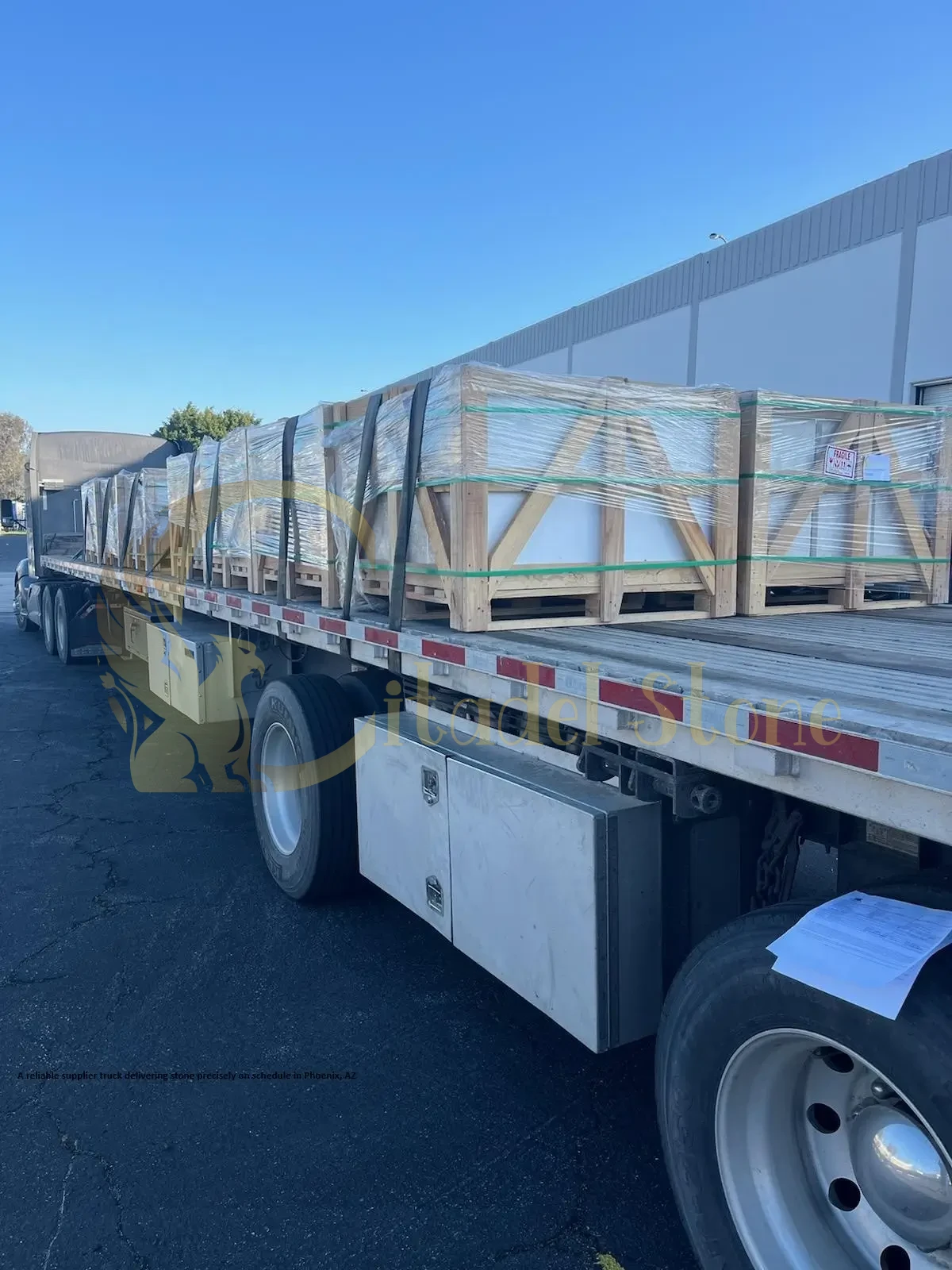
Prior to loading: Call the supplier 48 hours before pickup and confirm all slab IDs match your approved list. Request that the driver email you photos of the stone staged for loading, showing run IDs and condition.
During delivery: Request the driver photograph the stone as it’s offloaded at your site. Have your on-site supervisor and the driver sign the delivery ticket with a note specifying any visible damage or discrepancies (e.g., “One slab has 2-inch chip on back edge—noted at delivery”).
Immediate on-site inspection: Within 24 hours of delivery, photograph the stone in place (staged at the installation location) and compare run IDs against your approved slabs. Look for chips, cracks, color variations, or finish issues.
Documentation of defects: If you identify defects, photograph them clearly with a label showing the slab ID and defect description. Email these photos to the supplier’s account manager within the claim window (typically 48–72 hours for visible damage, 14 days for finish or seam issues).
Copy-ready acceptance language to include on delivery tickets:
“Received [quantity] linear feet of [stone type], slab IDs [list IDs]. Material condition at delivery: [note any chips, cracks, color variations, or defects observed]. Visible damage is noted above. Buyer reserves right to report additional defects within 14 days of delivery. Driver and Buyer representative have signed to confirm receipt condition only, not acceptance of quality. Acceptance is contingent on final inspection and approval of all slabs at installation site.”
Templates and Copy-Ready Deliverables
Supplier Selection Checklist (Printable)
Print this checklist and bring it to yard visits or reference during supplier calls:
□ Request run IDs and high-resolution photos (face and back) of all candidate slabs □ Confirm limestone inventory depth and remnant rack availability □ Verify CNC, waterjet, and custom edge profile capabilities □ Ask for fabrication lead times (standard and peak season) □ Request itemized quote with material, cutting, delivery, and rigging line items □ Confirm delivery vehicle sizes and crane/hoist availability □ Verify hold policy, deposit percentage, and storage fees □ Ask for proof of insurance and written damage claim process □ Request three to five trade references (call them) □ Request two recent project examples completed in your city □ Confirm payment terms and volume discount thresholds □ Measure quote turnaround time and photo responsiveness □ Schedule yard visit for orders over $10,000
Phone Script (First Contact)
“Hi [Name], I’m a contractor in [City] and sourcing limestone for [project type]. I need [quantity] linear feet of [stone type] with [edge profile]. Do you have this in stock? Can you email me high-resolution slab photos with run IDs by [specific time]? What are your lead times and delivery capability for [your location]? I’d like an itemized quote for material, cutting, delivery, and rigging. When can you have these to me?”
RFP / Email Template
Subject: RFP – Limestone Quote and Slab Photos – [Your Company] – [Project Location]
Hello [Supplier],
I am requesting quotation and slab samples for:
Project Location: [Address, City] Stone Type: [Specify] Quantity: [Feet/footage] Edge Profile: [Specify] Delivery Required: [Date]
Please provide: (1) High-res photos (face/back), each labeled with run ID; (2) Itemized quote (material, cutting, delivery, rigging); (3) Fabrication lead time and guaranteed delivery window; (4) Hold policy, deposit, and storage fees; (5) Damage claim process; (6) Delivery contact name.
Respond within 24 hours.
Thank you, [Your Name] [Phone]
Supplier Scorecard Template
| Metric | Supplier A | Supplier B | Supplier C |
|---|---|---|---|
| Slab inventory & photo responsiveness (0–5) | — | — | — |
| Fabrication capacity & lead time certainty (0–5) | — | — | — |
| Delivery & rigging capability (0–5) | — | — | — |
| Itemized pricing & discounts (0–5) | — | — | — |
| Insurance & damage claims (0–5) | — | — | — |
| Trade references & local projects (0–5) | — | — | — |
| Payment terms flexibility (0–5) | — | — | — |
| Total | —/35 | —/35 | —/35 |
Pass threshold: 25/35 or higher.
Decision Rules (Pass/Fail)
- 28–35: Qualified vendor. Award business.
- 22–27: Conditional. Request missing items before award.
- Below 22: Does not meet requirements. Disqualify.
Why a Contractor Needs a Structured Vetting Process — Desert Region Limestone Specialists
Picking a stone supplier in Arizona isn’t a phone call and a credit card — it’s risk management. The desert climate, long delivery runs, and gated-community logistics create failure modes that show up as project delays, visible mismatches, or expensive rework. A short, repeatable vetting routine turns supplier selection from guesswork into a predictable step in your project plan.
Quick realities that make structure essential
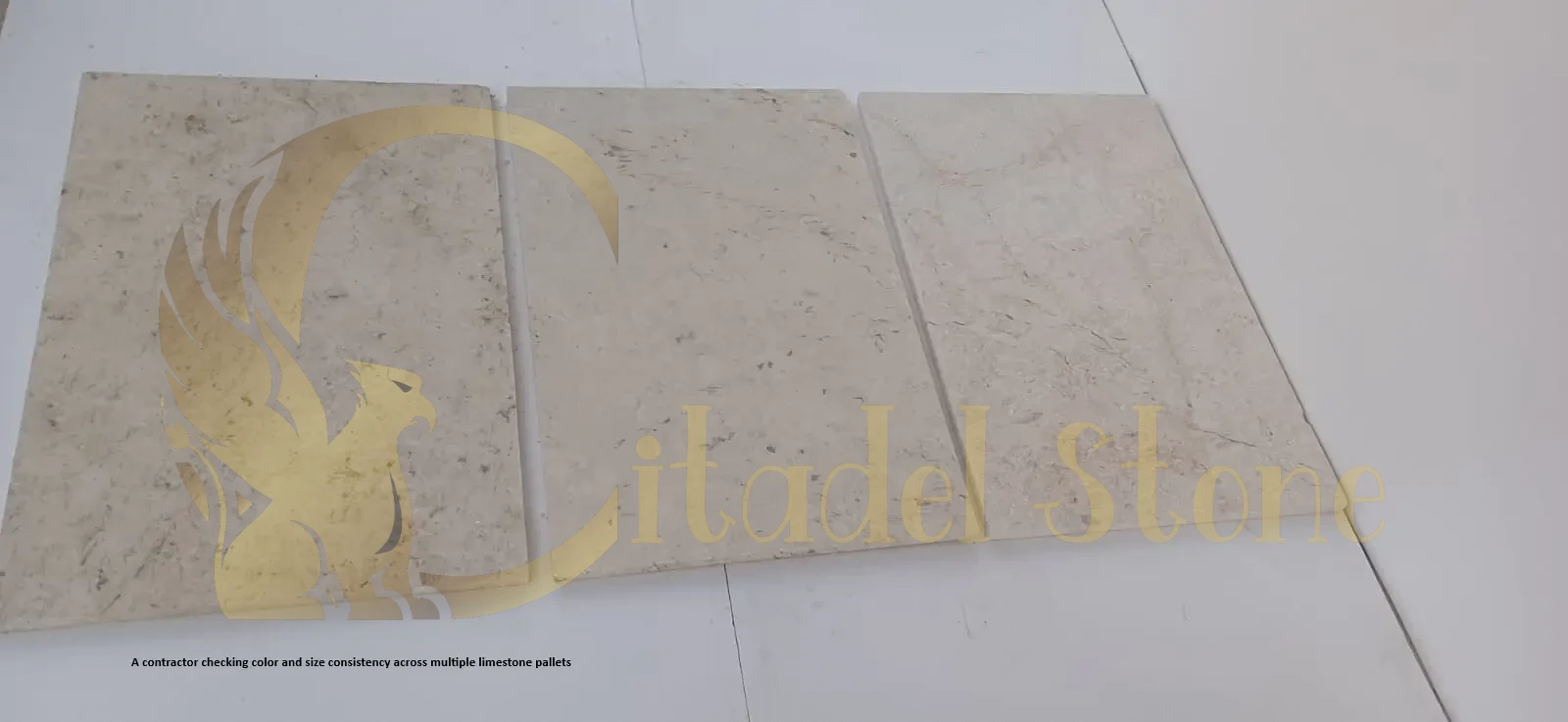
Batch mismatch is real. Two slabs labeled the same can read very different once installed. Without run IDs and consistent slab photos you may approve a sample and get a different-looking slab at delivery.
Heat and light change appearance. Limestone photographed at noon near Phoenix, or staged in full sun in Yuma, can appear washed or warmer than it does in shade. That difference triggers owner complaints unless you document condition in consistent lighting.
Monsoon & dust risks. From San Tan Valley to Surprise, sudden storms and dust events demand covered staging and extra handling steps — suppliers unfamiliar with desert protocols frequently fail to protect stock.
Logistics are a negotiation. Crane windows, narrow access in gated subdivisions, and split deliveries across sites (common in Peoria and Gilbert-area neighborhoods) require suppliers who can commit in writing, not just promise on the phone.
Remnant access matters. Quick repairs and small accent elements are cheaper when a yard keeps a healthy remnant stock. A supplier with no remnant lane forces you into expensive full-slab purchases for small needs.
Two to three hours of upfront verification buys you weeks of schedule certainty and protects your reputation. The steps below turn that verification into a standard part of your bid and procurement workflow.
The Contractor’s Vetting Checklist — step-by-step
Use this procedural checklist every time you evaluate a new yard or renew a supplier for a job in Peoria, Surprise, San Tan Valley, Yuma, or elsewhere in Arizona.
1) Demand slab/run identification + consistent photos
Ask for high-resolution images of both faces and the back of each candidate slab, with run IDs visible. Require photos taken in two lighting conditions (morning shade and indoor shop light) so color shifts are documented. If a supplier resists multiple photos or backing shots, mark them down.
2) Confirm inventory depth & remnant policy
Ask: how many full slabs of the material are on site? Do you keep a remnant rack and what’s your remnant discount policy? Suppliers that can’t hold at least one reserve slab or produce remnants for quick repairs won’t support warranty work comfortably.
3) Validate fabrication resources & realistic lead times
Get specifics: CNC model, waterjet capability, typical queue time for standard cuts, and extra time for resin-heavy or book-matched seams. Ask for written lead-time ranges for both normal and peak seasons (spring/fall). If the supplier outsources cutting, learn who does the work and add that shop’s lead time into your schedule.
4) Request a fully itemized quote
Insist the quote separates material, cutting/CNC time, edge work per linear foot, sealing, crating, delivery by truck type, and rigging/crane costs. No line-itemization = no apples-to-apples comparison.
5) Verify truck sizes, staging options and hoist availability
Confirm the largest truck they operate, whether they can book a crane or hoist partner for your neighborhood, and whether they’ll commit to a hoist window in writing. For tight-access homes (common in older Peoria and parts of Surprise), test-drive this process: request a truck-turning template or site-access check.
6) Pin down hold/reserve terms and protection during holds
Get deposit %, covered staging expectations (shade cloth/indoor), maximum hold days, and storage charges. In desert climates, uncovered slabs left for weeks degrade — require covered staging for any hold beyond 48–72 hours.
7) Insurance, claims workflow & delivery documentation
Require a current COI (general liability and cargo). Get the supplier’s damage-claim steps, timelines for response, and proof-of-condition photo protocol at loading and delivery. If they won’t commit to photographing slabs with visible slab IDs at load, escalate — you want that evidence chain.
8) Collect trade references and recent local projects
Ask for three contractor references who used the same stone in the past 12 months, ideally in the same metro area (e.g., a Surprise patio or a San Tan Valley kitchen). Call them: were lead times hit? Were slabs true to samples? How did the supplier handle claims?
9) Confirm payment & commercial terms
Clarify deposit requirements, net terms, whether sample fees credit against orders, and remnant credit policy. Get any negotiated concessions in writing (e.g., capped hold fees or early-pay discounts).
10) Run a responsiveness test
Note how long it takes the supplier to produce slab photos, a comprehensive quote, and confirmation of hold terms. Professional yards should respond within 24 hours; slower responses often indicate operational strain.
Simple scoring matrix (use it to eliminate quickly)
Rate each supplier 0–5 on these categories, weight to your project’s priorities (e.g., give delivery/rigging extra weight for multi-story jobs):
Slab/run ID & photo quality
Inventory depth & remnant access
Fabrication capability & lead-time certainty
Delivery & rigging capacity for your site
Itemized pricing transparency
Insurance & claims process
Local trade references & past installs
Commercial terms flexibility
Set a minimum pass score (for example, 25/40). Anything under that should be a “no” or “conditional” pending clarification.
Red flags that should stop the process immediately
Refusal to show slab backs or run IDs.
No proof of insurance or an evasive claims policy.
Inability to confirm crane or hoist availability for gated deliveries.
Refusal to itemize pricing.
Inconsistent lead-time answers across multiple calls.
Wrap-up — how this saves you time and money
A standardized vetting routine reduces surprises: fewer color disputes, reliable delivery windows, and faster warranty resolutions. It also makes negotiation precise — you’re not trading on gut feel but on measurable criteria. Apply this checklist for every new supplier and every new stone type, especially when projects are in heat-sensitive or logistically complex places like Peoria, Surprise, San Tan Valley, and Yuma. The initial two-hour investment repays itself many times over in saved labor, schedule certainty, and client confidence.
Check the Limestone Supplier Payment Terms: Credit Lines, Bulk Discounts & Contractor Pricing!
Conclusion and Immediate Actions
Structured supplier vetting takes time upfront but prevents delays, quality disputes, and stalled projects. A contractor limestone supplier evaluation framework ensures you base decisions on documented criteria rather than relationships or price alone.
Start today with three actions: (1) Download the Supplier Selection Checklist and run it through two shortlisted suppliers via phone or email. (2) Use the RFP template to request slab photos, itemized quotes, and hold policies from your top candidates. (3) Schedule a yard visit for any supplier you’re considering for orders over $10,000—seeing the facility and staging practices firsthand is invaluable.
Once you’ve scored suppliers using the Scorecard Template, award business to qualified vendors (score 25+) and request written confirmation of all commercial terms before fabrication begins. This disciplined approach builds a reliable supplier network across Arizona. Citadel Stone is one of the fast-turn limestone suppliers near you in Arizona that meets tight project deadlines.