
Code compliance isn’t the afterthought that gets addressed after you’ve already chosen your slab — it’s the first conversation you need to have before anything else moves forward. Your buying big paving slabs Arizona guide starts with understanding that Arizona’s structural and regulatory requirements impose non-negotiable constraints on material thickness, base depth, and edge detailing that filter out a significant portion of the slab options you’ll find advertised online. The projects that fail at the 5-year mark almost always skipped this step, not the material selection step.
Arizona Code and Structural Baseline Requirements
Arizona doesn’t have a unified statewide residential paving code the way some jurisdictions operate, but that doesn’t mean you’re working without regulatory guardrails. County and municipal building departments across Arizona adopt local amendments to the International Building Code and International Residential Code, and those amendments carry real teeth when it comes to load-bearing assemblies, base depth minimums, and drainage requirements. Before you finalize your slab specification, pull the applicable permit requirements for your jurisdiction — this is non-negotiable if you’re in an HOA-governed community or working on a commercial grade property.
Load-bearing requirements for exterior paving in Arizona typically target a minimum 3,000 PSI compressive strength for pedestrian-only applications, but driveway and vehicular applications push that threshold to 6,000–8,000 PSI for the slab surface itself. Large format natural stone slabs — particularly those running 24 inches by 48 inches or larger — need thickness verification against point load calculations, especially when vehicle overhang is part of the design. You’ll want slabs in the 2-inch to 3-inch nominal thickness range for any application where vehicle traffic is possible, even infrequent.
- Pedestrian-only patios: 1.25-inch to 1.5-inch slab thickness minimum, depending on material density
- Driveway and vehicular paving: 2-inch nominal minimum for natural stone, with 3-inch preferred for heavy loads
- Base depth for stable desert soils: 4–6 inches of compacted aggregate base
- Base depth over expansive clay soils: 6–8 inches with geotextile separation layer mandatory
- Edge restraint requirements: permanent mechanical restraint required on all unsupported slab edges
Seismic Considerations for Arizona Paving Projects
Arizona sits within USGS seismic hazard Zone 2A across much of the state, with pockets of elevated activity near the Basin and Range fault systems in the western corridor and the Colorado Plateau transition zones. For residential paving, this doesn’t mean you need an engineer on retainer for every patio project, but it does influence how you detail the bedding layer and joint systems for large format slabs.
Rigid mortar-set installations for big paving slabs in Arizona carry a genuine risk in seismically active areas — a mortar bed that doesn’t flex will crack through the slab itself rather than accommodating minor ground movement at the joint. The professional standard in moderate seismic zones favors a dry-set or semi-dry bedding approach with sand-filled joints wide enough to allow 3–4mm of lateral movement per 10 feet of installed surface. This is one of the details that separates a structural specification from a cosmetic one.
Projects in Sedona face additional complexity — the red rock terrain involves variable bearing capacity as you transition between native bedrock and the decomposed sandstone fill that commonly underlies developed residential lots in that area. Running a compaction test before finalizing your base depth spec is worth the modest cost in a market where slab replacement runs significantly higher than the test itself.
What to Check Before Purchasing Large Stone Slabs in Arizona
There’s a pre-purchase checklist that experienced specifiers run through before any order is placed, and it covers more ground than just checking the price per square foot. The buying big paving slabs Arizona guide that actually serves you well starts with confirming that the slab format you want is genuinely available in the thickness your structural conditions require — not all stone types come in the 2-inch or 3-inch thickness that vehicular-rated applications demand.
What to check before purchasing large stone slabs in Arizona comes down to four primary verification points: thickness range availability in your chosen material, confirmed compressive strength data from the quarry, surface finish slip resistance ratings, and current warehouse stock levels that align with your installation schedule. Skipping any of these creates downstream problems that are expensive to solve after the truck has delivered material to your site.
- Request third-party compressive strength test results — not manufacturer marketing claims
- Verify that the quoted thickness is nominal, not finished, and confirm both min and max within that nominal range
- Check warehouse stock depth: if the project requires 400 square feet, confirm at least 450 SF available to cover cuts and breakage
- Confirm lead times from the warehouse before signing a contractor agreement with a fixed installation start date
- Ask specifically about quarry lot consistency — large format slabs from different production runs can show noticeable color variation
- Verify that the material is rated for exterior use and specifically for the freeze-thaw or high-UV environment of your project site
Oversized Slab Thickness Options for Arizona Buyers
Oversized slab thickness options for AZ buyers are more varied than most buyers realize when they first start shopping, and the decision tree branches quickly based on application type and structural expectations. The baseline options you’ll encounter run from a 1.25-inch calibrated slab (appropriate for light-duty pedestrian use on a well-prepared base) up through a 3-inch split or gauged slab for heavy vehicular applications.
The 2-inch nominal range is the practical workhorse for most Arizona residential projects — it handles the combination of foot traffic, occasional vehicle overhang, and the thermal cycling that comes with the Sonoran Desert’s temperature differential. You’ll find that 2-inch slabs in travertine, limestone, and basalt all clear the compressive strength threshold for driveway applications, but the bedding system beneath them matters as much as the slab thickness itself. A 2-inch slab on a compromised base will fail faster than a 1.5-inch slab on a correctly prepared 6-inch compacted aggregate bed.
In Yuma, the combination of extreme heat and the highly alkaline Colorado River alluvium soils introduces a specific challenge for thinner slabs — the capillary moisture that migrates through alkaline soils accelerates surface efflorescence and can compromise mortar bond strength over time. The field-proven response in that region is to specify a thicker slab with wider open joints and a bedding system that allows drainage rather than sealing moisture into the assembly. Reviewing oversized slab thickness options for AZ buyers in high-alkaline soil zones means prioritizing drainage-friendly assemblies over purely aesthetic considerations.
Surface Finish Choices for Big Slabs Across Arizona
Surface finish choices for big slabs across Arizona are a structural and code question before they’re an aesthetic one — and that ordering matters more than most buyers recognize. Arizona’s building departments don’t prescribe specific finish types for residential exterior paving, but ASTM C1028 and the more current ANSI A137.1 coefficient of friction standards create a functional floor for what’s acceptable in wet or transitional-zone applications like pool surrounds, entry approaches, and shaded patios.
Honed finishes on large format slabs deliver a DCOF (dynamic coefficient of friction) in the 0.42–0.55 range, which technically meets the 0.42 minimum for interior and sheltered applications but sits at the low end for fully exposed exterior use in the wet season. Bush-hammered and natural cleft finishes push that number to 0.65–0.80, which is where you want to be for unprotected exterior paving in a state that does get seasonal monsoon rain concentrated into short, intense periods. The surface finish choices for big slabs across Arizona that perform best long-term are those selected with DCOF as a primary filter, not an afterthought.
- Natural cleft: highest DCOF (0.70–0.85), irregular surface texture, best for pool surrounds and sloped applications
- Bush-hammered: DCOF 0.65–0.78, uniform mechanical texture, good balance of aesthetics and slip resistance
- Sandblasted: DCOF 0.60–0.72, slightly more refined appearance than bush-hammered, suitable for main patios
- Honed: DCOF 0.42–0.55, smooth appearance, appropriate for covered or interior-adjacent applications only
- Polished: DCOF below 0.42 when wet — avoid for any exterior application in Arizona’s monsoon zone
At Citadel Stone, we test surface finish samples under simulated wet conditions before recommending specific finishes for pool deck or driveway applications — the nominal DCOF from a spec sheet doesn’t always match what field conditions produce when fine sediment from Arizona’s dust storms settles into the finish over the first season.
Base Preparation and Structural Requirements for Large Slabs
The base system under your big paving slabs in Arizona is doing more structural work than the slab surface itself, and yet it gets underspecified on more projects than any other element. For large format slabs — anything 24 inches or longer in either dimension — the base needs to be engineered for uniform load distribution, because the spanning capacity of a natural stone slab is finite and a soft spot in the base translates directly to a cracked slab within 2–3 years.
Arizona’s soils vary dramatically from the caliche-heavy desert floor of the Phoenix basin to the sandy alluvium of the river corridors to the red clay soils of the northern plateau. Each soil type demands a different base strategy, and applying a generic “4 inches of crushed aggregate” spec across all conditions is how you generate warranty claims. In expansive clay soils — which you’ll encounter across substantial portions of the Phoenix metro and Tucson basin — the base depth should increase to 8 inches with a positive drainage slope designed into the sub-grade, not just the surface.
You’ll want to confirm whether your site has caliche hardpan before deciding whether to excavate through it or engineer around it. Caliche that’s continuous and well-cemented can actually serve as a structural bearing layer — but caliche that’s intermittent or includes void zones needs to be broken up and removed, because differential settlement over caliche voids is one of the most common causes of large slab cracking in Arizona residential projects. This is the kind of site-specific knowledge that no generic buying big paving slabs Arizona guide can substitute for, which is why a pre-purchase soil probe on larger projects pays for itself quickly.
When you’re ready to browse current inventory, our big paving slabs available in Arizona are documented with thickness ranges, surface finish options, and compressive strength data — the specifics you need for informed specification rather than a general shopping experience.
Arizona Large Stone Slab Sourcing Tips
Arizona large stone slab sourcing tips that actually save you money and schedule headaches are almost entirely about timing and logistics intelligence — not just price comparison. The biggest practical challenge in sourcing large format slabs in Arizona is the lead time gap between what’s available in local warehouse stock versus what needs to be imported, and that gap can run from 1–2 weeks to 8–12 weeks depending on the material and format you’ve specified.
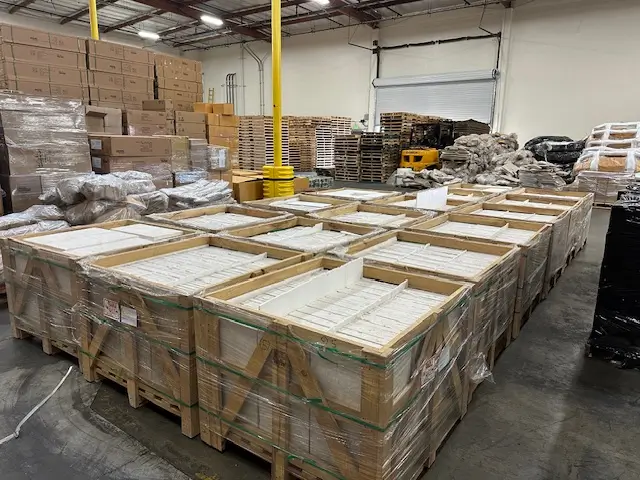
Citadel Stone maintains Arizona warehouse inventory that covers the most common large slab formats, which typically brings lead times to the 1–2 week range for in-stock materials. That’s a meaningful project scheduling advantage compared to the 6–10 week import cycle that custom quarry orders require. Your contractor’s installation window may not accommodate a 10-week wait — so matching your specification to available stock before your contractor commits to a start date is a professional practice that prevents costly project delays.
- Confirm current warehouse stock levels before issuing a purchase order — inventory moves quickly during spring and fall building season
- Order 10–12% overage on large format slabs to account for field cuts, site-specific adjustments, and future repairs
- Verify truck access to your delivery site — large slab orders typically arrive on flatbed trucks that require a clear turning radius and a level unloading area
- Inspect a minimum of 10% of delivered slabs before the truck departs — noting any damage, calibration inconsistency, or color lot mismatch while the driver is present protects your claim process
- Stage large slabs horizontally on a firm surface, not vertically — vertical storage of large format stone on soft ground leads to edge chipping and surface abrasion before installation even begins
Thermal Expansion and Joint Specification for Arizona Climates
Arizona’s temperature differential — ambient conditions that can swing from 45°F at night to 115°F midday in summer — creates thermal expansion demands on large format paving that generic joint specifications simply don’t address adequately. Natural stone expands at rates between 3.5 × 10⁻⁶ and 7 × 10⁻⁶ per degree Fahrenheit depending on the stone type, and across a 70°F differential, a 48-inch slab can move as much as 0.023 inches purely from thermal cycling.
That number sounds small until you’re looking at a 20-foot run of tightly jointed slabs that has nowhere to go when the afternoon surface temperature hits 150°F on a direct-sun installation. This buying big paving slabs Arizona guide addresses this explicitly: your joint specification for large format slabs in Arizona should run a minimum of 3/16 inch for covered or shaded applications and 1/4 inch minimum for direct-sun driveway and patio applications. Going below those thresholds is the primary cause of slab-to-slab contact cracking during the late spring heat ramp before monsoon season breaks the temperatures.
Expansion joints — full-depth breaks in the bedding layer filled with a compressible backer and flexible sealant — should appear every 10–12 feet in direct-sun applications. The standard 15-foot spacing that works in moderate climate zones undershoots the thermal movement Arizona conditions generate. It’s a detail that adds modest cost to the installation and eliminates a repair category that otherwise recurs every 3–4 years.
In Mesa, the combination of reflective heat from the dense urban built environment and the high solar exposure angle during summer months pushes surface temperatures on dark-colored slabs above 160°F — a condition where even properly jointed installations benefit from a light-colored or reflective surface finish to manage thermal mass buildup through the slab assembly.
Sealing and Maintenance Protocols for Large Format Paving
Sealing large format natural stone slabs in Arizona serves a different primary function than it does in humid climates — here, you’re not primarily sealing against moisture penetration, you’re managing UV degradation, dust infiltration into porous surfaces, and the alkaline residue that capillary moisture deposits on unsealed stone surfaces during the dry season. The maintenance schedule that makes sense in the Pacific Northwest doesn’t translate directly to Arizona conditions.
For most natural stone types used in Arizona exterior paving, a penetrating siloxane-based sealer applied every 24–36 months provides adequate protection without building up a surface film that would trap heat and reduce DCOF. Topical sealers — the film-forming type — can actually reduce the slip resistance of already smooth finishes and tend to delaminate under Arizona’s UV intensity within 18–24 months, creating maintenance costs that exceed the protection benefit.
- Apply penetrating sealer to clean, dry stone — moisture content above 5% prevents proper sealer penetration and causes surface whitening
- Test a discrete area with water before reapplication — if water still beads after 18 months, the sealer hasn’t reached end of service life yet
- Clean with pH-neutral products only — acid-based cleaners etch limestone and travertine, alkaline cleaners compromise sealer bonds in polished stone
- Address joint sand loss after each monsoon season — depleted joint sand destabilizes large format slabs by eliminating lateral interlocking support
- Inspect for slab-to-slab contact points annually before summer — address before thermal expansion season begins, not during it
Professional Summary: Getting Your Arizona Slab Specification Right
The buying big paving slabs Arizona guide that serves experienced buyers and specifiers isn’t primarily a product selection exercise — it’s a structural engineering and code compliance exercise that happens to end with a beautiful installation. Every decision point from base depth through slab thickness through surface finish through joint specification is governed by Arizona’s regulatory environment, regional soil conditions, and the thermal and seismic demands that the state’s geology and climate impose on exterior assemblies. Getting those decisions right upfront is the difference between a 25-year installation and a 10-year replacement cycle.
Your specification framework should follow a consistent sequence: confirm code requirements for your municipality first, select slab thickness based on load classification second, choose surface finish based on DCOF requirements third, and finalize material type and sourcing logistics last. That sequence keeps structural integrity as the lead variable and prevents the common mistake of falling in love with a material that doesn’t meet the thickness or friction requirements your project actually demands. The cost difference between a properly specified installation and a retrofit repair is typically 3–5 times the upfront specification investment.
For buyers comparing costs alongside specification decisions, How to Choose Big Paving Slabs in Arizona: Buyer’s Guide covers the pricing framework that complements the structural and regulatory guidance in this article — worth reviewing as you build your full project budget. Shoppers in Tucson, Scottsdale, and Tempe will find that Citadel Stone’s slab inventory covers honed, bush-hammered, and natural cleft finishes, each graded for exterior use under Arizona heat.