
What “Bulk Limestone Orders” Look Like (Types & Scales)
Bulk limestone procurement encompasses several order categories, each with distinct logistics and pricing structures.
Remnant consolidation orders aggregate 15–30+ smaller pieces from supplier remnant racks, creating cost-effective material packages for architectural details, fireplace surrounds, or accent applications across multiple units. Total square footage often reaches 200–500 SF when combining pieces, yielding 30–50% savings versus full-slab purchases.
Full-slab production runs involve 10–50+ slabs from the same quarry batch, ensuring color and veining consistency across large installations. Commercial lobbies, multi-building facades, and resort properties require this batch matching to produce seamless appearances.
Architectural veneer systems for exterior cladding or interior feature walls demand precision-cut panels, often 50–200+ pieces in standardized dimensions. Suppliers pre-cut, number, and package panels in installation sequence to simplify jobsite coordination.
Multi-site pallet orders distribute identical limestone products—tiles, pavers, coping—across 5–20+ residential lots in production-builder subdivisions. Deliveries occur in phases as sites reach readiness, requiring supplier staging and inventory management over 3–6 month timelines.
Municipal and commercial infrastructure projects include streetscape elements, public plaza installations, and government building renovations. These orders involve 500–2,000+ SF, formal bidding processes, performance bonds, and strict delivery scheduling tied to contractor milestones.
Volume fundamentally changes procurement: individual slab selection gives way to run-number sourcing, delivery becomes multi-trip logistics, and pricing shifts from retail to negotiated contractor rates. Understanding these differences prevents applying residential-scale assumptions to commercial-scale orders.
Key Cost Drivers for Bulk Orders — What Affects Pricing
Bulk limestone pricing incorporates more variables than small orders, making itemized quotes essential for accurate budgeting.
Material Cost Components
Slab or unit base price: Raw limestone pricing per square foot or per slab, varying by grade, finish, thickness, and origin. Bulk orders often unlock 10–25% volume discounts when committing to 15+ slabs or 300+ SF from the same quarry run.
Usable yield and waste allowance: Large projects with repetitive layouts reduce waste to 8–12%, while complex designs with irregular cuts require 15–25% allowances. Suppliers calculate total material needed as required SF × (1 + waste %), directly impacting final costs.
Cutting and fabrication hours: CNC programming, machine setup, cutting time, and quality inspection scale with volume. Simple cuts cost less per piece in bulk (economies of scale), but complex profiles require proportional shop time regardless of quantity.
CNC throughput and scheduling: High-volume orders may require dedicated CNC shifts or weekend production to meet deadlines. Rush throughput adds 15–30% premiums; standard timelines (14–21 days) avoid surcharges.
Edge work and finish passes: Polishing, honing, or beveling edges after cutting. Multiple finish passes achieve premium quality but add 8–15% to fabrication costs. Confirm pass counts in quotes—”standard edge finish” means different things to different suppliers.
Sealing and protective finishing: Factory-applied sealers protect limestone during transport, storage, and installation. Bulk sealing typically costs 5–10% of material value but prevents damage worth 20–30% in replacement costs. Arizona’s outdoor applications demand sealing for UV and mineral-water resistance.
Packing, crating, and palletization: Bulk orders require sturdy packaging to prevent transit damage across multiple delivery legs. Covered crates, corner protection, and secure banding add 3–8% to material costs but reduce damage claims significantly.
Delivery distance and freight: Local deliveries within 30 miles add 5–10% to material costs; hauls to Tucson from Phoenix yards or vice versa increase this to 12–20%. When evaluating wholesale limestone bulk Phoenix suppliers for projects in outlying areas, freight becomes a major cost variable.
Crane and hoist mobilization: Multi-site or multi-story bulk deliveries requiring specialized rigging equipment incur flat fees per deployment. Consolidating lifts reduces per-unit costs—three placements in one day costs less than three separate-day mobilizations.
Storage and extended hold fees: Bulk orders often span weeks or months between fabrication and final delivery. Suppliers charge storage after standard hold periods (14–21 days), typically adding daily or weekly fees that accumulate quickly.
Permit and delivery-window coordination: Commercial projects in regulated areas (downtown cores, gated communities, municipal sites) require permits and scheduled access. Coordination fees and permit costs add to delivered pricing when buyers don’t handle independently.
Always request itemized quotes separating these components. Bundled “all-in” bulk pricing obscures where costs concentrate and prevents meaningful comparison across competing suppliers.
How Suppliers Scale for Large Projects — Yard & Shop Capabilities
Not all limestone suppliers can handle bulk orders effectively. Verify operational capabilities before committing to large projects.
Inventory depth and run numbers: Bulk projects require consistent material from the same quarry run to ensure color matching. Ask: “Can you source 25 slabs from the same batch, and what’s the lead time if current inventory doesn’t cover my needs?” Suppliers maintaining deep inventory or direct quarry relationships fulfill bulk orders faster; those relying on spot purchases introduce delays.
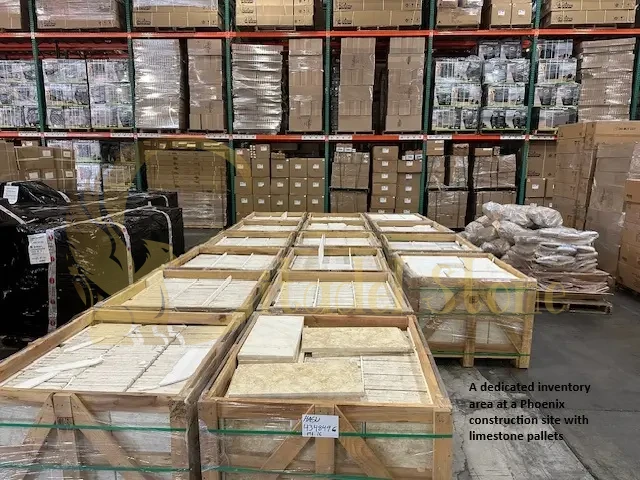
Dedicated staging areas: Large orders need secure, weather-protected staging separate from general inventory. Confirm: “Do you maintain covered staging for bulk projects, or will my material sit outdoors exposed to Arizona heat and dust?” Professional operations allocate dedicated space preventing mix-ups and environmental damage.
Forklift and crane capacity: Moving 20–50 slabs requires heavy equipment. Verify the yard operates forklifts rated for limestone weight (3,000–5,000 lbs per slab) and can load multiple trucks efficiently. Inadequate equipment causes handling damage and delays.
In-house versus subcontracted cutting: Suppliers with in-house CNC shops control quality and timelines; those outsourcing fabrication introduce coordination gaps and extended lead times. Ask: “Is cutting done in your facility or subcontracted, and how does that affect my delivery schedule?”
Water recycling and production capacity: High-volume cutting generates significant wastewater. Professional shops maintain water recycling systems and dust suppression, signaling operational sophistication and environmental compliance. Shops lacking these systems may face production constraints during bulk orders.
Quality control and batch sampling: For large orders, confirm: “Do you inspect incoming material for consistency, and will you pull samples from my batch for approval before cutting?” Systematic QC prevents delivering 500 SF that doesn’t match the 50 SF sample you approved.
Project manager assignment: Bulk orders benefit from dedicated contacts coordinating procurement, fabrication, and delivery. Ask: “Will I have a single point-of-contact managing my project from quote through final delivery?” Fragmented communication across multiple staff members creates errors and delays.
Suppliers unable to demonstrate these capabilities should be disqualified from bulk-order consideration regardless of attractive pricing.
Ordering Process for Large Projects — Step-by-Step Workflow
Bulk limestone procurement follows structured workflows preventing miscommunication and ensuring quality control.
Numbered Procurement Steps
1. Initial RFP and specification submission (Days 1–3): Issue detailed requests for proposal to 2–4 suppliers, specifying total SF, finish requirements, delivery phasing, and timeline. Include project drawings, slab preferences, and site logistics constraints. Suppliers respond with preliminary quotes and capability statements.
2. Slab or lot inspection and staged photo approval (Days 4–7): Visit yards to inspect proposed inventory or request high-resolution photos of slabs from the same run. Approve specific slab IDs or batch numbers in writing, documenting undertones, veining, and finish quality before fabrication begins.
3. Provisional hold with deposit (Days 8–10): Place deposits securing approved slabs, typically 15–30% for bulk orders versus 10–25% for small orders. Confirm hold duration in writing—bulk projects often require 30–60 day holds versus standard 14–21 days. Clarify whether deposits are refundable if supplier cannot fulfill specifications.
4. Production scheduling and cutting plan (Days 11–14): Finalize fabrication details—dimensions, edge profiles, numbering systems for sequenced installation. Suppliers create cutting plans showing yield calculations and waste projections. Review and approve before CNC programming begins.
5. Packing, crating, and transport booking (Days 15–20): Confirm protective packaging specifications, crate dimensions for site access, and delivery vehicle types. Book crane or hoist services for multi-story or restricted-access sites. Obtain written confirmation of delivery dates, windows, and driver contacts.
6. Delivery, hoist, and on-site acceptance (Days 21–30+): Receive material in scheduled phases. Inspect every crate upon arrival, photograph slab condition, verify IDs match documentation, and sign acceptance only after confirming quality. Reject damaged or mismatched pieces immediately with photographic evidence.
7. Post-delivery documentation and partial releases (Ongoing): For multi-phase projects, process partial payments tied to delivery milestones. Maintain photographic records throughout installation to document proper handling and identify any issues requiring supplier involvement.
Timing windows: Simple bulk orders (minimal cutting, single delivery) compress to 14–21 days. Complex orders (custom fabrication, multi-site phased deliveries) extend to 45–90 days. Arizona’s spring and fall peak seasons add 7–14 days due to shop backlogs; summer slowdowns enable faster turnarounds.
Storage, Staging and On-Site Logistics in Arizona Climate
Arizona’s extreme climate demands protective staging throughout procurement, transport, and installation phases.
Protected staging for heat and monsoon exposure: Summer temperatures exceeding 115°F damage adhesive packaging and can stress limestone thermal stability. Monsoon rains (July–September) stain unprotected slabs within hours. Require covered storage at supplier yards, covered transport, and immediate on-site protection. Include in purchase orders: “Material must remain in covered, climate-controlled staging until delivery and arrive in protective crates suitable for Arizona weather conditions.”
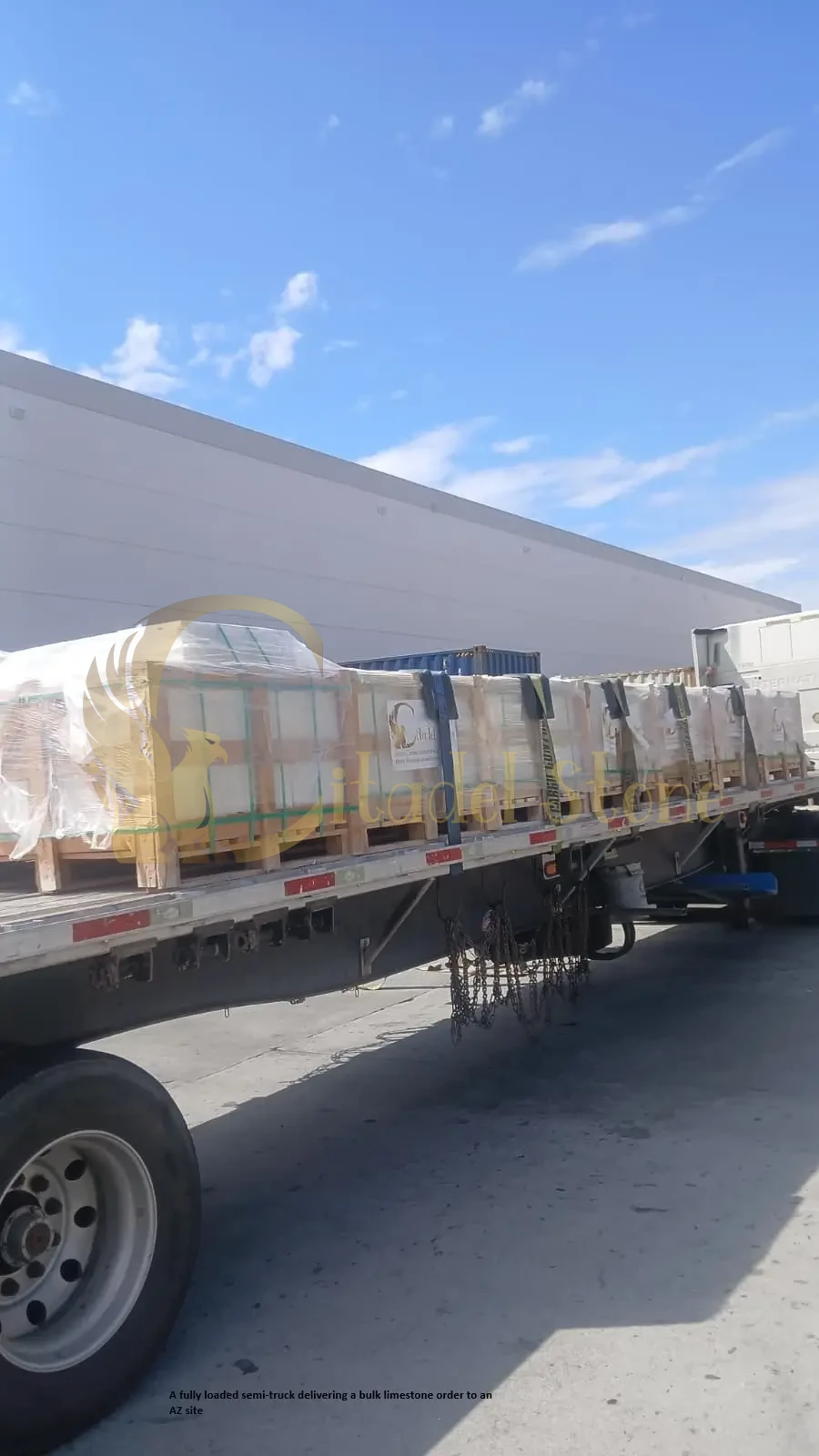
Recommended covered crating specifications: Heavy-duty wooden crates with weather-resistant tarps, corner padding preventing edge chips, and secure banding maintaining slab stability during transport. For commercial limestone delivery Arizona projects involving multiple stops, reinforced crating prevents cumulative damage across delivery legs.
Early-morning delivery windows in Phoenix metro: Schedule deliveries between 6 and 9 AM during summer months when temperatures remain below 95°F. Afternoon deliveries in 110°F+ heat complicate material handling, stress adhesives, and create safety risks for crews. Phoenix suppliers familiar with commercial projects expect and accommodate early-window requests.
Temporary shaded on-site storage: If installation timelines extend beyond delivery day, prepare temporary covered staging areas preventing direct sun exposure. Tarped pallets raised on blocks, portable canopies, or designated indoor space protect material until installation. Unprotected outdoor storage for more than 4–6 hours during summer risks heat damage.
UV and dust concerns for extended projects: Arizona’s intense UV degrades unprotected limestone surfaces over weeks or months. Airborne dust infiltrates packaging and embeds in porous stone. For projects spanning multiple months, schedule phased deliveries rather than accepting full volume upfront requiring extended on-site storage.
Secure yard storage when sites aren’t ready: Delays happen—permits, weather, prior-trade completion. Confirm suppliers maintain secure staging for your material beyond standard hold periods and understand associated storage fees. Negotiate caps: “Storage fees not to exceed $X per week for holds extending beyond 30 days due to circumstances outside buyer’s control.”
Climate-appropriate logistics prevent damage worth 15–30% of material value—budget 3–5% for protective measures rather than risking replacement costs.
Contractor Pricing Models & Negotiation Levers
Bulk orders unlock pricing structures unavailable to retail buyers, but negotiation requires understanding how suppliers calculate contractor rates.
Unit price models: Suppliers quote per-slab or per-SF pricing with volume discounts kicking in at specified thresholds—15+ slabs, 300+ SF, or total project values exceeding certain amounts. Negotiate tier breakpoints: “Can you extend the 20-slab discount rate to my 18-slab order given future project commitments?”
Per-square-foot with waste allowance: Suppliers quote installed SF pricing including waste calculations. Confirm waste percentages match your project complexity—challenge inflated allowances: “Your quote uses 22% waste for a straightforward layout. Industry standard for this design is 12–15%. Please revise.”
Lump-sum project pricing: Fixed prices for complete scope—material, fabrication, delivery, installation support. Lump sums simplify budgeting but obscure cost components. Request itemized breakdowns anyway to verify reasonableness: “Provide lump sum and itemized versions so I can validate the total against component costs.”
Negotiation levers for bulk buyers: Longer lead times reduce rush premiums—accepting 21-day fabrication versus 10-day rush yields 12–18% savings. Consolidated deliveries (three sites in one day) reduce per-site delivery fees by 25–40% versus separate trips. Committed volume discounts for multi-project annual commitments unlock 15–25% savings over one-off pricing. Multi-phase billing tied to delivery milestones reduces upfront cash requirements and provides holdback leverage for quality issues. Remnant substitution—accepting supplier-selected remnants for non-critical elements—saves 30–50% on those portions.
Trade account terms and contractor limestone bulk pricing: Established contractors request trade accounts providing baseline discounts (10–20% below retail), priority scheduling, extended credit terms (net-30 or net-60), and dedicated account managers. Applications require contractor licenses, business references, and credit checks—apply proactively rather than project-by-project.
Frame negotiations as partnerships: “I manage 8–12 projects annually in this size range. If we establish favorable terms now, you’ll be my first call for future work.” Volume commitments over time yield better pricing than one-time hard bargaining.
Risk Management for Large Orders: Quality, Damage, and Returns
Bulk orders amplify financial exposure, making systematic risk management essential.
Acceptance criteria in purchase orders: Define acceptable quality parameters in writing before fabrication begins: “Material must exhibit consistent color within [specify tolerance], finish quality of [honed to 800-grit / polished to 3000-grit], edge straightness within [specify mm], and back-side resin fills not exceeding 5% of surface area.” Measurable standards enable objective acceptance/rejection decisions.
Photographic delivery records: Require time-stamped photos at loading, during transport for multi-stop deliveries, and upon each jobsite arrival. Include in purchase terms: “Supplier will photograph each crate at loading showing slab IDs and condition. Buyer will photograph upon delivery before acceptance. Photos constitute evidence for damage claims.” This protects both parties.
Reservation of rights clauses: For phased deliveries, protect against early acceptance limiting later claims: “Acceptance of partial deliveries does not constitute acceptance of entire order or waiver of claims for future deliveries.” This prevents suppliers arguing that accepting Phase 1 waives defect claims for Phase 2.
Damage claim procedures: Establish upfront: “Buyer will document damage photographically within 2 hours of delivery. Supplier will respond within 24 hours acknowledging claim and proposing remedy—repair, replacement, or credit. Resolution timeline not to exceed 72 hours for material replacement.” Clear procedures accelerate resolution.
Holdback strategies: Retain 10–15% of final payment until installation completion and verification that all material meets specifications. Structure agreements: “Final 10% payment due upon buyer confirmation that installed material performs as specified, with final payment not unreasonably withheld beyond 14 days of installation completion.”
Refusal and return policies for mismatched batches: Bulk orders risk receiving mixed batches with visible color variation. Include terms: “Buyer reserves right to refuse delivery of material not matching approved batch samples. Supplier will replace refused material at no additional cost within [specify days].” Photograph approved samples and delivered material side-by-side if color concerns arise.
Copy-ready purchase order language: “Delivered slabs must match slab IDs [list specific IDs] approved [date]. Supplier will provide photographic documentation at loading and delivery showing slab ID tags and condition. Buyer may refuse material not matching approved IDs or showing damage. Refused material replacement at supplier cost within 10 business days.”
Bulk Project Logistics — Phoenix through Tempe
Phoenix
Phoenix’s size and commercial construction volume create competitive bulk limestone markets, but heat and logistics require careful planning. Insist on morning delivery windows between 6 and 9 AM for summer projects—afternoon deliveries in 110°F+ heat complicate offloading, stress material, and create crew safety hazards. Require covered truck staging or immediate transfer to climate-controlled job-site areas; limestone sitting in direct sun for more than 30–45 minutes risks thermal stress and packaging adhesive failure. For multi-site Phoenix projects, negotiate consolidated delivery routes where one truck services 2–4 sites in sequence, reducing per-site delivery fees by 30–45%. Confirm suppliers maintain multiple yard locations across Phoenix metro (north, south, east, west quadrants)—distributed inventory reduces delivery times and freight costs compared to single-location operations. Phoenix’s spring construction surge (March–May) strains supplier capacity; place bulk orders 4–6 weeks ahead during peak season versus 2–3 weeks during summer slowdowns. Verify that quoted wholesale limestone bulk Phoenix pricing includes heat-appropriate packaging and early-delivery windows rather than treating them as optional upcharges.
Tucson
Tucson’s desert environment and fine particulate dust require extra material protection throughout bulk order fulfillment. Verify dust-protected staging at supplier yards—tour facilities and confirm slabs are stored indoors or under full enclosures preventing contamination. Request inspection of slab backs before final acceptance; Tucson’s airborne dust embeds in porous limestone surfaces and back-side contamination indicates inadequate storage practices. For bulk orders, require suppliers to photograph slab backs during loading so you can compare against delivery condition—dust infiltration during transport signals improper crating. Tucson’s commercial market serves hospitality and municipal projects; confirm suppliers maintain relationships with commercial-scale riggers capable of multi-story crane placements and traffic-control coordination downtown. Tucson-to-Phoenix freight or vice versa adds 12–20% to delivered costs; for large projects, compare Tucson suppliers with Phoenix yards factoring total delivered pricing including freight. Monsoon season (July–September) creates staging challenges; negotiate firm delivery dates and covered storage commitments in writing: “Material will remain in covered staging until delivery date, with no outdoor exposure during monsoon season.”
Mesa
Mesa’s active residential construction market generates consistent bulk demand during spring and fall seasons, making early reservation critical. During peak remodel months (March–May, September–November), reserve bulk lots 4–6 weeks ahead and request extended hold windows—30 to 45 days versus standard 14–21 days—to accommodate phased installation timelines. Ask about remnant-rack consolidation for bulk orders; Mesa yards serving volume contractors often aggregate remnants into discount packages yielding 35–50% savings on architectural details or accent elements across multiple units. Confirm supplier capacity for multi-phase deliveries; production-builder projects in Mesa’s master-planned communities require releasing material as lots reach readiness over 3–6 month periods. Verify the yard will honor locked pricing across all phases rather than repricing for later deliveries. Mesa’s proximity to Phoenix fabricators means some suppliers outsource cutting; confirm turnaround times and whether outsourcing introduces coordination delays affecting your project schedule.
Chandler
Chandler’s master-planned subdivisions impose delivery constraints that affect bulk order logistics significantly. For gated community projects, confirm HOA delivery windows and crane permit timing in writing before placing deposits—many Chandler neighborhoods restrict commercial vehicles to weekday mornings (7–10 AM only) or require 48–72 hour advance notification. Obtain written confirmation: “Supplier will coordinate HOA access for deliveries on [dates], securing necessary permits and confirming gate codes prior to dispatch.” Multi-site production-builder projects in Chandler demand phased deliveries synchronized with construction progress; verify suppliers maintain staging capacity for holding material between phases without daily storage fees. For outdoor limestone near Chandler’s ubiquitous pool installations and irrigation systems, require factory sealing as part of bulk orders—unsealed material stains permanently within days of exposure to high-mineral water. Chandler’s tight delivery windows make backup planning essential; include in agreements: “If initial delivery attempt fails due to HOA/access issues outside buyer’s control, supplier will reattempt within 48 hours at no additional charge.”
Scottsdale
Scottsdale’s luxury residential and high-end commercial markets demand elevated quality standards affecting bulk order specifications and pricing. For high-visibility architectural limestone installations, request seam mock-ups and written finish tolerances before authorizing full production: “Supplier will create 24×36 seam mock-up showing adjacent slab joins for buyer approval before cutting production run. Finish quality will meet or exceed 3000-grit polish with written tolerance of ±200-grit.” Mock-ups add 3–5% to project costs but prevent 20–30% rework charges when production doesn’t meet expectations. Scottsdale’s design-focused market means suppliers maintain premium inventory and white-glove services; clarify what’s included versus optional in bulk quotes—templating coordination, designer consultations, installation liaison. Negotiate bundled services: “Include project-manager assignment and installation coordination in bulk pricing rather than separate fees totaling 12–15%.” Scottsdale’s gated estates require advance security coordination; confirm suppliers maintain relationships with specific community management companies to expedite access rather than learning protocols on your project’s timeline.
Glendale
Glendale’s diverse housing types—from older narrow-lot homes to newer subdivisions—require flexible bulk delivery planning for retrofit and production-builder projects. Pre-plan split-slab cutting for older neighborhoods where full slabs won’t navigate tight access; confirm suppliers will cut slabs into manageable sections with pre-numbered reassembly sequences before delivery. Verify crane reach and truck maneuvering capabilities for specific sites before dispatch—provide aerial satellite images and street-level photos showing access paths, overhead clearances, and turn radii. Glendale yards serving commercial contractors often maintain small-truck or trailer options for tight-access deliveries; confirm availability and any size-based delivery premiums. For bulk orders spanning multiple Glendale neighborhoods with varying access profiles, negotiate delivery pricing by site type (open access, standard gated, tight retrofit) rather than flat per-site fees. Glendale’s western location near Luke Air Force Base means some areas experience temporary flight-pattern restrictions; confirm delivery timing avoids military operation windows requiring street closures or noise limitations.
Gilbert
Gilbert’s rapid growth and outdoor limestone demand for production-builder communities create bulk-order opportunities focused on pool coping, patio pavers, and exterior cladding. For irrigation-adjacent installations across multiple lots, require sealing schedule built into bulk delivery plans—specify: “Supplier will apply factory sealer appropriate for Gilbert’s high-mineral water content on all pieces before delivery, with technical data sheets showing calcium resistance and re-seal intervals.” Unsealed bulk material across 15–30 lots creates massive re-sealing labor costs better prevented upfront. Confirm covered delivery for bulk orders traveling Gilbert’s dusty construction corridors (Val Vista, Gilbert Road, Baseline); unprotected transport contaminates material requiring cleaning that delays installation. Gilbert’s production-builder market means some suppliers cater to volume contractors; verify they provide per-lot breakdown pricing and phased delivery coordination rather than forcing single-shipment bulk drops overwhelming job-site storage. For Gilbert’s master-planned communities, obtain HOA delivery windows and staging protocols in writing—coordinate with general contractors to ensure material arrives when sites are ready for installation rather than requiring extended on-site storage.
Tempe
Tempe’s fast-paced urban environment and Arizona State University area construction demand bulk suppliers capable of quick-turn coordination and explicit lead-time guarantees. Prioritize yards offering short-run fabrication slots and written production timelines: “Supplier confirms 14-day turnaround from approved cutting plan to first delivery, with firm dates [specify] for Phases 1, 2, and 3.” For student-housing or rental-turnover projects, bulk orders benefit from staged releases aligned with unit completion—confirm suppliers will hold material for phased deliveries at locked pricing without repricing risk between phases. Tempe’s compact urban core means delivery timing significantly affects costs; verify suppliers understand ASU campus-area restrictions requiring off-peak delivery (5–7 AM or post-5 PM) and parking permits. For multi-family projects common in Tempe’s mixed-use developments, negotiate volume discounts tied to per-unit pricing: “15 units at $X per unit for consistent material across full building.” Tempe’s commercial market serves quick-turnover retail and hospitality; confirm suppliers maintain emergency capacity for accelerated schedules and clarify rush premiums before committing to aggressive timelines.
Copy-Ready RFP & Email Template for Bulk Limestone Orders
Use this template to solicit consistent, comparable bulk quotes:
Subject: Bulk Limestone RFP – [Project Name / Location]
Hello [Supplier Contact],
I’m requesting a detailed quote for bulk limestone for [describe project—commercial plaza, multi-unit residential, municipal streetscape, etc.] in [City, Arizona].
Project specifications:
- Total square footage or slab quantity: [___]
- Limestone variety, color, finish: [___]
- Cutting/fabrication requirements: [___]
- Delivery location(s): [list addresses]
- Phased delivery schedule if applicable: [dates]
- Project timeline: [start date – completion date]
Please provide the following in your written quote:
- Slab IDs or run numbers with batch consistency confirmation
- High-resolution photos of proposed inventory (both faces, backs, ID tags visible)
- Itemized cost breakdown: material per SF, fabrication hours/rate, sealing, packing/crating, delivery per location, crane/hoist, storage/hold fees, permits
- Recommended waste allowance percentage for this project type
- Production schedule showing fabrication start, completion, and delivery dates for each phase
- Hold deposit amount, duration, and terms
- Payment schedule options (deposit, milestone payments, final payment)
- Insurance certificates (general liability, cargo coverage)
- Damage claim and replacement process
- References for similar large limestone orders supplier projects completed in past 12 months
Additional requirements:
- All material from same quarry batch/run
- Covered staging and transport appropriate for Arizona climate
- Photographic documentation at loading and delivery
- Dedicated project manager contact
Please reply with complete itemized pricing by [date]. I’m evaluating multiple suppliers and will decide within [timeframe].
Thank you,
[Your Name]
[Company]
[Contact Information]
Bulk Order Checklist for Contractors (Copy-Ready)
Print and follow this checklist for every bulk limestone project:
- Slab IDs or run numbers confirmed in writing: Email or signed agreement showing exact batch identification matching approved samples.
- Physical samples approved and photographed: 12×12 or larger pieces inspected and documented showing color, finish, and quality standards.
- Hold deposit processed with written terms: Deposit amount, hold duration, expiration date, refund policy, and whether deposit applies to final invoice.
- Production schedule confirmed in writing: Fabrication start date, completion date, and delivery windows for all phases with firm dates not estimates.
- Packing and crate specifications documented: Covered crates, corner protection, weather-resistant materials suitable for Arizona climate.
- Insurance and claims contact verified: Current liability and cargo certificates received; damage claim procedure and contact person documented.
- Delivery slots and windows confirmed: Specific dates and 2-hour windows for each delivery; driver contact numbers; site-access instructions provided.
- Hoist, crane, and rigging coordination locked: Operator names, contact numbers, equipment specifications, and mobilization timing confirmed in writing.
- Acceptance photo protocol agreed: Buyer will photograph all material within 2 hours of delivery; supplier provides loading photos; both constitute evidence for claims.
- Payment milestones and holdback defined: Deposit, progress payments tied to delivery phases, and final payment retention (10–15%) until installation completion verified.
- Site staging and protection prepared: Covered areas, pallets, or indoor space ready to receive material; temporary protection for extended storage.
- Contingency plan for delivery failures: Backup delivery dates, alternate site-access routes, and supplier commitments for re-attempts at no additional charge.
Check Immediate Arizona Stone Availability and Order Now!
Payment Terms, Deposits & Staged Releases
Bulk orders require structured payment schedules aligning cash flow with project milestones and protecting against supplier non-performance.
Recommended deposit amounts: 15–25% for bulk orders secures material and initiates fabrication. Lower deposits (10–15%) apply when you have established trade accounts or provide performance bonds. Higher deposits (25–35%) may be required for custom specifications or imported specialty limestone. Negotiate deposits as percentage of material cost only, not total project including delivery/rigging.
Staged payment tied to milestones: Structure payments around tangible progress points: 20% deposit upon order confirmation, 30% at fabrication start (verified by production photos), 30% upon first delivery, 10% upon mid-project delivery, 10% final payment upon completion and acceptance. This schedule aligns payments with value received and maintains leverage throughout the project.
Retention for quality assurance: Withhold 10–15% of total value until final installation and verification that all material meets specifications. Define retention release conditions: “Final payment due 14 days after installation completion and buyer confirmation that material performs as specified, with payment not unreasonably withheld.” Retention protects against latent defects discovered during installation.
Multi-phase billing for extended projects: Production-builder developments or multi-site commercial projects spanning 3–6 months benefit from phase-specific invoicing. Pay for each delivery phase separately rather than upfront for entire volume: “Phase 1 (Lots 1–10): $X due upon delivery. Phase 2 (Lots 11–20): $X due upon Phase 2 delivery.” This reduces working capital requirements and limits exposure if quality issues arise early.
Damage and rejection impact on payment: Include terms: “Buyer may withhold payment for damaged or non-conforming material until supplier provides acceptable replacement. Withheld amounts will be released upon delivery and acceptance of conforming replacement material.”
Early-payment discounts: Some suppliers offer 2–5% discounts for payment within 10 days versus standard net-30 terms. Evaluate whether cash-flow allows capturing these savings.
What “Bulk Limestone Orders” Look Like (Types & Scales)
Bulk limestone orders cover a spectrum of needs — from many small pieces bundled for repetitive details to thousands of square feet for civic or hospitality projects. Below are the common order types, typical scales, and the procurement realities you would expect when planning large-volume work in Arizona.
1. Remnant consolidation packs — economical small-piece bundles
Scope: dozens of cutoffs and smaller panels grouped into a single purchase for trim work, vanity tops, fireplace facings, or accent panels.
Typical scale: 150–600 ft² aggregated from many pieces.
Why it matters: remnant consolidation can deliver 25–50% unit cost savings but requires a supplier willing to sort, size, and stage mixed pieces for coordinated release. In markets around Peoria and San Tan Valley, remnant runs can be a fast route to cost-effective trim material when you accept some visual variation.
2. Matched full-slab runs — colour/vein continuity at scale
Scope: multiple whole slabs pulled from the same quarry run to maintain consistent color and pattern across visible surfaces (lobbies, façades, continuous floor fields).
Typical scale: 10–100+ slabs (often 300–2,000+ ft² depending on slab size).
Why it matters: specifying run-number continuity reduces visible seam contrast and simplifies mock-ups; it requires suppliers with inventory depth or direct quarry relationships. For projects staged from yards serving Surprise or regional distribution hubs, confirming run availability early is critical.
3. Pre-cut architectural panels — sequenced cladding packages
Scope: precision-cut panels supplied in numbered crates, often delivered in installation sequence for façade systems or feature walls.
Typical scale: 50–500+ panels; packages sized to match shop drawings.
Why it matters: factory pre-cutting reduces on-site cutting and speeds installation, but it shifts risk into the fabrication phase — ensure the supplier provides clear marking, sequencing, and a mock-up prior to full production.
4. Multi-site pallet programs — production-builder logistics
Scope: identical tiles, pavers, coping, or trim shipped in staged pallet drops across multiple lots in a subdivision or across several project sites.
Typical scale: per-site quantities can be small (20–100 ft²) but total program volume commonly hits 500–5,000+ ft² across many deliveries.
Why it matters: multi-site orders demand supplier staging capacity and flexible release terms; in more remote delivery corridors like Yuma, factor additional freight or early-morning delivery windows to protect material from heat.
5. Municipal & commercial procurement — large public or hardscape works
Scope: plazas, streetscape paving, government or hotel fit-outs needing large, contract-driven purchases with performance bonding, tight scheduling and formal acceptance procedures.
Typical scale: 500–5,000+ ft².
Why it matters: these orders typically use formal RFPs, run-number sourcing, and stricter QA protocols (sampling, pre-shipment photos, documented hold procedures). Lead times and staged delivery coordination are non-negotiable to align with civil works and site logistics.
How scale changes logistics and contract needs
Selection vs. sourcing: small orders let you pick individual slabs; bulk orders shift to batch selection and run-number approvals.
Packaging & protection: large shipments require reinforced crating, numbered palletization and weather-rated protection — essential in Arizona’s sun and monsoon seasons.
Staging & storage: suppliers should offer dedicated covered staging for multi-week holds to avoid heat- or dust-related damage.
Scheduling: expect phased production windows and staged delivery plans rather than single-shot drop-offs; build contingency for seasonal peaks.
Practical note for Arizona projects — plan site access, early-morning delivery windows, and covered staging into your contract language. Whether you’re consolidating remnants for detail work in Peoria, coordinating run-number slabs for a Surprise façade, staging multi-site drops across San Tan Valley developments, or protecting palletised loads destined for Yuma’s heat, bulk orders require clear, itemized agreements and a supplier with volume experience.
See the Pricing Difference: Wholesale Limestone vs. Big Box Stores in Arizona!
Conclusion & Immediate Procurement Actions
Executing successful bulk limestone orders Arizona projects requires verifying supplier capabilities, structuring clear contracts, and coordinating complex logistics across procurement, fabrication, and multi-phase delivery. Bulk pricing yields 15–35% savings over retail when managed systematically, but poor planning introduces delays, damage, and disputes that erase cost advantages.
Three immediate next steps:
- Issue the copy-ready RFP to 2–3 local suppliers. Use the provided template ensuring consistent, comparable responses covering material, fabrication, delivery, and project management.
- Require itemized quotes and specific slab IDs or run numbers. Refuse bundled pricing lacking transparency—demand line-item breakdowns showing where costs concentrate and enabling meaningful comparison.
- Confirm delivery windows, hoist coordination, and staging protocols in writing before deposits. Lock critical logistics elements—dates, times, equipment, weather protection—via email or contract addenda preventing “we never agreed to that” disputes mid-project.
Apply the city-specific tactics and copy-ready checklists to streamline bulk limestone procurement for your Arizona project. As one of the top limestone suppliers near you in Arizona, Citadel Stone provides warranty-backed materials and care guidance.