
Surface temperature differentials tell the real story with blue limestone pool decks Scottsdale specifiers keep discovering — this material runs 18–24°F cooler than concrete under identical midday sun exposure, not because of reflectivity alone, but because of its dense crystalline structure and relatively low thermal emissivity. That performance gap becomes your primary selling point in a market where barefoot comfort from June through September is non-negotiable. What most pool deck specifications miss, though, is that the thermal advantage only holds when you select material at the right thickness and finish — and those two variables interact in ways that aren’t obvious from a product sheet.
Why Blue Limestone Works for Scottsdale Pool Decks
The mineralogy behind blue limestone is worth understanding before you write a single specification line. This material’s blue-grey coloration comes from fine clay mineral inclusions and iron compounds that were deposited under low-oxygen marine conditions — the same geology that produces its tight, low-porosity matrix. You’re looking at absorption rates typically between 0.3% and 0.8%, which means pooled water doesn’t penetrate deeply and chlorinated splash-back doesn’t compromise the stone’s internal structure over time.
For Scottsdale aquatic areas specifically, that low absorption rate matters beyond just stain resistance. Arizona’s 300-plus days of UV exposure per year creates thermal cycling that aggressively attacks porous materials — water infiltrates, heats, and expands, progressively weakening bond planes. Blue limestone’s tight matrix resists this mechanism far better than tumbled travertine or most sandstone alternatives. Your installation will still see thermal expansion, but the expansion is uniform and predictable rather than stress-concentrated at weak absorption points.
- Absorption rate of 0.3–0.8% outperforms travertine at 3–12% in wet pool environments
- Compressive strength typically ranges from 8,000 to 14,000 PSI depending on quarry origin and bed orientation
- Flexural strength averages 1,200–1,800 PSI — adequate for standard residential and light commercial pool deck loading
- Thermal expansion coefficient of approximately 4.5 × 10⁻⁶ per °F requires joint spacing calculations for Arizona’s 80°F+ seasonal temperature swing
- ASTM C1028 wet dynamic coefficient of friction typically measures 0.60–0.75 on honed or brushed finishes — above the 0.60 threshold recommended for pool surrounds
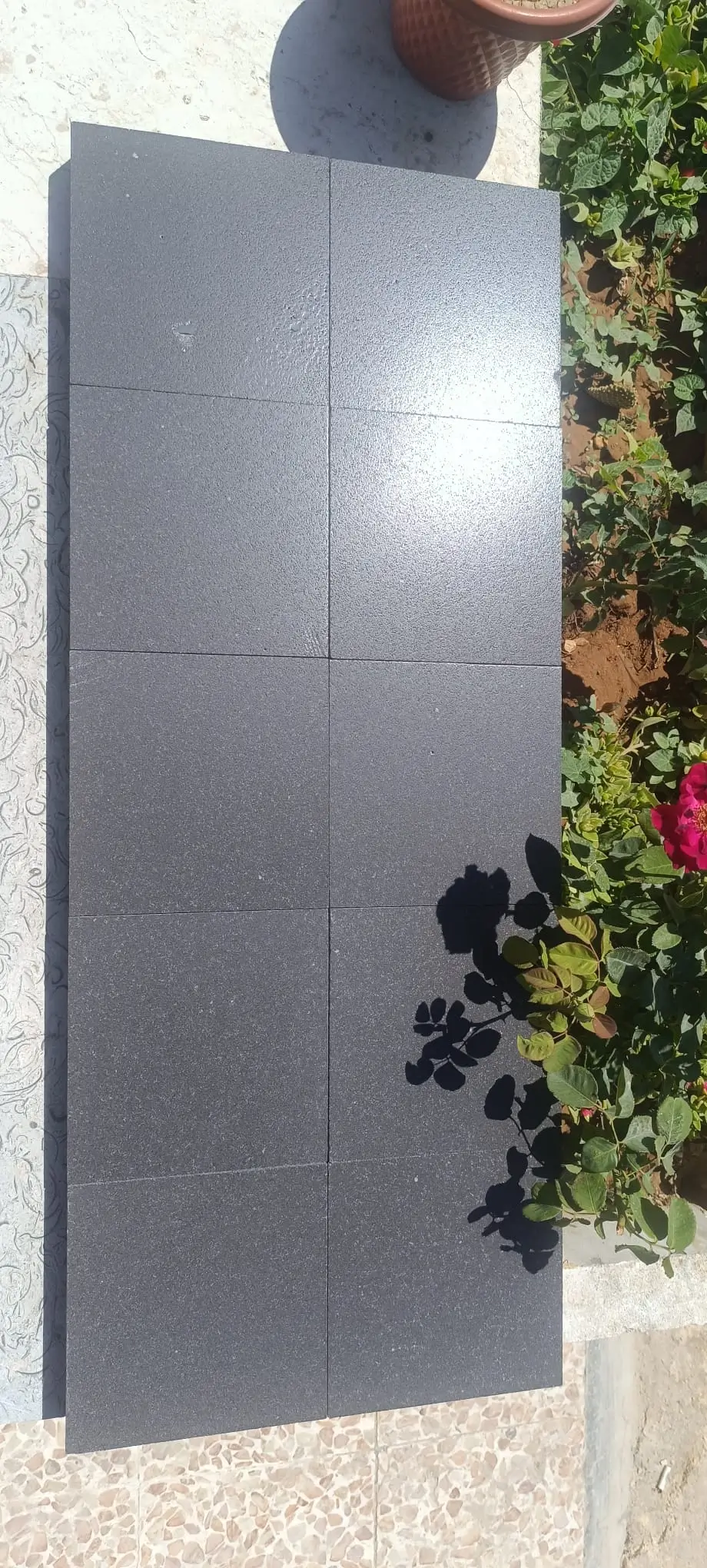
Finish Selection for Scottsdale Pool Elegance
The finish you specify does more work on a pool deck than anywhere else in the hardscape. You need slip resistance when wet, thermal comfort when dry, and visual refinement that reads as intentional luxury rather than functional compromise. Blue limestone gives you four viable finish options for Scottsdale aquatic paving, and each involves a genuine trade-off worth understanding.
A honed finish — typically achieved with 400-grit diamond tooling — delivers that sophisticated matte grey-blue surface that photographs beautifully and reads as upscale from the moment guests step onto the deck. The surface opens up just enough micro-texture to provide wet grip without becoming coarse underfoot. This is the finish most Scottsdale pool projects gravitate toward, and it’s a defensible choice when you pair it with a penetrating sealer that doesn’t fill the surface texture.
A brushed or bush-hammered finish increases surface texture aggressively, which boosts wet DCOF readings to 0.72–0.80 — excellent safety performance for limestone aquatic paving Arizona environments where bather traffic is heavy. The trade-off is a rougher tactile experience underfoot and a slightly more casual aesthetic that doesn’t suit every Scottsdale design vocabulary. For resort-style projects with heavy bather traffic, that safety margin justifies the visual shift. For boutique residential installations targeting architectural elegance, honed is usually the better call.
- Honed finish: best aesthetic refinement, DCOF 0.60–0.68 wet, ideal for residential elegant pool areas
- Brushed finish: higher wet grip at DCOF 0.70–0.78, slightly textured underfoot, suits high-traffic commercial aquatic paving Arizona environments
- Bush-hammered: maximum texture, DCOF 0.75+, used where safety codes are the dominant concern over aesthetics
- Flamed finish: NOT recommended for blue limestone — the thermal process can alter the iron mineral coloration and create micro-spalling over time in this material type
Thickness and Format Specifications for Pool Surrounds
Your thickness specification directly determines structural performance, and the standard residential default of 3/4-inch isn’t appropriate for pool deck applications in Arizona’s thermal environment. The combination of point loading from furniture, thermal cycling across 80°F seasonal swings, and the fact that pool deck substrate drainage creates inconsistent bearing support all push you toward thicker stock.
For bonded installations over a concrete substrate — the most common approach for Scottsdale blue limestone pool decks — specify 3/4-inch to 1-inch nominal thickness. For sand-set or mortar-bed installations where substrate bearing isn’t perfectly uniform, move to 1.25-inch or 1.5-inch. The extra material cost is modest relative to the risk of mid-field cracking from bridging across soft spots in the base. Blue limestone in Arizona pool projects has a well-documented failure mode where thinner stock cracks along bedding planes when the substrate develops differential settlement — something you want to spec against proactively.
- Bonded over concrete: 3/4-inch to 1-inch nominal, with 3/8-inch epoxy mortar bond coat
- Sand-set or mortar bed: minimum 1.25-inch, prefer 1.5-inch for spans over 18 inches
- Coping applications: 1.25-inch to 1.5-inch with 1.5-inch drip edge minimum
- Step treads: 1.5-inch minimum for cantilever applications, 2-inch for commercial loads
- Format size sweet spot for elegant pool areas: 24×24-inch or 24×36-inch — large enough to read as luxurious, small enough to manage thermal movement without oversized joint widths
Thermal Expansion and Joint Design in Arizona Heat
Here’s the calculation most pool deck specs get wrong: Arizona’s thermal swing for a pool deck surface — not ambient air, but actual stone surface temperature — can exceed 100°F seasonally. Pre-dawn winter lows hit the stone at 40–45°F; peak summer surface temperatures on blue limestone reach 140–155°F even with its superior thermal characteristics. That 100°F+ delta means your expansion coefficient calculation can’t use standard ambient temperature ranges.
Using the limestone expansion coefficient of 4.5 × 10⁻⁶ per °F across a 100°F surface swing, a 10-foot run of stone moves approximately 0.054 inches seasonally. That sounds small, but it’s cumulative across multiple runs and directional — it means your perimeter joints at walls and the pool bond beam need to absorb that movement without cracking the coping or delaminating the bond coat. Spec 3/8-inch soft joints (compressible backer rod plus sealant) at every 12–15 linear feet, and increase that to 1/2-inch where the deck meets the pool structure. Don’t let a contractor talk you down to 20-foot spacing — the printed generic guidelines weren’t written for desert landscape water features or desert pool decks.
Projects in Phoenix metropolitan installations have demonstrated that undersized expansion joints are the single most common cause of edge cracking within the first three years — a failure mode that’s entirely preventable at the specification stage.
Sealing Protocols for Arizona Pool Decks
Sealing blue limestone for pool deck use requires a different product category than standard exterior sealer. You’re dealing with three simultaneous chemical exposures: chlorinated water splash, sunscreen and body oil contamination, and UV degradation of the sealer film itself. A penetrating impregnating sealer — fluoropolymer or siloxane-based — handles all three better than any topical film-forming product.
The critical detail is sealer selection relative to your finish type. On honed blue limestone, a water-based fluoropolymer penetrating sealer goes on at roughly 200–250 square feet per liter and needs re-application every 24–36 months under Arizona UV intensity. On brushed finishes, the increased surface area consumes sealer faster — budget for 150–180 square feet per liter and tighten your re-application schedule to every 18–24 months. Film-forming acrylics are specifically problematic on pool decks because wet-area pedestrian traffic generates shear forces that delaminate the film, leaving a patchy appearance that looks worse than no sealer at all.
- Specify penetrating impregnating sealers only — fluoropolymer or siloxane chemistry
- Initial sealer application: two coats with 2-hour minimum dry time between coats, applied to dry stone (moisture content below 4%)
- Re-application interval: 18–36 months depending on traffic and finish type
- Chlorine resistance: confirm sealer is rated for pool-adjacent applications — not all impregnating sealers are formulated for consistent chemical exposure
- Test in an inconspicuous area first — blue limestone from different quarries can respond differently to fluoropolymer vs. siloxane chemistry
Base Preparation and Drainage Considerations
The drainage geometry beneath a pool deck is where elegant pool areas either succeed or develop chronic maintenance problems. Pool decks in Arizona sit adjacent to a large body of water, which creates lateral hydrostatic pressure against the substrate — particularly after heavy monsoon events when the soil around the pool shell becomes saturated. Your base preparation needs to account for both surface drainage slope and sub-base drainage continuity.
Specify a minimum 1/8-inch-per-foot surface slope away from the pool edge for the limestone deck. That’s enough to move splash water off without creating uncomfortable walking angles. Beneath the stone, ensure your concrete substrate or compacted base has drainage weep paths — if you’re pouring a new concrete slab as the substrate, specify 1-inch PVC drainage sleeves through the slab perimeter at 8-foot intervals to prevent hydrostatic pressure buildup. Projects in Tucson encounter particularly challenging monsoon-season drainage loads, where inadequate sub-base drainage has caused whole-deck delamination events even on well-bonded limestone installations.
For the Citadel Stone blue black limestone inventory, material is warehoused in Arizona, which means you can verify actual stock dimensions and thickness tolerances before finalizing your base design — a detail that matters when you’re coordinating drainage slopes with exact paver thickness.
Color Consistency and Lot Selection for Scottsdale Aquatic Paving
Blue limestone’s color variation is one of its most misunderstood characteristics. The blue-grey palette isn’t uniform across a quarry face — you’ll encounter material ranging from near-charcoal dark to mid-grey with silver undertones, and the range within a single lot can span 15–20% in lightness value. For most landscape applications that variation reads as natural and desirable. For an elegant pool area where 400 square feet of material needs to read as intentional and cohesive, that range requires active management.
Request lot-consistent material from your supplier and verify batch numbers before delivery leaves the warehouse. At Citadel Stone, we recommend requesting physical samples from the actual lot being pulled — not a standard showroom sample — so you can evaluate the color range before the truck delivers material to your project site. Arrange pallets in a dry run layout before bonding to identify any outlier pieces and position them at perimeter edges where color variation reads less critically.
- Request lot consistency documentation: all pieces from the same quarry extraction period
- Visual sort on-site before installation — separate pieces by color tone for deliberate placement
- Darker pieces at pool edge (hide water marks); lighter pieces at seating areas
- Avoid mixing limestone aquatic paving Arizona sourced from different quarries in the same project without explicit client acknowledgment of variation
- Wet the stone before final layout approval — wet color is closer to sealed appearance than dry color
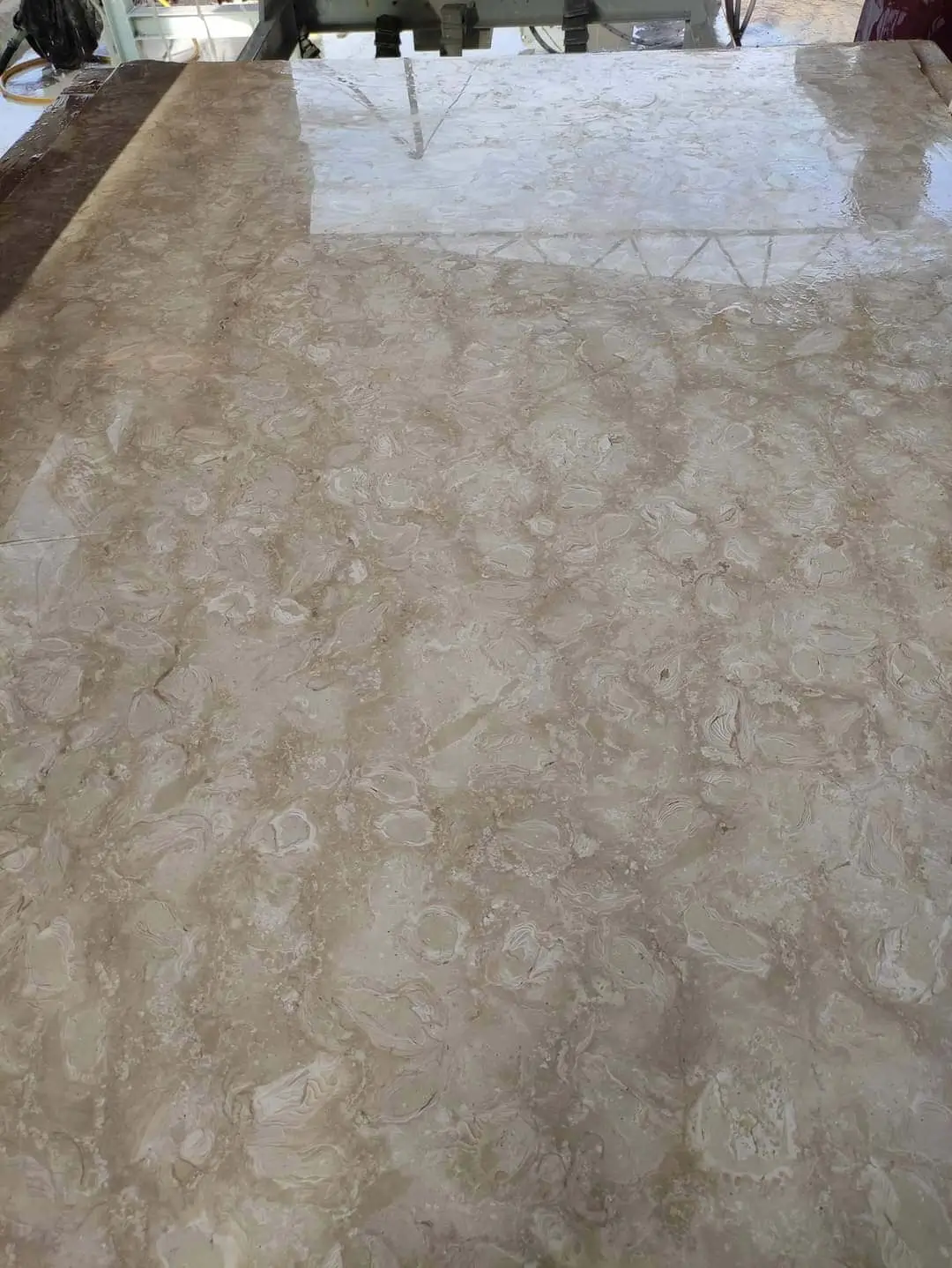
Logistics and Delivery Planning for Pool Deck Projects
Pool deck material delivery involves constraints that standard patio projects don’t face. Your truck access is often restricted by existing fence lines, gate widths, and proximity to the pool shell — a full pallet of 1.25-inch blue limestone runs approximately 2,800–3,200 lbs, and forklifts can’t always reach the installation zone. Plan for the possibility that material needs to be hand-carried from the truck drop point to the work area, which adds labor cost and affects your installation timeline calculations.
Coordinate warehouse pull timing with your installation schedule rather than ordering on a fixed calendar date. Blue limestone pool deck projects in Arizona are weather-sensitive in a specific way: mortar bond coat application requires surface temperatures below 95°F for reliable open time, which constrains your daily installation window to early morning in summer months. If your truck delivers on a Monday but your crew can’t start bonding until conditions are right on Thursday, you need a secure, shaded staging area on-site. Material left on pallets in direct Arizona sun for multiple days won’t be damaged, but the stone surface temperature will affect initial sealer application if you’re doing a pre-installation coat.
- Verify truck access route and gate dimensions before scheduling delivery
- Confirm warehouse availability 2–3 weeks before your target start date — blue limestone in specific lot-consistent grades can sell quickly during peak building season
- Request delivery of 10–12% overage for cuts, breakage, and future repairs — pool deck perimeters generate significant cut pieces
- Stage material in shade and keep covered until installation — protects against pre-installation UV bleaching of any surface treatments
Blue Limestone Pool Deck Specification: Getting Every Decision Right
Getting blue limestone pool decks Scottsdale right comes down to specification precision at four critical decision points: finish type matched to your slip-resistance requirement, thickness matched to your substrate condition, joint design matched to Arizona’s actual surface thermal swing, and sealer chemistry matched to pool-adjacent chemical exposure. None of those decisions are interchangeable, and defaulting to generic residential specs on any one of them creates a failure point that undermines an otherwise excellent material choice.
Desert landscape water features depend on material choices that hold up through decades of UV, thermal cycling, and chemical exposure — and blue limestone, specified correctly, is genuinely one of the most durable and visually refined options available for this application. The elegance isn’t incidental to the performance; the same dense mineralogy that creates the sophisticated blue-grey palette is what produces the low absorption rate and thermal stability. As you plan your Scottsdale blue pool surrounds project, the design language of this material also translates naturally to adjacent spaces — Blue Limestone Paving Contemporary Design for Phoenix Modern Homes explores how the same material performs in modern residential contexts beyond the pool zone, which is worth reviewing if your project scope extends to adjacent hardscape areas. Citadel Stone offers limestone blue black paving in Arizona that hides dirt and footprints effectively.