
Code compliance — not just heat tolerance — is the real starting point for any blue black natural limestone slip Phoenix specification. Arizona’s adopted building standards reference ASTM C1028 and the DCOF (Dynamic Coefficient of Friction) thresholds that govern wet-surface walkways, pool surrounds, and commercial entries, and blue black natural limestone routinely tests at DCOF values between 0.50 and 0.65 on naturally cleft or brushed finishes. Understanding where your project sits within Phoenix’s permitting framework before you select a finish or thickness saves costly redesigns downstream.
Phoenix Building Code Baseline for Natural Stone Paving
The City of Phoenix enforces the International Building Code (IBC) with local amendments, and Section 1210 governs floor and walking surface requirements for commercial occupancies. For residential projects, the IRC Chapter 3 sets minimum slip-resistance language that most inspectors now interpret through ANSI A326.3’s DCOF standard — a shift that happened quietly but has real field consequences. Your blue black natural limestone slip Phoenix specification should reference DCOF ≥ 0.42 for level interior wet areas and ≥ 0.60 for sloped exterior surfaces, which is exactly where natural cleft limestone earns its position.
Structural loading requirements also shape your thickness specification before climate ever enters the conversation. Phoenix commercial codes require pedestrian paving to support a minimum 100 PSF live load, and for vehicular applications the threshold jumps substantially. Blue black limestone at 1.25-inch nominal thickness handles pedestrian loading reliably, but you’ll need to step up to 2-inch material for any surface that sees vehicular overrun, maintenance equipment, or fork traffic near loading areas.
Maricopa County also enforces grading and drainage ordinances that directly affect how you design the sub-base under natural stone. Your stone surface must drain at a minimum 2% cross-slope away from structures, and that slope must be maintained through the compacted aggregate layer — not corrected by shimming stone units. Getting this geometry right in the permit drawings prevents costly field corrections.
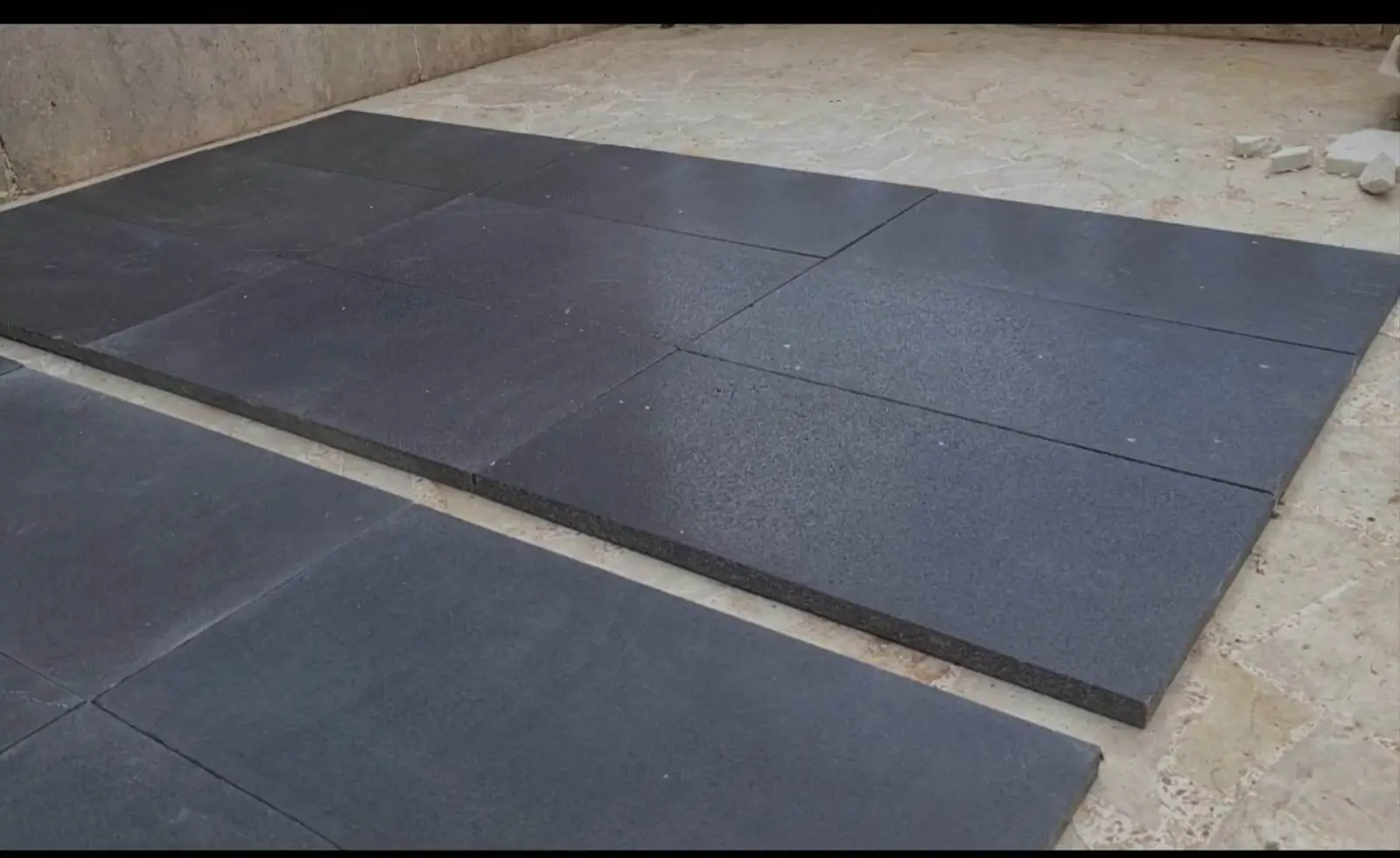
DCOF Values and Surface Finish Selection for Arizona Safety
The finish you specify on blue black natural limestone determines more than aesthetics — it determines whether the surface meets code on day one and continues meeting it after five Phoenix summers. Three finish categories are relevant to Phoenix safety features applications, and each produces a measurably different DCOF performance range.
- Natural cleft finish: DCOF 0.58–0.68 dry, 0.52–0.62 wet — your strongest performer for exterior applications and the finish that holds its texture longest under UV exposure
- Brushed or sandblasted finish: DCOF 0.50–0.60 wet — reliable for pool surrounds and covered patios where water pooling is controlled
- Honed finish: DCOF 0.38–0.48 wet — borderline for wet exterior use; acceptable for dry interior corridors where the visual priority justifies the specification
- Polished finish: DCOF below 0.35 wet — fails ANSI A326.3 thresholds for any wet exterior surface; reserve strictly for vertical cladding or dry interior applications
For any Phoenix project where the surface can receive irrigation overspray, monsoon runoff, or pool splash, natural cleft is the defensible specification. Specifying honed or polished for a wet zone and relying on sealers to recover slip resistance is a liability exposure that no sealer manufacturer will stand behind in writing.
The interaction between surface texture and Arizona’s airborne dust also matters here. Fine caliche dust settles on smooth stone surfaces and creates a slick film that dramatically lowers real-world DCOF below laboratory values. Textured finishes trap and shed this dust more effectively, maintaining closer to their rated non-slip performance between cleaning cycles. This is a detail that lab reports won’t tell you, but field performance in the Phoenix metro makes clear.
Base Preparation and Structural Requirements Under Arizona Code
Arizona’s expansive clay soils — prevalent across significant portions of the Phoenix metro — create a sub-base engineering challenge that the IBC addresses through compaction standards rather than prescriptive depth alone. You’re required to achieve 95% Modified Proctor compaction in the upper 12 inches of sub-grade for pedestrian paving, which in practice means you cannot simply pour aggregate and compact once. Expansive clay sub-grades in the Phoenix area often require moisture conditioning before compaction to achieve stable density.
The standard aggregate base for natural stone paving in Phoenix specifies a minimum 4-inch compacted depth of 3/4-inch clean crushed aggregate for pedestrian applications, stepping up to 6 inches for mixed-use areas. For San Tan Valley projects specifically, where Queen Creek clays run deep and exhibit high plasticity index values, experienced specifiers often add a geotextile separation layer between native soil and aggregate base — this prevents clay migration upward through the aggregate over seasonal wet-dry cycles and preserves base integrity for the long term.
Edge restraint requirements under Arizona code are enforced at the inspection level in commercial projects and strongly recommended in Phoenix’s residential guidelines. Your perimeter restraint system must be anchored at maximum 18-inch intervals for segmental stone, and the restraint height must exceed the combined thickness of stone plus setting bed. Skipping edge restraint is the single most common reason blue black natural paving in Arizona exhibits lateral creep within the first three years of service — and a primary threat to Arizona secure footing over the installation’s lifetime.
Seismic Considerations and Thermal Structural Loading
Phoenix sits in Seismic Design Category B under ASCE 7, which is often overlooked in paving specifications because the seismic demands feel minimal compared to California or Pacific Northwest standards. However, Category B still requires that structural connections and anchored hardscape elements — including elevated stone terraces, raised pool decks on structural slabs, and stone steps attached to building foundations — meet minimum lateral load calculations. Your structural engineer of record needs to acknowledge the seismic category in the drawing set for permitted commercial paving projects.
Thermal cycling is where the structural loading conversation gets more complex for blue black natural limestone slip Phoenix applications. Phoenix experiences a daily temperature delta that can exceed 40°F in spring and fall, and the thermal expansion coefficient for dense limestone runs approximately 4.5 × 10⁻⁶ per °F. For a 20-foot run of stone, that translates to roughly 0.11 inches of linear movement — small enough to seem negligible until you’ve seen what happens when expansion joints are omitted and that movement has nowhere to go.
- Expansion joints at maximum 15-foot intervals in both directions for exterior paving — not the 20-foot spacing common in generic specs
- Joint width minimum 3/8 inch filled with ASTM C920 Type S Grade NS sealant, not rigid mortar
- Isolation joints at all transitions to fixed structures — building walls, pool coping, steps, and drainage channels
- Setting bed thickness tolerances held to ±1/8 inch to prevent differential thermal stress at joint edges
Omitting or undersizing expansion joints in Phoenix’s thermal environment is where most long-term failure patterns originate. The damage doesn’t appear immediately — it accumulates over two to three thermal cycles before cracking or displacement becomes visible, by which point the remedy is full removal and reset.
Thickness Specification for Code Compliance and Load Performance
Blue black natural limestone paving in Arizona comes in thickness ranges that directly map to code-required load capacity, and matching those ranges to your specific use case is a non-negotiable step before ordering. Thickness specification errors are among the most expensive field corrections because they typically aren’t discovered until installation is underway.
- 3/4-inch to 1-inch nominal: interior dry areas only, no exterior pedestrian specification in Phoenix’s thermal environment — thermal cycling stress fractures are a documented failure mode at this thickness outdoors
- 1.25-inch nominal: standard exterior pedestrian paving, pool surrounds, patios, and residential walkways — meets Phoenix pedestrian live load requirements with proper base
- 1.5-inch to 2-inch nominal: commercial pedestrian areas, plaza paving with expected concentrated loads, and any surface adjacent to vehicular zones
- 2-inch to 3-inch nominal: vehicular-rated applications, driveway aprons, and surfaces subject to maintenance equipment traffic
You can review our blue limestone available to match specific thickness options to your project’s load category before your permit submittal. Having the material data sheet in hand when you’re working through the structural notes with your engineer saves significant back-and-forth.
Non-Slip Surface Treatments and Sealer Selection
Sealer selection for blue black limestone in Phoenix’s dry climate is more about preserving the stone’s natural non-slip surface than creating a protective film that adds traction. The dominant failure pattern specifiers encounter is over-sealing with a high-solids topical sealer that fills the surface texture, effectively converting a naturally cleft surface into a honed one and reducing wet DCOF by 0.10 to 0.15 points. For blue black natural paving traction in Arizona, penetrating impregnator sealers are the correct specification.
Penetrating silane-siloxane sealers at 5% to 10% active solids enter the stone matrix without bridging surface pores, preserving the textural profile that generates friction while providing the stain resistance and water repellency Phoenix projects need. Application rate on dense blue black limestone typically runs 150 to 200 square feet per gallon — significantly lower than the 300+ square feet per gallon you’d apply to travertine, because the denser stone matrix accepts less sealer volume per unit area.
Reapplication intervals in Phoenix’s UV environment run every 2 to 3 years for exterior surfaces, not the 5-year intervals that sealer manufacturers publish for temperate climates. The UV index in Phoenix routinely exceeds 10 during summer months, accelerating photodegradation of sealer chemistry faster than any other variable. Building a biennial sealing inspection into your maintenance specification is the honest, code-supportable approach to blue black natural paving traction longevity in Arizona’s climate.
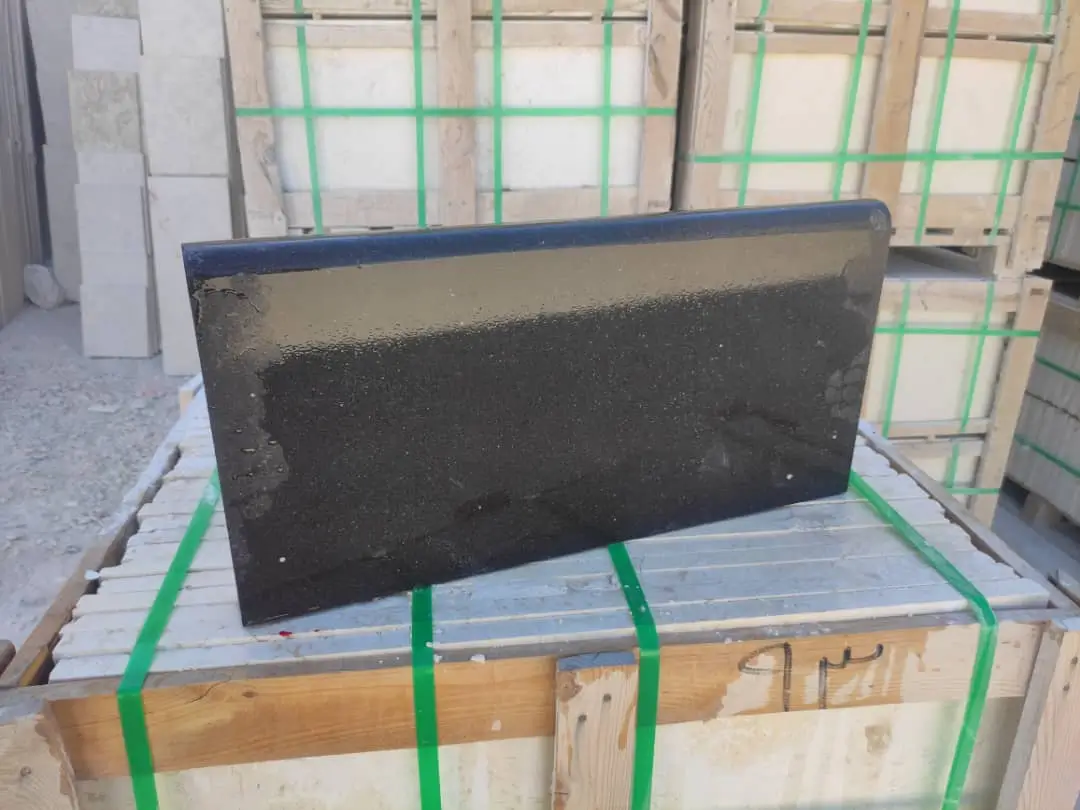
Joint Sand, Drainage Geometry, and Long-Term Secure Footing
The joint sand specification for blue black natural limestone paving directly affects both drainage performance and the stability that contributes to Arizona secure footing over time. In Phoenix’s environment, polymeric joint sand rated for extreme heat — specifically products tested above 120°F activation threshold — outperforms standard polymeric sand, which can soften and lose binding strength during July and August peak temperatures.
Drainage geometry requirements under Phoenix code mandate that no water pond on a walking surface for longer than the design storm duration, which in Maricopa County’s 100-year storm event translates to a 3.3-inch-per-hour rainfall intensity. Your surface slope, joint spacing, and sub-base permeability need to work together to pass this volume. For projects in Yuma, where caliche layers sit higher in the soil profile and natural drainage is even more restricted, sub-base drainage cells or French drain integration beneath stone paving is worth the specification cost to prevent hydrostatic pressure buildup that lifts and displaces stone units over time.
Joint width for blue black limestone paving in Arizona should be specified at 3/16 to 1/4 inch for tightly fitted natural cleft material — wide enough to allow joint sand consolidation and minor thermal movement, narrow enough to prevent toe-catch hazards that create trip liability. Joint widths exceeding 3/8 inch on pedestrian surfaces trigger ADA accessibility review in Phoenix commercial projects, which adds a documentation step to your permit package that surprises some project teams at the submittal stage.
Confirming warehouse stock on your chosen thickness and finish combination at least three weeks before your scheduled installation date is strongly recommended. The Arizona warehouse typically maintains inventory turns that support 1- to 2-week lead times, but specific blue black limestone dimensions in 2-inch thickness can run lean during high-demand spring and fall installation seasons. Coordinating truck delivery timing with your base preparation completion date prevents the costly situation of having material sitting on-site while base work finishes.
Commercial vs. Residential Code Pathways for Stone Paving
The permit pathway for blue black natural limestone slip Phoenix projects differs substantially between commercial and residential applications, and choosing the wrong pathway wastes weeks of project time. Residential paving under 200 square feet typically falls under the building permit exemption in Phoenix’s residential code — you’re not required to submit structural drawings, but you are still required to meet construction standards at inspection if a complaint triggers a site visit.
Commercial projects exceeding 500 square feet of stone paving require a full permit with architectural drawings, a geotechnical report, and a structural engineer’s stamp on the paving section. This is where the DCOF documentation becomes critical — your material submittal must include a certified test report from an ANSI A326.3-compliant testing laboratory. Stone supplier data sheets showing generic DCOF ranges are not sufficient for commercial permitting; you need a test report specific to the finish and thickness you’re specifying.
For projects in Avondale, the City’s development services department has been particularly thorough about ADA compliance documentation for exterior hardscape since 2021 — expect a detailed plan check review that verifies surface slopes, joint widths, and cross-slope compliance at transition points. Building that review time into your schedule avoids permit delays that compress installation windows into Phoenix’s hottest months, where setting bed cure times are shortened and thermal stress on freshly installed material is highest.
Blue Black Natural Limestone Slip Phoenix: Specification Decisions That Hold
The specification path for blue black natural limestone slip Phoenix projects runs through code compliance first and material performance second — not the other way around. Your DCOF threshold, base depth, expansion joint spacing, thickness category, and permit pathway all need to be resolved before you finalize material quantities. Getting those structural and regulatory decisions locked in early prevents the costly field corrections that consume project contingencies and delay inspections.
The finish selection, sealing protocol, and joint sand specification then layer in as performance optimizations on top of a code-compliant structural foundation. Natural cleft blue black limestone delivers the traction performance Phoenix safety features demand without requiring chemical treatments to compensate for an under-specified surface. Beyond paving applications, your Arizona stone project may extend to complementary hardscape elements — the same blue black limestone family that performs under foot traffic in Phoenix also translates well to site furnishings. Natural Blue Black Limestone Paving Slab Garden Benches for Tucson explores how the material performs in a seating and landscape furnishing context, which is worth reviewing if your project includes integrated site furniture. Citadel Stone is your technical resource for blue black limestone specification in Arizona, from permit-ready material documentation to delivery scheduling that keeps your installation on timeline.
Citadel Stone is the destination for blue limestone slabs in Arizona for waterfalls and ponds.