
Surface finish selection for blue black limestone textures Phoenix projects carries more weight than most designers initially realize — the finish you choose doesn’t just determine how the stone looks, it dictates how it behaves thermally, how it ages under UV, and whether it meets code for slip resistance in your specific application. Across Arizona’s desert climate, blue black limestone brings a distinctive depth that contrasts beautifully against warm stucco and concrete, but unlocking that visual potential means matching the right texture to the right condition. The variety of available surface treatments is wider than most specification sheets let on, and each one performs differently once Phoenix heat cycles start doing their work.
Why Finish Selection Shapes Performance, Not Just Appearance
The finish on blue black limestone does more than control gloss level — it fundamentally alters the stone’s surface porosity, thermal absorption rate, and long-term maintenance requirements. A honed surface left slightly open will absorb heat differently than a flamed texture that has been physically altered at the crystal level, and that difference compounds over years of Phoenix summers. You’re not just picking an aesthetic; you’re choosing a maintenance commitment and a performance profile that will define the project for the next two decades.
Field performance data on blue black limestone across Arizona climates consistently shows that finish type influences surface temperature variance by 8–14°F under identical solar exposure. That range matters significantly when you’re barefoot on a pool deck in July. The darker the material and the smoother the finish, the more radiant heat you’ll feel underfoot — a trade-off worth addressing at the specification stage rather than after installation.
- Polished and honed finishes absorb and retain more surface heat due to reduced microtexture and lower air-pocket diffusion
- Textured finishes like flamed, bushhammered, and sandblasted create micro-surface relief that dissipates heat slightly faster and provides superior traction
- Sealed finishes can shift thermal behavior further depending on coating type and application thickness
- Your application context — pool deck, driveway, covered patio, or open courtyard — should drive finish selection before color preference enters the conversation
Polished Finish: Dramatic Look, Demanding Conditions
A polished blue black limestone surface delivers the most visually striking result — the stone’s deep charcoal-to-cobalt tones saturate fully, and the reflective quality creates a level of formality that works well in covered entry courts or interior-to-exterior transitions. For outdoor Phoenix surface finishes, though, polished finish carries genuine trade-offs you need to weigh carefully. The smooth surface becomes significantly more slippery when wet, and ASTM C1028 wet dynamic coefficient of friction for polished limestone typically falls in the 0.35–0.45 range — below the 0.60 threshold most jurisdictions require for exterior wet-zone applications.
Polished finish also demands the most rigorous sealing schedule of any surface option. In Avondale, where alkaline soils and irrigation water with high mineral content are common, polished limestone faces accelerated efflorescence risk because the sealed surface tends to trap migrating salts rather than allowing them to exhale naturally. Annual resealing with a penetrating impregnator — not a topical coating — keeps the surface protected without building up a film that eventually delaminates under UV.
- Best suited for covered patios, interior foyers, and vertical feature walls in Phoenix-area residential projects
- Requires annual penetrating sealer application and prompt attention to standing water or spill absorption
- Not recommended for pool surrounds, uncovered driveways, or high-traffic exterior paths without anti-slip additive treatment
- Blue black limestone’s dark saturation is most dramatic in polished form, making it popular for architectural accent strips
Honed Finish: The Practical Specification for Most Phoenix Projects
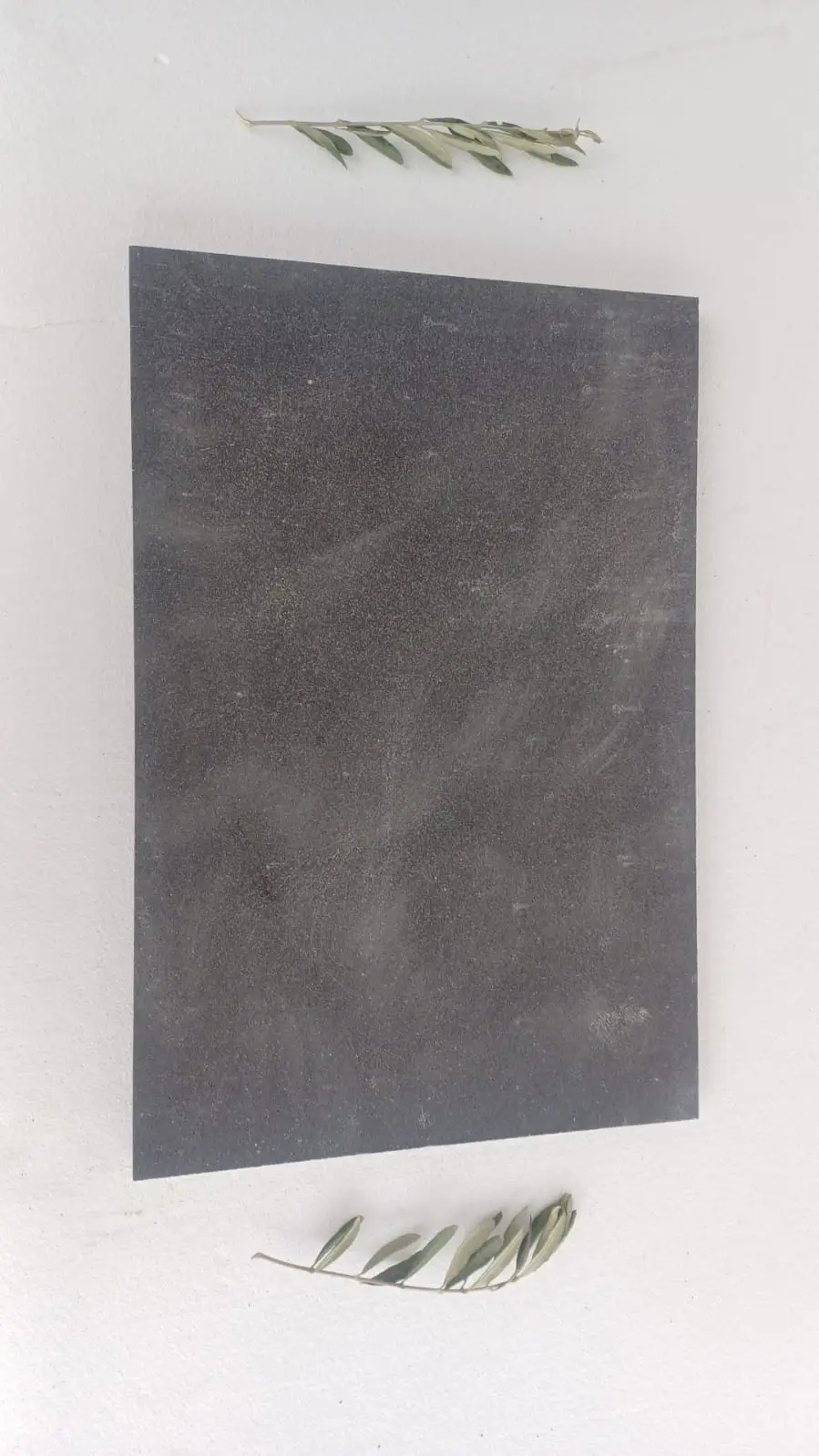
Honed blue black limestone sits at the sweet spot between visual impact and practical performance for the majority of Phoenix-area exterior applications. The surface retains the material’s dark, cool-toned depth without the mirror sheen that creates both glare and slip risk outdoors. Wet DCOF for honed limestone typically lands in the 0.55–0.65 range, which meets or just exceeds the 0.60 exterior wet requirement — though you should specify a test on your actual material lot rather than relying on published averages, since surface variation between quarry cuts can shift that number.
At Citadel Stone, we recommend honed finish for covered outdoor living areas, transition zones between interior and exterior spaces, and feature paving runs where the design calls for a sophisticated but low-maintenance surface. The finish ages gracefully in Arizona’s dry climate, and it doesn’t require the same rigorous annual maintenance that polished limestone demands. Every slab we receive goes through warehouse inspection for consistent surface quality — finish uniformity across a pallet matters more than most buyers realize until they’re laying adjacent tiles on the job site.
- Achieves a matte-to-satin appearance that reads as refined without creating maintenance liability
- Appropriate for covered patios, entry courts, and low-grade exterior paths with good drainage
- Biennial penetrating sealer application is typically sufficient in Phoenix’s low-humidity climate
- Blue black limestone in honed finish photographs exceptionally well for architectural documentation and project portfolios
Flamed Finish: Heat-Treated Surface for High-Demand Outdoor Use
Flamed finish is produced by subjecting the limestone surface to a high-temperature torch that causes rapid thermal expansion and micro-fracturing of the crystal structure — the result is a visually roughened, matte surface with excellent non-slip performance. For blue black limestone specifically, flaming creates a lighter, slightly bleached appearance on the surface peaks while the valleys retain deeper tone, producing a two-dimensional texture that adds visual complexity. Slip resistance numbers improve substantially with this finish: wet DCOF for flamed limestone typically reaches 0.70–0.85, making it suitable for pool decks, ramp approaches, and uncovered exterior paving in Phoenix surface conditions.
The trade-off with flamed blue black limestone is surface texture uniformity — natural variation in crystal density means the flaming process produces slightly inconsistent results across a batch, which you’ll want to evaluate with a warehouse sample review before committing to a full project order. Specifying a calibrated thickness is especially important with flamed material because the surface treatment creates slight dimensional variation that can affect your bedding mortar depth calculations.
- Recommended finish for pool surrounds, uncovered patios, commercial exterior paths, and vehicular paving
- Retains blue black limestone’s tonal character but with a lighter, more weathered surface appearance than polished or honed
- Requires less frequent sealing than polished or honed — every 3–4 years with a breathable penetrating impregnator
- Verify lot-to-lot consistency before large orders; flamed finish amplifies natural variation in crystal structure
Bushhammered and Sandblasted Finishes for Textural Variety
Beyond the three primary finish types, bushhammered and sandblasted surfaces give you additional options within the blue black limestone texture range that serve specific design intentions. Bushhammered finish uses a mechanical head to create a uniform dimpled surface — the visual result is industrial and tactile, suited to contemporary hardscape designs where the stone’s natural veining takes a back seat to pure surface geometry. Sandblasted finish sits between honed and flamed in terms of texture depth, producing a fine-grain matte surface with slightly more grip than honed without the dramatic texture change of flaming. Both finishes expand your blue black paving texture choices Arizona projects can accommodate without sacrificing performance.
For projects in Yuma, where extreme summer heat creates one of the most demanding thermal environments in Arizona, bushhammered blue black limestone on horizontal surfaces provides a practical advantage — the mechanical dimple pattern creates micro air pockets that reduce thermal contact area slightly, and the surface profile channels water away from foot contact zones during the brief but intense monsoon season. These finishes aren’t commonly stocked in standard warehouse inventory but can be ordered in project quantities with appropriate lead time planning.
- Bushhammered: uniform dimple pattern, industrial aesthetic, excellent slip resistance, works well in contemporary commercial exteriors
- Sandblasted: fine matte texture, moderate slip resistance improvement over honed, preserves more of the stone’s tonal depth than flaming
- Both finishes require the same penetrating sealer protocol as honed material — biennial application in Phoenix climate conditions
- Allow additional lead time for non-standard finishes; project timelines should account for a 3–5 week production window beyond standard stock availability
For design teams working with darker stones, the range of cobalt-toned limestone slabs available for Arizona projects provides a useful reference point for understanding how finish type interacts with inherent stone color across different application contexts.
Matching Finish to Application Zone in Arizona Designs
Zoning your finish selection across a project is a technique that experienced Arizona designers use to manage both performance and visual coherence simultaneously. A single home might specify honed blue black limestone for the covered lanai, flamed for the pool surround, and polished for the interior great room floor — each finish is calibrated to the specific conditions of that zone rather than applying a single specification across all surfaces. This approach requires coordination with your stone supplier to ensure consistent color lot availability across multiple finish types from the same quarry run.
The blue black paving texture choices Arizona designers navigate most often come down to a fundamental question: how much maintenance is the end user realistically going to perform? A polished finish in a luxury resort setting with dedicated facilities staff is a sound specification. The same finish on a single-family residence in Phoenix where the homeowner may go years between professional maintenance cycles is a liability waiting to develop. Calibrating finish selection to realistic maintenance capacity is as important as any technical performance metric.
- Pool surround: flamed or bushhammered only — wet slip resistance is non-negotiable, and no sealer application schedule fully compensates for a smooth finish in a wet zone
- Covered patio and entry: honed or sandblasted — balances visual quality with manageable maintenance requirements
- Interior-to-exterior threshold: honed both sides maintains visual continuity and meets interior slip requirements
- Uncovered driveway or pedestrian path: flamed or bushhammered — UV exposure and thermal cycling are most aggressive here, and textured finishes handle the stress better
- Feature wall or water feature surround: polished delivers maximum visual impact in vertical applications where slip resistance is irrelevant
Sealing Protocols Adjusted for Each Finish Type
Sealing blue black limestone in Arizona surface conditions isn’t a single protocol — finish type fundamentally changes how sealant penetrates, how long protection lasts, and what failure looks like when maintenance lapses. Polished surfaces require the most frequent application because the closed pore structure limits penetrating sealant depth, meaning you’re relying on a thinner protection layer that UV and thermal cycling degrade faster. Flamed and bushhammered surfaces accept penetrating sealant more deeply due to their open micro-structure, extending effective protection duration significantly.
Across the range of Arizona surface options, a penetrating silane-siloxane impregnator at 20–30% solids concentration is the standard specification that performs well across all finish types in Arizona’s low-humidity environment. Topical coatings — epoxies, acrylics, and urethane systems — create maintenance complications over time in extreme UV environments because they delaminate, yellow, and trap moisture beneath the film. Arizona surface options that rely on topical sealers tend to show maintenance failure within 3–5 years, while properly applied penetrating sealants on blue black limestone have demonstrated 6–10 year intervals in sheltered applications.
- Polished finish: penetrating impregnator annually, inspect for surface haze that indicates salt migration from below
- Honed finish: biennial application, monitor grout joints for efflorescence as the primary early-warning indicator
- Flamed and bushhammered finishes: every 3–4 years in covered applications, biennial for uncovered pool-adjacent areas
- Always apply sealer to a clean, fully cured installation — minimum 28 days after grouting before first sealer application
Ordering and Logistics for Multi-Finish Projects in Arizona
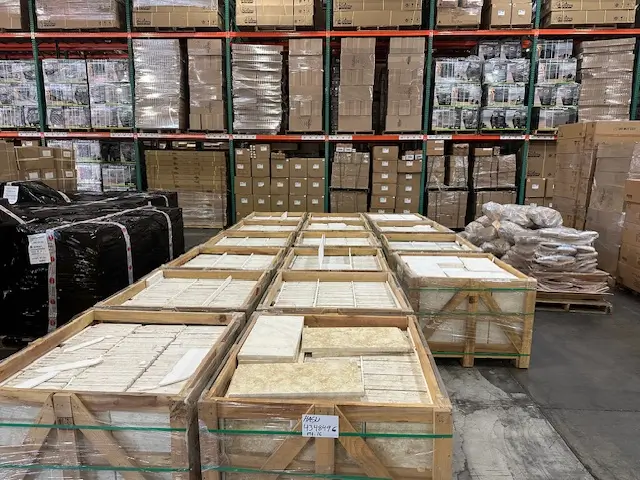
Projects that specify multiple finish types within a single blue black limestone paving in Arizona design need careful coordination at the procurement stage. Sourcing all finishes from the same quarry lot ensures color consistency — blue black limestone exhibits natural variation between quarry runs, and a flamed tile from one batch placed adjacent to a honed tile from a different batch can show visible tonal inconsistency that becomes obvious once the full surface is laid. At Citadel Stone, we source this material directly and maintain lot-matched warehouse inventory across finish types, which simplifies the specification process for projects requiring finish variety.
In San Tan Valley, where residential development has accelerated significantly in recent years, truck access to job sites often requires coordination — standard flatbed delivery works for most street-accessible sites, but staged delivery on phased builds may require multiple truck runs scheduled around site readiness rather than warehouse availability. Building delivery scheduling into your project timeline rather than assuming same-week availability protects against the most common installation delays on complex projects.
- Request a color lot confirmation from your supplier before finalizing multi-finish orders — same quarry run across all finish types is the safest specification
- Standard warehouse lead times for blue black limestone in common finishes (honed, flamed) run 1–2 weeks from in-stock inventory; specialty finishes like bushhammered may require 3–5 additional weeks
- Order a minimum 10% overage on each finish type to account for cuts, breakage, and future repairs without risking lot-match problems
- Confirm truck delivery access and unloading requirements with your site superintendent before scheduling delivery — last-minute logistics changes add cost and delay
Expert Summary: Getting Blue Black Limestone Textures Phoenix Projects Right
Treating finish selection as a technical specification decision rather than a purely aesthetic one is what separates successful blue black limestone textures Phoenix projects from ones that underperform within a few seasons. Each finish variant — polished, honed, flamed, bushhammered, sandblasted — carries a distinct performance profile that intersects with Arizona’s thermal demands, your application zone’s slip requirements, and the realistic maintenance capacity of the end user. The designers and contractors who consistently achieve 20-plus-year performance from these installations are the ones who match finish to condition rather than defaulting to a single specification across every surface.
Your material selection process should start with application zone mapping, move through slip resistance requirements, factor in maintenance commitments, and only then arrive at aesthetic preference — in that order. Blue black limestone rewards this disciplined approach with performance and visual depth that few other materials in the Arizona palette can match. As you refine your specification for related stone applications, Blue Black Limestone Paving Spa Surrounds for Tucson Wellness Centers explores how this material performs in another high-demand Arizona context worth considering alongside your current project scope. Citadel Stone delivers Blue Limestone Paving in Arizona directly to homeowners and trade pros alike.