
Structural performance in multi-level hardscape design comes down to one decision most specifiers get wrong at the planning stage — thickness selection relative to tread span and riser height simultaneously. Blue black limestone steps Peoria projects carry a specific load geometry that differs from flat paving applications, and the compressive forces concentrate differently at the nosing edge than anywhere else on the slab. Specifying blue black paving slab stairs Arizona at 3 cm for treads spanning beyond 24 inches creates a stress concentration zone that accelerates micro-fracturing within the first three to five monsoon seasons. You need to understand exactly where the numbers break down before you commit to a layout.
Understanding Peoria Elevation Context
Peoria elevation changes create a design demand that flat-site projects simply don’t face. The northwest Phoenix metro corridor sits at roughly 1,100 to 1,200 feet, but individual residential and commercial parcels often feature engineered grade changes of 4 to 12 feet across a buildable area. That range puts your step count into the 6-to-20 range depending on riser height, and once you exceed eight consecutive risers without a landing, building code and practical drainage geometry start pulling in opposite directions.
The key distinction for blue black limestone steps in this context is that the material’s thermal mass actually works against you in rapid elevation transitions. Slabs in direct sun at a lower terrace level can read 155°F surface temperature while the shaded upper landing measures 118°F on the same afternoon. That 37-degree differential across a short vertical run creates differential thermal expansion between adjacent treads that standard 3/16-inch joints can’t accommodate. You’ll want to open joint width to 1/4 inch minimum on any run with more than four steps exposed to west-facing sun exposure.
Slab Thickness and Tread Geometry for Blue Black Limestone Steps
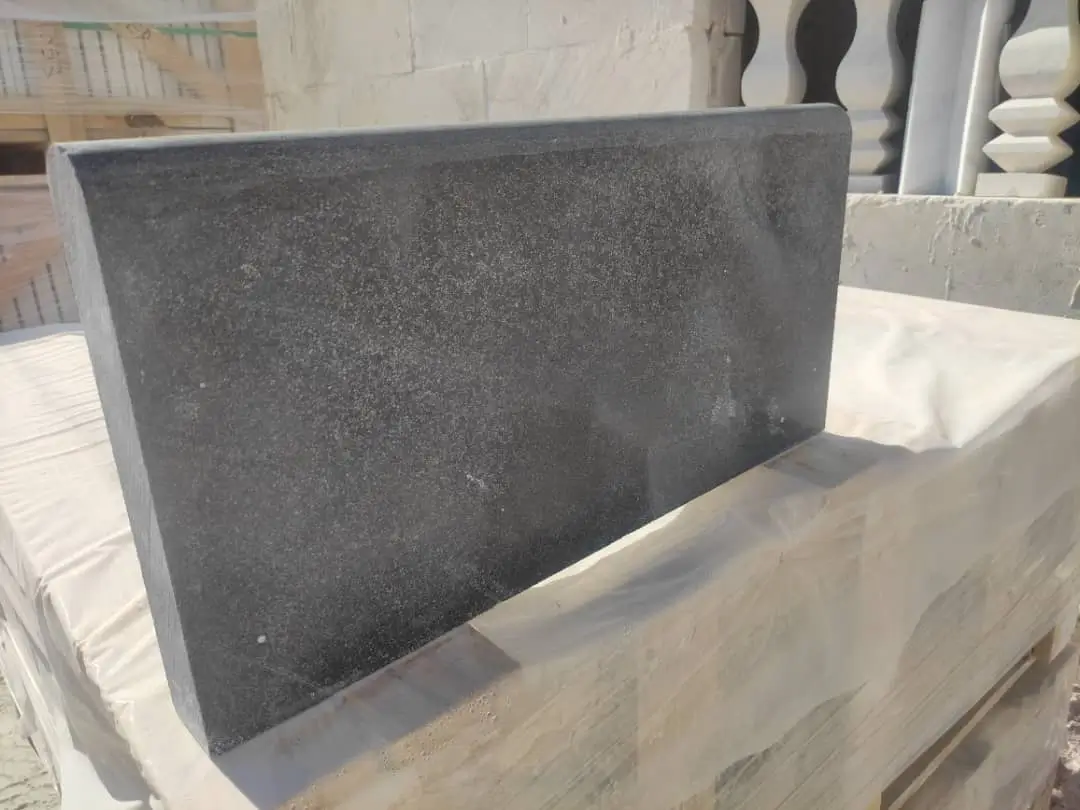
Blue black paving slab stairs Arizona demand a thickness specification that accounts for both cantilever loading and point-load impact at the nosing. The industry minimum of 30mm (roughly 1.2 inches) is fine for flush paving applications, but for cantilevered step treads projecting more than 1.5 inches beyond the riser face, you should move to 40mm or 50mm stock. The bending moment at the nosing under a 250-pound dynamic load — someone stepping down firmly — generates tensile stress on the underside of the slab that 30mm limestone handles poorly without continuous substrate support.
- Tread depth should be 12 inches minimum for residential use; 14 inches for commercial or high-traffic terraced entries
- Riser height of 6 to 7 inches works best with blue black limestone’s slab weight — heavier 50mm treads at 7.5-inch risers create an uncomfortable stride rhythm
- Nosing projection beyond 1.5 inches requires full mortar bed support underneath the projection, not just perimeter bonding
- For runs exceeding six steps, integrate a landing at minimum 36 inches deep to allow drainage break and thermal joint reset
- Side overhang past the string line should stay at or below 1 inch to prevent edge spalling from lateral impact loading
The 40mm thickness tier is the sweet spot for most Peoria multi-level residential projects. It handles the load, it cuts cleanly on a bridge saw without the micro-cracking risk you get pushing 30mm stock through tight radii, and the weight per tread (typically 28 to 35 pounds for a 12×24 step) stays manageable for two-person installation without mechanical lifting equipment.
Base Preparation for Terraced Design in Arizona
Terraced design in the Phoenix metro requires you to think about base preparation as a series of independent structural platforms rather than a continuous paving field. Each terrace level effectively acts as a retaining element for the level above, and the interface between the step riser and the terrace surface behind it is a high-stress zone where moisture, soil movement, and thermal cycling all converge.
Your aggregate base for each terrace platform should be a minimum of 6 inches of compacted class II base, with the top 2 inches being a finer screeded setting bed. In expansive clay soils — which you’ll encounter in pockets across the northwest Peoria corridor — increase your base depth to 8 inches and introduce a geotextile separation fabric at the subgrade interface. In Mesa, caliche layers at 18 to 24 inches actually provide a naturally stable sub-base when scarified and recompacted, which is a genuine advantage that Peoria projects sometimes lack.
- Compact base material to 95% Modified Proctor density — not 90%, which is the minimum for standard paving
- Establish positive drainage of at least 1/8 inch per foot away from any structural element or building foundation
- Install perforated drain tile behind each riser line where the terrace meets a retained grade condition
- Allow compacted base to cure for a minimum of 72 hours before screeding the setting bed, particularly after any rainfall
Thermal Performance and the Blue Black Color Advantage
The blue black coloration of this limestone family sits in a reflectance range of roughly 18 to 28% — significantly lower than white or buff limestone, which reflects 60 to 72% of solar radiation. That matters in a Peoria context because your surface temperature differential between blue black and light-toned alternatives can reach 25 to 30°F under peak summer sun. For step applications, this trade-off is actually more manageable than it sounds.
Here’s what most specifiers overlook: the thermal mass of blue black limestone steps moderates foot traffic comfort in ways that lower-mass materials can’t. Concrete steps in full afternoon sun can hold residual heat past 9 PM, while a 40mm to 50mm limestone tread radiates its stored heat more rapidly after the sun angle drops. The mineral density of this stone family — typically 2.65 to 2.72 g/cm³ — allows faster heat dissipation compared to concrete’s more insulating character. For evening entertaining spaces on a terraced Peoria backyard, that matters to your clients.
Projects in Yuma — where peak summer temperatures exceed Peoria averages by 8 to 12°F — have demonstrated this thermal cycling behavior most acutely. Surface readings on blue black limestone treads in Yuma show peak temperatures around 165°F in July, which requires you to specify a penetrating silane-siloxane sealer rated for substrates exceeding 150°F surface temperature. Standard acrylic sealers break down at those thresholds and leave a patchy residue that accelerates within two seasons. For reliable slab sourcing in extreme-heat zones, calibrated blue limestone slabs in Yuma represent a proven supply pathway that accounts for these specification demands.
Installation Sequencing for Multi-Level Steps
The sequencing of blue black limestone step installation in a multi-level terraced design follows a bottom-up logic that most crews understand intuitively, but the details of bond coat timing are where installations fail. Your mortar bed should be Type S mortar — not Type N — mixed to a dry-pack consistency that holds a rod impression without slumping. In Peoria summer conditions above 95°F, your open time on the bond coat drops from the standard 45 to 60 minutes down to 15 to 20 minutes. You need to work in smaller sections than you’re used to.
- Set riser pieces first, allow initial set for 2 to 4 hours before placing treads to prevent riser displacement under tread weight
- Back-butter tread undersides with a 3/16-inch combed layer of polymer-modified thinset in addition to the mortar bed — this eliminates air voids that cause hollow spots and eventual tread fracture
- Use non-sag epoxy joint filler for the tread-to-riser interface at the nosing — standard grout at this joint fails within two to three seasonal cycles under the dynamic loading of foot traffic
- Check for level and pitch after each tread placement before mortar stiffens — blue black limestone’s calibration tolerance of ±1mm means slight variations in bed depth must be corrected immediately
- Protect fresh installations from direct sun with shade cloth for the first 48 hours to prevent rapid moisture loss from the mortar bed
Citadel Stone’s technical team has worked through enough Arizona step installations to know that the tread-riser bond joint is the single most common failure point in terraced designs. We recommend specifying the epoxy nosing detail in writing on every project — it’s the one line item contractors sometimes value-engineer out, and it’s the one that costs your client a re-installation in year four.
Drainage Design at Arizona Level Transitions
Arizona level transitions concentrate stormwater in ways that flat sites simply don’t generate. During monsoon events, you can see 1 to 2 inches of rainfall in under 30 minutes across the Phoenix metro, and that water needs a path that doesn’t run across your step treads in sheet flow. The drainage geometry of a terraced design is as important as the structural geometry — arguably more so, because water damage is cumulative and invisible until it’s already caused mortar washout or joint erosion beneath a tread.
Your terrace platform drainage should direct water laterally to collection points at the outside corners of each level, not through the center of the step run. Installing a linear channel drain behind the top riser of each terrace captures water before it reaches the step face. In Gilbert, where HOA design standards often require contained drainage systems rather than sheet flow to street, this detail is frequently required by the municipality in addition to being structurally sound practice.
- Maintain a minimum 2% cross-slope on each terrace platform — flat terraces pool water at riser bases, which is the fastest path to mortar deterioration
- Slot drains at the rear of each terrace should connect to a subsurface collection system, not daylight directly to the downslope terrace surface
- The step tread itself should pitch forward at 1/8 inch per foot toward the nosing — this allows surface water to shed forward rather than pooling on the tread
- Avoid weep holes through riser faces as the primary drainage method — they clog with mineral deposits and become ineffective within two to three years in Arizona’s hard water conditions
Sealing and Long-Term Maintenance for Blue Black Limestone Steps
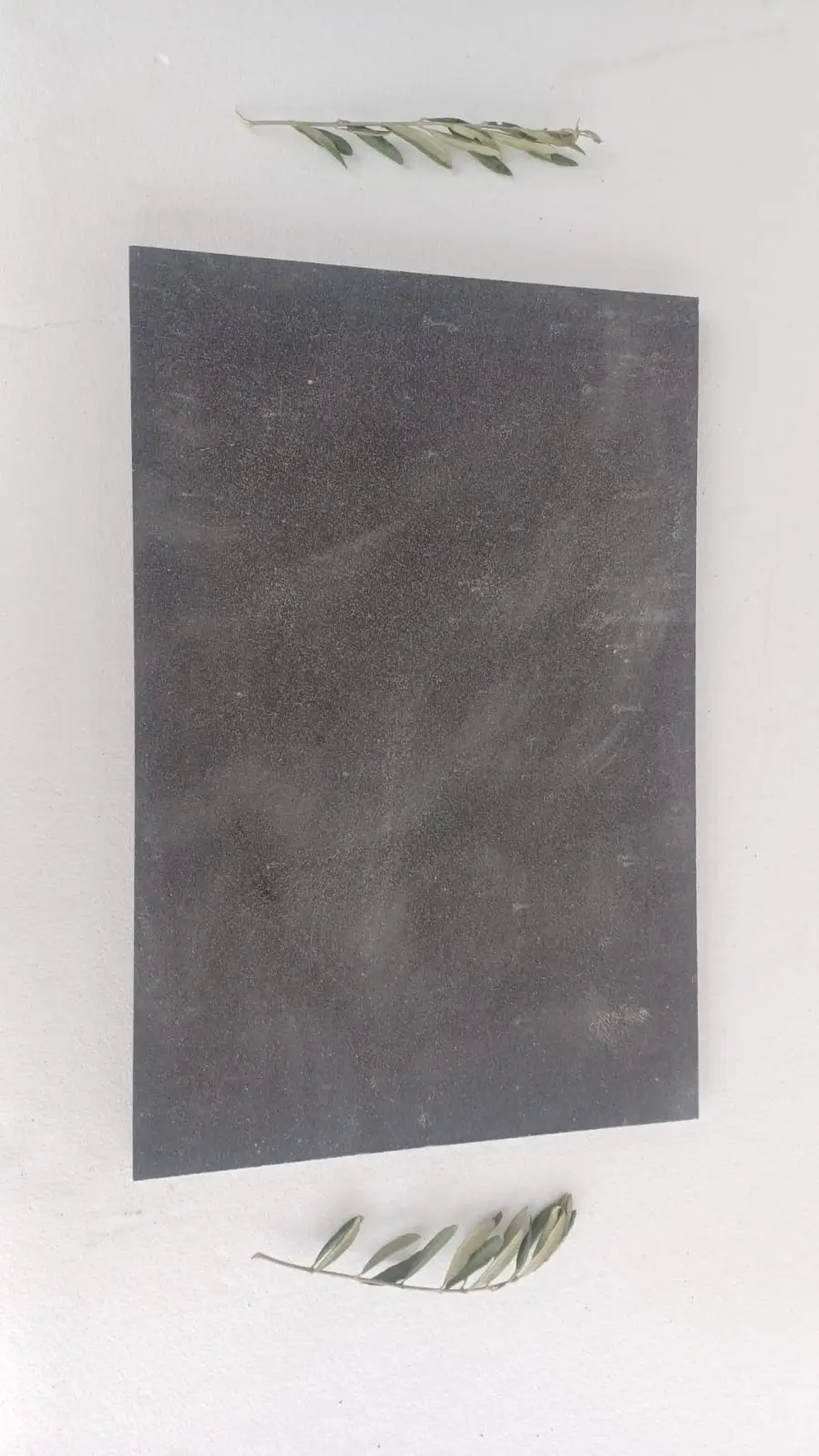
Sealing blue black limestone paving slabs in Arizona step applications requires a different approach than horizontal paving maintenance because the nosing and riser face junction is a natural water collection point. A penetrating silane-siloxane sealer at 20% active solids concentration provides the right balance of water repellency and vapor permeability — the stone needs to breathe to avoid subsurface moisture pressure that causes spalling. Apply two coats 24 hours apart on initial installation, and plan for reapplication on a two-year cycle for step treads versus three years for flat terrace surfaces.
The blue black coloration responds well to sealer application in terms of color enhancement — the iron and silica mineral content that creates the dark tonal range deepens slightly with quality penetrating sealers, which most clients consider an aesthetic benefit. Surface sealers that create a topcoat film are a liability on step treads because they create a slip hazard when wet and peel at nosing edges under foot traffic abrasion. For high-foot-traffic step runs, you can spec a light mechanical honing of the tread surface to DCOF 0.60 minimum before sealing — this maintains the aesthetic character while ensuring compliance with ADA slip-resistance requirements on commercial projects. Citadel Stone warehouse testing on blue black limestone stock consistently shows natural surface DCOF values between 0.52 and 0.68 depending on the specific finish profile, so specifying the finish type precisely at the order stage matters.
Ordering, Logistics, and Lead Times for Peoria Projects
Sourcing blue black limestone steps in Arizona for Peoria projects requires you to plan your material order well ahead of the installation window. Step-profile stock — particularly in 40mm and 50mm thicknesses with one long edge bullnosed — is a custom-cut item that isn’t typically held in standard warehouse inventory at high volume. Standard 20mm and 30mm flat slab stock is more readily available, but the thicker step-specific sizes often carry a 3 to 4 week fabrication lead time on top of shipping.
Your truck delivery logistics for step material deserve specific attention because the weight per pallet of 50mm stock is substantially higher than standard paving slabs. A pallet of 50mm blue black limestone treads in 12×24 configuration typically runs 2,200 to 2,600 pounds — that’s near the limit for standard residential driveway access. Confirm truck clearance and weight rating before scheduling delivery, and arrange for a forklift or boom truck on-site if the installation location is more than 40 feet from a truck-accessible surface. Field issues from deliveries that couldn’t reach the installation zone add a full day of labor to most projects.
- Order 8 to 10% overage on step tread material to account for cuts, rejects, and future repair stock
- Specify calibration tolerance at ±1mm thickness across all step pieces — inconsistent thickness creates riser height variations that building inspectors flag
- Request a material sample from the specific lot before committing to the full order — blue black limestone can shift toward more blue-gray or more charcoal-black depending on the quarry face being worked
- Coordinate warehouse pickup versus jobsite delivery based on your installation schedule — holding material in a covered area prevents surface staining from standing water on the pallet
Expert Summary: Blue Black Limestone Steps Peoria
Getting blue black limestone steps right in Peoria multi-level design comes down to treating each decision point — thickness, base depth, drainage geometry, joint specification — as interdependent rather than sequential. The material performance is genuinely excellent for Arizona conditions when the details are right; the compressive strength typically exceeds 14,000 PSI, the mineral density supports long-term thermal cycling, and the color family weathers with character rather than degrading. What separates a 25-year installation from a 12-year one is almost always the joint detail at the nosing, the drainage slope on each terrace platform, and the sealer selection relative to surface temperature exposure. Beyond steps and terracing, the broader material family has strong applications in other outdoor living contexts — Blue Black Limestone Paving Slab Outdoor Kitchens for Glendale Cooking explores how the same material performs in a high-heat cooking environment where thermal stress and surface maintenance follow a related but distinct specification logic.
Your project timeline should build in the fabrication lead time for step-specific profiles, confirm truck access early, and align the installation sequence with the bottom-up terrace logic that protects your bond work from displacement. The blue black color family delivers the aesthetic weight that multi-level terraced entries demand — it reads as intentional and architectural in a way that lighter stones struggle to achieve at grade transitions. We offer the natural limestone blue black paving slab in Arizona for creating stunning mosaic effects.