
Specifying blue black limestone commercial Prescott projects means reconciling a material with exceptional thermal mass against the demands of high-foot-traffic retail and professional environments — and that balance isn’t automatic. The dark, dense composition of blue black limestone absorbs heat differently than lighter sedimentary alternatives, which creates both an advantage and a liability depending on how your facade or paving layout is oriented relative to Prescott’s predominant afternoon sun angle. Getting this right from the spec sheet forward is what separates installations that hold their visual weight for two decades from those that start showing stress fractures within five years.
Why Blue Black Limestone Works for Commercial Facades
The performance case for blue black limestone in commercial applications starts with compressive strength. You’re typically looking at values between 12,000 and 16,000 PSI depending on the quarry source and bedding plane orientation — that’s a meaningful margin above what most retail and professional foot traffic environments ever demand. For Prescott business exteriors with loading dock adjacencies or covered parking transitions, that structural reserve matters more than most specifiers account for in early design stages.
The color palette also serves a specific commercial function that lighter stones can’t replicate. That deep blue-charcoal tone creates visual contrast against Prescott’s sandstone-heavy architectural vernacular, which means your building reads as intentional and premium from the street rather than blending into the ambient palette. Property managers consistently report stronger tenant retention in commercial spaces where exterior material quality signals investment.
- Compressive strength range of 12,000–16,000 PSI handles heavy-use commercial thresholds without sub-base overengineering
- Low porosity (typically 1.5–3%) reduces maintenance cycles compared to more porous sedimentary options
- Natural cleft and brushed finishes provide slip resistance ratings that meet ADA commercial requirements without chemical etching
- Color consistency across slabs allows large-format facade panels without visible tone discontinuity
- Thermal mass properties create passive temperature buffering in entry vestibules and covered walkway applications
Facade Applications for Prescott Business Exteriors
Your facade specification determines whether blue black limestone reads as architectural cladding or surface treatment — and that distinction affects everything from structural support requirements to maintenance access planning. For commercial buildings in Prescott’s downtown core, 30mm panels on aluminum rainscreen subframes have consistently outperformed direct-set applications because the ventilation cavity behind the stone mitigates the moisture cycling that Prescott’s monsoon season introduces from July through September.
Rainscreen detailing also gives you a serviceable backup if a panel needs replacement — something that matters significantly in retail environments where facade damage creates liability exposure. Direct-set installations look cleaner at the soffits, but you’re committing to a repair methodology that requires partial demolition for single-panel replacement. For high-value commercial work, that trade-off rarely makes sense.
- 30mm minimum thickness for vertical cladding panels on commercial structures over two stories
- 20mm panels acceptable for single-story retail facades with confirmed wind load calculations under 25 PSF
- Aluminum subframe spacing at 600mm maximum centers prevents panel flex under thermal cycling
- Open-joint rainscreen systems require 10–15mm gaps — enough to allow ventilation without exposing subframe to UV degradation
- Mortar-set applications need flexible epoxy-modified mortars rated for stone-to-concrete bonding to accommodate differential movement
Blue Black Paving for Retail Entries and Professional Spaces
The transition from facade cladding to ground-level paving is where blue black limestone commercial Prescott projects most often encounter specification gaps. Your facade panels and your entry pavers may look visually unified, but they’re performing under entirely different load and moisture conditions — and treating them identically in the spec is a mistake that shows up 18 to 24 months post-installation.
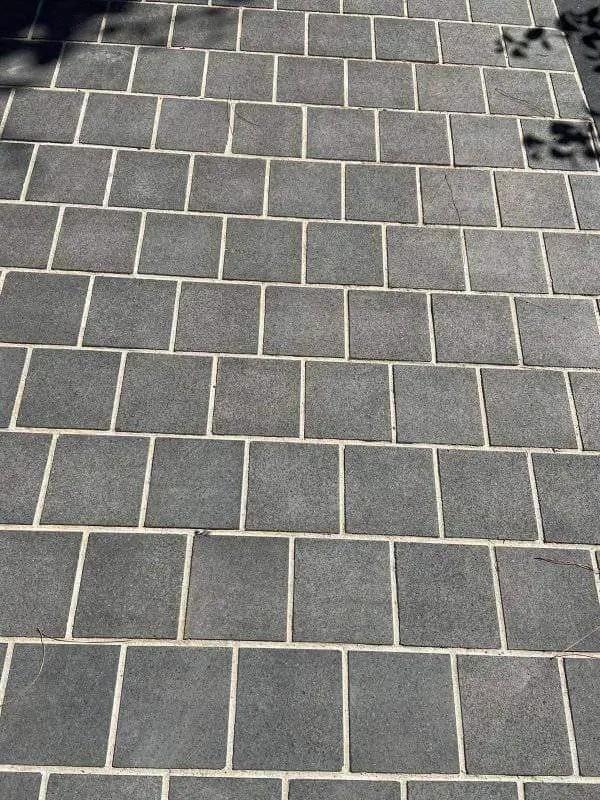
For blue black paving retail Arizona applications, 40mm slab thickness is your practical minimum for pedestrian-priority retail entries. You can push to 30mm in covered vestibule conditions where ponding risk is controlled, but exposed entry plazas in Prescott’s climate need the additional thickness to resist the thermal cycling that comes from afternoon shade moving across the surface. That daily heat-cool cycle creates micro-stress at thin cross-sections that standard compressive strength ratings don’t fully predict.
Consider how your drainage geometry interacts with the paving layout before finalizing joint patterns. The 1.5–2% minimum cross-slope recommendation in standard commercial paving specs assumes relatively uniform surface drainage — but Prescott’s site topography often introduces concentrated flow paths that need deliberate channel design rather than uniform slope.
- 40mm minimum for exposed retail entry plazas under direct foot traffic
- 50mm for service corridor adjacencies where occasional wheeled equipment crosses
- Minimum 1:80 cross-slope on all exterior paving runs to prevent ponding at joint lines
- Compacted aggregate base depth of 150mm minimum in Prescott’s zone — increase to 200mm on sites with documented clay subgrade
- Polymeric joint sand rated for commercial use — standard residential-grade products break down under high-UV Arizona exposure within 2–3 seasons
Thermal Performance in Arizona Professional Spaces
Here’s what most commercial specifiers underestimate about blue black limestone in Arizona’s high desert climate: the material’s dark surface absorbs significantly more solar radiation than its lighter counterparts, which means surface temperatures on an unshaded entry plaza can reach 140–155°F in peak summer — roughly 25–35°F above what you’d measure on an equivalent beige travertine surface. That’s not a disqualifier, but it does shape how you design the pedestrian experience around the material.
In Prescott‘s elevation range of 5,300–5,400 feet, the ambient temperature moderates the worst of low-desert heat extremes, which helps. Shade structure planning for blue black paving applications should still target 60–70% coverage for high-dwell areas like outdoor seating adjacent to retail entries. Covered portions of the same installation will perform closer to 115–120°F surface maximum, which remains comfortable for brief contact applications like building entry approaches.
For Arizona professional spaces — medical offices, law practices, financial services buildings — the thermal mass of blue black limestone in entry vestibule applications actually works as a passive temperature buffer. You’re looking at 3–4 degree interior temperature mitigation during peak afternoon hours when the vestibule slab has properly thermally coupled with the interior slab system. That’s not trivial for HVAC load calculations on tightly designed commercial shells.
Choosing Surface Finish for Commercial Applications
The finish decision on blue black limestone commercial Prescott projects carries more consequence than most specifications acknowledge. A flamed finish opens the surface slightly, reducing the deep charcoal intensity but dramatically improving wet-weather slip resistance — which matters for covered entry areas where water tracks in from Prescott’s monsoon events. A honed finish preserves the richest color expression but requires a penetrating sealer with documented R11 slip resistance ratings to meet commercial safety thresholds in wet conditions.
For Flagstaff-area commercial projects at higher elevation, the freeze-thaw consideration adds another dimension — a flamed or brushed finish with slightly more open texture drains faster and resists ice formation better than a sealed honed surface where water can pool in micro-depressions. Prescott sits at intermediate elevation, so you’re not managing hard freeze cycles as aggressively, but the principle of faster-draining finishes in shaded north-facing entries still applies.
- Flamed finish: Best for exterior plazas with uncontrolled wet exposure — consistent R11+ slip resistance without sealers
- Brushed finish: Balanced option for transitional covered-to-open applications — retains more color depth than flamed
- Honed finish: Reserved for interior vestibules and fully covered commercial walkways where moisture control is reliable
- Sawn finish: Acceptable for vertical facade panels — not recommended for any pedestrian paving surface without mechanical texturing
The technical nuances of brushed blue limestone paving are worth reviewing when you’re finalizing your finish spec for Arizona commercial projects — the brushed profile offers a particularly practical middle ground for mixed-use facades where cladding panels and ground-level pavers need visual continuity.
Base Preparation for Commercial-Grade Results
The installation quality gap in commercial limestone paving almost always traces back to base preparation, not material quality. Your spec can call for premium blue black limestone and still deliver a 10-year installation instead of a 25-year one if the aggregate base isn’t compacted to 95% Proctor density before the bedding layer goes down. That number isn’t a guideline — it’s the threshold below which differential settlement becomes statistically likely within the first three monsoon seasons.
Commercial projects in Prescott benefit from a crushed granite aggregate base rather than the decomposed granite sometimes used in residential applications. Crushed granite provides angular particle interlock that resists lateral movement under repeated loading — critical in entry plazas where delivery carts and ADA-compliant mobility equipment create concentrated point loads that exceed what pedestrian-only specs assume. At Citadel Stone, we consistently recommend the crushed granite base approach to commercial clients after seeing too many early-onset joint opening failures on projects where decomposed granite was substituted.
- Subgrade preparation: Proof-roll with vibratory compactor before aggregate placement — look for deflection under loading that indicates soft zones
- Aggregate base: 150–200mm crushed granite compacted to 95% Proctor density minimum
- Bedding layer: 25–30mm dry-pack mortar for rigid installation, or 25mm compacted bedding sand for flexible paving systems
- Expansion joints: Every 12–15 feet in both axes on exterior paving — don’t use the 20-foot figure in generic concrete specs
- Edge restraint: Commercial-grade aluminum or steel — plastic residential edging fails under sustained load within 3–5 years
Sealing and Long-Term Maintenance Planning
Sealing protocols for blue black limestone paving in Arizona differ from standard concrete maintenance because you’re working with a material that has genuine porosity — typically 1.5–3% — that responds to impregnating sealers rather than surface-film products. A topical sealer on exterior commercial paving creates a maintenance liability: it builds traffic wear patterns that become visually uneven within 18 months, and re-application requires surface preparation that creates downtime for retail tenants.
Impregnating sealers penetrate below the surface and don’t create a visible film, which means wear patterns don’t alter the stone’s appearance the way topical products do. For Prescott commercial applications, a fluorocarbon-based impregnator rated for natural stone provides the best combination of oil and water resistance without changing the surface texture profile that your slip resistance rating depends on. Initial application before installation — factory-sealed slabs — is the approach our technical team recommends for projects where post-installation sealing access will be constrained by retail operations.
In Sedona, where red iron oxide from surrounding soils creates distinctive staining pressure on natural stone paving, the impregnating sealer protocol is even more critical — but Prescott’s soil chemistry is less aggressive, giving you slightly more tolerance if maintenance cycles extend beyond the recommended 2–3 year re-application window.
- Initial sealer application: Before installation where possible — controlled environment produces better penetration
- Re-application cycle: Every 2–3 years for exterior commercial paving, every 3–4 years for covered applications
- Cleaning protocol: pH-neutral commercial stone cleaner only — acidic cleaners etch the surface and destroy sealer integrity
- Joint sand refresh: Inspect annually and replenish polymeric joint sand where wind erosion or ant activity has reduced fill level below 80% of joint depth
- Stain response: Address oil and grease staining within 48 hours — blue black limestone’s dark color conceals early staining but the pore structure will permanently bind petroleum compounds if untreated
Sourcing and Logistics for Commercial Projects
Your project timeline for blue black limestone commercial Prescott work needs to account for material lead times that differ substantially from domestic stone sources. Blue black limestone with consistent commercial-grade color and density typically sources from quarries in Asia or Europe, which means standard import cycles run 8–12 weeks from order to Arizona delivery — and that’s before warehouse processing and delivery scheduling. Locking your material spec and ordering early relative to your installation window isn’t optional on commercial projects; it’s the difference between hitting your tenant occupancy deadline and explaining a 6-week delay to a retail client.
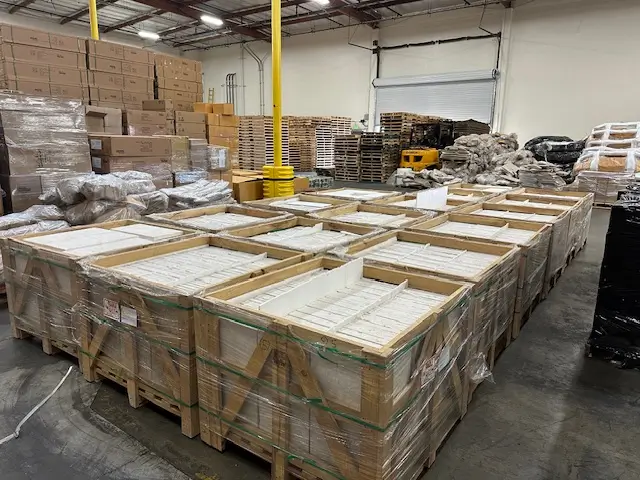
Citadel Stone maintains warehouse stock of blue black limestone in Arizona, which compresses that timeline significantly for projects that can work within available inventory dimensions. You’ll want to verify warehouse stock levels before finalizing your panel layout, since available slab dimensions directly affect your cut sheet and waste factor calculations. Our warehouse team can pull sample boards from specific lot runs so your architect can confirm color consistency before the full quantity commits — a step that saves significant rework when a second shipment doesn’t match the first batch’s tonal range.
Truck access at the delivery site is a practical constraint that often gets overlooked in commercial project logistics. Full flatbed truck deliveries for large slab orders require 14-foot clearance and a turning radius that many downtown Prescott commercial sites can’t accommodate at the curb. Coordinating a staging area within a reasonable proximity to the installation zone — or requesting boom truck delivery for tight sites — should be part of your pre-construction logistics planning, not a last-minute adjustment.
- Standard import lead time: 8–12 weeks from confirmed order to Arizona warehouse arrival
- In-stock lead time from Citadel Stone’s Arizona warehouse: typically 1–2 weeks depending on volume and truck scheduling
- Waste factor for commercial facade panels: 10–12% standard, 15% for complex geometric layouts
- Waste factor for ground-level paving: 8–10% for rectangular layouts, 15–18% for diagonal or custom-cut patterns
- Confirm delivery access requirements with your logistics contact before finalizing the truck delivery schedule
Your Action Plan for Blue Black Limestone Commercial Prescott Projects
The specification decisions that define a blue black limestone commercial Prescott installation’s long-term success aren’t made on installation day — they’re made at the drawing stage, when finish selection, panel thickness, base depth, and sealing protocol get locked into the project documents. The commercial applications where this material genuinely performs for 20-plus years share a consistent pattern: they treated the specification as an integrated performance system rather than a materials list with installation notes appended.
Your next step is confirming that your base prep spec aligns with actual site soil conditions — particularly if the project footprint sits on any previously developed land where fill material may be present at unexpected depths. For commercial projects in the Peoria metro area and across the broader Arizona market, soil variability between sites means generic base specs carry real risk. A geotechnical report review before your base depth spec is finalized is time well spent.
As you finalize your material and application planning, consider how evening ambiance affects your commercial exterior’s year-round performance — Blue Black Limestone Paving Night Lighting for Marana Evening Ambiance explores how blue black limestone responds under artificial lighting conditions, which is a relevant dimension for Prescott business exteriors where evening foot traffic drives a meaningful share of business. Citadel Stone supplies commercial-grade blue black limestone for Prescott business exteriors, with technical guidance available from our team throughout the specification and installation process.
Citadel Stone has a vast selection of blue limestone slabs in Arizona for creating custom hearths.