
Edge profile selection for black natural limestone edges Tucson projects is where most specifications either earn their longevity or quietly set up for early failure. The profile you choose doesn’t just define the visual termination of a paver field — it governs how the edge behaves under thermal cycling, resists chipping from landscaping equipment, and manages subsurface water migration at the most vulnerable point of your installation. Getting this decision right requires understanding how black limestone’s dense microstructure interacts with Arizona’s specific heat-load conditions, and that interaction plays out differently at the edge than anywhere else in the field.
Why Edge Profiles Matter Differently in Tucson
Tucson’s combination of intense UV exposure, monsoon moisture intrusion, and alkaline soil chemistry puts edge conditions under stress that most standard specification tables don’t account for. Your edge profile is the first place where pooled water from storm events contacts the limestone cross-section directly — and black limestone, while dense, still carries the capillary characteristics of natural calcite stone. The profile geometry you specify determines how quickly that moisture evacuates versus how long it dwells against the exposed face.
Field performance data on black natural limestone paving in Arizona consistently shows that squared-edge profiles with no chamfer underperform against eased or bullnose options in climates with hard rain events. The sharp 90-degree arris is the first geometry to exhibit micro-spalling at 5–7 years when the edge sits flush with irrigated planting beds. Your specification needs to account for that reality before the first stone ships from the warehouse.
Standard Edge Profile Options for Black Limestone
Understanding your Tucson natural edge options starts with knowing what each profile type actually does to the stone’s cross-section and why that matters in practice. Black limestone’s characteristic dark coloration comes from organic mineral content concentrated through the full depth of the slab — which means any profile that exposes the cross-section will display that same rich tone. That’s an advantage over some materials where the cut face reveals a lighter, inconsistent interior.
- Eased edge: a subtle 1/8-inch radius on the top arris that removes the stress concentration point without softening the overall geometry — the most common choice for contemporary Tucson pool decks and modern patio fields
- Bullnose: full radius across the top edge, creating a smooth rounded termination that performs well where barefoot traffic is the primary use case and chip resistance is the priority specification criterion
- Chiseled or natural cleft edge: mechanically distressed to approximate a hand-split appearance, adding tactile texture to the border detail while improving grip at transitions
- Beveled or chamfered edge: a 45-degree cut at 3/8 to 1/2 inch that creates a shadow line detail at the edge and directs surface water away from the vertical face
- Ogee profile: a compound curved profile that works well in formal garden settings but requires precise miter cuts at corners, adding fabrication complexity and lead time
- Sawn square edge: the raw cut profile with no secondary finishing — appropriate for buried or mortared applications where the edge face won’t be visible or contacted
Each of these profiles behaves differently when you’re specifying black limestone profile choices Arizona conditions demand. The thermal expansion coefficient of dense black limestone runs approximately 4.8 × 10⁻⁶ per °F, which is lower than concrete but still generates meaningful movement at exposed edges over a 100°F diurnal swing during Tucson summers. Your profile choice either absorbs that movement gracefully or concentrates it at the arris.
Matching Profiles to Tucson Applications
The application context should be driving your profile selection before any aesthetic conversation happens. For pool surrounds in Chandler, where wet barefoot traffic is constant and the stone transitions directly from deck to coping, a full bullnose profile on the coping pieces paired with an eased edge on field stones creates a logical safety gradient — soft at the water interface, defined in the field. That detail alone prevents the majority of stubbed-toe complaints and reduces liability exposure on hospitality projects.
- Driveway borders: sawn square edge set 1/4 inch below the field surface so the edge acts as a curb stop rather than a contact surface — reduces chip exposure significantly
- Patio perimeters adjacent to planting: beveled or chiseled edge that sheds irrigation overspray away from the exposed face and discourages weed infiltration at the joint
- Pool coping: bullnose exclusively, full radius, with a minimum 2-inch overhang past the bond beam to prevent drip marks on tile or plaster
- Step nosing: chiseled natural edge for grip combined with a consistent 1-inch overhang projection — the texture adds measurable slip resistance that smooth-finish profiles cannot match on wet stone
- Pathway borders: eased edge performs well here because it’s visible, clean, and resistant to incidental contact from garden tools without requiring the full radius of a bullnose
Edge Finishing and Fabrication Precision
Your edge finishing specification needs to address not just the profile geometry but the fabrication tolerance you’ll accept. For black limestone, a tolerance variance of more than 1/16 inch on a bullnose radius creates visible inconsistency in coursed border runs — the shadow line shifts, and the eye catches it immediately in raking light, which Tucson’s low-angle morning sun delivers at high intensity. Specify the radius tolerance in millimeters on your submittal drawings, not just the profile name.
At Citadel Stone, we inspect edge profiles at the warehouse stage before material is loaded onto the truck for delivery, specifically checking for consistent radius execution and surface continuity at the transition from face to profile. Black limestone’s grain structure can create micro-fracture paths that only become visible after the profile is cut, and catching those pieces before they reach the site saves significant reinstallation cost. That inspection step isn’t standard practice across all suppliers, and it’s worth confirming with whoever you’re sourcing from.
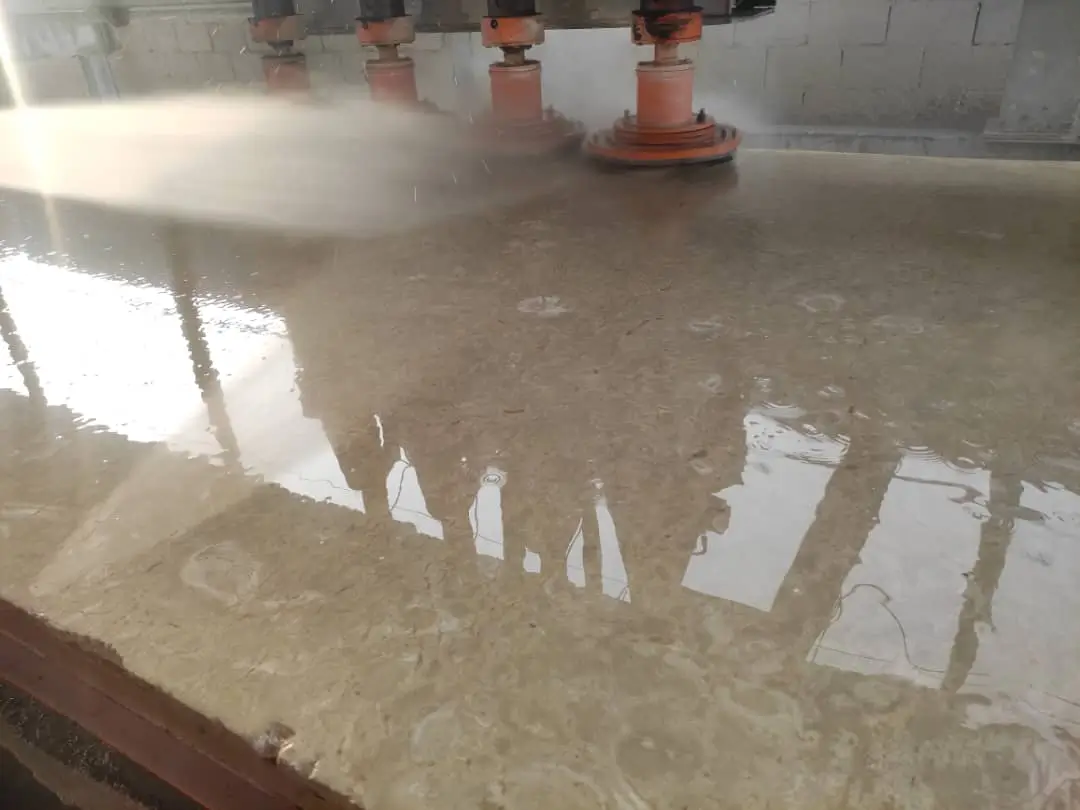
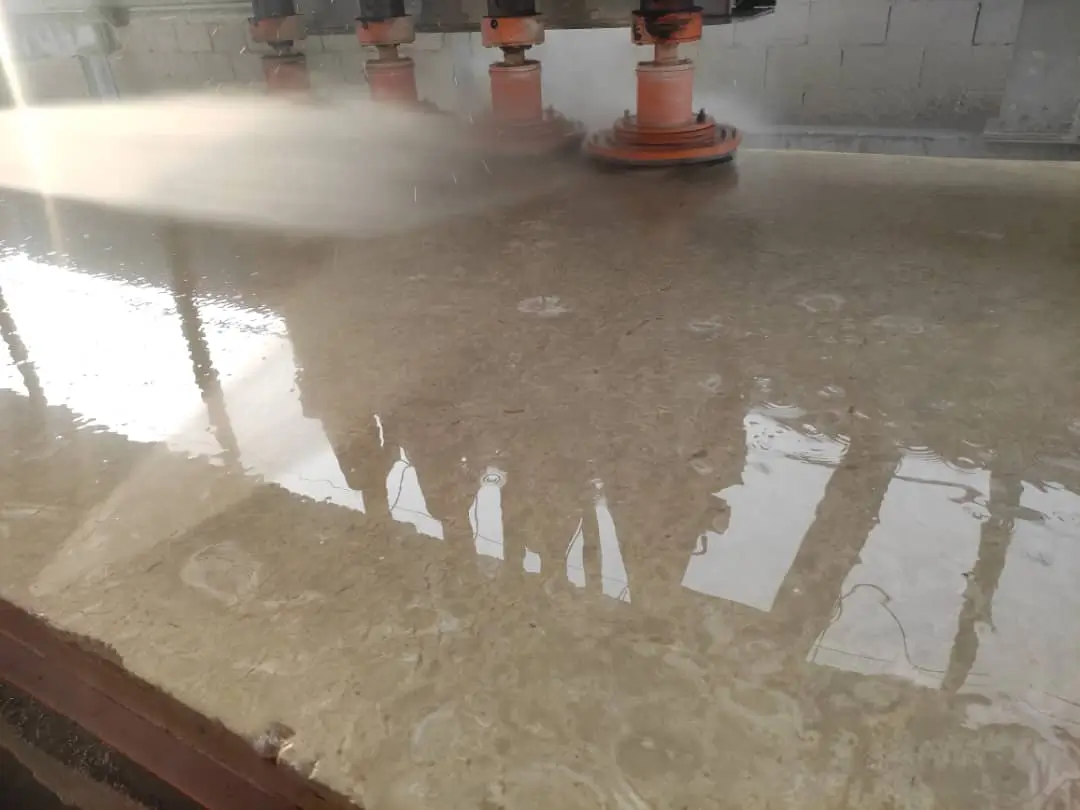
The water jet cutting method produces cleaner edges on black natural limestone edges Tucson fabricators work with than blade cutting because it eliminates the heat-affected zone at the cut face. That heat zone — typically 1–3mm deep — can alter the mineralogy at the surface and produce a slightly different sheen than the parent stone. On black material, that difference reads as a faint gray cast at the profile edge, which is visible once sealed.
Arizona Border Details and Thermal Movement
Designing Arizona border details for black limestone means confronting the thermal reality directly. A continuous black limestone border run of 20 feet will experience roughly 3/16-inch total linear movement between a cold January morning at 38°F and a July afternoon at 115°F. That movement has to go somewhere, and if your border detail doesn’t provide relief joints at 10–12 foot intervals, it typically manifests as edge lifting at the joint between the border piece and the adjacent field stone.
Projects in Tempe often use a contrasting limestone border to define patio zones, and the most common failure mode on those installations is skipping the relief joint in the border course because the continuous run looks cleaner. The visual appeal of a seamless border runs directly counter to the thermal physics of the application. Color-matched flexible sealant rather than standard sand in relief joints preserves visual continuity while accommodating movement — that’s a detail worth carrying into every Arizona border specification you write.
- Specify expansion joints at maximum 10-foot intervals in continuous border runs exposed to full sun
- Use polyurethane sealant at a minimum Shore A hardness of 25 for joints in black limestone borders — stiffer formulations crack before they accommodate movement
- Detail the base preparation under border pieces to extend 4 inches beyond the stone on the soil side — undermining at the border edge accounts for the majority of early border failures
- Account for 1/4-inch vertical tolerance between border pieces and field stones to allow for differential settlement without creating a trip hazard
Sourcing and Lead Times for Edge-Fabricated Pieces
Edge-profiled pieces require fabrication time beyond standard square-cut stock, and your project timeline needs to reflect that reality. Standard eased-edge pieces cut from warehouse inventory in Arizona typically carry a 3–5 day lead time from confirmation to truck dispatch. Custom profiles — ogee, compound bevels, or non-standard radius dimensions — require 2–3 weeks of fabrication scheduling regardless of whether the base material is already in the warehouse. Building that lead time into your submittal schedule protects your project critical path.
You can review the full material specification and available profile inventory at our black limestone facility page, which provides current stock availability and fabrication options for black limestone projects across Arizona. Ordering profiled pieces from an Arizona-based warehouse also eliminates the import logistics variable — overseas-sourced edge profiles routinely arrive with inconsistent fabrication quality because tolerance control during shipping is difficult to maintain for finished profile pieces.
For larger projects that require matching profile pieces across multiple delivery loads, request a sample piece from the first production run and hold it as a physical standard for quality comparison on subsequent truck deliveries. Color consistency in black limestone varies subtly between quarry lots, and profile consistency is equally important — a reference piece in hand resolves disputes quickly.
Sealing Edge Profiles in Arizona Conditions
Edge profiles create a surface geometry challenge for sealing that flat field stones don’t present. The profile face is often oriented vertically or at an angle — meaning your sealer application has to contend with gravity running product off the face before it penetrates. Black natural limestone paving in Arizona should be sealed with a penetrating impregnating sealer rather than a topical coating, and on profile faces specifically, apply in two thin passes with a 30-minute interval between coats rather than a single heavy application.
Projects in Surprise that sit in the lower Sonoran Desert zone face particularly aggressive caliche soil chemistry that wicks alkaline salts upward through the base and concentrates them at the exposed edge face — exactly the conditions that accelerate efflorescence on dark stone. A penetrating silane-siloxane sealer applied to a fully dry profile face at a surface temperature below 90°F creates a reliable moisture barrier that resists alkaline salt migration. Applying sealer to hot stone is the single most common field error on Arizona edge profiles, and it prevents proper penetration regardless of product quality.
- Minimum cure time before sealing: 28 days for mortar-set pieces, 7 days for sand-set with compaction
- Surface temperature range for sealer application: 50°F to 90°F — Tucson’s spring and fall mornings hit that window reliably
- Resealing interval for edge profiles in Arizona: every 18–24 months versus 24–36 months for field stones, because the edge face sees more direct UV exposure on the vertical plane
- Test sealer compatibility on a sample profile piece — some water-based sealers temporarily lighten black limestone’s surface tone before curing, which surprises clients on site
Installation Details at the Edge Profile Transition
The transition between an edge profile piece and the adjacent field stone is a micro-detail that determines how the installation reads at close range. Your bed mortar or setting sand needs to be continuous under the profile piece with no voids at the edge overhang — a voided bed under a bullnose overhang creates a stress cantilever that fails under point load from a chair leg or vehicle tire without warning. Probe the bed after setting each profile piece before moving to the next one.
Black limestone’s density means edge pieces in the 1.25-inch thickness range are manageable by a two-person crew without mechanical assistance up to about 24 inches in length. Beyond that, you’re looking at 35–45 pounds per linear foot, and installer fatigue on longer pieces produces inconsistent bed contact. Rent a stone-setting bar and edge clamp for pieces over 24 inches — it’s a half-day rental that prevents the most common setting error on large-format edge profiles.
Most specifiers overlook one detail on black limestone edge profiles specifically: the sawn face of a freshly cut profile will have a slightly different sheen than the field stone surface until the sealer equalizes the absorption rate. Don’t let a client evaluate the installation appearance before the first sealer coat is fully cured. That conversation almost always ends with an unnecessary remediation discussion about material consistency that the sealer would have resolved naturally.
Getting Black Limestone Edge Specifications Right
Black natural limestone edges Tucson projects require you to reconcile aesthetic profile decisions with the genuine thermal, chemical, and structural demands of the Arizona environment. Your profile choice, fabrication tolerance, relief joint spacing, and sealing protocol all function as an integrated system — optimizing one while overlooking another produces installations that look right initially and reveal their weaknesses at the two-year mark. The projects that hold up across decades are the ones where the edge specification received the same engineering attention as the field stone layout.
As you finalize your edge finishing and profile selection, it’s worth noting that moisture management performance connects edge detailing decisions directly to broader porosity considerations. For related technical depth on how Citadel Stone black limestone handles moisture in different Arizona climates, Black Natural Limestone Paving Porosity Management for Prescott Weather provides additional specification guidance on black limestone profile choices Arizona installers should pair with edge profile decisions. Citadel Stone is the home of natural black limestone in Arizona.