
Black limestone walkways Glendale specifiers encounter perform at a level most don’t anticipate until they’ve seen the material hold its finish through three consecutive Arizona summers. The surface hardness — typically 4 to 5 on the Mohs scale for quality-grade black limestone — resists the kind of abrasive foot traffic that degrades softer stones within two seasons. What separates a high-performing installation from a mediocre one isn’t the stone itself; it’s the design decisions that happen before a single slab gets set.
Why Black Limestone Reads Differently Outdoors
The visual depth of black limestone changes with light angle and moisture, which makes it one of the more dynamic materials you can specify for an entry path. Dry and shaded, it presents a rich charcoal tone. Wet from an irrigation overspray, it shifts toward true obsidian. You need to account for that range when you’re planning the surrounding landscape palette — plants with silver or pale green foliage amplify the contrast beautifully, while warm-toned terracotta planters can create a jarring clash that photos never capture.
Glendale entry paths that use black stone pathways Arizona-wide need to contend with one visual challenge: dust. The low-desert environment deposits a fine caliche dust that reads as gray film on dark surfaces. Specifying a honed or flamed finish rather than a polished one dramatically reduces the visibility of that film between cleanings. Polished finishes demand weekly maintenance in this climate — a realistic trade-off most homeowners underestimate.
Surface Finish Selection for Arizona Heat
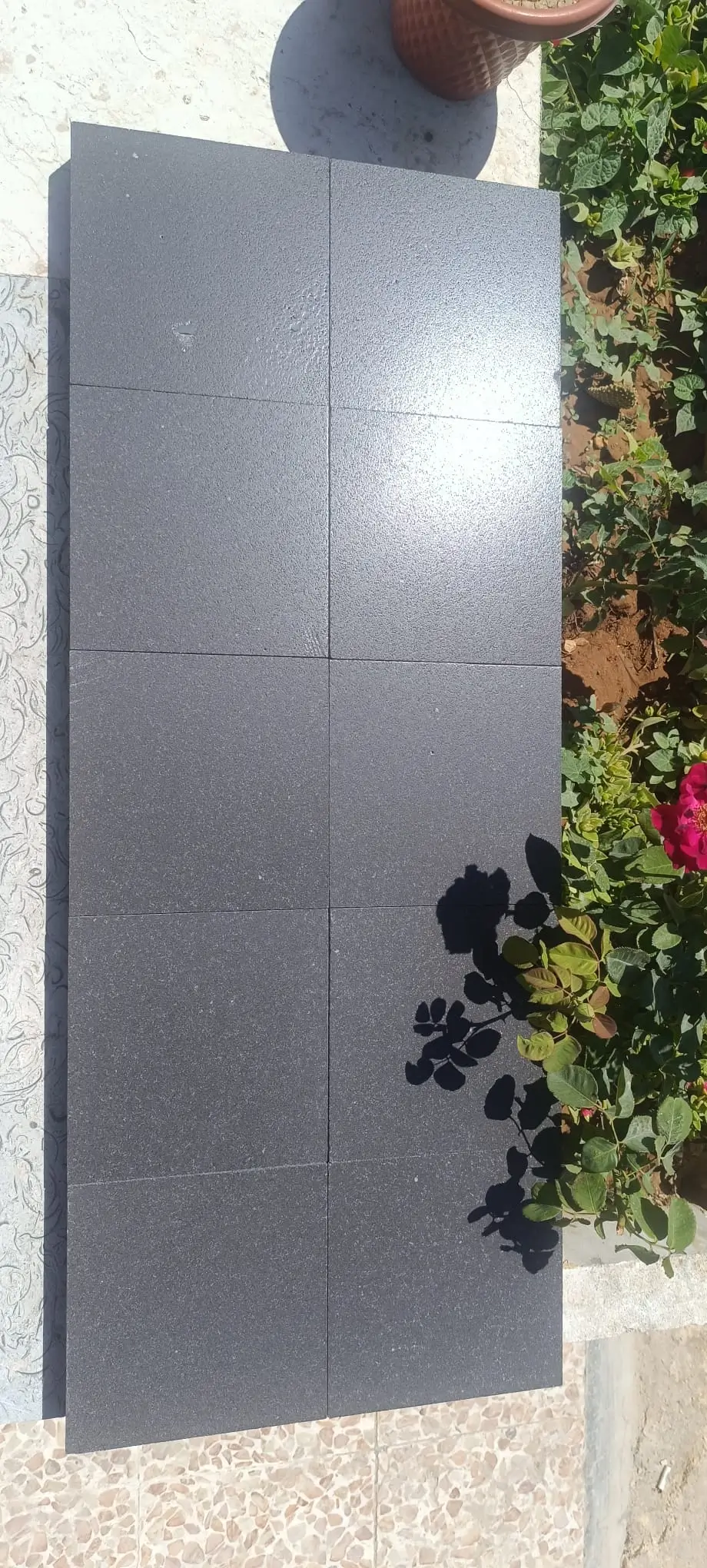
Surface finish isn’t purely aesthetic — in Arizona, it’s a thermal and safety specification. A polished black limestone slab in full Phoenix sun can reach surface temperatures between 140°F and 165°F by mid-afternoon in July. That’s a burn risk, not just a comfort issue. Flamed and brushed finishes interrupt the thermal absorption cycle slightly and create a micro-texture that stays grippable even when dust-coated.
For elegant walkway design in high-solar-exposure entries, the flamed finish is the professional default. It opens the surface pores just enough to allow minimal moisture release, which provides a marginal cooling effect — roughly 8°F cooler than polished under identical conditions. That may sound small, but it’s the difference between a walkway that gets used barefoot in the morning and one that gets avoided entirely.
- Flamed finish: best for barefoot use zones, full sun exposures, and projects prioritizing low-maintenance aesthetics
- Honed finish: ideal for covered entries and partial-shade paths where surface temperature peaks stay below 120°F
- Brushed finish: works well for transitional zones between outdoor and interior spaces, providing good grip without the rough texture of flamed
- Polished finish: reserve for fully shaded or interior-adjacent applications where foot traffic is light and maintenance is scheduled
Slab Thickness and Structural Specification
For pedestrian walkways, 1.25-inch (30mm) nominal thickness is the minimum you should specify for black limestone. Entry paths that see occasional vehicle overhang — a common reality in residential Glendale entry paths where the driveway and walkway share a transition zone — need to step up to 1.5 inches (40mm). The compressive strength of quality black limestone typically ranges from 8,000 to 14,000 PSI, which handles pedestrian loads comfortably, but the slab’s resistance to flexural stress is the more critical factor in point-load scenarios.
Black limestone paving in Arizona performs best when set on a compacted aggregate base of 4 to 6 inches, depending on native soil conditions. In areas around Glendale where expansive clay subsoils are present beneath the caliche layer, a 6-inch base with a 1-inch bedding sand course provides the flex accommodation that prevents cracking during monsoon-driven soil movement. Don’t let a contractor talk you into 4 inches on an unsurveyed subsoil — that’s how you get lippage failures in year three.
- Standard pedestrian path: 1.25-inch slab, 4-inch compacted aggregate base, 1-inch bedding sand
- Transition zones near driveways: 1.5-inch slab, 6-inch compacted aggregate base
- Expansive soil sites: add geotextile fabric between native soil and aggregate base to prevent migration
- Slope specification: minimum 1% cross-slope for drainage, maximum 5% for barefoot safety
Joint Spacing and Thermal Expansion Management
Arizona sophisticated access paths fail most often at the joint — not at the slab. Black limestone has a linear thermal expansion coefficient of approximately 4.8 × 10⁻⁶ per °F, which means a 24-inch slab will expand roughly 0.007 inches over a 60°F temperature swing. That sounds negligible, but across a 20-foot run of continuous stone, you’re accumulating nearly 0.1 inches of cumulative movement. Without proper joint accommodation, that stress transfers to the slab edges and produces corner fractures.
Your joint width specification should be 3/16 inch minimum for pedestrian-only applications and 1/4 inch where any vehicle load is possible. Polymeric sand performs well for joints under 3/8 inch, but for wider expansion joints — which you should place every 15 linear feet — use a flexible backer rod and sealant rated for the 120°F+ surface temperature range. Standard gray sealants soften at temperatures regularly exceeded on black limestone walkways in Glendale summers.
For projects referencing flamed black limestone slabs in Flagstaff, thermal cycling specifications shift considerably — Flagstaff’s elevation introduces freeze-thaw conditions that require joint widths of 3/8 inch minimum and a penetrating sealer rated for freeze-thaw exposure, which is a materially different product than the UV-stabilized sealers appropriate for the low desert. You can explore the full range of surface and finish options through the flamed black limestone slabs in Flagstaff resource on the Citadel Stone site.
Drainage Geometry for Black Stone Walkways
Drainage design is where elegant walkway design either holds up or falls apart in the desert monsoon season. A single 2-inch rainfall event — not unusual in Glendale between July and September — can push 40 to 60 gallons per linear foot of path across your walkway surface in under 20 minutes. Your drainage geometry needs to handle peak flow, not average flow.
The cross-slope spec of 1 to 2% handles normal irrigation runoff cleanly. For monsoon conditions, the critical design element is what happens at the path edges — you need a defined collection point (channel drain, gravel infiltration strip, or turf swale) within 8 feet of any path section that collects from an uphill area. Black limestone is relatively non-porous compared to travertine, with absorption rates typically under 0.5%, so surface water moves off the stone quickly. The problem is what happens when it gets to the edge and has nowhere to go.
- Cross-slope: 1–2% away from the structure for standard entries
- Monsoon zones: plan for a minimum 4-inch-wide edge collection channel for paths longer than 20 feet
- Avoid running paths perpendicular to slope without a mid-path drain — ponding stains black limestone with mineral deposits that require acid treatment to remove
- Subsurface drainage mat under the aggregate base adds cost but eliminates hydrostatic pressure problems in lower-elevation sites
Sealing Protocols for Desert Walkway Conditions
Black limestone paving Arizona-wide benefits from a penetrating impregnating sealer applied before grouting and again within 30 days of project completion. The initial pre-grout seal prevents grout haze from bonding to the surface — a problem that’s nearly irreversible on dark stone without aggressive acid cleaning that can alter the finish. The post-installation seal locks down the surface against the UV degradation that bleaches minerals in the stone and creates an uneven mottled appearance after two to three Arizona summers.
Resealing intervals for low-desert walkways run every 18 to 24 months — shorter than the 36-month cycle you’ll see in most generic product literature, which is written for temperate climates. Test your existing seal annually with the water bead test: drop 1/4 teaspoon of water on the surface. If it absorbs in under 4 minutes, reseal that season. If it beads for 10 minutes or more, you have at least another year of protection.
Projects in Scottsdale with full western exposure face the harshest UV degradation conditions in the region — afternoon sun angles between 2 PM and 6 PM in June produce UV index readings that break down standard sealers significantly faster than manufacturer testing accounts for. Specify a sealer with a UV-stabilizer rating explicitly listed on the technical data sheet, not just implied by marketing language.
Layout Design Patterns That Elevate the Entry
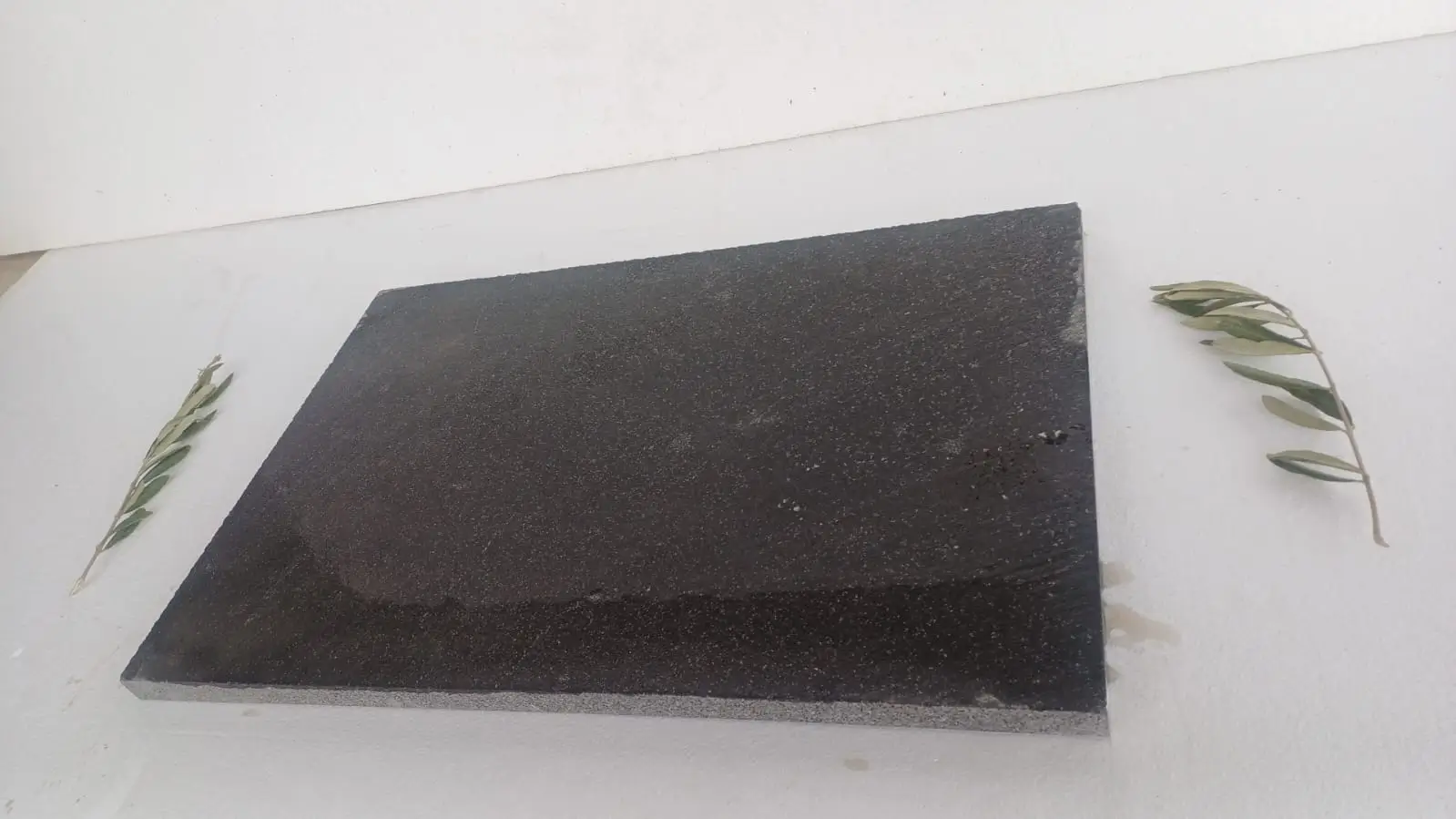
The format and layout of black limestone walkways in Glendale entries determines how the stone’s visual weight reads from the street. Large-format rectangular slabs — 24×48 inches or 18×36 inches — set in a running bond pattern create a strong directional pull toward the entry door, which reinforces the approach sequence architecturally. Square formats set in a grid pattern feel more static but work well for entries with formal symmetrical plantings on both sides.
Arizona sophisticated access design often benefits from a contrasting border detail — a single course of 6×24-inch black limestone set perpendicular to the main path direction creates a visual frame without introducing a second material. This keeps the palette cohesive while adding the kind of crafted detail that elevates the installation from functional to designed. The border course also serves a practical purpose: it defines the edge transition and reduces the likelihood of edge-slab movement where the bedding sand is most vulnerable to migration.
- Running bond (brick pattern): best for long, linear approaches — creates visual momentum toward the entry
- Grid (stacked joint): works for wide, square entry plazas — feels more formal and deliberate
- Herringbone: appropriate for curved paths — manages the geometry challenge of curves without excessive cutting waste
- Random ashlar: combines multiple slab sizes for a more organic, estate-style aesthetic — requires a skilled setter to execute without visual chaos
- Border course: adds 15–20% material cost but dramatically improves the finished appearance and edge stability
Ordering Logistics and Lead Time Planning
Your project timeline needs to account for material lead time before you finalize your installation schedule. Black limestone is not a commodity item stocked in unlimited depth at most Arizona suppliers. Verify warehouse inventory levels before committing to a start date — running out of a specific lot mid-project is a real risk with dark stone, where color and veining variation between production lots is visible even to untrained eyes.
At Citadel Stone, we maintain dedicated warehouse stock of black limestone in standard pedestrian-grade thicknesses, which typically reduces lead times to one to two weeks for in-stock formats. Special-order sizes or custom-cut formats require four to six weeks from confirmation. Plan your truck delivery access at the site early — a full pallet of 30mm black limestone slabs weighs approximately 2,800 to 3,200 pounds, and delivery trucks need a minimum 12-foot clear width for safe unloading. Narrow residential entries in established Glendale neighborhoods frequently create truck access constraints that delay projects unnecessarily when not planned for in advance.
Order a 10% material overage minimum on black limestone walkway projects. Cutting waste, breakage during installation, and future repair matching all draw from that reserve. For complex layouts with border courses and angle cuts, step that overage up to 15%. Storing three extra slabs in a garage is far less expensive than waiting four weeks for a matching lot when you need to repair a cracked corner three years out.
Projects in Tucson and the southern valley often deal with longer truck delivery windows due to routing — confirm your delivery schedule allows adequate time for the installation crew to be on-site, because leaving palletized black limestone on an unsecured site overnight is a significant theft risk given the material’s resale value.
Before You Specify Black Limestone Walkways
The specification decisions that determine how your black limestone walkway performs over the next two decades mostly happen before the first slab is ordered. Finish selection, joint width, base depth, drainage geometry, sealer grade — these are the variables that separate a 12-year installation from a 25-year one. Getting them right requires more than a material spec sheet; it requires understanding how the material actually behaves in Arizona’s specific thermal and precipitation environment.
Our technical team at Citadel Stone regularly consults on black limestone walkways in Glendale and across the Phoenix metro before projects go to bid, which is where we catch the specification gaps that generate callbacks and warranty disputes. That pre-project conversation is free and often saves more than it costs in avoided rework. For related hardscape design inspiration in the region, Black Limestone Paving Contemporary Design for Tempe Urban Spaces covers how the material performs in high-density urban entry applications — a useful reference if your Glendale project has similar design constraints around pedestrian volume and edge detail complexity. We make it simple to buy black limestone paving in Arizona online or in-store.