
Black limestone sealing in Scottsdale isn’t a maintenance checkbox — it’s the single variable that separates a stunning, decade-long installation from one that starts showing efflorescence and surface etching within eighteen months. The Sonoran Desert’s combination of intense UV radiation, alkaline caliche soils, and hard mineral-rich water creates a chemical environment that attacks unsealed dark stone from multiple directions simultaneously. Understanding exactly how these forces interact with black limestone’s dense crystalline matrix is what drives every black limestone sealing Scottsdale decision you’ll make on an Arizona project.
Why Black Limestone Demands Different Treatment in Arizona
Dark-colored natural stones absorb significantly more radiant heat than their lighter counterparts, and black limestone can reach surface temperatures of 140–160°F under direct Scottsdale summer sun. That thermal cycling — rapid heating through the day and cooling overnight — drives moisture vapor movement through the stone’s pore structure more aggressively than most installers anticipate. You’re not just sealing against liquid water infiltration; you’re creating a vapor management system that has to perform across a 90°F daily temperature swing without delaminating or clouding.
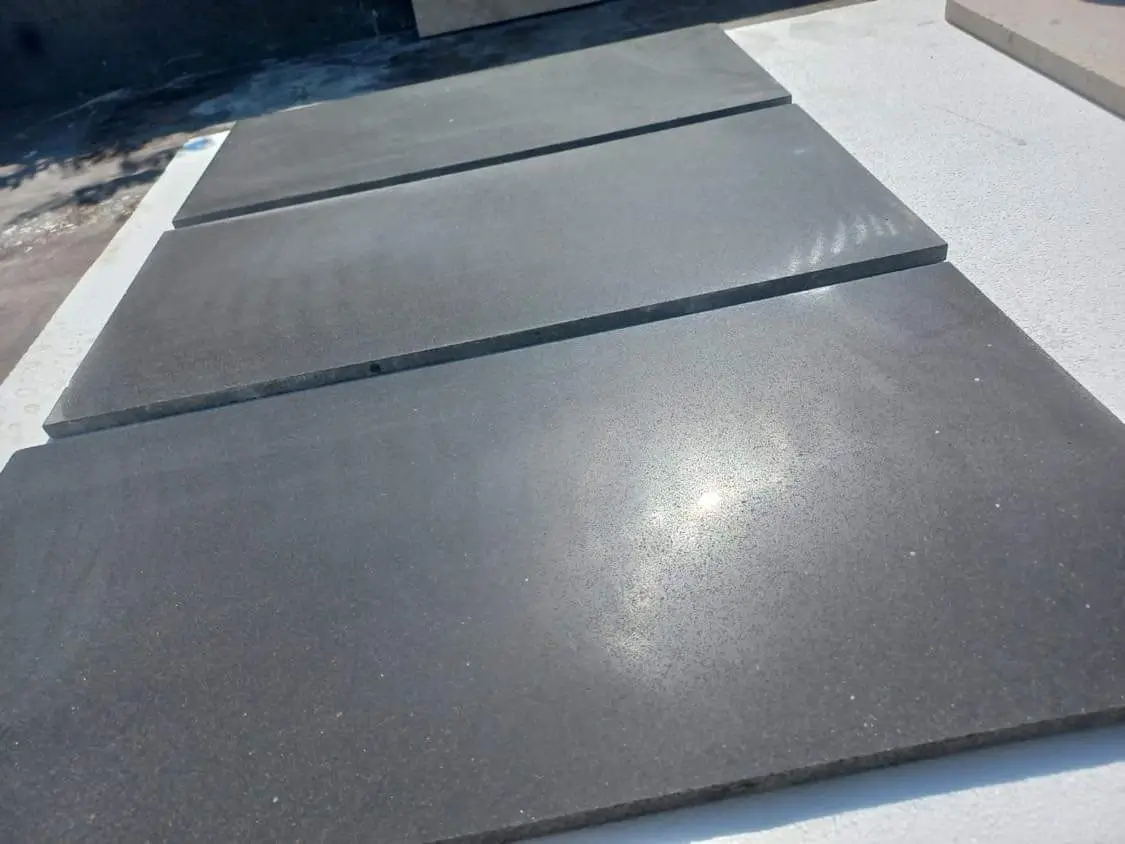
The stone’s density is both an asset and a complication. Black limestone typically exhibits lower porosity than travertine or sandstone — absorption rates in the 0.3–0.8% range by weight — which means it doesn’t soak up sealant as readily and requires more precise application technique to achieve genuine penetration. Surface flooding the product gives you a film that peels, not a matrix that protects. Getting sealant into the stone, not onto it, is the technical standard you should hold your installation to.
Black limestone paving in Arizona also picks up mineral deposits more visibly than lighter stones. The white calcium carbonate residue from hard water — Phoenix municipal water runs at 200–300 ppm total dissolved solids — reads like chalk against a dark background. A quality impregnating sealer dramatically slows this process by reducing the capillary action that draws mineralized water to the surface as it evaporates.
Sealer Types and Their Arizona Performance Profiles
The sealer category decision matters more than the brand. For black limestone sealing in Scottsdale conditions, you’re choosing between three primary chemistries, each with distinct performance trade-offs that the Arizona climate exposes quickly.
- Penetrating silane-siloxane sealers: these molecular-level treatments bond within the stone matrix rather than forming a surface film, providing excellent breathability and UV stability — critical for outdoor Arizona applications where vapor-trapping sealers fail within 18–24 months
- Fluoropolymer impregnating sealers: offer superior stain resistance and heat tolerance up to 300°F, making them the appropriate choice for pool decks and outdoor kitchen areas in Scottsdale where cooking splash and chlorinated water create dual chemical challenges
- Acrylic topical sealers: deliver a wet-look or gloss finish that many homeowners find appealing initially, but Arizona’s UV index degrades acrylic coatings rapidly — expect yellowing and peeling within 2–3 years on south-facing exposures, requiring complete stripping before recoating
- Natural-look penetrating sealers: solvent-based formulations that enhance the stone’s inherent depth without altering sheen, the most commonly specified option for black limestone maintenance Arizona projects where natural aesthetics are the design intent
For most Scottsdale residential projects, a premium silane-siloxane or fluoropolymer impregnating sealer with a 10–15 year rated service life represents the best value calculation. The upfront cost differential between a quality penetrating sealer and a budget acrylic product disappears completely when you factor in the stripping labor on an acrylic failure at year three.
Surface Preparation: The Step That Determines Everything
Your sealing outcome is decided before you open the sealer container. Surface preparation quality correlates directly with sealer adhesion, penetration depth, and service life — and this is where most DIY and contractor applications fall short in Scottsdale’s climate.
The desert environment leaves a specific contamination profile on black limestone surfaces: fine silica dust from the Sonoran Desert’s periodic dust storms, calcite scale from sprinkler overspray, and residual alkaline compounds from caliche-influenced soils. Standard pressure washing removes surface debris but doesn’t address the mineral scale or chemical residue that prevents molecular bonding between sealer and stone. A pH-appropriate cleaner — typically a diluted phosphoric acid solution at 5–10% concentration — applied with a stiff nylon brush, followed by thorough neutralization and a minimum 48-hour dry time before sealing, is the correct sequence for black limestone maintenance Arizona conditions demand.
- Surface moisture content must be below 4% — use a calcium chloride moisture test or pin-type moisture meter; Scottsdale’s low humidity typically gets you there within 48 hours of washing, but shaded areas with poor airflow may need 72 hours
- Efflorescence must be fully removed with appropriate crystalline salt removers before sealing, or you’ll trap the salts beneath the sealer and accelerate delamination
- Joint sand should be at full depth — degraded jointing sand allows water ingress at the perimeter of each paver, bypassing your sealer investment entirely
- New limestone installations should cure for a minimum of 28 days before initial sealing to allow residual alkalinity from setting materials to dissipate
Application Technique in Extreme Heat Conditions
The black limestone sealing window in Scottsdale is narrower than most product data sheets suggest. Standard guidance says apply when ambient temperature is between 50–90°F, but your substrate temperature is what actually governs open time and penetration behavior — and black stone in direct June sun at 9 AM is already at 100°F before the air hits 85°F.
Schedule sealing for early morning applications in the summer months, targeting surface temperatures below 85°F. This typically means working between 5:30 and 8:30 AM from June through September. Solvent-based sealers flash off at dramatically accelerated rates above 90°F substrate temperature, leaving a surface film rather than achieving penetration. Water-based sealers experience the opposite problem — the water carrier evaporates before the active chemistry has time to migrate into the pore structure. Neither scenario gives you the Scottsdale stone protection you’re paying for.
Apply using a low-pressure pump sprayer at 30–40 PSI, working in 3×3 foot sections and back-brushing immediately with a lambswool applicator to work product into the surface and prevent pooling in low spots. A second coat applied wet-on-wet while the first is still tacky achieves a dual-layer penetration profile that single-application techniques don’t match. At Citadel Stone, we consistently recommend the two-coat wet-on-wet method for Phoenix and Scottsdale projects specifically because the substrate temperatures make single-coat penetration unreliable.
Establishing the Right Sealing Frequency for Arizona Stone Protection
The Scottsdale stone protection schedule differs from what you’d follow in more temperate climates, and generic sealer manufacturer guidance typically undersells the maintenance frequency Arizona conditions require. UV degradation, thermal cycling, and hard water mineral exposure collectively shorten sealer service life by 30–40% compared to Pacific Northwest or Midwest performance benchmarks.
- Initial sealing: 28–60 days after installation, after the curing period clears
- High-traffic areas (driveways, pool decks): reseal every 2–3 years for penetrating sealers, annually for topical products
- Low-traffic areas (garden pathways, covered patios): 3–5 year resealing intervals are generally adequate with premium penetrating products
- After chemical exposure events (pool acid washing splash, fertilizer contact): spot-treat affected areas within 30 days regardless of schedule
- Water bead test: pour water on the surface — if it absorbs rather than beading within 30 seconds, sealer is exhausted and reapplication is overdue
Sealing dark pavers on a fixed calendar without the water bead test leads to both over-sealing (product buildup that clouds dark surfaces) and under-sealing (protective gaps that allow staining). The bead test costs nothing and takes 30 seconds. Build it into your spring and fall inspection routine, and you’ll optimize your sealing schedule without guesswork.
How Scottsdale’s Heat and UV Exposure Degrades Stone Sealers
The Sonoran Desert delivers roughly 300 sunny days annually, and UV index values regularly exceed 10 in summer months — the extreme category. This creates a specific failure mode for sealers that most product specifications don’t address transparently: UV photodegradation of the polymer chains that give sealers their water-repellent and stain-resistant properties.
For Tucson and Scottsdale installations, look for sealers that explicitly list UV stabilizers in their formulation. Silane-siloxane chemistry has inherent UV resistance because the silicon-oxygen bond at its core is not photosensitive — the same reason silicone sealants maintain flexibility for decades outdoors. Acrylic and urethane-based topical sealers contain organic polymer chains that UV light breaks down, creating the characteristic chalking and yellowing that ruins the aesthetic of black limestone paving within a few years on unshaded exposures.
When reviewing technical data sheets as part of your Arizona preservation methods evaluation, the key specification to verify is the sealer’s UV resistance rating, expressed either as hours under ASTM G154 accelerated weathering or a qualitative rating in the manufacturer’s documentation. Products without this data point are unlikely to have been formulated with desert climates in mind.
Efflorescence Management: The Visibility Problem Unique to Dark Stone
Efflorescence is a universal limestone issue, but it’s a critical aesthetic problem for black limestone because the white mineral deposits are maximally visible against the dark background. Understanding what drives it helps you prevent it at the source rather than just treating the symptoms.
Efflorescence in Arizona black limestone paving develops from three distinct sources: residual alkalinity in mortar or setting bed materials (most common in the first 6–18 months), capillary rise of groundwater carrying dissolved calcium and magnesium salts (ongoing in high water table areas), and sprinkler system overspray that deposits mineral-laden water on vertical surfaces and grout joints. Your sealing program addresses all three by reducing the capillary channels through which dissolved minerals migrate. These Arizona preservation methods apply equally whether you’re managing a residential patio or a commercial hardscape installation.
- Use low-alkali setting mortars and adhesives wherever possible on black limestone projects — the color contrast makes even minor efflorescence unacceptable
- Specify 30-mil polyethylene vapor barriers under all ground-level installations to interrupt capillary rise from subgrade moisture
- Adjust irrigation heads to prevent direct overspray on stone surfaces — this single operational change eliminates a significant percentage of ongoing efflorescence complaints
- For established efflorescence, diluted sulfamic or phosphoric acid cleaners work effectively on limestone without the etching risk that hydrochloric acid creates
The connection between thorough sealing and reduced efflorescence is direct. Quality anthracite black limestone materials sealed with penetrating impregnators show substantially lower efflorescence incidence over time because you’re reducing the pathway through which mineral-laden water accesses the surface.
Pool Deck and Outdoor Kitchen Sealing Specifications
The black limestone maintenance requirements for pool deck applications in Arizona add chemical resistance considerations that standard patio sealing doesn’t address. Pool water chemistry — chlorine concentrations typically between 1–3 ppm free chlorine, pH maintained at 7.2–7.8, and periodic superchlorination events — creates a specific oxidizing environment at the stone surface.
Fluoropolymer-based impregnating sealers are the appropriate specification for pool deck black limestone because fluorine chemistry resists chlorine oxidation more effectively than silane or siloxane alternatives. At Citadel Stone, our technical team has observed that silane-siloxane sealers installed within 18 inches of pool coping show noticeably shorter service lives — typically 40–50% reduction — compared to the same product installed further from water contact zones. Matching the sealer chemistry to the exposure zone matters more than most specification documents acknowledge. Sealing dark pavers in pool environments without accounting for this chemistry mismatch is one of the most common and costly oversights on Arizona projects.
For outdoor kitchen areas, thermal stability becomes the primary selection criterion. Cooking surface radiant heat, grease splash, and acidic food residue from citrus-heavy Arizona cuisine all test sealer performance in ways pool environments don’t. Specify sealers with documented heat resistance above 300°F and confirmed resistance to cooking oil penetration — your product data sheet should show immersion test results for common organic solvents as a proxy for cooking oil behavior.
Planning Around Inventory and Delivery Logistics
Sealing project timing in Scottsdale needs to account for material lead times if you’re coordinating initial sealing with a new installation. Black limestone paving in Arizona stock levels fluctuate seasonally — the October through April construction season creates real inventory pressure at warehouse locations, and delays in receiving material push your installation date, which in turn affects your sealing window relative to the cooling weather you need for proper application.
Your project timeline should build in a 48–72 hour buffer between stone delivery and installation start, allowing you to inspect material in staging and confirm you have the full quantity before mobilizing the setting crew. Citadel Stone maintains Arizona warehouse inventory that typically reduces lead times to 1–2 weeks for standard black limestone product lines, which helps you coordinate installation and sealing scheduling without the 6–8 week import cycle that custom or non-stocked materials require.
Verify truck access to your site before scheduling delivery — black limestone pallets run 2,000–3,200 lbs depending on slab thickness, and a standard flatbed truck requires a minimum 14-foot clearance height and adequate apron space to set pallets without repositioning. Scottsdale’s gated communities and narrow residential streets occasionally create delivery complications that add cost and delay when they’re not planned for in advance.
Last Word
Black limestone sealing in Scottsdale comes down to three decisions executed correctly: choosing a sealer chemistry that’s genuinely appropriate for UV exposure and chemical contact in your specific application zone, preparing the surface to the standard that allows real penetration rather than surface film formation, and building a maintenance schedule calibrated to Arizona’s accelerated degradation environment rather than generic product guidance. The black limestone maintenance Arizona investment is front-loaded in specification and preparation — if you get those two right, the ongoing sealing labor over a 20-year installation lifecycle is minimal.
Your stone is one of the most durable materials available for Arizona hardscape, but it performs to that potential only when the sealing system behind it is selected and applied with the same care you gave to material selection. For projects that combine outdoor entertainment spaces with pool environments in the Phoenix metro area, the sealing specifications here integrate directly with installation decisions covered in Black Limestone Paving Installation for Phoenix Modern Patios, which addresses the base preparation and layout considerations that set your sealing program up for long-term success. We are the volume leader in limestone paving black in Arizona.