
Black limestone inlays Peoria designers rely on most often aren’t just decorative flourishes — they’re precision design instruments that require the same technical rigor you’d apply to structural stonework. The critical variable most project teams underestimate is cut-to-joint tolerance: inlay pieces that land even 1/16-inch off centerline in a radial or geometric pattern will compound across a field installation into a visible alignment failure by the time you’ve laid your fourth or fifth repeat. Getting this right from the specification stage saves you the expensive rework that plagues otherwise beautiful custom inlay design projects.
What Makes Black Limestone Ideal for Inlay Work
The material characteristics that make black limestone paving slabs in Arizona perform so well as accent inlays come down to three measurable properties: consistent cleavage planes, a compressive strength range of 9,000–13,000 PSI, and a thermal expansion coefficient close to 3.0 × 10⁻⁶ per °F. That last figure is the one specifiers in hot climates should care about most. Your inlay pieces and your field stone need to expand and contract at nearly the same rate — otherwise, differential movement telegraphs as hairline cracking along inlay borders within two or three Arizona summer cycles.
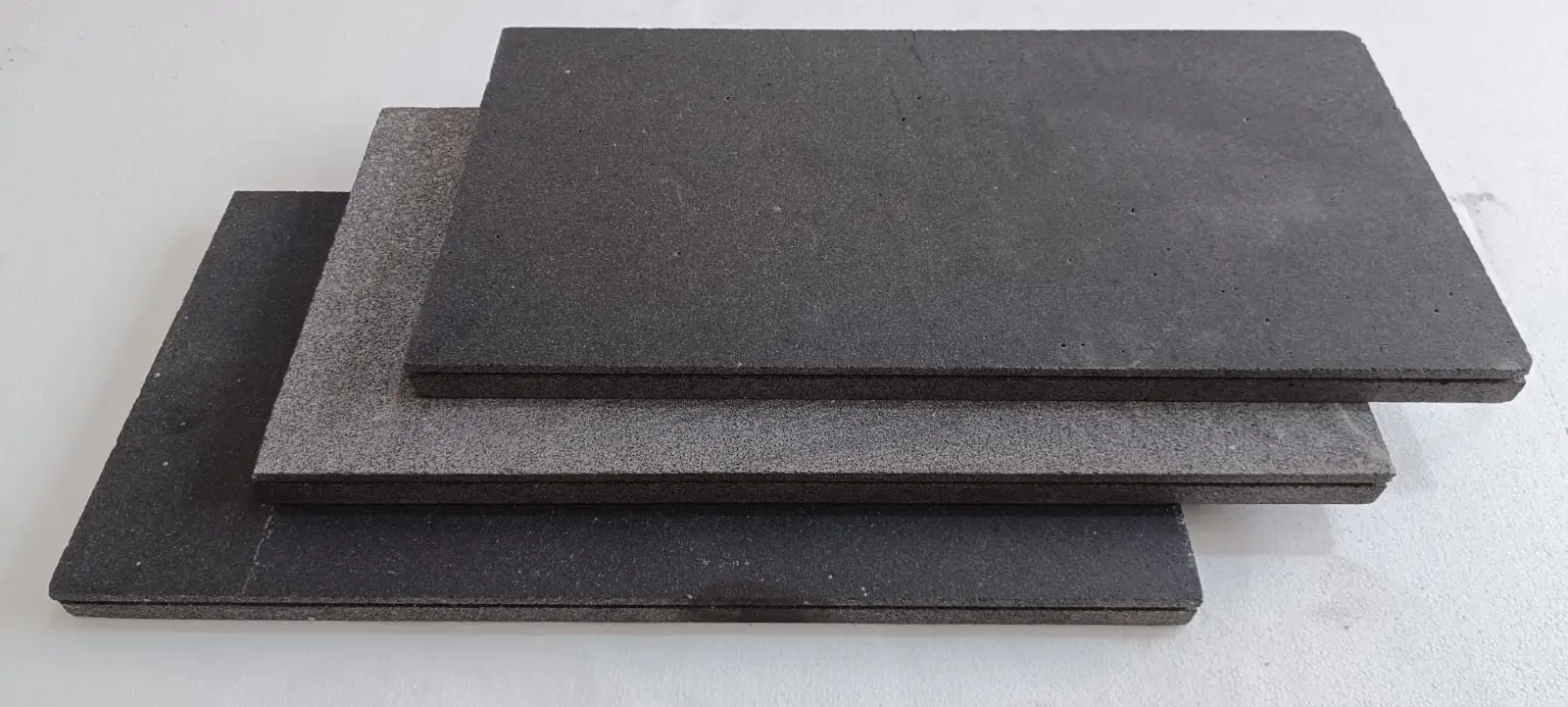
Black limestone’s naturally fine crystalline structure also gives you the cut precision that custom inlay design demands. Softer materials like certain sandstones tend to chip at corners and edges during waterjet or wet-saw cutting, which degrades your inlay geometry before it ever reaches the field. Dense limestone holds a clean 90-degree arris even on tight radii, which is exactly what you need when you’re running a geometric border pattern around a pool deck or entry courtyard.
The dark tonal range — from deep charcoal to near-black with subtle grey veining — also provides the visual contrast ratio that makes inlay patterns legible from architectural viewing distances. Peoria decorative accents built from materials with insufficient contrast tend to read as muddy at distance, defeating the entire design purpose.
Inlay Pattern Geometry and Design Intent
Your pattern selection drives nearly every downstream specification decision — base depth, joint width, cut complexity, and installation sequencing all trace back to the geometry you commit to at the design stage. There are four dominant inlay pattern families used in Arizona custom design work, each with its own installation logic.
- Linear border inlays: single or double-course black limestone bands set perpendicular or parallel to the primary field stone — the most forgiving pattern for field cutting adjustments
- Medallion inlays: radial or starburst patterns cut to a pre-fabricated template, requiring shop-cut precision and level-critical substrate preparation within ±1/8 inch across the medallion diameter
- Geometric grid inlays: diamond, herringbone, or chevron configurations using black slab pattern inserts in Arizona projects where architectural lines align with interior design language
- Freeform feature panels: designer-specified organic or branded shapes cut by waterjet, typically set as a centerpiece in entry courts or outdoor living areas
The fabrication method matters as much as the pattern itself. Waterjet cutting delivers the tightest tolerances — typically ±0.015 inch — and handles curves without the micro-fracturing risk that blade cutting introduces on tight radii. For straight linear work, wet-saw cutting is entirely adequate and reduces your lead time from the fabrication shop.
Substrate and Base Requirements for Inlay Installations
Here’s what most specifiers miss when they move from standard paver layouts to inlay work: the substrate flatness tolerance tightens considerably. Standard field pavers will tolerate a 3/16-inch variation under a 10-foot straightedge. Inlay installations — especially medallions and geometric patterns — demand you hold that to 1/8 inch or tighter, because pattern pieces butt against each other without the visual forgiveness of a grout joint wide enough to absorb minor lippage.
Your aggregate base specification should call for a minimum 6-inch compacted Class II crushed aggregate base in Arizona’s expansive soil zones, increasing to 8 inches where your geotechnical report identifies PI (plasticity index) values above 15. In Yuma, decomposed granite subgrades can be deceptively stable during dry months but exhibit 0.5–1.5 inches of differential settlement after monsoon saturation — a movement range that will fracture even the best-executed black slab pattern inserts Arizona installations if you haven’t spec’d a proper transition layer.
- Compacted subgrade to 95% modified Proctor density minimum
- 6–8 inch Class II aggregate base, compacted in lifts no deeper than 4 inches
- 1-inch dry sand setting bed for dimensional control — avoid wet mortar beds under large-format slabs unless you have a specialist crew with direct experience on format sizes above 24 × 24 inches
- Full mortar bed required for medallion inlays larger than 36 inches in diameter — the sand bed can’t hold registration under foot traffic before the surrounding field stone locks the piece in place
Thickness Specifications for Black Limestone Inlays Peoria Projects Require
Thickness selection for black limestone inlays Peoria projects specify isn’t just a structural question — it’s a flush-finish question. Your inlay pieces must finish flush with the surrounding field stone, which means your nominal thickness has to account for both the material itself and the setting bed variation between the two stone types.
The practical specification range for residential and light commercial inlay work runs from 3/4 inch (20mm) for cut-to-size border pieces up to 1.25 inches (30mm) for medallion centers and high-traffic crossing zones. The 30mm range gives you a meaningful margin for grinding flush if a piece sets slightly proud — you can remove up to 3mm by machine without compromising structural integrity. Arizona Craftsmanship Details on high-end custom projects increasingly call out 30mm as the minimum for any piece larger than 12 × 12 inches, and that’s a specification choice with real field logic behind it.
You’ll also want to specify consistent thickness tolerances on your purchase order. Dimensional stone from some quarry sources carries a ±3mm thickness tolerance as standard — acceptable for field paving but problematic for inlay work where your setting bed can’t fully compensate for a 6mm total swing across adjacent pieces. Specify ±1.5mm or tighter for inlay components, and verify your supplier can actually deliver to that tolerance before committing to a project schedule.
Joint Design and Spacing for Arizona Heat Conditions
The joint between your black limestone inlay and the surrounding field stone is the single most critical detail in the entire installation — it’s where differential thermal movement concentrates, and where most inlay failures originate. Arizona’s surface temperature range from roughly 45°F winter nights to 170°F summer surface highs on dark stone means you’re engineering for a 125°F+ delta, which translates to measurable expansion even in a material as dimensionally stable as dense limestone.
For black limestone specifically, that dark surface absorbs significantly more solar radiation than lighter field stones — in some mixed installations, surface temperature differentials between the black inlay and an adjacent white or cream limestone field can reach 30–40°F under peak solar exposure. That differential creates micro-movement between adjacent pieces that a rigid, fully filled joint cannot accommodate without eventually spalling.
- Maintain a minimum 3/16-inch joint at all inlay-to-field-stone interfaces
- Use flexible, color-matched polyurethane sealant at the perimeter of all medallion and freeform inlay pieces — not standard grout
- For geometric grid inlays, standard unsanded grout at 1/8-inch joints is acceptable within the inlay field, but the perimeter transition still requires flexible fill
- Never fully grout a medallion inlay on the day of installation — allow 24 hours minimum for the setting bed to cure and any initial settlement to stabilize before filling joints
Sealing Black Limestone Inlays in Arizona Climates
Sealing black limestone inlay work requires a different approach than sealing standard field pavers, primarily because the aesthetic stakes are higher. An uneven sealer application on a border inlay reads as a sheen inconsistency that draws the eye directly to the detail you spent the most money on. The sealer chemistry also matters more with dark stone — certain topical sealers will shift the apparent color of black limestone toward a brown or greenish cast over time as UV degrades the polymer.
For inlay work in Arizona, penetrating impregnator sealers (silane-siloxane chemistry, minimum 40% active solids) outperform topical options for three reasons: they don’t alter the surface sheen, they don’t create a film layer that can delaminate under thermal cycling, and they allow the stone to breathe — critical in installations where vapor drive from below-grade sources can trap moisture under an impermeable film coat. These qualities make penetrating sealers the preferred choice for Peoria decorative accents where long-term finish consistency is part of the project brief.
You can verify warehouse inventory and sealer compatibility at our black natural limestone facility, where our technical team evaluates sealer performance across different limestone densities before recommending specific products for Arizona project conditions.
- Apply sealer to clean, dry stone — surface moisture above 4% will prevent penetrating sealers from bonding to the pore structure
- Two-coat application at 4–6 hour intervals outperforms single heavy coats, which pool on the surface rather than penetrating
- Resealing interval in Arizona UV exposure: 18–24 months for high-sun inlay surfaces, 36 months for covered or shaded installations
- Test sealer on an inconspicuous offcut before full application — even within the same shipment, slight density variations can produce different sheen levels
Ordering Logistics and Lead Time Planning
Custom inlay design introduces supply chain complexity that standard paver orders don’t have. Your cut-to-size inlay pieces are typically fabricated to shop drawings — which means you’re adding a shop drawing review and approval cycle, a fabrication queue, and a quality inspection step before material ships to the project site. Plan your procurement schedule with a minimum 4–6 week lead time from approved shop drawings to truck delivery, longer if your pattern requires waterjet cutting with tight tolerance callouts.
Citadel Stone maintains warehouse stock of black limestone paving slabs in Arizona, which gives you a meaningful advantage on the raw material side — the typical 6–8 week import cycle for specialty stone is eliminated when the base material is already in-country. Your fabrication lead time is the governing constraint, not material procurement, which lets you run your shop drawing process in parallel with base preparation work on site. That warehouse availability is particularly valuable when project schedules compress and Arizona Craftsmanship Details on shop drawings require revision cycles that eat into your float.
For projects in Mesa, confirm your truck access dimensions before scheduling delivery of large-format slabs. Standard flatbed deliveries require 50-foot turn radius clearance minimum, and residential project sites in established neighborhoods frequently can’t accommodate that without staging at a nearby lot. A staging and re-handling plan adds cost, but it’s less expensive than a damaged slab that needs replacement and restarts your fabrication lead time.
Installation Sequencing for Custom Inlay Patterns
The sequencing of a custom inlay installation is fundamentally different from laying field pavers, and getting it wrong produces a result that’s difficult or impossible to correct without removing finished work. The principle is straightforward but counterintuitive: you set your inlay pieces first, then work your field stone outward from the inlay geometry. Most general paving contractors do it in reverse — they lay the field, leave a hole, and try to drop the inlay into an opening that’s rarely dimensioned correctly.
For medallion inlays, establish your centerpoint precisely using laser layout, not string lines — string sag introduces errors that compound at the outer rings of a radial pattern. Set the center piece, confirm it’s level, allow the setting bed to achieve initial cure (minimum 4 hours in Arizona summer heat, 8 hours in cooler months), then work ring by ring outward. Each ring locks the geometry of the next.
- Pre-dry-fit the entire inlay pattern on a flat staging surface before any adhesive or mortar is applied — this catches fabrication errors before they become installation problems
- Number each piece on the back face during staging so field installation follows the exact sequence you validated
- In Arizona summer conditions, your open time on polymer-modified mortar drops to 15–20 minutes — batch smaller quantities and work in shaded conditions when ambient temperature exceeds 100°F
- Protect newly set inlay work from foot traffic for 48 hours minimum — premature loading will displace pieces that haven’t fully bonded, and repositioning disturbed pieces on a cured bed is rarely successful
Projects in Gilbert benefit from the slightly lower nighttime temperatures compared to the Phoenix core, which extends your working window in early morning hours and reduces the thermal shock risk to fresh mortar beds during summer installation periods — a small but real scheduling advantage for complex black slab pattern inserts Arizona work that involves multiple ring layers or tight geometric tolerances.
Final Considerations for Black Limestone Inlays Peoria Projects
What black limestone inlays Peoria projects demand most is precision at every phase — from the tolerance callouts on your purchase order, through the substrate flatness requirements, to the sequencing logic on installation day. The material itself rewards that precision: a correctly executed black limestone inlay in Arizona holds its geometry, color, and finish performance across decades of thermal cycling in ways that synthetic alternatives simply can’t match. The failure cases you see in the field — cracked borders, lippage at medallion edges, color inconsistency — trace almost universally back to specification shortcuts, not material limitations.
Your specification document should address joint flexibility at inlay perimeters, setting bed cure times under Arizona summer conditions, sealer chemistry compatibility, and fabrication tolerance callouts as explicit line items — not assumptions left to installer discretion. These are the details that separate a 25-year installation from a 10-year replacement cycle. Peoria decorative accents executed at this specification level become permanent architectural features rather than maintenance liabilities. As you plan related outdoor features around your Peoria project, Black Limestone Paving Slab Outdoor Showers for Glendale Pool Areas explores another dimension of how black limestone performs in Arizona’s demanding pool environment, which can inform your broader hardscape material decisions. Our Black Limestone Paving Arizona selection includes rare dark charcoal tones.