
Black limestone drainage Buckeye installations fail at a predictable point — not at the surface, but at the transition zone between your slab field and the collection channel below it. The slab’s density, typically 160–165 lbs/ft³ for quality black limestone, creates a sealed plane that redirects water laterally rather than vertically, and if your drainage geometry doesn’t account for that horizontal movement, you’re building a pond, not a patio. Buckeye’s monsoon events deliver rainfall intensities that regularly exceed 2 inches per hour, which means your drainage system isn’t a luxury feature — it’s the structural backbone of the entire installation.
Why Black Limestone Drainage Buckeye Demands a Different Approach
The thermal mass characteristics of black limestone create a complication that most drainage specs ignore. By mid-afternoon in Buckeye’s summer, your slab surface can reach 155–165°F, and when a monsoon rolls in at 4 PM, the rapid thermal shock — sometimes 60°F in under 10 minutes — causes micro-contraction across the slab field. That contraction briefly opens joint gaps by 0.5–1mm, which sounds minor until you realize that’s exactly when peak rainfall is hitting. Your drainage system needs to handle both the expanded thermal state and the contracted state without losing channel alignment.
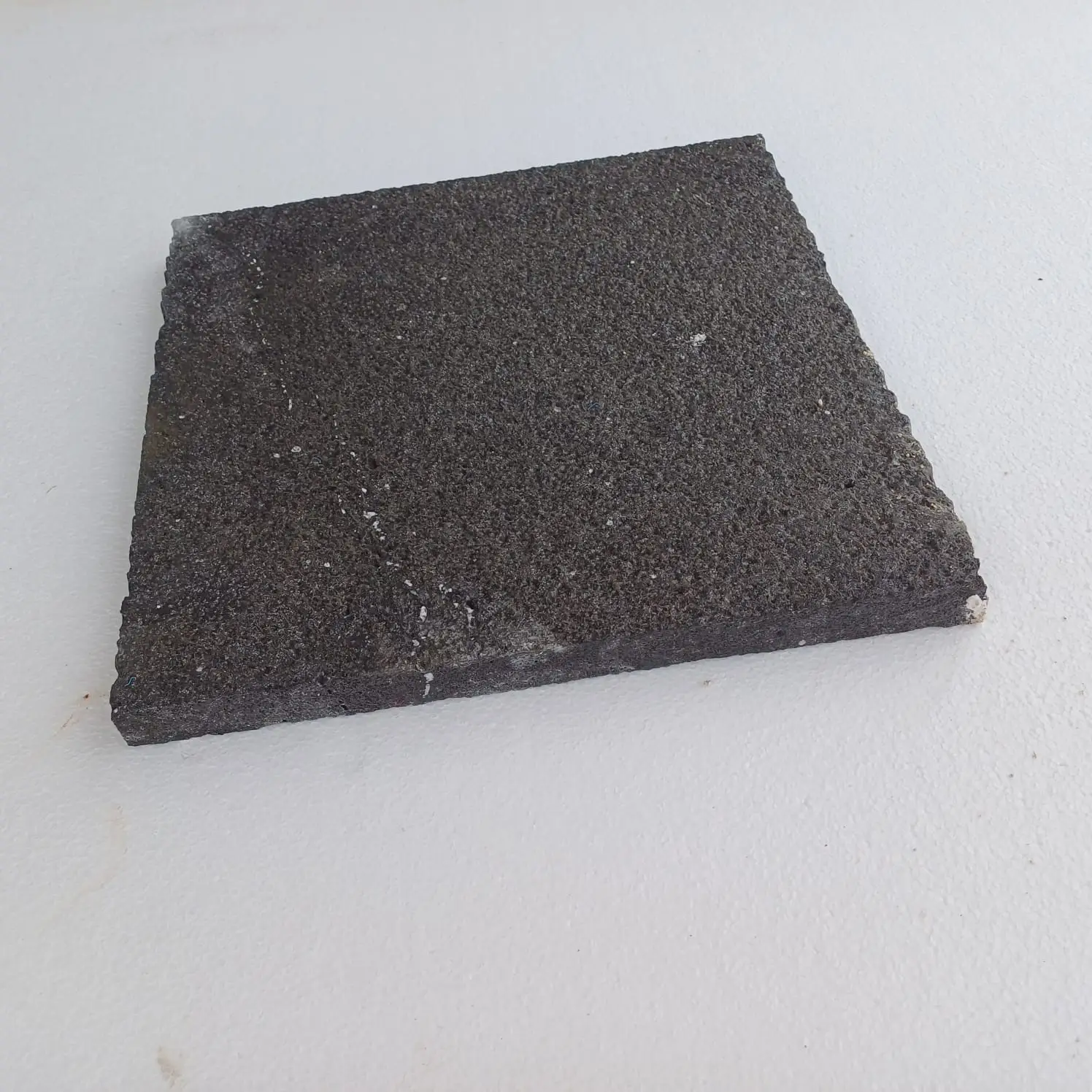
Paving slabs of black limestone in Arizona also carry a porosity factor that’s frequently misunderstood. Black limestone sourced from quality quarries runs at 1.2–2.8% porosity — significantly lower than travertine but not zero. During a sustained monsoon event, that absorbed moisture adds measurable weight and slightly alters the slab’s surface coefficient. You’ll want your cross-slope gradient set at a minimum of 1.5%, not the 1% that shows up in generic hardscape specs, because that extra half-percent becomes the margin that keeps water moving toward your collection points when slab absorption slows the sheet flow.
Cross-Slope and Channel Geometry for Monsoon Performance
The geometry of your drainage channels determines whether a 2-inch-per-hour event moves cleanly off the surface or backs up at low points. For black limestone slab fields wider than 14 feet, a crowned cross-slope — pitched to both edges — outperforms a single-direction slope every time. The reason is simple: a single-direction pitch on a wide slab field creates a travel distance that exceeds the sheet flow capacity of natural stone under high-intensity rainfall. You end up with ponding in the center-to-far-side zone regardless of your outlet elevation.
Channel sizing is where Buckeye water management specs get under-engineered more often than any other element. The standard formula for residential drainage channels assumes a 10-year storm event — but Buckeye’s location in the West Valley means you’re regularly dealing with storm cells that hit 25-year intensity even in moderate monsoon seasons. Your linear drain channels alongside black limestone slab fields should be sized for a minimum flow rate of 0.45 gallons per second per linear foot when the contributing slab area exceeds 400 square feet.
- Cross-slope minimum of 1.5% across the slab field, increasing to 2% for slab widths over 18 feet
- Channel invert depth of at least 4 inches below finish grade to maintain gravity flow under sediment load
- Outlet points positioned no more than 20 feet apart on runs parallel to the home foundation
- Channel grate open area must equal or exceed 40% to avoid clogging under debris load typical of Arizona monsoon events
- Expansion joints at channel-to-slab interfaces should be set at 3/8 inch, filled with silicone rated to 400°F service temperature
Base Preparation That Supports Both Drainage and Structural Load
Your base preparation for black limestone drainage Buckeye projects has to reconcile two competing demands. You need adequate compaction — typically 95% of Modified Proctor density — to prevent settlement under foot and vehicle traffic. But you also need enough permeability in your base profile to handle the water that does penetrate through joints and edges. A rigid, fully compacted Class II base with zero permeability simply redirects subsurface water to wherever your compaction layer terminates, which is often directly under your foundation wall.
The solution that works consistently in Buckeye’s caliche-influenced soils is a two-layer base system. Your lower 4 inches use a 3/4-inch crushed aggregate with a 20–30% void ratio, functioning as a drainage reservoir. Your upper 2 inches use a finer Class II base that compacts to specification and provides a stable setting bed. This configuration lets you hit structural compaction targets at the slab interface while maintaining subsurface drainage capacity in the lower zone.
Projects in Mesa that use similar dual-layer base systems under large-format black limestone have demonstrated noticeably lower incidence of slab lifting and joint separation compared to single-layer installations — the subsurface drainage relief appears to reduce hydrostatic pressure buildup after sustained monsoon events.
Joint Spacing and Fill Materials for Arizona Monsoon Conditions
Joint spacing on black limestone slab installations in Buckeye follows a tighter tolerance than most southwest contractors expect. For 24×24-inch slabs, maintain a 3/16-inch joint minimum and 1/4-inch maximum. Go narrower and thermal expansion at peak summer temperatures — your slab field can see differential expansion of up to 3/8 inch across a 20-foot run — will close the joint entirely and begin transferring compressive stress into adjacent slabs. You’ll see edge chipping on the hard corners of black limestone within two to three monsoon seasons if you under-specify your joint width.
Polymeric sand performs adequately in moderate climates but degrades faster than most specs acknowledge under Buckeye’s conditions. UV intensity at 33° north latitude combined with surface temperatures above 150°F accelerates binder breakdown in standard polymeric products. You’ll want a higher-temperature-rated polymeric formula — look for products specifying a heat threshold of at least 180°F — or consider a mortar-set joint with a flexible admixture in high-traffic zones. Either way, plan for joint inspection and selective reapplication every 24–30 months rather than the 5-year interval that works in cooler climates.
- Joint width: 3/16 inch minimum, 1/4 inch maximum for 24×24 slabs; scale up proportionally for larger formats
- Polymeric sand: use high-temperature-rated formulas rated to minimum 180°F surface exposure
- Mortar joints: specify Type S mortar with a latex-modified admixture at a 15% volume substitution for flexibility
- Inspection cycle: every 24–30 months in Buckeye’s desert climate, not the 5-year interval common in manufacturer guidelines
- Avoid silica-based joint fills without sealant overcoat — they deteriorate under monsoon saturation cycles and leave voids that accelerate slab rocking
Sealing Black Limestone for Monsoon and UV Resilience
Sealing protocols for paving slabs of black limestone in Arizona differ substantially from the maintenance schedules manufacturers publish for temperate markets. The penetrating impregnating sealers — fluoropolymer or silane-siloxane chemistry — perform better than topical coatings on black limestone in desert climates because they don’t create a surface film that can blister under thermal cycling. Your application window matters significantly: apply only when slab surface temperature is between 50°F and 85°F, which in Buckeye means early morning application in spring and fall, or waiting for your November-February window in summer projects.
The sealer’s role in drainage performance is underappreciated. A properly sealed black slab drainage Arizona surface sheet-flows water at roughly 2–3 times the speed of an unsealed surface with equivalent slope — the reduction in surface tension friction is that significant. For Yuma-region projects and Buckeye installations alike, sealing isn’t just aesthetic protection, it’s a drainage performance specification. An unsealed slab field that looks fine in winter will show its drainage deficiencies the first July afternoon a monsoon cell parks over your project for 45 minutes.
For Buckeye’s black limestone drainage applications, our technical team at Citadel Stone recommends a two-coat penetrating sealer application at initial installation, followed by a single-coat maintenance application every 18–24 months — tighter than manufacturer-standard intervals because the combination of UV exposure and monsoon saturation cycles accelerates sealer depletion faster than the manufacturer’s temperate-climate testing accounts for. You can verify sealer performance by watching bead behavior on the slab surface after a light rainfall — if water stops beading and begins sheeting without defined droplet formation, your sealer is due for reapplication.
You can also explore how midnight black paving limestone in Yuma handles the unique combination of extreme UV intensity and hard-water mineral deposits that affect sealer longevity in that corridor — the specification details there translate directly to Buckeye project conditions.
Monsoon Preparation and Pre-Season Inspection Protocol
Monsoon preparation for black limestone slab drainage systems starts in late May, before the first significant storm event hits. Your pre-season inspection should systematically cover outlet conditions, joint integrity, and channel flow paths — the three elements most likely to have shifted during the winter dry period. Caliche soils in Buckeye’s west valley can experience minor heave during freeze-refreeze nights in December and January, and that movement sometimes partially occludes drain outlets without being obvious from surface inspection alone. Arizona stormwater management regulations are also worth reviewing ahead of each season, since compliance requirements for hardscaped areas can evolve at the municipal level.
- Flush all linear drain channels with a garden hose to confirm unobstructed flow to the outlet point
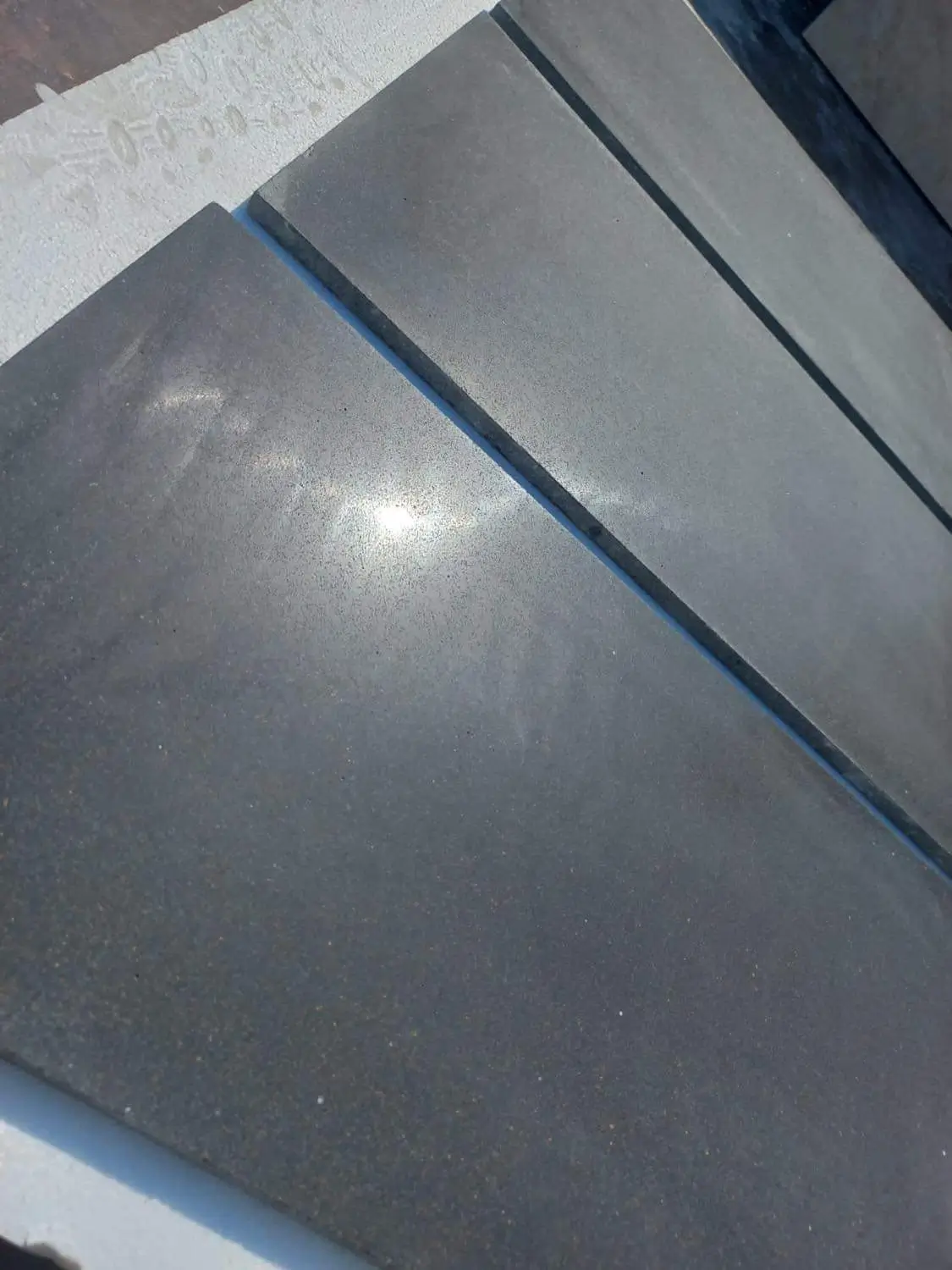
- Check slab cross-slope with a digital level — any section reading below 1.2% should be flagged for releveling before monsoon season
- Inspect all expansion joints for cracking or pullback in the silicone fill — monsoon water penetrating a failed expansion joint can undermine your entire base layer in a single heavy event
- Clear debris from drain grates and verify grate seating — even a partially dislodged grate reduces effective open area by 40–60%
- Check the termination point at street, alley, or landscape drainage — confirm no obstruction has developed during the dry season
Arizona stormwater management regulations carry real weight here. Buckeye, like most Maricopa County municipalities, requires that post-development runoff from hardscaped areas not exceed pre-development flow rates. If your black limestone slab field is part of a larger hardscape expansion, you may need a detention calculation to demonstrate compliance — particularly if your total impervious area increase exceeds 1,000 square feet. Your drainage design should account for this from the specification stage, not as a retrofit after the city inspector flags it.
Thickness and Format Selection for Drainage Performance
Slab thickness directly affects how your installation responds to the hydraulic load during a monsoon event. For pedestrian-only areas, 1.25-inch (30mm) black limestone slabs are structurally adequate and create a lower curb-to-channel transition that improves sheet flow. For areas that will see occasional vehicle access — delivery trucks, golf carts, or similar — spec 2-inch (50mm) thickness minimum. The structural argument is obvious, but the drainage argument is equally important: thicker slabs sit higher relative to adjacent grade, and if your channel design doesn’t compensate for that elevation difference, you create a low point at the slab perimeter that traps water.
Larger format slabs — 24×48 or 24×24 — reduce the total joint linear footage in your slab field, which has a nuanced effect on drainage performance. Fewer joints mean less opportunity for water infiltration into the base layer, which is good for base stability but shifts more surface water to the sheet flow path. That means your cross-slope and channel capacity have to carry more of the load. For Buckeye water management plans where large-format black limestone slabs are popular for contemporary outdoor room designs, this trade-off needs to be accounted for in the drainage engineering, not assumed away.
Projects in Gilbert using similar large-format black limestone layouts have reinforced this point — when joint linear footage drops, the sheet flow burden on the surface plane increases proportionally, and channel sizing needs to reflect that shift. At Citadel Stone, we source our black limestone slabs directly from quarries with documented thickness tolerances of ±1/8 inch — tighter than the ±3/16 inch common in lower-tier supply chains. That consistency matters when you’re setting a large slab field with a precise cross-slope, because slab thickness variation translates directly into surface elevation variation that disrupts your drainage plane. Our warehouse quality checks flag any material outside tolerance before it leaves for the job site, preventing the headache of a drainage plane that doesn’t perform because two pallets had different effective thicknesses.
Project Planning, Lead Times, and Delivery Logistics
Your project timeline for a black limestone drainage installation in Buckeye should build in material lead time before your pre-monsoon installation window closes. The realistic truck delivery scheduling from warehouse to job site typically runs 1–2 weeks for stocked formats — but if you’re specifying a custom thickness or a less common slab dimension, add 4–6 weeks for quarry sourcing. Starting that conversation in March or early April gives you comfortable margin for a May installation completion, which is exactly where you want to land before the monsoon season activates.
Access conditions in Buckeye’s newer subdivisions can complicate truck delivery logistics. Many HOA communities have weight restrictions on interior streets that limit delivery vehicles to single-axle trucks. A full pallet of 2-inch black limestone — typically 2,400–2,600 lbs — requires careful thought about staging and split delivery when your truck access is constrained. Coordinate with your supplier early to confirm vehicle options; a supplier who only runs standard flatbed configurations will cost you time and money when the HOA gate won’t permit entry. Our warehouse team regularly works through these access scenarios in advance, so staging plans are confirmed before the first delivery is scheduled.
Getting Black Limestone Drainage Specifications Right
Delivering solid black limestone drainage Buckeye specifications comes down to committing to the details that generic hardscape guides skip. Your cross-slope geometry, base layer permeability, joint fill temperature rating, sealer application timing, and channel sizing are all interdependent — a deficiency in any one of them undermines the performance of the others during a genuine monsoon event. The material itself, black limestone at proper thickness and porosity specification, is more than capable of handling Arizona’s storm demands when the surrounding system is engineered to match.
Your drainage design should be treated as an engineering deliverable in its own right — not an afterthought attached to the aesthetic specification. Pre-season inspection, joint maintenance on a 24-month cycle, and sealer reapplication before the slab surface starts sheeting instead of beading will keep your installation performing at the level you specified for 20 years or more. Proper black slab drainage Arizona practice means treating every component — from base aggregate void ratio to channel grate open area — as load-bearing in the hydraulic sense, not just the structural one. If your project scope includes other Buckeye outdoor areas beyond the primary slab field, Black Limestone Slab Laying Patterns for Avondale Courtyards covers complementary layout approaches for black limestone that apply directly to connected hardscape zones across the West Valley. We are the standard-bearers for Black Limestone Paving in Arizona.