
Tolerance stacking is the hidden enemy of black limestone custom cutting Scottsdale specifiers rarely account for upfront — and it’s where most custom dimension projects quietly unravel. You’re dealing with a material that carries natural bedding plane variation of 0.5 to 1.2mm across a single slab face, and when you’re ordering bespoke dimensions for a feature wall or pool surround with tight reveal lines, that variation compounds across every joint. Getting your tolerances defined in writing before the blade touches stone is the difference between a seamless installation and a job site full of shimming headaches.
Why Custom Cutting Differs from Standard Sizing
Standard black limestone slabs leave the quarry dimensioned to nominal stock sizes — typically 24×24, 12×24, or 18×18 — and the tolerances built into those formats are forgiving enough to absorb minor field variation. Custom cutting for Scottsdale bespoke dimensions is an entirely different discipline. You’re not pulling from a calibrated production run; you’re specifying exact finished dimensions on material that has already been gauged to thickness, and every secondary cut introduces new surface geometry that must be reconciled with your installation system.
The cutting method matters as much as the dimension itself. Waterjet cutting holds tolerances of ±0.5mm and works without introducing the micro-fracture risk that blade work can create on thinner 3/4-inch profiles. Bridge saw cutting is faster and cost-effective for straight linear cuts but typically holds ±1.5mm — acceptable for most field applications but not for furniture-grade interior work where grout joints are intentionally closed to 1/16 inch. Knowing which method applies to your project before you write the spec prevents expensive change orders later.
Material Characteristics That Affect Cut Quality
Black limestone isn’t a monolithic category — the term covers materials ranging from dense, fine-grained Belgian-style blue limestone at 2.68 g/cm³ to more porous regional formations that carry visible fossiliferous structure and respond differently under the blade. The density and calcite matrix of the specific stone your project uses directly determines blade wear rates, edge chipping probability, and the radius you can safely achieve on profiled cuts.
For Arizona projects, the thermal behavior of the stone is equally relevant to cutting strategy. Black limestone slabs for Arizona installs carry a thermal expansion coefficient of approximately 4.5 × 10⁻⁶ per °F. That number looks small, but across a 6-foot slab in direct Scottsdale sun exposure — where surface temperatures routinely reach 145°F in July — you’re looking at linear expansion approaching 3.5mm. Your custom cut dimensions need to account for this at the specification stage, not after the slabs are delivered to the truck.
- Dense, low-porosity black limestone (absorption rate below 0.5%) produces the cleanest custom edges and is the preferred material for interior feature applications
- Medium-density formations with 1–3% absorption are adequate for most exterior applications when properly sealed but require slightly wider saw kerfs to reduce edge blow-out
- High-porosity formations above 3% absorption should be avoided for precision custom cutting — the open pore structure increases chipping at the cut face and complicates sealing at exposed edges
- Slab thickness consistency across the batch matters more than nominal thickness — request a thickness range certificate from your supplier before confirming custom dimensions
Specifying Your Dimensions Accurately
The specification document for black limestone custom cutting Scottsdale projects needs three data points that most design teams don’t include in their initial orders: finished face dimension, maximum allowable thickness variation, and edge profile detail. Missing any one of these forces your fabricator to make assumptions — and fabricators default to their production preferences, not your design intent.
Finished face dimension means the dimension of the exposed surface after installation, accounting for any overlap onto substrate or into adjacent materials. This is distinct from the cut dimension, which must incorporate the edge profile radius or chamfer. A 24×36 slab with a 3/16-inch chamfer on all four edges is actually cut to approximately 23-5/8 × 35-5/8 before profiling — if you specify 24×36 as the cut dimension without clarifying this, your reveal lines will be off by 3/8 inch across the full run.
- Always specify dimensions in decimal inches or millimeters — fractional inches introduce ambiguity in fabrication environments where digital CNC files use decimal notation
- Provide a dimensioned shop drawing, not just a verbal description — even simple L-shaped or notched cuts require a drawing to eliminate misinterpretation
- Confirm your tailored cutting specification includes material grain direction relative to the long dimension of the cut piece — this affects both visual appearance and structural performance in cantilevered applications
- Include a flatness tolerance spec — ASTM C1528 provides the basis for natural stone dimensional tolerance, and referencing this standard in your spec gives your fabricator a defensible benchmark
Arizona Special Orders and Lead Time Realities
Arizona special orders for custom-cut black limestone operate on a timeline that surprises project managers who have only worked with standard-format material. Domestic stock slabs can move from warehouse to job site in 3–5 business days. Custom cutting adds fabrication time, but the real schedule driver is slab availability in the specific batch lot you need.
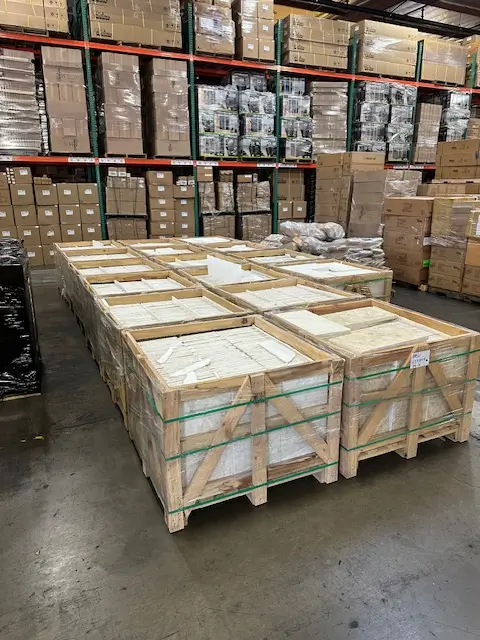
At Citadel Stone, we source black limestone in full-container lot purchases and maintain slab inventory in Arizona warehouse stock specifically to reduce the lead time gap that kills project schedules. The practical reality is that matching lot consistency — critical for any custom cut project where color and veining continuity matter — requires having sufficient linear footage from a single quarry pull. Confirming warehouse stock levels before your cutting order is placed is non-negotiable for projects with hard completion dates.
Typical lead times for Arizona special orders of custom cut black limestone run as follows, assuming stock slab availability:
- Straight saw cuts to custom dimension: 5–7 business days from confirmed order
- Waterjet-cut pieces with curved geometry or complex profiles: 10–14 business days
- CNC-profiled edge work (ogee, bullnose, drop-face): add 3–5 business days to the base fabrication window
- Rush orders requiring truck delivery on a fixed date need to be flagged at order entry — last-minute scheduling compounds cost and frequently requires a dedicated delivery rather than a consolidated route run
Base Preparation for Custom Cut Installations
Custom cut dimensions amplify the consequences of base preparation shortcuts. Standard paver installations tolerate minor variation in base compaction because the tile format distributes load across a smaller footprint — a 12×12 piece sitting 1/8 inch high reads as a single tile issue. A 24×72 custom-cut black limestone slab sitting 1/8 inch high is a prominent plank-format problem visible from 30 feet away.
The compressive strength requirements for black limestone slabs increase with the aspect ratio of the custom cut. Elongated pieces — anything with a length-to-width ratio exceeding 3:1 — require a full mortar bed rather than a dot-and-dab adhesive application. The unsupported mid-span of a long slab transfers point load to the adhesive bond, and dot-and-dab systems fail at the void between contact points under repeated thermal cycling. In Phoenix conditions, where 50°F day-to-night temperature swings are common for roughly 5 months of the year, that thermal cycling is relentless.
- Minimum compacted aggregate base for exterior custom-cut black limestone: 6 inches in Type A soil, 8 inches in expansive clay soils
- Sand setting bed thickness for slab formats: 3/4 inch nominal, screeded to ±1/8 inch across the setting field
- Full mortar bed specification for pieces exceeding 18 inches in any dimension: 3/4-inch bed at 95% coverage minimum, verified with lift-and-check spot sampling during installation
- Perimeter edge support for cantilevered cut pieces: structural mortar haunch or mechanical angle support depending on cantilever distance
Sealing Custom Cut Edges Correctly
The exposed cut edge is the most vulnerable surface on a custom-dimensioned black limestone slab. The factory face carries whatever surface treatment — honed, brushed, or flamed — was applied during original processing. The cut edge exposes raw stone matrix that has never been sealed and absorbs penetrating sealer at a rate 3–4 times higher than the face surface. Applying face sealer rate to edges leaves them under-protected.
For black limestone slabs in Arizona climates, the sealing protocol for custom cut edges should involve two penetrating impregnator applications at the cut face before installation, with a 30-minute dry time between coats. This pre-installation treatment addresses the initial absorption surge. A third application after the installation mortar has cured — typically 28 days for full cure in summer conditions — completes the sealing system. The alkalinity from fresh mortar can inhibit sealer penetration if you apply it too early, which is a field error that gets repeated constantly on fast-tracked projects.
Citadel Stone’s black limestone paving facility
Our technical team at Citadel Stone has evaluated sealer performance on black limestone across Scottsdale, Phoenix, and Tucson installations over multiple product cycles. The fluoropolymer-based impregnators consistently outperform silicone-based alternatives in high-UV environments — the UV degradation rate of silicone chemistry in Arizona direct exposure reduces effective re-sealing intervals to 12–18 months, compared to 24–36 months for fluoropolymer systems.
Thickness Selection for Bespoke Dimension Applications
Thickness is the specification variable that most strongly governs the structural behavior of custom-cut black limestone, and it’s frequently under-specified because designers default to standard commercial thicknesses without checking them against the custom format dimensions. The governing factor is the span-to-thickness ratio for unsupported or point-loaded conditions.
For black slab custom sizes Arizona projects, the practical thickness guidelines by application run as follows: 3/4-inch nominal (18–20mm) is appropriate for wall cladding and floor tile up to 24 inches in the long dimension when installed in full mortar bed. 1.25-inch (30–32mm) handles exterior paving up to 36 inches and pool surround applications. For custom feature pieces exceeding 48 inches — the increasingly popular large-format floor slabs appearing in Tucson luxury residential projects — 2-inch (50mm) minimum thickness is the defensible specification.
- Verify actual delivered thickness against nominal specification — natural stone carries a ±3mm manufacturing tolerance on thickness that compounds with custom cut length
- Oversized pieces in 3/4-inch thickness are a common source of callbacks — the math on span-to-thickness ratio shows clearly why, but the spec often gets approved without checking it
- Thickness consistency within a single installation lot should be confirmed at the warehouse before the truck is loaded — mixing 18mm and 21mm pieces from different production batches in a seamless installation is a leveling nightmare
- Pool coping with overhang: minimum 1.25-inch thickness for overhangs up to 2 inches, 1.5-inch minimum for overhangs exceeding 2 inches
Ordering Black Limestone Slabs for Arizona Projects
The ordering sequence for black limestone custom cutting Scottsdale projects runs differently than standard paver procurement, and compressing the sequence to save time is where most schedule and cost problems originate. The correct sequence starts with slab selection from physical samples — not digital catalog images. Black limestone color consistency between production batches can vary by 15–20% in tone, and the black color family reads dramatically different under Arizona direct sunlight versus the warehouse fluorescent lighting under which most material selections are made.
Request hold tags on the specific slabs you want before submitting your custom cut order. This reserves your exact material against other orders pulling from the same lot. For black slab custom sizes Arizona projects with precise pattern work or book-matched layouts, lot reservation isn’t optional — it’s a fundamental part of the order process. Citadel Stone maintains this reservation system to protect project continuity for fabrication orders, which is a supply chain discipline that makes a genuine difference when you’re cutting pieces that can’t be re-matched mid-project.
- Submit a cutting list with piece count, finished dimensions, edge profile, and thickness for each unique piece type — not a single repeat dimension with a quantity multiplier
- Build 10–12% overage into your cutting order to account for natural material variation and field-adjusted dimensions that arise during installation
- Confirm fabrication yard lead time against your installation start date and add one week buffer for quality inspection before truck dispatch
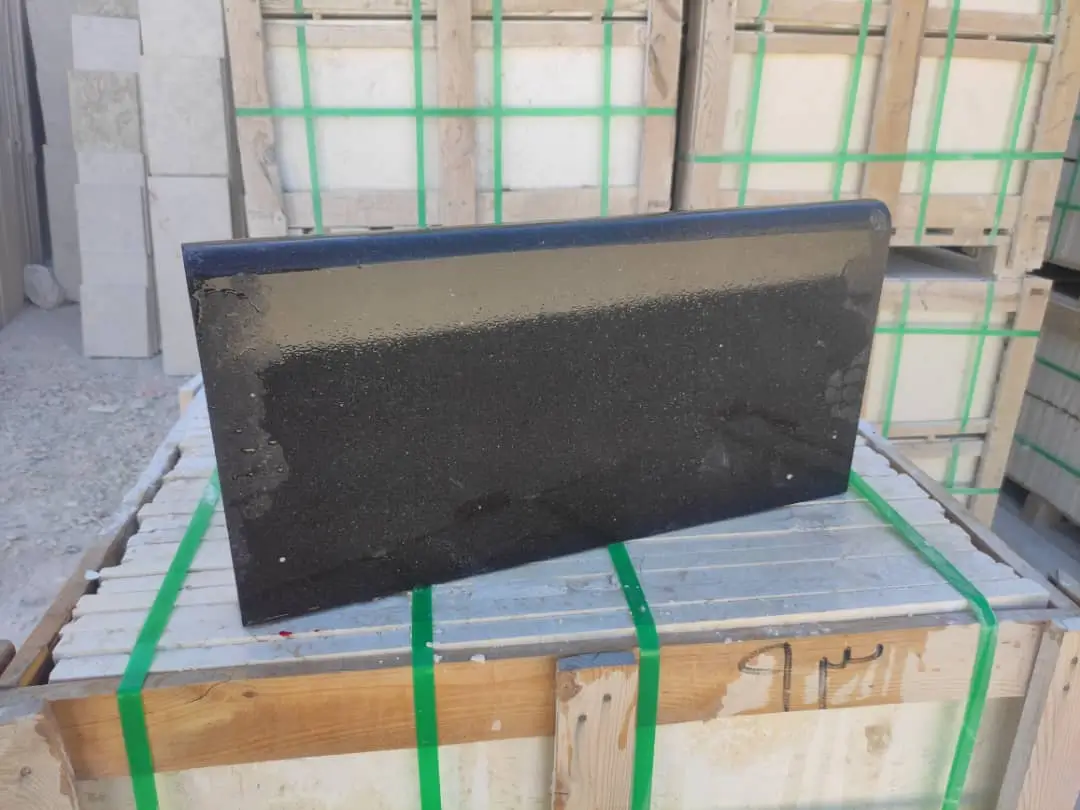
- Specify packaging requirements for custom cut pieces — longer slabs need individual foam interleaving and wooden crating, not the standard strapped bundle used for stock-format material
Getting Your Custom Cut Black Limestone Specification Right
Black limestone custom cutting Scottsdale projects succeed when the specification does the heavy lifting before fabrication begins. The material performs at a high level — compressive strength typically exceeding 14,000 PSI, thermal stability appropriate for Arizona’s extreme diurnal range, and a surface density that holds a sharp custom edge cleanly when the right cutting method is applied. The specification variables that determine whether your installation lands exactly as designed are tolerance definition, cutting method selection, thickness-to-format verification, and sealing sequence — not material quality alone.
Your project timeline depends equally on warehouse stock confirmation and fabrication lead time, both of which need to be locked in at the same time the design dimensions are finalized. Leaving either open while the design evolves is the scenario that consistently produces compressed fabrication windows and the corner-cutting that follows. As you plan your Arizona stone project, complementary specification resources can support your full material program — Black Limestone Slab Inventory Availability for Phoenix Immediate Needs provides direct access to current stock data for time-sensitive procurement decisions. Our black natural limestone paving in Arizona creates a seamless transition.