
Compressive strength ratings above 15,000 PSI position black limestone commercial Gilbert projects among the most structurally capable natural stone installations in the Phoenix metro — but that number only matters if your specification accounts for the specific load distribution patterns that Gilbert’s mixed-use commercial corridors actually produce. The material’s dense, low-porosity matrix gives it a fundamental advantage over lighter-colored limestones in heavy-traffic commercial environments, where surface degradation typically begins at microscopic pore interfaces rather than at the surface itself. Understanding how these performance characteristics translate to real specification decisions is where most commercial projects either succeed long-term or start showing wear patterns within five years.
Why Black Limestone Performs in Gilbert Commercial Settings
The density that makes black limestone visually striking is the same property that drives its commercial durability. Gilbert’s commercial zones — particularly along Williams Field Road and Higley Road corridors — see foot traffic volumes that would compromise softer natural stones within a few seasons. Black limestone’s Mohs hardness rating of 3–4 keeps it competitive in these environments, especially when specifying for entryways, plazas, and covered walkways where point-load concentration from carts, trolleys, and high-heel foot traffic creates localized stress.
The material also exhibits exceptionally low water absorption — typically below 0.5% — which matters considerably in a climate where monsoon season delivers intense, short-duration rainfall events. Surface water that sits on more porous materials accelerates staining and biological growth; on dense black limestone, it sheets off cleanly with proper slope specification. Confirm absorption rates on your specific material batch through ASTM C97 testing before finalizing your spec.
Surface Finish Selection for Arizona Commercial Exteriors
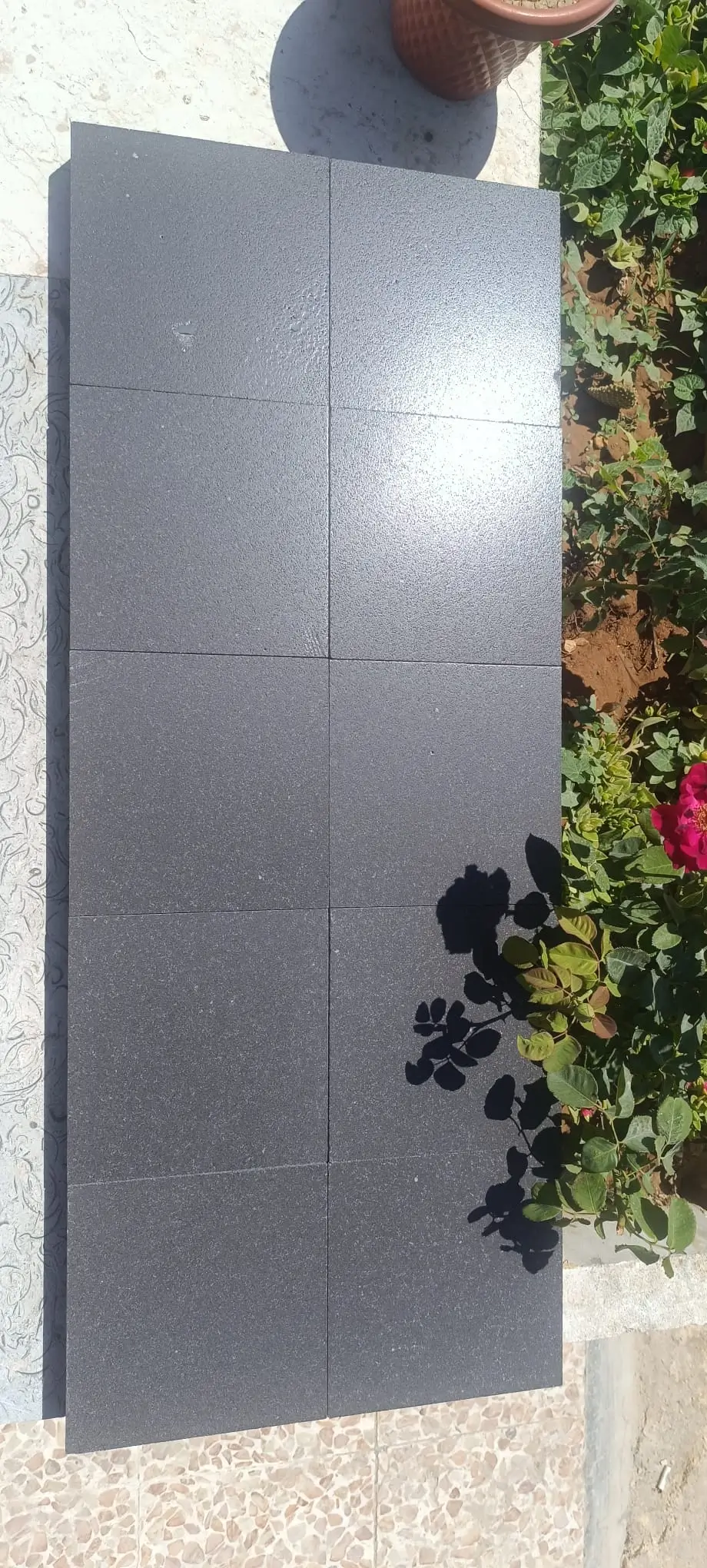
Finish choice on black limestone commercial Gilbert projects carries more consequence than most specifiers realize. The four primary finishes — honed, flamed, bush-hammered, and sawn — each produce measurably different slip resistance coefficients, and Arizona’s commercial code requirements under ADA guidelines demand a minimum Dynamic Coefficient of Friction (DCOF) of 0.42 for wet exterior surfaces.
- Honed finishes deliver a smooth, matte surface with DCOF values typically in the 0.45–0.55 range when dry, dropping to 0.38–0.43 when wet — borderline for uncovered exterior applications
- Flamed finishes create micro-texture through thermal shock, producing DCOF values consistently above 0.55 wet, making them the preferred choice for Gilbert business exteriors with outdoor seating or uncovered pedestrian areas
- Bush-hammered finishes offer the highest slip resistance in the range but sacrifice some of the material’s visual depth and reflectivity
- Sawn finishes work well for covered areas where wet-surface exposure is limited and the cleaner edge profile supports modern commercial design aesthetics
For retail spaces in Chandler and Gilbert that share similar design vernaculars — contemporary, clean-lined commercial — the honed finish with a penetrating sealer achieving DCOF uplift to 0.50+ wet is often the specification sweet spot. The sealer needs reapplication every 24–36 months in high-traffic zones; your maintenance contract should specify this explicitly.
Thermal Performance and Heat Island Considerations
Here’s what most commercial specifiers in the Phoenix metro underestimate: black limestone absorbs and retains significantly more solar energy than lighter-colored alternatives, which creates a surface temperature differential that directly affects occupant comfort and material longevity. On a 108°F Gilbert afternoon, a black limestone surface in direct sun can reach 145–155°F — well within the material’s thermal tolerance, but a genuine consideration for outdoor dining areas, playground adjacencies, or any zone where occupants contact the surface directly.
The thermal mass characteristic does, however, work in your favor in covered commercial applications. Under shade structures, colonnades, or interior-to-exterior transition zones, the material’s ability to buffer temperature fluctuations between conditioned and unconditioned space reduces thermal cycling stress at the paver joints. Expansion joint spacing for black limestone in Arizona’s commercial outdoor areas should be calculated at 12–15 feet maximum — tighter than the 20-foot intervals seen in generic specifications developed for temperate climates.
Black limestone paving in Arizona commercial projects that include outdoor dining or retail patios benefits from orienting the material’s longest dimension perpendicular to the prevailing afternoon sun angle. This is a small detail that meaningfully reduces the visible thermal patina — a surface color shift caused by repeated high-temperature cycling — that can emerge over five to seven years on southern and western exposures.
Thickness and Base Preparation Standards
For commercial applications in Gilbert, the minimum thickness specification depends entirely on anticipated load category. Getting this wrong in either direction creates problems — over-specification wastes budget; under-specification produces cracking within 18–24 months.
- Pedestrian-only zones: 1.25-inch (30mm) nominal thickness with a 4-inch compacted aggregate base and 2-inch concrete sub-base
- Mixed pedestrian and light vehicular (delivery vehicles, golf carts, service vehicles): 2-inch (50mm) nominal thickness with 6-inch compacted aggregate base and 4-inch concrete sub-base
- Heavy vehicular access points or loading zone adjacencies: 3-inch (75mm) nominal thickness on a 6-inch reinforced concrete sub-base with saw-cut expansion joints at 12-foot intervals
- All installations: crushed aggregate base compacted to 95% Standard Proctor density — Arizona’s sandy soils shift under load more than eastern soils, and this compaction standard is non-negotiable for long-term performance
Gilbert’s soil profile in commercial zones frequently includes caliche layers at varying depths. Where caliche is present at 12–18 inches, it can actually serve as a natural compaction platform — but only if it’s contiguous and at consistent depth across the installation area. Irregular caliche creates differential settlement, which telegraphs directly to the surface as joint displacement within three to five monsoon seasons.
Sealing and Surface Protection for Commercial Longevity
Black limestone’s dark coloration makes sealer application both more forgiving visually and more critical technically. Staining from cooking oils, tyre rubber transfer, bird droppings, and irrigation overspray becomes permanently embedded in unsealed limestone within 48–72 hours in Arizona’s heat — the elevated temperatures accelerate capillary absorption dramatically compared to cooler climates.
Your sealer specification should distinguish between the initial application and the maintenance program. For new black limestone commercial Gilbert installations, a two-coat penetrating silane-siloxane sealer applied to a bone-dry surface — minimum 48 hours post-installation, and never during monsoon humidity spikes above 60% RH — provides the foundation. The first coat saturates the surface matrix; the second coat, applied within 20–30 minutes of the first going tacky, fills the residual pore structure that the first coat misses.
- Initial sealer application: two penetrating coats of silane-siloxane formulation, pH-neutral, with a minimum 4-hour cure before foot traffic
- Maintenance resealing schedule: every 18–24 months for high-traffic zones, every 30–36 months for covered or low-traffic areas
- Spot treatment: any oil-based spill should be treated with a pH-neutral limestone cleaner and diluted white spirit within 2 hours to prevent permanent staining
- Avoid: acidic cleaners, pressure washing above 1,000 PSI directly on joints, and chlorine-based sanitizers — all degrade sealer integrity and accelerate surface micro-etching
For Tempe-area commercial projects with similar exposure profiles, the sealing protocol above applies equally — the UV intensity across the East Valley is consistent enough that a unified maintenance specification works across Gilbert, Tempe, and Chandler sites within the same commercial portfolio.
Drainage Slope and Joint Design for Arizona Monsoons
Arizona’s monsoon season compresses annual rainfall into eight weeks of high-intensity events, and your drainage specification needs to treat this reality as the primary design condition — not an edge case. The standard 1–2% slope adequate for gradual rainfall regions is the minimum for Gilbert commercial outdoor areas; in practice, 2% slope toward defined drainage points produces meaningfully better ponding performance during 2-inch-per-hour rainfall events.
Consider your dark natural limestone paving selection in the context of joint width and infill material. For commercial applications, a 3/16-inch joint with a polymeric sand rated for heavy traffic provides the best balance between surface stability and drainage capacity. Narrow joints below 1/8-inch are tempting for a cleaner visual line but create pooling problems when individual units experience minor differential settlement — and they will settle to some degree in Arizona’s thermal-cycling environment.
Joint sand loss is the most common maintenance failure point in Arizona commercial limestone installations. Standard joint sand washes out within two to three monsoon seasons; specify polymeric sand with a hardening agent rated for temperatures above 140°F, as standard polymeric formulations can soften and lose their binding integrity on black limestone surfaces that absorb and radiate heat at the levels Arizona summer sun delivers.
Specifying Black Paving for Retail Spaces and Professional Image
The visual durability of black paving in retail spaces across Arizona installations is as important as structural performance — commercial properties live and die on first-impression aesthetics, and a material that looks exhausted after three years costs tenants and owners alike in retention and property valuation regardless of structural integrity. Black limestone maintains its visual depth exceptionally well compared to concrete alternatives, which chalk and lighten under UV exposure; the stone’s mineral matrix doesn’t photobleach the same way manufactured materials do.
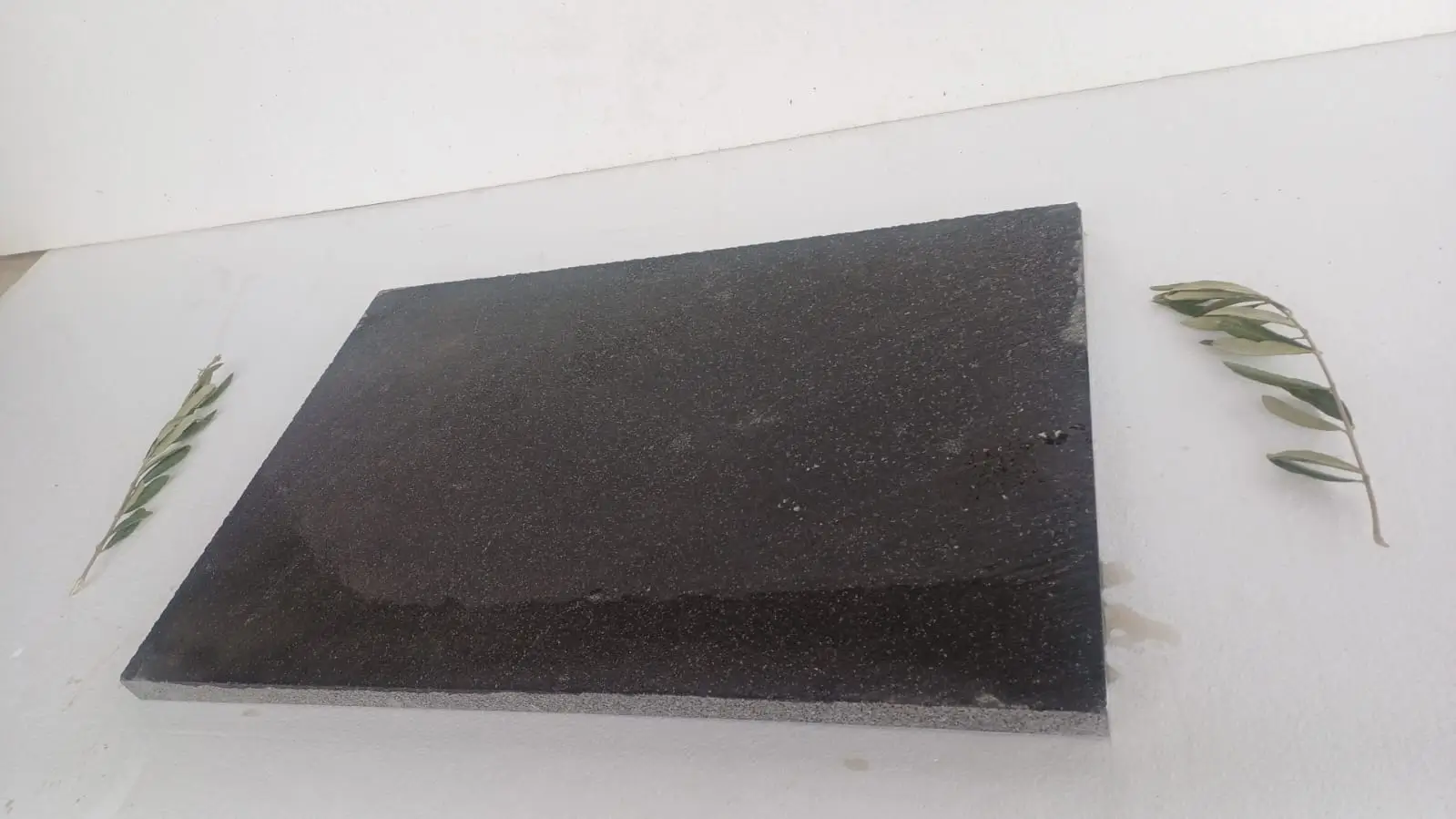
For Gilbert business exteriors oriented toward professional image — medical offices, legal and financial services, corporate campuses, upscale retail — the material’s inherent formality and visual weight communicate permanence and investment. Pair it with stainless steel or brushed bronze architectural elements and the combination reads as intentionally premium rather than simply expensive. The contrast between the dark limestone field and lighter-colored building facades also frames entryways in a way that concrete or asphalt simply cannot replicate at any price point.
At Citadel Stone, we see this professional image specification most consistently on multi-tenant commercial projects where the owner is establishing a design standard for the entire development. The material’s uniformity across large installations — something that’s harder to achieve with natural stones exhibiting high color variation — makes it particularly effective for corporate outdoor areas where visual consistency across hundreds of linear feet matters.
Ordering Logistics and Project Timeline Planning
Commercial project timelines need to account for material lead times honestly. Black limestone for commercial applications in Gilbert typically requires more precision in ordering than residential projects — commercial quantities in consistent thickness tolerances (±1/8 inch for large format tiles) require selection from specific warehouse stock or quarry runs, not a mix of batches.
- Standard warehouse stock in common sizes (24×24, 12×24, 18×18 inches): typically available with 1–2 week lead time for in-stock material
- Custom sizing or non-standard thickness specifications: allow 6–8 weeks minimum for quarry sourcing and fabrication
- Large commercial quantities above 5,000 square feet: verify that your supplier can confirm single-batch sourcing — color and density variation between quarry batches is subtle but visible at scale
- Truck delivery scheduling: Gilbert commercial sites with restricted access hours or limited staging areas should confirm delivery windows at order placement, not at shipping confirmation
At Citadel Stone, our warehouse inventory includes commercial-grade black limestone in the sizes most commonly specified for Arizona commercial projects, and our technical team can advise on batch consistency verification before your order is finalized. For projects in Surprise or east valley locations, truck routing and delivery access are worth confirming in advance — site access constraints affect scheduling more than distance does in the Phoenix metro’s commercial corridor traffic patterns.
Black Limestone Commercial Gilbert Specifications That Last
Black limestone commercial Gilbert specifications succeed when the material’s genuine performance characteristics — compressive strength, low absorption, thermal tolerance, and visual stability — are matched with installation details that reflect Arizona’s specific climate demands rather than generic commercial standards developed for milder environments. The specifications that fail aren’t typically the result of wrong material selection; they’re the result of base preparation shortcuts, inadequate joint design, and maintenance programs that treat limestone like concrete tile. Your commercial outdoor areas deserve a specification document that addresses all three.
The design dimension of this material goes beyond performance — for Gilbert business exteriors investing in exterior environments that communicate professional quality, the visual vocabulary of black limestone carries weight that no manufactured alternative replicates at the same longevity. If you’re also exploring design-driven applications in the broader East Valley market, Black Limestone Paving Monochrome Schemes for Chandler Sophistication covers the aesthetic specification decisions that complete a cohesive commercial design strategy using this material across adjacent markets. Our black limestone slabs for sale in Arizona are competitively priced.