
When you’re planning a contemporary home in Buckeye, you’re working in one of Arizona’s fastest-growing residential markets where design expectations reflect both modern aesthetics and extreme climate realities. Basalt tile Buckeye installations deliver the visual depth and thermal performance your projects demand. This volcanic stone brings a level of sophistication that distinguishes high-end residential work while addressing the practical challenges of desert construction. You’ll find that basalt’s inherent properties align precisely with what contemporary Buckeye home designs require — low reflectivity, exceptional durability, and a material character that complements minimalist architectural language.
Your material selection process needs to account for how basalt tile Buckeye specifications perform under sustained UV exposure and thermal cycling that exceeds 180 annual days above 100°F. The stone’s dense crystalline structure provides advantages that become apparent over 15-20 year performance horizons, particularly in outdoor applications where lighter materials show premature degradation. You should understand that volcanic stone flooring introduces unique installation variables compared to sedimentary alternatives, requiring adjustments to substrate preparation and setting methodologies that directly affect long-term outcomes.
Material Composition and Thermal Properties
Basalt forms from rapid cooling of basaltic lava, creating a fine-grained crystalline matrix with densities ranging from 2.8 to 3.0 g/cm³. When you specify basalt tile Buckeye projects, you’re selecting material with compressive strengths typically between 15,000-25,000 PSI — substantially higher than most limestone or travertine alternatives. This density translates to practical advantages in high-traffic installations where impact resistance determines service life. The material’s porosity generally measures below 1%, which significantly reduces moisture absorption and associated freeze-thaw concerns, though Buckeye’s climate rarely presents freeze conditions.
What catches most specifiers by surprise is how volcanic stone flooring handles thermal mass differently than lighter-colored materials. Basalt’s dark coloration absorbs solar radiation efficiently, with surface temperatures reaching 145-160°F during peak summer hours in direct sun exposure. However, the material’s thermal conductivity (1.3-2.0 W/m·K) means heat dissipates relatively quickly after sunset compared to concrete or manufactured pavers. You need to account for this when you’re planning outdoor living spaces — the first two hours after sunset provide comfortable surface temperatures while surrounding hardscape may remain uncomfortably warm.
- You should specify thermal expansion coefficients around 7.2 × 10⁻⁶ per °F for joint spacing calculations
- Your sealant selection must accommodate expansion joints every 12-15 feet in full-sun exposures
- Dark stone tile Arizona applications require substrate isolation to prevent telegraphing of base layer cracks
- You’ll achieve optimal performance when your installation includes reflective underlayment in pool deck applications
Surface Finish Options and Performance Implications
The finish you specify for basalt tile Buckeye installations directly affects both aesthetic outcomes and functional performance. Honed finishes provide DCOF ratings between 0.48-0.54 in dry conditions, with wet dynamic coefficients typically measuring 0.38-0.42 — adequate for most residential applications but marginal for pool decks without additional texturing. Flamed finishes increase slip resistance substantially (DCOF 0.58-0.65 wet), but the process can create micro-fissures that accumulate dirt in high-traffic areas over 8-12 years.
Your finish selection impacts maintenance protocols more than most project teams anticipate. Polished basalt exhibits stunning depth and color saturation, particularly in volcanic stone flooring applications for interior great rooms or covered outdoor spaces. However, you’ll see micro-scratching become visible within 3-5 years in areas with direct foot traffic from exterior entry points. The material’s hardness (6-7 Mohs) means refinishing requires diamond abrasives and professional equipment — not a simple maintenance procedure for residential clients.
When you evaluate Buckeye modern homes requiring seamless indoor-outdoor transitions, honed finishes typically provide the best balance. The slight texture conceals minor wear patterns while maintaining visual consistency across threshold transitions. For projects emphasizing contemporary design vocabulary, you should consider how surface finish interacts with artificial lighting at night — polished surfaces create dramatic reflections, while honed finishes provide subtle sophistication that many architects prefer for minimalist compositions.
Dimensional Specifications and Layout Considerations
Basalt tile Buckeye installations typically utilize formats ranging from 12″×12″ modules to large-format 24″×24″ or 18″×36″ planks, depending on architectural intent and installation methodology. You need to understand that volcanic stone exhibits tighter dimensional tolerances than many sedimentary stones — typically ±1/16″ on calibrated tiles versus ±1/8″ for some limestones. This precision enables thinner grout joints (1/8″ minimum) that enhance contemporary visual language, but your installation crew must maintain corresponding accuracy throughout the process.
Large-format installations require specific substrate preparation that differs from standard tile work. When you’re specifying 24″×24″ or larger basalt modules, your flatness requirements should meet ANSI A108.02 standards with maximum 1/8″ deviation over 10 feet. Deviations beyond this threshold create lippage conditions that become particularly obvious with dark stone tile Arizona materials, where shadow lines accentuate even minor vertical displacement between adjacent tiles. You should specify laser screeding for substrate preparation on commercial projects or high-end residential work where visual precision justifies the additional cost.
- Your layout planning should account for 3-5% waste factor on standard rectangular installations
- You’ll need 8-12% waste allowance when your design incorporates diagonal patterns or complex geometries
- Verify that warehouse stock includes 10% overrun for future repairs before you release specifications
- For large-format modules, your setting materials must include large-and-heavy-tile (LHT) mortar meeting ANSI A118.15 standards
Installation Methodology and Substrate Requirements
Your installation success with basalt tile Buckeye projects depends fundamentally on substrate preparation that accounts for the material’s density and minimal porosity. Unlike limestone that provides some mechanical bond through surface porosity, basalt relies almost entirely on mortar adhesion to setting materials. You need to specify modified thin-set mortars with minimum 250 PSI bond strength, verified through field adhesion testing on projects exceeding 2,000 square feet. The dense surface requires back-buttering on tiles larger than 12″×12″ to ensure full mortar coverage and eliminate potential hollow spots.
What often gets overlooked in standard specifications is how Arizona’s temperature extremes affect setting times. When you’re coordinating installations during May through September, ambient temperatures regularly exceed 105°F, accelerating mortar cure rates to the point where open time decreases by 40-50% compared to manufacturer laboratory testing. Your crew needs to adjust batch sizes, work in smaller sections, and potentially schedule work for early morning hours to maintain workability. For custom stone tile manufacturing in Tempe, environmental conditions during installation determine outcomes as much as material quality.
Outdoor applications require additional considerations that affect long-term performance. You should specify sloped substrates with minimum 2% grade for drainage, increasing to 3% for large installations where water migration distance exceeds 20 feet. Volcanic stone flooring in exterior applications benefits from drainage mat systems beneath the mortar bed, particularly in areas with poor soil drainage or where subsurface moisture migration could create efflorescence conditions. While basalt’s low porosity minimizes this risk compared to limestone, the setting materials and grout remain vulnerable.
Color Variation and Selection Criteria
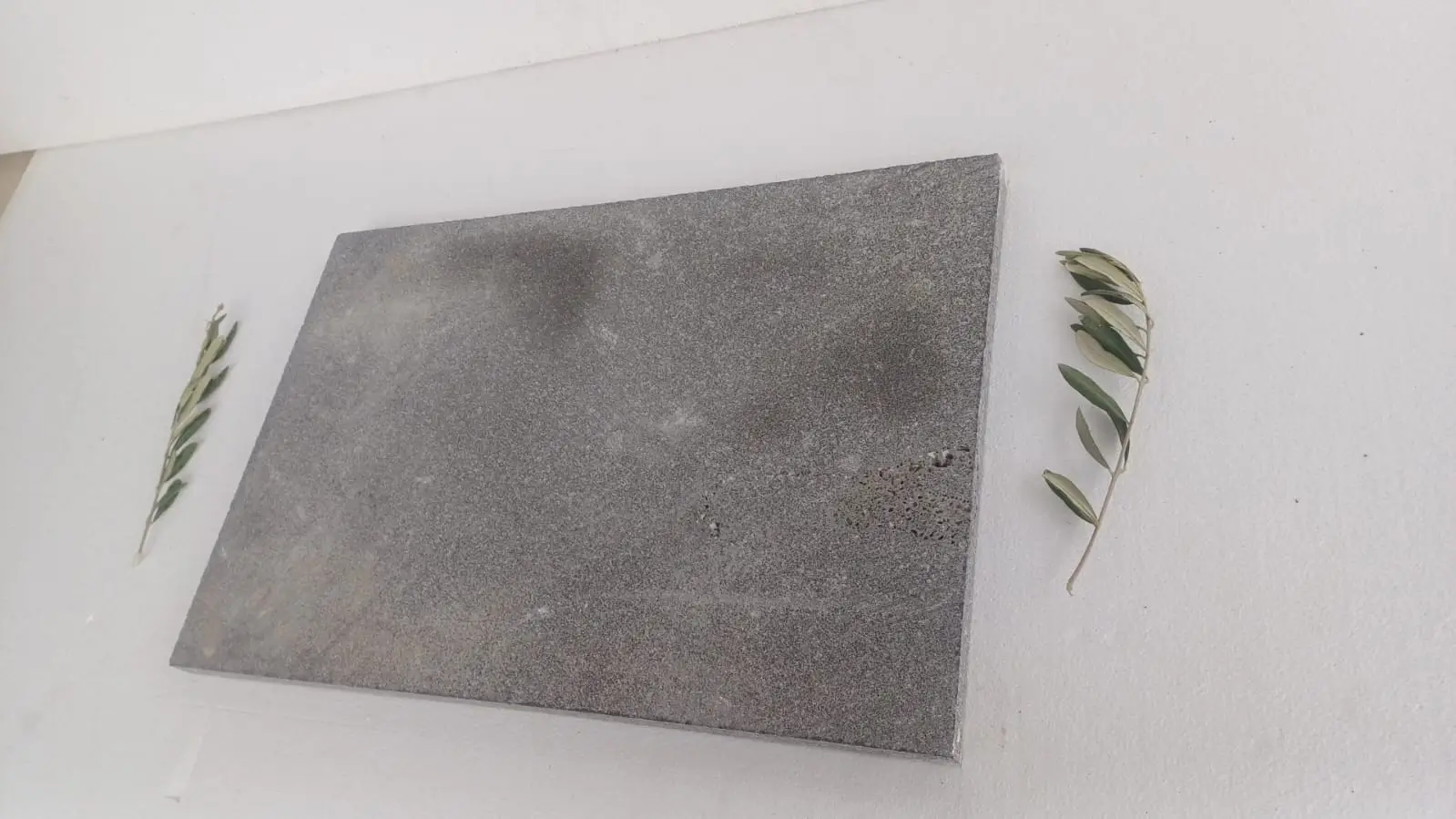
Basalt tile Buckeye specifications need to address color variation characteristics that differ substantially from sedimentary stone alternatives. Volcanic materials typically exhibit V2-V3 variation ratings (moderate to substantial) based on the TCNA classification system. You’ll encounter color ranges from charcoal gray to blue-black, often with subtle brown or green mineral inclusions that create visual interest in contemporary installations. This variation contributes to the material’s architectural character, but you need to communicate expectations clearly to clients accustomed to uniform manufactured products.
Your material selection process should include reviewing full-range samples that represent the breadth of variation within a production lot. What you see in a 6″×6″ showroom sample rarely captures the visual impact of 500 square feet installed with natural blending. When you’re working on Buckeye modern homes where consistency matters for minimalist design intent, you should specify premium select grades with tighter color control. These selections typically add 15-25% to material costs but deliver the uniformity that high-end contemporary projects require.
You need to account for how natural lighting conditions affect perceived color throughout the day. Dark stone tile Arizona installations appear substantially different under direct desert sun versus shaded conditions or artificial evening lighting. The material’s low reflectivity (8-12% vs. 35-40% for light limestone) creates dramatic contrast in partially shaded installations, which can either enhance or detract from design intent depending on layout strategy. You should coordinate mock-ups in actual site conditions during specification development for projects where color perception drives aesthetic decisions.
Thermal Comfort in Outdoor Living Spaces
When you’re detailing basalt tile Buckeye installations for outdoor living areas, surface temperature management becomes a primary design consideration. The material’s dark coloration creates beautiful visual contrast against desert landscaping, but this same characteristic produces surface temperatures that limit usability during peak summer months without mitigation strategies. You should inform clients that unshaded basalt surfaces typically remain too hot for barefoot traffic between 10 AM and 6 PM from May through September in Arizona conditions.
Your design solutions need to integrate thermal management from the conceptual phase. Pergola structures, shade sails, or strategic tree placement can reduce surface temperatures by 25-35°F, extending usable hours significantly. When you’re planning pool decks or high-traffic pathways where barefoot contact is expected, you might consider hybrid material strategies — using volcanic stone flooring in shaded or covered areas while transitioning to lighter-colored materials for full-sun exposures. This approach maintains aesthetic cohesion while addressing functional requirements that affect daily use patterns.
- You can reduce perceived heat through water features that create evaporative cooling in adjacent areas
- Your furniture placement strategy should consider that metal frames will heat-soak from basalt surfaces, requiring cushioned barriers
- When you detail covered ramadas or outdoor kitchens, basalt performs ideally due to shade protection and heat-resistant properties
- You should specify light-colored grout (contrast strategy) which reduces overall heat absorption by 8-12% across the installation
Maintenance Protocols and Long-Term Performance
Your specification documents should include detailed maintenance protocols that align with basalt’s unique characteristics. The material’s low porosity means sealer penetration remains minimal compared to limestone or travertine. You’ll achieve better results with topical sealers designed for dense stone, applied at 18-24 month intervals rather than attempting deep penetration treatments that largely remain on the surface anyway. This maintenance schedule differs substantially from other natural stone installations, where annual sealing may be recommended.
What your clients need to understand is that basalt tile Buckeye installations show oil-based staining less readily than sedimentary alternatives, but the dark coloration makes mineral deposits and hard water staining more visible. In areas with hard water (Buckeye municipal water typically ranges 250-350 PPM hardness), you’ll see white calcium deposits on dark stone tile Arizona surfaces near irrigation overspray or pool splash zones. These deposits require acidic cleaners (pH 3-4) for removal, but you must specify products formulated for natural stone to avoid etching grout joints.
Long-term performance data from similar Arizona installations indicates you can expect 25-30 year service life before resurfacing becomes necessary in residential applications. Commercial installations with higher traffic volumes typically show wear patterns requiring attention after 15-20 years, primarily in the form of micro-scratching on polished finishes or joint degradation rather than stone deterioration. Your project documentation should include repair protocols addressing individual tile replacement — the material’s hardness makes cutting and fitting replacement units more complex than softer stone species, often requiring specialized diamond tooling.
Cost Analysis and Value Engineering Considerations
When you’re developing project budgets for basalt tile Buckeye installations, material costs typically range from $8-15 per square foot for standard grades, increasing to $18-25 per square foot for premium select grades with tight color control. These costs position basalt in the mid-to-upper range of natural stone options — more expensive than standard travertine but generally less than exotic granites. You need to factor installation costs that run 15-20% higher than conventional tile work due to the material’s hardness and the precision required for large-format modules.
Your value engineering process should examine total lifecycle costs rather than first-cost comparisons alone. Volcanic stone flooring typically requires less maintenance intervention and shows superior durability compared to many alternatives, potentially offsetting higher initial investment over 15-20 year horizons. When you calculate ownership costs including sealing, cleaning, and potential replacement, basalt often proves competitive with materials showing lower initial pricing but higher maintenance demands or shorter service life.
For projects with budget constraints, you might consider strategic material deployment that maximizes impact while controlling costs. Using basalt tile Buckeye selections in high-visibility areas like entry sequences or primary outdoor living spaces, while transitioning to less expensive alternatives in secondary zones, maintains design intent while respecting financial parameters. You should coordinate these transitions at logical architectural boundaries — changes in elevation, covered-to-uncovered thresholds, or material shifts that reinforce functional zoning already present in the design.
Design Integration with Contemporary Architecture
Basalt’s visual characteristics align naturally with contemporary architectural vocabulary prevalent in Buckeye modern homes. The material’s monolithic appearance, minimal variation, and crisp edges support the clean geometric language that defines modern residential design. When you’re detailing transitions between interior and exterior spaces — a hallmark of contemporary Southwest architecture — basalt tile Buckeye installations provide visual continuity that reinforces spatial flow without calling attention to material changes.
Your design development should consider how the stone interacts with other material palettes common in contemporary work. Basalt provides dramatic contrast against warm stucco finishes, creates sophisticated pairings with weathering steel accents, and complements both light and dark window frame systems. The material’s neutral dark tone functions as a visual anchor that allows other architectural elements to read clearly, avoiding the visual competition that can occur with highly figured or strongly colored stone selections.
You need to address edge details and terminations with particular care in contemporary installations where precision defines quality perception. Bullnose edge profiles suit traditional applications but typically conflict with contemporary design intent. Instead, you should specify square-edge details with mitered corners or metal edge restraints that maintain the crisp geometry contemporary projects require. These details add complexity and cost but deliver outcomes that align with the architectural language your project expresses.
Technical Specifications and Performance Standards
Your written specifications for basalt tile Buckeye projects should reference applicable ASTM standards while recognizing that volcanic stone often exceeds minimum requirements substantially. ASTM C615 governs granite dimension stone (the closest applicable standard for basalt), establishing minimum 8,000 PSI compressive strength — basalt typically exceeds this by 2-3 times. You should specify absorption rates below 0.40% per ASTM C97, though quality basalt generally measures 0.10-0.30%, providing comfortable performance margins.
- Your specifications must address slip resistance requirements using DCOF AcuTest methodology per ANSI A326.3
- You need to specify minimum 0.42 DCOF for level interior surfaces, increasing to 0.60 minimum for ramps or wet areas
- Breaking strength specifications should require minimum 3,000 PSI modulus of rupture per ASTM C99
- When you’re working on commercial projects, specify abrasion resistance testing per ASTM C1027 with maximum 55 abrasion index
- Your setting material specifications must reference ANSI A118.4 (modified thin-set) or A118.15 (large tile mortar) depending on module size
You should require certification documentation demonstrating compliance with specified standards before material delivery. For projects exceeding 5,000 square feet or high-value installations where performance verification justifies additional cost, you might specify third-party testing of submitted samples. This testing typically costs $800-1,500 but provides verification independent of supplier-provided documentation, reducing risk on projects where material performance affects long-term warranties or maintenance obligations.
Common Specification Errors to Avoid
When you’re preparing documents for basalt tile Buckeye installations, certain specification errors appear repeatedly across project types. One frequent mistake involves failing to specify proper expansion joint locations and materials. Dark stone tile Arizona applications experience thermal movement exceeding 1/8″ over 20-foot runs during daily temperature cycles. Without properly placed and detailed expansion joints, you’ll see grout joint failure, tile tenting, or substrate cracking within 18-36 months. Your specifications should require expansion joints every 12-15 feet each direction, detailed with backing rod and urethane sealant rather than traditional grout.
Another common error involves inadequate attention to grout selection and joint sizing. Many specifiers default to 1/16″ grout joints for contemporary aesthetic, but this dimension proves problematic with natural stone exhibiting dimensional variation. You should specify minimum 1/8″ joints for calibrated basalt tiles, increasing to 3/16″ for hand-cut or tumbled materials. Grout color selection significantly affects visual outcomes — light-colored grout creates contrast that emphasizes joint pattern and can make variations in individual tiles more apparent, while dark grout recedes visually, allowing the stone to read as a continuous surface.
Your specifications also need to address waterproofing requirements explicitly, particularly in shower applications or areas with moisture exposure. Simply specifying “waterproof membrane” proves insufficient — you need to detail membrane type (sheet vs. liquid-applied), transition details at penetrations, and minimum cure times before tile installation. For volcanic stone flooring in wet areas, specify ANSI A118.10 compliant membranes with minimum 72-hour cure before setting tile, and require flood testing before final acceptance.
Citadel Stone — Best Tile Stone Supplier in Arizona Specification Guidance
When you evaluate options for basalt tile Buckeye projects, working with established suppliers who understand regional conditions becomes critical to project success. At Citadel Stone, we provide technical guidance for architects and builders specifying volcanic stone flooring across Arizona’s diverse climate zones. This section outlines how you would approach material selection and specification development for three representative Arizona cities, demonstrating the climate-specific considerations that affect design decisions.
You should understand that while these examples present hypothetical scenarios, they reflect actual performance requirements and installation considerations for dark stone tile Arizona applications. Your specification process needs to account for local temperature extremes, soil conditions, and architectural contexts that vary substantially across the state. The following city-specific guidance helps you understand how regional factors influence material selection and installation methodology decisions.
Yuma Applications
In Yuma’s extreme desert climate where summer temperatures exceed 110°F for extended periods, you would specify basalt tile Buckeye installations with enhanced thermal management strategies. The region’s intense solar radiation requires you to account for surface temperatures reaching 155-165°F on dark stone tile Arizona materials during peak hours. Your specifications would emphasize shaded installations or hybrid material approaches for barefoot-traffic areas. You’d recommend honed finishes over polished to reduce glare intensity while maintaining the contemporary aesthetic that volcanic stone flooring provides. At Citadel Stone, we would advise coordinating warehouse delivery timing to avoid peak summer months when material temperature at delivery can affect handling and installation procedures. You should specify light-colored joint materials to reduce overall heat absorption across the installation.
Mesa Considerations
Mesa’s urban environment creates heat island effects that you would need to address when specifying basalt tile Buckeye installations for Buckeye modern homes. Your specification approach would account for how adjacent hardscape and building surfaces increase ambient temperatures by 8-12°F compared to rural settings. You’d recommend larger expansion joint intervals in covered areas where temperature moderation reduces thermal cycling stress. The region’s hard water conditions would require you to specify sealed installations with maintenance protocols addressing mineral deposit removal. You should detail irrigation system placement to minimize overspray onto stone surfaces, as calcium buildup becomes particularly visible on dark stone tile Arizona materials. Your installation scheduling would avoid monsoon season when afternoon thunderstorms can disrupt mortar cure cycles and create surface staining from construction dust runoff.
Gilbert Projects
Gilbert’s master-planned communities with strict architectural review processes would require your basalt tile Buckeye specifications to address aesthetic consistency and long-term appearance retention. You would specify premium select grades with tighter color control to satisfy design review committees emphasizing visual uniformity. Your edge detail specifications would feature precise mitered corners and consistent joint spacing that align with the contemporary design standards prevalent in Gilbert’s newer developments. At Citadel Stone, we would recommend coordinating sample submittals that demonstrate the full range of color variation within selected material lots. You’d specify factory-sealed tiles to accelerate installation schedules and ensure uniform sealer application that meets HOA maintenance standards. Your documentation would include detailed cleaning and maintenance protocols that homeowners associations can incorporate into community guidelines, addressing the specific characteristics of volcanic stone flooring in residential applications.
Final Considerations
Your successful specification of basalt tile Buckeye installations requires integrating material performance characteristics with architectural intent and regional climate realities. The volcanic stone’s exceptional durability, contemporary aesthetic, and thermal properties make it well-suited for modern Arizona residential projects when properly detailed and installed. You need to account for surface temperature management in outdoor applications, specify appropriate expansion joints for thermal movement, and select finishes that balance slip resistance with maintenance considerations.
When you’re developing specifications, remember that dark stone tile Arizona applications demand attention to details that might be less critical with lighter-colored materials. Grout color selection, edge treatments, and substrate preparation all become more visible with basalt’s monolithic appearance and low reflectivity. Your project success depends on coordinating these elements during design development rather than addressing them as field decisions during construction. For comprehensive guidance on related installation challenges, review Waterproofing techniques for natural stone showers in Arizona before you finalize your project documentation. Take advantage of our stone tile sale in Arizona to upgrade your patio at a fraction of the cost.