
Edge profile selection for black granite stairs and tile applications carries more structural consequence in Arizona than most specifiers initially recognize — and the decision point isn’t aesthetic preference, it’s mechanical performance under storm stress. The choice between bullnose and square edge in black granite bullnose tile in Arizona projects determines how well your installation holds up when wind-driven rain infiltrates joints, when hail impact loads concentrate at exposed corners, and when thermal cycling compounds the stress already introduced by severe weather events. Getting this specification right from the start separates installations that perform for 25 years from those that show progressive edge deterioration within a decade.
Why Storm Mechanics Drive Edge Selection in Arizona
Arizona’s monsoon season doesn’t get enough credit for the mechanical punishment it delivers to stone installations. Sustained wind gusts exceeding 60 mph during haboobs and convective storms create lateral pressure differentials across stair nosings and tile fields that most generic specifications never account for. The leading edge of any stair tread or tile border is the first point of contact for wind-driven debris — and the geometry of that edge determines whether impact energy dissipates across a radius or concentrates at a 90-degree corner.
Bullnose profiles, with their rounded or eased leading edge, distribute impact loads across a larger surface area. Square edges, by contrast, present a sharp arris that concentrates stress at a single point. Under repeated hail impact — which occurs with genuine frequency in central and northern Arizona — that concentrated stress creates microfractures that propagate inward along the granite’s natural crystal boundaries over time. Black granite’s tight interlocking crystal structure gives it excellent compressive strength above 18,000 PSI per Natural Stone Institute granite durability specifications, but tensile strength at sharp corners is considerably lower, making edge geometry a primary durability variable in high-impact environments. The black stone edge profile differences across Arizona installations become most apparent after three or more monsoon seasons, when unprotected square-edge corners begin showing the cumulative effects of repeated impact loading.
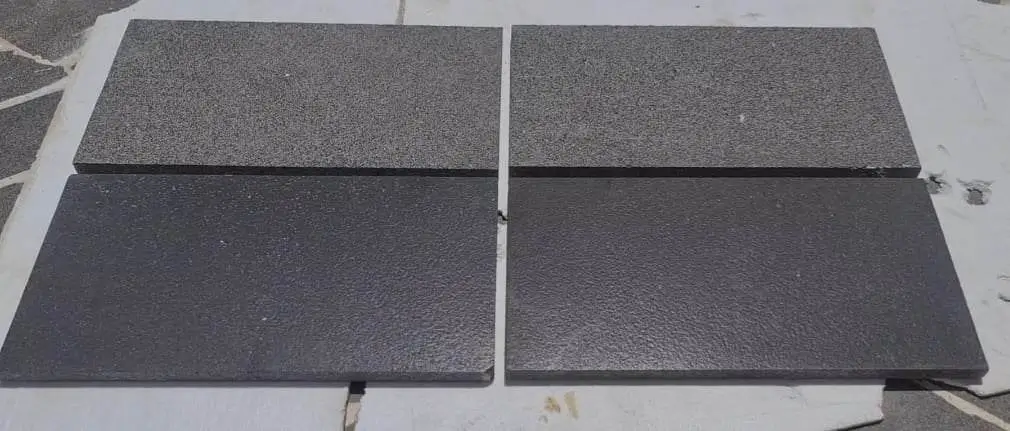
Bullnose Profile Performance Under Wind and Storm Load
The rounded geometry of a bullnose profile does something that’s easy to underestimate until you’ve watched a square-edge installation fail: it redirects lateral wind pressure rather than absorbing it perpendicularly. On stair applications, the nosing takes the full force of any wind-driven object — debris, gravel, hail — and a well-radiused bullnose deflects a meaningful portion of that energy tangentially rather than transferring it straight into the stone body. That redirection matters enormously in cumulative fatigue terms.
For projects in Sedona, where wind events are channeled by canyon topography into concentrated gusts that exceed open-terrain speeds by 20–30%, bullnose profiles on exterior stair treads show measurably better long-term arris integrity compared to square-edge alternatives installed in identical conditions. The rounded edge also reduces the likelihood of spalling when small stones carried by high-velocity wind contact the stair nosing at oblique angles. This bullnose tile edge comparison in Arizona locations with canyon-channeled wind exposure consistently favors the rounded profile for unprotected exterior applications — the square-edge installations almost always show corner chipping after five or more monsoon seasons without resealing, while bullnose installations retain their profile integrity.
- Bullnose radius distributes hail and debris impact across 15–25mm of curved surface rather than concentrating at a single arris point
- Rounded profiles reduce wind-driven water infiltration at the nosing-to-riser joint by minimizing the gap geometry that allows capillary action under pressure
- Bullnose edges eliminate the 90-degree corner stress concentration that initiates microfracture propagation in high-impact environments
- For stair applications exposed to monsoon-season wind loads, bullnose profiles consistently outperform square edges in arris retention over 10+ year observation periods
Square Edge Applications: Where the Profile Actually Holds Up
Square-edge black granite profiles aren’t a compromise — they’re the correct specification for a specific set of conditions, and understanding those conditions is where real specification expertise earns its value. The critical factor is exposure geometry. Square edges perform reliably when the exposed arris is protected from direct lateral impact — meaning the profile faces inward, sits flush against a wall, or is recessed into a frame condition that absorbs impact before it reaches the stone corner.
Interior flooring field tile, countertop edges against backsplash walls, and stair applications where the nosing is recessed under a metal or stone overhang are all environments where square-edge black granite excels. The clean geometric line of a square profile also integrates better with contemporary metal stair systems common in Mesa commercial developments, where the exposed edge is protected by steel nosing channels that take the primary storm load. In those protected conditions, the square arris remains crisp for decades because it’s never subjected to the direct impact loads that cause progressive chipping in unprotected applications. Understanding these black stone edge profile differences across Arizona project types allows designers to make specification decisions based on exposure analysis rather than aesthetic preference alone.
- Square edges are appropriate when the arris is protected by framing, metal nosing, or recessed geometry
- Interior applications with controlled foot traffic and no weather exposure are ideal square-edge environments
- Flush-to-wall tile installations eliminate lateral impact exposure, making the square profile a non-issue structurally
- When the aesthetic goal is sharp geometric definition and the installation is sheltered, square edge delivers a cleaner visual result
- Commercial interior environments with polished black granite benefit from square-edge profiles because the crisp line reads more powerfully under interior lighting
Joint Integrity Under Wind-Driven Rain
Here’s what most specifiers miss when comparing bullnose tile edge options for Arizona installations: the edge profile directly affects how wind-driven rain behaves at the joint. During peak monsoon events, rain doesn’t fall vertically — it arrives horizontally at speeds that force water under inadequate joint fills and behind improperly set stone. The nosing geometry determines whether water finds a pathway into the substrate or gets redirected away from the setting bed.
Bullnose profiles, when properly set with the rounded edge slightly overhanging the riser face, create a drip edge condition that sheds wind-driven water away from the riser-tread joint. Square-edge profiles set flush create a continuous vertical plane that channels wind-driven water directly along the joint line, increasing hydrostatic pressure at the setting mortar interface. Over multiple monsoon seasons, that repeated pressurization saturates polymer-modified mortars that were specified for intermittent exposure — and once the mortar bond degrades, the tile lifts. You can verify this pattern by reviewing ASTM C615 granite dimension stone standards, which specify absorption rates that become relevant when joint integrity fails and water reaches the stone body directly.
The practical implication: on any exterior stair or tile border application with direct weather exposure, bullnose edges set with a 3–5mm overhang beyond the riser face perform significantly better in wind-driven rain events. That small overhang creates the drip edge geometry that protects the joint below it.
Thickness and Structural Considerations for Stair Applications
Edge profile choice interacts with thickness specification in ways that aren’t immediately obvious. For black granite bullnose tile in Arizona stair applications, the industry standard thickness range is 3/4 inch (20mm) for residential treads and 1-1/4 inch (30mm) for commercial applications with point-load traffic. At the 3/4-inch thickness, a bullnose profile machined with a full radius works without compromising the stone’s cross-sectional integrity because the radius terminates before it reaches the midpoint of the tile body.
Square-edge profiles at 3/4-inch thickness retain full cross-section right to the arris — theoretically stronger in pure section, but that corner is exactly where storm-related impact energy concentrates. At 1-1/4 inch thickness, both profiles provide adequate mass for most Arizona residential and commercial applications. The specification that actually matters more than profile choice at this thickness is the setting bed depth and substrate rigidity. A granite stair tread, regardless of edge profile, will fail at the bond line if the substrate flexes more than 1/360 of the span under impact loading — a condition that becomes more common after monsoon seasons with significant soil saturation and subsequent shrinkage. According to ASTM natural stone compressive strength and flexural standards, granite dimension stone must meet minimum flexural strength requirements that your substrate preparation needs to actually support.
- Residential stair treads: specify 20mm minimum thickness for both bullnose and square-edge profiles
- Commercial applications with regular foot traffic: 30mm thickness provides adequate flexural reserve under point-load and impact conditions
- Substrate deflection must not exceed L/360 under impact loading to protect the mortar bond at the setting bed
- Bullnose radius machining should not exceed 60% of the tile thickness to preserve adequate cross-sectional integrity at the nosing
Impact Resistance and Hail Performance: What the Numbers Actually Mean
Black granite’s Mohs hardness of 6–7 gives it genuine resistance to the abrasion and scratching that characterize high-traffic stair applications, but hardness and impact resistance aren’t the same thing. Impact resistance is a function of crystal structure, grain size, and the presence of natural cleavage planes — and here’s where black granite outperforms most alternatives. The fine-grained interlocking crystal matrix typical of commercial black granites produces a material that absorbs impact energy through micro-deformation across thousands of crystal boundaries rather than concentrating it at a single fracture plane.
In practical Yuma-area testing where hail events occasionally deliver stones up to 1.5 inches in diameter, black granite stair treads with bullnose profiles show no visible surface damage at standard residential installation thickness. Square-edge profiles in the same conditions show corner chipping at the exposed arris after two to three seasons of similar hail exposure — not structural failure, but cosmetic degradation that compounds over time. The geometry difference, not the material, drives that outcome. This is precisely why granite stair tile options AZ designers recommend for unprotected exterior exposures consistently favor bullnose profiles — the performance data supports the specification, not just the aesthetic preference. For a closer look at how profile selection translates to performance specifics across Arizona conditions, our Arizona bullnose granite comparison provides additional technical context worth reviewing before finalizing your specification.
Edge Restraint and Perimeter Anchoring Under Storm Stress
Edge restraint for granite tile borders and stair perimeters is where the specification gets technical in a way that most installation guides skim over. The concern in Arizona isn’t freeze-thaw heave — it’s the combination of wind uplift on cantilevered elements and the soil movement that follows intense monsoon saturation events. When the ground saturates quickly and then dries at Arizona’s evaporation rate, differential settlement across the substrate introduces shear forces at the perimeter tile that the edge restraint must absorb.
For bullnose border tiles along pool decks or elevated terraces, mechanical edge restraint — not just mortar — is the correct specification. A perimeter angle iron or aluminum restraint system anchored to the structural substrate at 24-inch centers transfers wind uplift and storm-induced substrate movement away from the tile bond. Without mechanical restraint, repeated storm cycles eventually fatigue the mortar bond at perimeter tiles, and the bullnose edge — which extends beyond the setting bed — becomes a lever point that accelerates delamination. At Citadel Stone, we recommend specifying edge restraint as a structural element, not an aesthetic border, particularly for any installation within 50 feet of an unprotected southern or western exposure where monsoon wind loading is most severe.
- Mechanical edge restraint anchored at 24-inch centers is mandatory for cantilevered or elevated tile applications in storm-exposed conditions
- Perimeter mortar alone cannot absorb the shear forces introduced by monsoon-season soil saturation and subsequent rapid drying
- Bullnose border tiles with overhanging profiles require restraint anchored to the structural substrate, not just the setting bed
- Wind uplift calculations for elevated terraces should assume a minimum 90 mph design wind speed for most Arizona locations, consistent with Arizona’s building code wind exposure requirements
Finish Selection and Slip Resistance After Storm Events
The finish on your black granite edge profile affects storm performance in a way that’s worth addressing directly. Polished black granite is visually striking — the mirror surface amplifies the material’s deep color and crystalline pattern — but polished finishes on stair nosings create a coefficient of friction problem that intensifies after rain events. A wet polished granite nosing can drop to a dynamic coefficient of friction below 0.4, which falls below the 0.6 minimum recommended for stair treads in public applications.
Honed or flamed finishes on bullnose profiles resolve this issue without sacrificing the material’s character. A honed surface on a bullnose profile delivers a dynamic COF above 0.6 in wet conditions, maintaining safe traction during and immediately after monsoon rain events when stair surfaces are most likely to be trafficked while still wet. Flamed finishes — where the surface is thermally shocked to create micro-texture — push the wet COF above 0.7 on most black granite varieties, making them the appropriate specification for unprotected exterior stair treads in Phoenix and surrounding valley locations where summer monsoon events move through quickly and stairs are used before surfaces fully dry. Your finish selection for the nosing face and the tread surface should be specified independently: a flamed tread with a honed bullnose provides optimal traction across the tread while preserving the smooth visual edge at the profile.
Ordering, Lead Times, and Matching Profiles Across Your Project
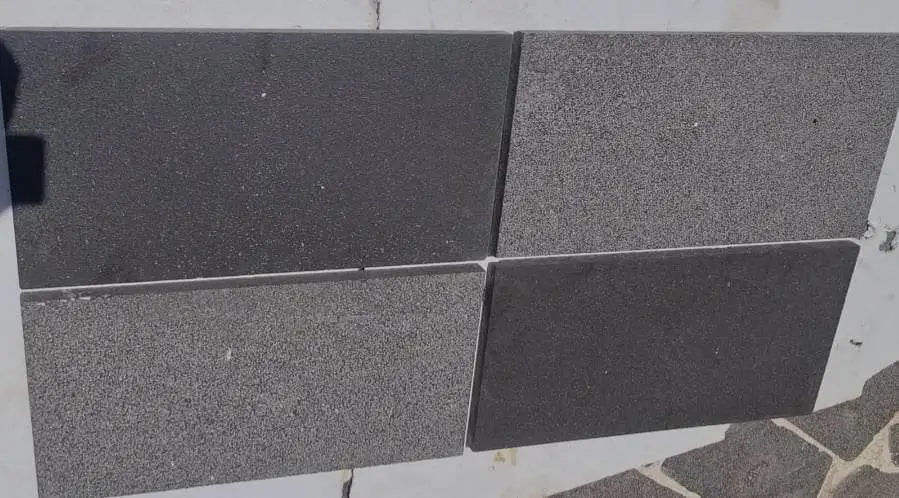
Profile consistency across a project is a supply chain problem as much as a specification problem. Black granite bullnose tile in Arizona sourced from different production batches — even from the same quarry — can show variation in color depth, crystal pattern density, and finish uniformity that becomes visible when bullnose border tiles sit adjacent to field tiles from a different lot. The solution is to order your full bullnose quantity and field tile quantity from the same warehouse lot, with enough overage to cover cuts and potential storm-damage replacements over the first five years.
Citadel Stone maintains warehouse inventory of both bullnose and square-edge black granite profiles, which typically allows Arizona project deliveries within one to two weeks rather than the six to eight week import lead time that custom-profile orders from overseas manufacturers require. For projects in high-storm-exposure locations, ordering a 10–12% material overage — rather than the standard 7% — provides adequate replacement stock for any edge chipping that occurs in the first few monsoon seasons before the installation fully cures and stabilizes. Your truck delivery schedule should coordinate with your substrate work: setting granite on a substrate that hasn’t fully cured introduces bond inconsistency that compounds under the first season of storm loading. A second truck delivery for replacement stock, ordered at the same time as the primary material, ensures color lot consistency for any repairs needed after the first monsoon season.
- Order bullnose and field tile from the same warehouse lot to ensure color and finish consistency across the installation
- Specify 10–12% overage for storm-exposed Arizona installations rather than the standard residential 7%
- Coordinate truck delivery timing with substrate cure schedule — granite installation on uncured mortar beds degrades bond strength under first-season storm loading
- Verify warehouse stock confirmation before finalizing project timelines to avoid mid-project profile substitutions
Matching Profile to Exposure: Final Specification Guidance
The granite stair tile options that Arizona designers recommend most consistently share a common thread: profile selection driven by exposure analysis, not aesthetic default. Bullnose profiles earn their specification on unprotected exterior stair and border applications because storm mechanics in Arizona — wind loads, hail impact, wind-driven rain infiltration — favor the rounded geometry’s ability to distribute stress, redirect water, and maintain arris integrity through cumulative storm cycles. Square edges earn their specification in protected interior and semi-interior applications where the clean geometric line serves the design intent and the exposure conditions never subject the corner to direct impact loading.
The detail that defines long-term performance isn’t which profile you choose — it’s whether you’ve matched the profile geometry to the actual mechanical demands of the installation location. A bullnose profile on a protected interior stair is overspecified; a square edge on an unprotected monsoon-exposed exterior tread is underspecified. Understanding that distinction, specifying the correct finish for wet-condition traction, and anchoring perimeter edges with mechanical restraint rather than relying solely on mortar bond — those are the decisions that determine whether your installation looks the same at year fifteen as it did at installation. Beyond stair and border applications, your Arizona stone project may benefit from understanding related hardscape performance — granite vs natural stone for outdoor steps explores how material selection affects step durability across Arizona’s varied climate zones, complementing the edge profile guidance covered here. Stone for Arizona projects from Citadel Stone includes both bullnose and square-edge black granite formats, allowing designers in Phoenix, Mesa, and Sedona to match edge profiles to structural and aesthetic requirements without compromising material quality.