
What Gilbert’s Soil Conditions Mean for Your Entryway Floor
Black limestone entryway flooring in Gilbert performs differently than it does in most other markets — and the reason starts below the slab, not above it. Gilbert sits on a mix of expansive desert soils and caliche-rich substrates that create variable bearing conditions across even a single property. You’ll encounter zones where dense caliche pan creates a rock-solid base at 8 inches down and zones immediately adjacent where loose sandy alluvium sits 24 inches deep before you hit anything stable. That variation is what separates a 25-year black limestone entryway from one that needs releveling at year six.
The structural reality of black limestone entryway flooring in Arizona’s East Valley means your base preparation has to be engineered to match actual soil conditions, not a generic specification sheet. Dense-grade aggregate at 6 inches may be perfectly adequate over well-compacted caliche but dangerously insufficient over poorly consolidated fill material — which is common in newer Gilbert subdivisions where cut-and-fill grading has disrupted native soil stratification.
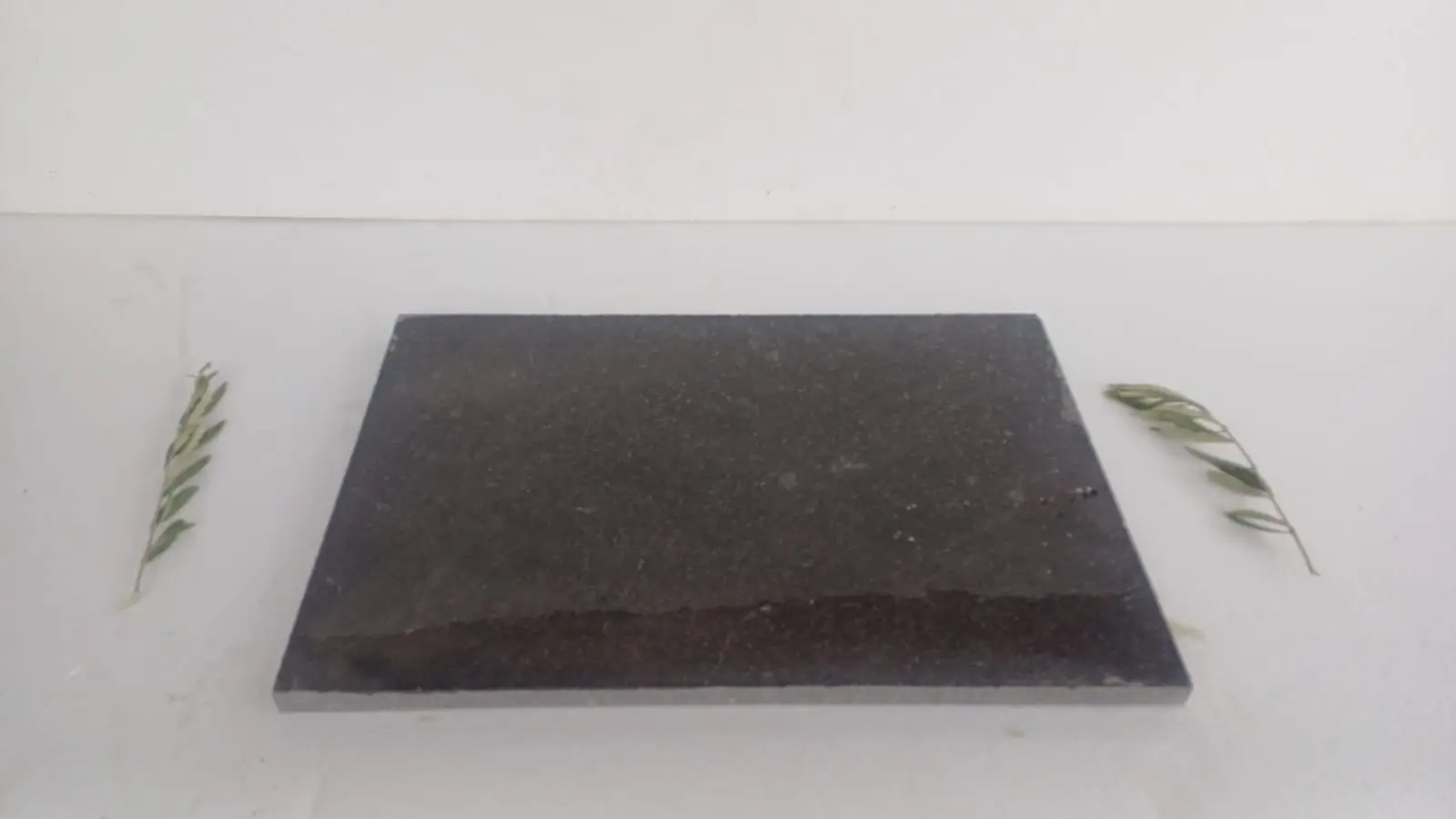
Reading Caliche Before You Set a Single Tile
Caliche is the defining ground condition for entryway installations across the Gilbert entrance floors corridor, and it behaves in ways that catch specifiers off guard. Solid caliche acts as an excellent base — compressive values can exceed 500 psi — but fractured or layered caliche creates differential settlement problems that transmit directly to stone joints. You’ll see tight, hairline cracks develop at grout lines within 18 to 24 months when fractured caliche beneath the slab flexes unevenly during the monsoon saturation cycle.
Before committing to your black limestone foyer Arizona layout, probe your subgrade to a minimum depth of 18 inches across a grid pattern, spacing test points no more than 24 inches apart in a 48-inch wide entryway corridor. If you hit caliche layer variation greater than 3 inches across that grid, plan for a 4-inch reinforced concrete substrate rather than a direct mortar bed. That extra investment — typically a 15 to 20 percent cost premium — is the difference between a stable installation and an ongoing callback scenario. Per Natural Stone Institute limestone technical specifications and properties, substrate uniformity ranks as the primary long-term performance variable for limestone tile installations over any other installation factor.
Thickness Selection for Gilbert’s Ground Realities
Tile thickness for black limestone entryway flooring in Gilbert should be driven by subgrade conditions, not aesthetic preference alone. For Gilbert entryway applications over well-verified stable caliche or compacted aggregate, 3/4-inch (20mm) nominal limestone performs adequately for residential foot traffic. The moment you’re working over fill soil, amended subgrade, or any zone where you’ve identified caliche layer discontinuity, move to 1-inch (25mm) or 30mm tile thickness without compromise.
- 3/4-inch thickness is appropriate over verified, uniform subgrade with less than 1/4-inch differential across the installation area
- 1-inch thickness handles point loads better and bridges minor subgrade voids without cracking under typical entryway furniture movement
- 30mm thickness is the professional default when subgrade conditions are uncertain or when the entryway transitions directly to exterior paving
- Avoid anything under 5/8-inch nominal for entryway applications regardless of what a product sheet suggests — entryways experience concentrated impact loads that thinner material doesn’t handle well over time
- Black limestone’s density — typically 165 to 168 lbs per cubic foot — means the added weight of thicker tile also helps suppress minor subgrade movement through sheer mass
In San Tan Valley, where newly developed parcels commonly contain engineered fill placed over graded desert floor, the 30mm specification is essentially a default rather than a premium option. Soil consolidation in those areas continues for several years post-grading, and undersized tile thickness amplifies every minor settlement event into a visible surface crack.
Design Character of Black Limestone in Entry Spaces
The welcoming entry design argument for black limestone goes beyond aesthetics, though the visual case is compelling on its own. Black and near-black limestone absorbs and holds light in a way that makes entryway proportions feel more deliberate — narrower corridors read as gallery-like rather than cramped, and double-height foyers gain gravitas that lighter materials dilute. Working with a material that has genuine optical weight matters architecturally, and it shows in finished Gilbert entrance floors.
Honed finishes are the standard specification for Arizona doorway flooring, delivering a surface that reads as sophisticated without the maintenance burden of a high polish. Honed black limestone in a 24×24 format creates clean sightlines that complement the contemporary and transitional architecture that dominates Gilbert residential construction. For a more textured visual character, a brushed finish introduces subtle surface movement that reads differently at various light angles — useful when you’re working with entryways that receive strong afternoon western exposure, which is common in Gilbert’s grid-planned neighborhoods.
Tile sizing relative to entryway scale matters more than most clients realize. A 12×12 tile in a 10-foot wide foyer creates a busy, small-scale pattern that reads as dated. A 24×24 tile in that same space reduces grout line frequency by 75 percent and lets the stone’s natural variation carry the visual interest. For larger foyer applications — anything over 200 square feet — 24×48 plank formats or 30×30 slabs deliver a genuinely bespoke appearance that photographs exceptionally well and holds up to scrutiny on inspection.
Subgrade Drainage and Moisture at the Threshold
Arizona doorway flooring sits at a transition zone that deserves specific drainage engineering attention. The threshold between interior slab and exterior grade creates a moisture management challenge: monsoon rain infiltrates along foundation edges, capillary moisture rises through sandy subgrade in the pre-monsoon humidity period, and thermal cycling creates minor condensation at the stone’s underside during the brief cold season. All three of these vectors introduce moisture to the mortar bed in a way that a purely interior tile installation never faces.
For black limestone entryway flooring in Gilbert, your mortar bed specification should account for this moisture exposure. Use a latex-modified thinset rated for exterior wet zones even when the tile placement itself is technically interior. The ASTM standards for stone tile absorption and performance testing — referenced through Tile Council of North America natural stone tile installation standards — provide specific guidance on mortar bed compatibility with stone having absorption rates above 0.4 percent, which encompasses most black limestone products. Black limestone’s porosity varies by quarry origin, but material in the 0.5 to 0.8 percent absorption range is common and requires this consideration.
Verify that your perimeter drainage detail directs water away from the entryway slab edge at a minimum 2 percent slope across the exterior approach. In Yuma, where soil salt content can be measurably higher due to historical agricultural irrigation and alkaline desert substrates, that drainage detail takes on added importance because mineral-laden moisture traveling through the base can deposit efflorescence at tile joints over time — a problem that’s almost entirely preventable with correct approach grading.
Joint Spacing, Expansion, and the Soil Connection
The detail most specifiers undervalue on Gilbert entryway projects is this: joint spacing isn’t just about thermal expansion in the stone itself — it’s about accommodating the cumulative movement your substrate generates. Black limestone’s coefficient of thermal expansion runs approximately 4.5 to 5.0 × 10⁻⁶ per degree Fahrenheit, which is moderate. The substrate beneath it — particularly caliche and sandy desert soils — can generate seasonal movement cycles of 1/8 inch to 3/16 inch across a standard entryway width just from moisture variation. Your joint width needs to accommodate both simultaneously.
- Minimum 3/16-inch grout joint for standard residential entryway applications over stable subgrade
- 1/4-inch joint width when the base includes any percentage of expansive clay-bearing soils or known soil variability
- Perimeter expansion joints at all wall interfaces — these cannot be eliminated without risking tile lift at wall edges within two to three seasons
- Expansion joint placement every 8 to 10 linear feet in any direction — tighter than the 15-foot spacing typical for exterior applications because entryway slab edges receive concentrated thermal cycling at the threshold
- Use a flexible polyurethane sealant at perimeter joints rather than standard grout — it accommodates the micro-movement cycles that grout would crack through within one season
For projects where you’re referencing performance data from similar installations, Natural Stone Institute ASTM tile stone specifications and standards document the dimensional tolerances and movement accommodation requirements that underpin these joint spacing recommendations. Having that reference in your specification package also provides a defensible standard if installation questions arise later.
Your project logistics benefit from verifying warehouse stock levels for your selected limestone format before finalizing joint width decisions — slab dimensions from different production batches can vary by 1 to 2mm, which affects your grout joint calculations across the full installation area. Citadel Stone maintains regional warehouse inventory in Arizona that allows for pre-delivery dimensional verification, reducing the risk of batch variation affecting your entryway layout.
For projects that extend the black limestone aesthetic beyond the entryway threshold, weather-resistant outdoor limestone tiles in Peoria covers the outdoor performance specifications that connect interior and exterior applications in Arizona climates.
Sealing Protocols That Actually Protect Black Limestone
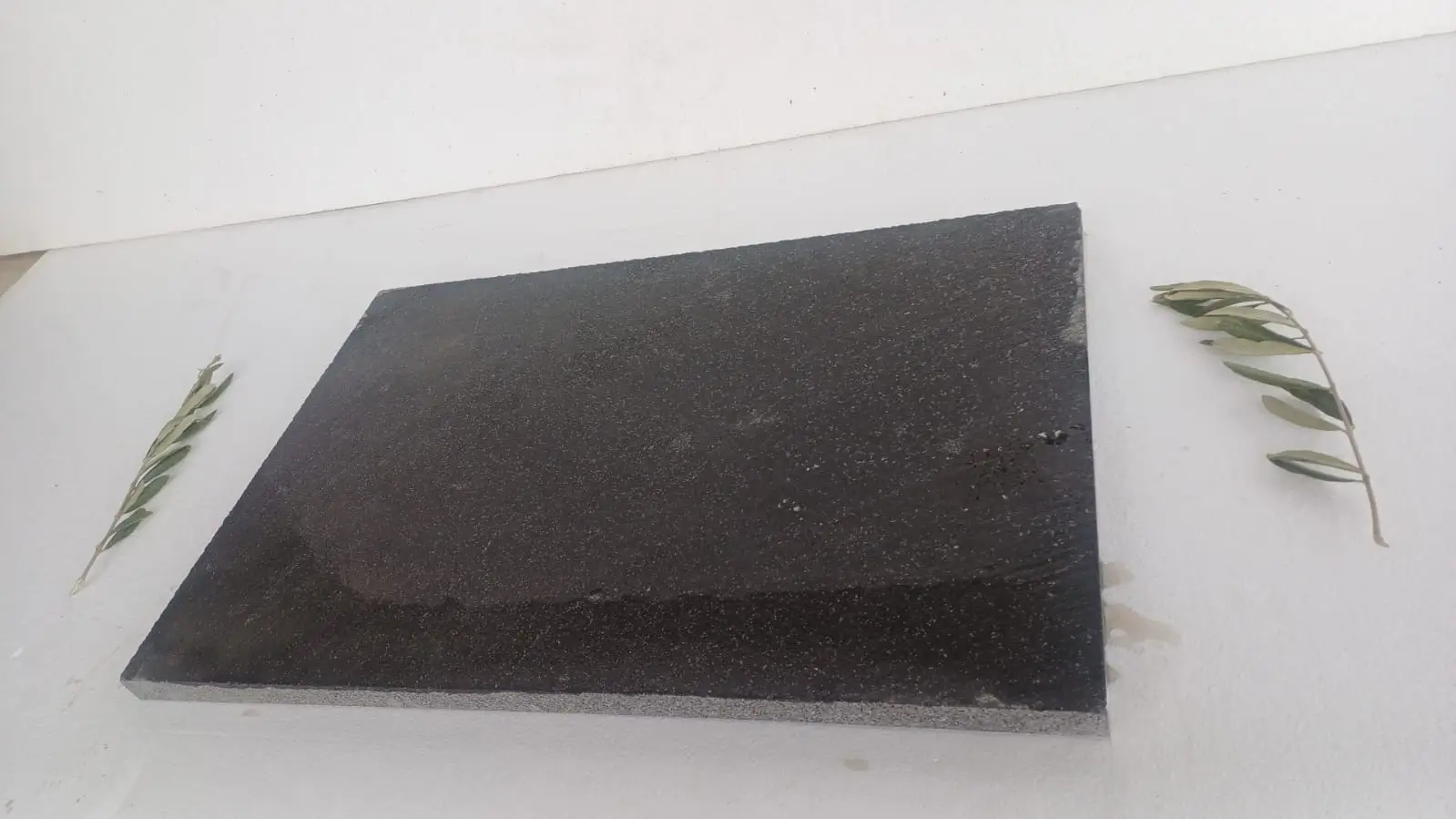
Black limestone’s darker pigmentation does a reasonable job of hiding minor soiling, but it makes sealer wear dramatically more visible than lighter stone. Sealer depletion appears first as a slight lightening or chalky haze in high-traffic zones — typically the first 18 inches inside the entry door. Addressing that early, before the stone opens to oil and moisture penetration, protects the stone’s long-term appearance without aggressive restoration work later.
For honed black limestone in a Gilbert entryway context, a penetrating impregnating sealer with a dry or natural finish is the professional standard. Topical sealers — those that film-form on the surface — introduce a sheen that reads as artificial under the directional lighting most entryways use, and they wear unevenly under door threshold traffic. An impregnating sealer rated for dense limestone with absorption below 1 percent should be applied in two light coats at initial installation, allowed to cure for 48 hours between applications, and refreshed every 18 to 24 months in a residential entryway context.
- Test sealer compatibility on a spare tile before applying to the full installation — some sealers alter the perceived color depth of black limestone
- Apply sealer at substrate temperatures between 50°F and 85°F — Gilbert’s summer morning temperatures typically fall within range if you schedule application before 9 a.m.
- Wipe excess sealer within the manufacturer’s stated open time — black limestone’s honed surface doesn’t absorb quickly, and standing sealer can leave streaks
- Seal grout joints with a dedicated grout sealer separately — entryway grout takes a disproportionate share of tracked-in soil and moisture
In Avondale, where residential construction has accelerated significantly and many entryway projects are completed under tight scheduling pressure, the temptation is to skip the second sealer coat or reduce cure time. That shortcut typically means resealing within 9 to 12 months instead of 24 — a false economy on a high-visibility surface that clients notice immediately.
Finish Options and Their Practical Trade-offs
The finish you specify for black limestone entryway flooring directly determines both maintenance requirements and slip resistance performance. These aren’t separate decisions — they’re the same decision viewed from different angles.
Honed finish delivers a matte to low-satin surface that reads cleanly under most entryway lighting conditions. Its coefficient of friction in dry conditions typically runs 0.6 to 0.7, which exceeds the 0.5 threshold referenced in standard occupational safety guidance from CDC NIOSH outdoor surface slip and fall prevention guidance for interior walkway surfaces. In wet conditions — when Gilbert monsoon rain tracks in on foot traffic — that number drops to approximately 0.45 to 0.55, which is acceptable but warrants a quality entry mat at the threshold.
Brushed finish adds micro-texture to the stone surface, improving wet-condition slip resistance to the 0.55 to 0.65 range while maintaining the material’s deep visual character. For Arizona doorway flooring that receives frequent wet-weather foot traffic or households with children and older adults, the brushed finish specification is the more responsible choice. The visual trade-off is minimal — brushed black limestone reads as slightly more organic than honed but retains the material’s characteristic depth and color richness.
- Polished finish is not recommended for entryway flooring in residential applications — slip resistance drops significantly, and surface scratching from tracked-in grit is visible and difficult to remediate
- Tumbled finish introduces significant texture that traps soil and is difficult to clean in an interior entryway context — reserve it for exterior pathway applications
- Honed finish is the professional default for this application unless wet-traffic conditions justify brushed
- Confirm your finish selection before placing a warehouse order — transitioning between finish types mid-project requires a new material batch and creates an interruption in your installation schedule
Final Recommendations for Black Limestone Entryway Flooring
Getting black limestone entryway flooring in Gilbert right means starting with an honest assessment of what’s below the surface before making any material or format decisions above it. Probe your subgrade, document your caliche conditions across the full installation footprint, and let those findings drive your substrate engineering choices. A 30mm tile over a reinforced concrete slab on variable ground will outlast a 20mm tile over an undersized aggregate base by a decade or more — and the cost difference is recoverable in avoided remediation expenses within the first maintenance cycle.
Finish and joint width decisions should follow from your site conditions and traffic patterns, not from whatever is standard on the current project in your area. Gilbert’s soil variability is real, its monsoon moisture cycling is predictable, and both of those factors have specific, manageable implications for how you specify and install this material. The entryways that perform consistently for 20-plus years in this market are the ones where those details were addressed methodically at the design stage rather than improvised during installation.
As you consider how black limestone performs across different areas of Arizona properties, exploring related applications can add useful context to your specification decisions. Black Limestone Flooring Bathroom Applications for Chandler Luxury Baths covers how this material translates into a different high-moisture Arizona interior environment, which informs finish and sealing decisions that carry over to entryway applications. At Citadel Stone, we work directly with quarry sources and conduct dimensional and absorption checks at our Arizona warehouse before truck delivery — which means you receive material that meets the specification you wrote, not an approximation of it. Citadel Stone’s brushed Black Limestone Flooring in Arizona provides subtle texture for slip resistance.