
Base failures in rustic limestone flooring installations almost always trace back to one overlooked mechanical factor — the cumulative stress from wind-driven moisture infiltration working against adhesive bond lines over repeated seasonal cycles. Arizona’s storm events aren’t gentle, and Tempe‘s monsoon season delivers wind gusts that push water horizontally under exterior thresholds and through improperly sealed expansion joints. Your rustic limestone flooring installation must be engineered for that mechanical reality from the slab up, not treated as an afterthought once the stone is already down.
Why Storm Resistance Drives Your Installation Decisions
Arizona’s weather reputation focuses on heat, but the mechanical stress profile from its storm season is what separates durable limestone installations from problem ones. Haboobs, monsoon squalls, and dust-laden wind events create positive and negative pressure differentials across floor assemblies — particularly at transitions, doorways, and perimeter edges. Rustic limestone flooring with its characteristically open texture and variable surface topography is actually well-suited to handle storm-season conditions, but only when the substrate and joint system are specified correctly.
The pressure differential effect matters most at slab edges and door thresholds. Wind-driven rain infiltrating at 35–50 mph doesn’t just wet the surface — it finds pathways into joint structures and migrates beneath stone through capillary action. Your adhesive system, joint filler selection, and edge restraint detailing all need to account for this behavior before a single tile goes down.
- Specify a polymer-modified thinset rated for exterior exposure even on covered interior-adjacent installations where wind-driven rain can reach
- Edge restraint systems at thresholds should use mechanical anchoring, not adhesive-only profiles, to resist wind-load-induced prying forces
- Expansion joint spacing of 12–15 feet (tighter than generic 20-foot guidelines) accommodates both thermal cycling and the micro-movement caused by pressure differentials
- Joint filler must be a flexible, weather-rated grout or sanded caulk at all perimeter runs — standard cement grout cracks under repeated mechanical cycling
Site Preparation and Base Assessment for Arizona Desert Homes
Natural stone flooring prep work AZ homeowners trust starts well before any adhesive touches a surface. Your slab needs to meet a flatness tolerance of FL25 or better — measured with a 10-foot straightedge with no gaps exceeding 3/16 inch. In practice, most residential slabs in Arizona come in between FL15 and FL20, which means grinding high spots and filling low spots with a portland-based leveling compound before you even open a bag of thinset.
Concrete moisture vapor emission is the sleeper issue in Arizona desert construction. You’d assume the desert means dry slabs, but on-grade and below-grade sections in Phoenix and surrounding areas regularly test above the 3 lb/1000 sq ft/24-hour threshold that most stone adhesive manufacturers specify as the maximum. Test your slab with calcium chloride kits (ASTM F1869) before committing to your adhesive system — if readings exceed that threshold, a moisture-vapor barrier membrane becomes mandatory, not optional.
- Allow new concrete slabs a minimum 60-day cure before installing natural stone flooring — 90 days is better in thick pour situations
- Use a 10-foot straightedge to identify high and low spots; document variance before ordering material quantities
- Check slab for existing cracks and repair with epoxy injection before installation — cracks will telegraph through limestone over time
- Verify there are no active plumbing leaks or irrigation line proximity that could raise moisture vapor levels post-installation
At Citadel Stone, we recommend requesting a technical data sheet for your specific limestone selection before finalization — absorption rate and modulus of rupture both affect your adhesive and joint sizing decisions in ways that generic specs don’t capture.
Understanding Rustic Limestone Characteristics That Affect Installation
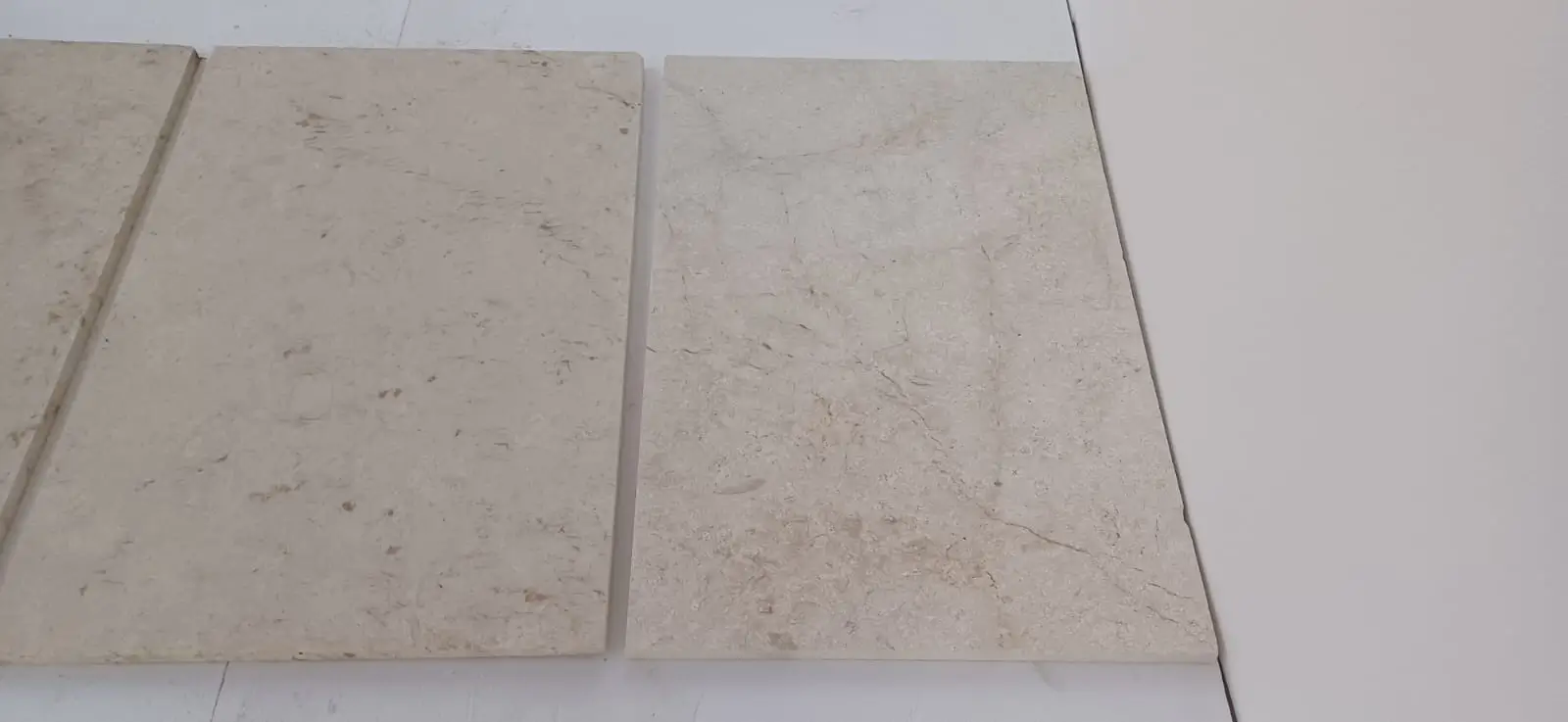
Rustic limestone flooring behaves differently from honed or polished stone because its surface relief and natural fissuring create variable contact points with the adhesive bed. You’re not working with a flat, consistent back surface — the stone’s texture means you need full adhesive coverage rather than the ribbon-and-spot method that works fine for rectified porcelain. A proper back-butter technique combined with a notched trowel on the substrate gives you the 95%+ coverage that prevents hollow spots, which become failure points under the mechanical stress of wind-pressure cycling.
The material’s inherent porosity is worth understanding before you choose your sealer schedule. Rustic limestone typically runs 8–15% porosity by volume, which is higher than travertine and significantly higher than basalt. That open structure is part of what gives it thermal mass benefits, but it also means the stone is a vector for moisture migration if the installation isn’t sealed correctly at commissioning. For laying limestone floors across Arizona desert homes — particularly in covered patio transitions and entry vestibules — apply a penetrating impregnating sealer before grouting, not after. Pre-sealing prevents grout haze from bonding into the stone’s pores during installation.
- Back-butter each piece with a thin coat of unmodified thinset before setting — critical for rustic profiles with irregular backs
- Use a ½-inch x ½-inch square-notch trowel on the substrate for adequate adhesive volume under textured stone
- Adjust joint width for rustic limestone: 3/16 to ¼ inch minimum to accommodate natural dimensional variation in handcut or gauged-rustic pieces
- Confirm your stone’s modulus of rupture exceeds 1,000 psi before specifying in high-traffic zones — lower values require additional substrate support
Adhesive Selection and Storm Season Performance
Your adhesive system is where wind-load resilience either gets built in or gets missed entirely. For rustic limestone flooring in Arizona, the minimum specification is an ANSI A118.15 polymer-modified mortar — but for any installation within 10 feet of an exterior opening or covered patio transition, you should step up to a large-format tile mortar with anti-slump additives. The anti-slump characteristic matters because it maintains adhesive thickness across the irregular back profiles of rustic stone while you work, preventing slippage before the initial set period completes.
Pot life management becomes critical during Arizona’s monsoon months (July through September), when humidity can spike from 8% in the morning to 45% by afternoon in a single day. High humidity slows the open time of latex-modified mortars unpredictably — what reads as a 30-minute open time on the bag can stretch to 50 minutes, causing the adhesive skin to form and reducing bond strength. Check your adhesive surface with a gloved finger every 10 minutes during these conditions; if it doesn’t transfer, it’s skinned and needs to come up.
- ANSI A118.15 polymer-modified thinset as the minimum for interior rustic limestone in Arizona conditions
- Large-format mortar (ANSI A118.15 with anti-slump) for stone pieces over 15 inches in any dimension
- Two-part epoxy adhesive for installations over radiant-heat slabs where thermal cycling exceeds ±30°F
- Avoid rapid-set mortars during high-humidity monsoon periods — open time unpredictability creates bond failures
Expansion Joints and Edge Restraint for Wind Events
The specification detail most installers undervalue is the edge restraint at transitions between rustic limestone flooring and adjacent floor systems, exterior thresholds, and door frames. During high-wind events, the pressure differential between indoors and outdoors creates a prying force at these edges that cement grout alone cannot resist. Mechanical edge trim profiles — aluminum or stainless-steel transition strips anchored with fasteners, not adhesive — provide the structural connection that keeps edge tiles from lifting under that load.
For interior-only installations in spaces like living rooms and hallways in Phoenix homes that are well-sealed from exterior exposure, standard perimeter expansion joints at 12 feet suffice. But for great rooms with sliding glass wall systems, covered loggias with open sides, or any Arizona space where indoor-outdoor transition is a design goal, treat your interior limestone installation to the same expansion joint spec as an exterior installation. That means movement joints every 8–12 feet in each direction, filled with ASTM C920 sealant rather than grout — and perimeter joints at every fixed vertical surface (walls, columns, cabinetwork bases). Following rustic limestone floor installation steps in Arizona that account for these pressure dynamics is what separates a five-year problem-free floor from one that needs remediation by year two.
Hail Impact Resistance and Thickness Specification
Arizona hail events are localized but intense — the Phoenix metro area records hail events multiple times per year, and coverage extends to areas like Tucson where storm cells track from the southeast. For any rustic limestone specified on covered exterior surfaces (loggias, covered entries, porte-cochères), hail impact resistance needs to factor into your thickness selection. Stone under ¾ inch nominal thickness in the rustic limestone category is vulnerable to fracture from hail impact on unsupported spans — your substrate must be continuous and fully bonded with no voids.
The practical specification for hail-exposed rustic limestone flooring is 1¼-inch nominal thickness minimum, with full adhesive coverage verified by lifting and inspecting a test piece after initial set. Thinner pieces can work in fully enclosed spaces, but the mechanical argument for thicker stone in Arizona’s storm zone is straightforward — greater cross-section means higher resistance to point-load impact and less risk of through-cracking. Sourcing limestone in the 1¼-inch to 1½-inch range does require confirmation of warehouse stock levels, since this thickness category moves quickly in the Arizona market during spring project season.
- Minimum ¾-inch thickness for fully enclosed interior installations with complete substrate support
- 1¼-inch minimum for covered exterior or semi-exterior surfaces in storm-exposed zones
- Full adhesive coverage mandatory — no ribbon-and-spot application on any hail-exposed surface
- Verify dimensional tolerances: rustic limestone can vary ±3/16 inch in thickness, requiring adhesive bed adjustment piece by piece
Sourcing your stone through Arizona rustic limestone floors from Citadel Stone gives you access to pre-sorted inventory where thickness groupings are maintained, which dramatically reduces the field adjustment time that variable-thickness stone creates.
Installation Sequencing for Arizona Desert Conditions
Sequencing your rustic limestone flooring installation correctly in Arizona’s climate requires adjusting the standard installation order based on seasonal conditions. From October through April, the low-desert environment is close to ideal for stone installation — low humidity, moderate temperatures, and predictable adhesive open times. From May through September, you’re managing heat and humidity variables that standard installation guides don’t fully address.
The Arizona interior limestone flooring installation guide most contractors reference typically understates the effect of substrate temperature on adhesive performance. Slab surface temperatures in an unshaded Arizona interior can reach 95–110°F by midday in summer, even with HVAC running, because radiant heat conducts through concrete. At those temperatures, polymer-modified thinset can lose 40–60% of its rated open time. Start installation before 9 AM, work in sections no larger than 40 square feet at a time, and keep adhesive buckets in shade or HVAC-cooled spaces until use.
- Pre-condition all stone for at least 48 hours in the installation space before setting — acclimation reduces dimensional movement after installation
- Wet the slab surface lightly (not puddled) before applying thinset in summer conditions to manage absorption from hot concrete
- Install in early morning during June–September; halt installation when ambient or slab temperature exceeds 95°F
- Allow minimum 24-hour initial cure before foot traffic, 72 hours before furniture or heavy loads in summer conditions
Grouting and Sealing for Long-Term Joint Integrity
Joint integrity under wind-driven rain is the performance specification that distinguishes a durable rustic limestone flooring system from one that requires remediation within five years. Your grout selection needs to match the joint width and movement expectations of the installation. For the 3/16-inch to ¼-inch joints typical of rustic limestone, an unsanded grout won’t provide adequate bulk — use a sanded grout with a latex additive replacing the water component, which improves both adhesion to the stone edges and flexibility under thermal and mechanical cycling.
Natural stone flooring prep work AZ homeowners trust doesn’t end once the stone is set — the grouting and sealing phase is where long-term performance is secured or compromised. Epoxy grout at perimeter joints, rather than cement-based products, is the right call at any joint line exposed to repeated wetting and drying cycles in storm-prone zones. It’s harder to work with — the open time is short and cleanup is unforgiving — but it eliminates the joint deterioration that wind-driven rain eventually produces in standard cement grout. Laying limestone floors across Arizona desert homes with this level of joint specification makes the difference in installations that face sustained monsoon winds year after year.
- Apply penetrating impregnating sealer before grouting — this prevents grout haze from locking into the stone’s open pore structure
- Allow grout to cure a minimum of 72 hours before applying topcoat sealer
- Apply final sealer in two thin coats with a 2-hour minimum wait between coats — one heavy coat traps moisture and clouds the surface
- Reapply sealer every 2–3 years in Arizona’s UV-intense environment; high-sun exposures may require annual resealing at perimeter joints
- Inspect all perimeter caulk joints annually after monsoon season — replace any cracked or separated sections before the next storm season
Spec Wrap-Up: Getting Your Rustic Limestone Installation Right
The complete rustic limestone floor installation steps in Arizona come down to one central discipline — treating mechanical stress from wind events and storm exposure with the same rigor you’d apply to structural connections. Your base preparation, adhesive system, expansion joint placement, and edge restraint specifications are all wind-load decisions, not just surface aesthetic decisions. Get those details right and your rustic limestone flooring will perform across multiple storm seasons without remediation.
Material selection, thickness, and sourcing logistics all feed into the same outcome. Verify warehouse stock levels for your specified thickness before finalizing project timelines — 1¼-inch rustic limestone in popular finishes can have 3–4 week lead times when Arizona project season peaks. Truck delivery scheduling at your site also matters more than most homeowners anticipate; confirm truck access dimensions and off-load surface condition before your delivery date to avoid costly delays. Once your installation is complete and sealed, your maintenance schedule should prioritize joint inspection after every significant storm event — catching early joint separation before water infiltrates the adhesive bed is the difference between a 30-minute caulk repair and a full tile replacement.
For ongoing care of your Arizona stone floors, the guidance in How to Maintain French Limestone Floors in Arizona covers sealer reapplication schedules and joint maintenance practices that apply broadly to limestone flooring in the Arizona desert environment — worth reviewing as you plan your long-term maintenance program. Builders in Tucson, Mesa, and Chandler specify rustic limestone flooring from Citadel Stone, noting its suitability for adhesive systems designed to handle Arizona’s wide seasonal temperature swings.