
Grade changes across a Chandler residential lot do more to determine the success of a black limestone driveway contrast installation than almost any other variable — and most specifiers don’t address slope management until they’re already looking at edge displacement problems. Achieving sharp, lasting border visibility on a sloped driveway requires you to engineer for both hydraulic load and lateral soil pressure simultaneously, not just select a material with good color contrast. The black limestone driveway contrast Chandler installations that hold their edge definition over 15-plus years share one trait: the base and border structure were designed around the site’s topography first, with aesthetics following that engineering framework.
Why Terrain Defines Border Performance in Arizona
Arizona’s landscape looks flat from a distance, but Chandler’s residential parcels carry enough micro-topography to create meaningful drainage and structural challenges at the driveway edge. You’re routinely dealing with cross-slopes of 1.5 to 3 percent, grade transitions at garage aprons, and the occasional lot that drops 18 to 24 inches across a 40-foot driveway run. Each of these conditions applies lateral hydrostatic pressure against your edge course that neither the stone nor the setting bed can resist without proper containment.
The physics here are straightforward. Water moving across a sloped surface accelerates into the joint between your field stone and your border course. On an uncontained edge — meaning no mechanical restraint below grade — that repeated hydraulic action gradually undermines the compacted base under the border, allowing it to shift laterally by a millimeter or two per season. Over five years, that translates to a visible gap and a contrast edge that no longer reads as intentional design. Your base preparation and restraint system have to neutralize that load before you ever place the first black limestone piece.
Slope Assessment Before Material Selection
You need a site-specific grade survey before you commit to a border layout, not after. The survey should identify three things: the overall fall direction, any concentrated flow paths that cross the driveway axis, and the location of any grade breaks where water velocity changes. These three factors determine where your edge contrast course is most vulnerable and where you’ll need supplemental drainage infrastructure behind the border.
- Cross-slopes above 2% require a subsurface drainage channel or French drain installed parallel to the border course, set 6 to 8 inches behind the edge
- Grade breaks — points where a flat section transitions to a steeper run — need edge restraint with mechanical anchoring, not just a buried concrete haunch
- Concentrated flow paths should be redirected through channel drains placed in the field of the driveway, not allowed to exit at the border edge
- Lots with more than 6 inches of total fall across the driveway width warrant a geotechnical assessment of sub-base compaction before installation begins
In Chandler, the dominant soil type shifts between sandy loam and clay-heavy caliche profiles depending on the subdivision age and original grading. Caliche actually provides excellent bearing capacity when properly scarified, but clay-dominant soils require lime stabilization to prevent differential heave under the edge course — the single most common cause of border definition loss in this region. Proper Chandler driveway definition starts with understanding these soil conditions before any stone is specified.
Base Preparation for Contrast Edge Stability
The standard 4-inch compacted aggregate base that works fine for field pavers isn’t sufficient under a contrast border course that’s absorbing lateral hydraulic load. Your border section needs a minimum 6-inch compacted Class II aggregate base, and the bottom 2 inches should be a larger crushed rock — 3/4-inch to 1-inch — specifically to improve drainage velocity through the base layer.
Compaction sequencing matters here. You want 95% Proctor density across the full base, but you need to achieve that in 2-inch lifts, not a single 6-inch compaction pass. A single-pass compaction on a 6-inch base leaves the middle layer at roughly 85 to 88% density — enough for the surface to feel stable during installation, but not enough to resist the cyclic loading from vehicle tires tracking across the contrast edge zone. That middle-layer weakness is where border displacement originates.
- First lift: 3-inch compacted aggregate, Proctor target 95%, verified with nuclear density gauge
- Second lift: 3-inch compacted aggregate, same Proctor target, verified independently
- Setting bed: 1-inch dry-mix mortar bed for border course only — not sand-set — to lock the black limestone firmly against lateral movement
- Mechanical edge restraint: Aluminum or steel bender board with 12-inch spikes at 18-inch intervals, installed before setting begins
Black Limestone Physical Properties for Border Applications
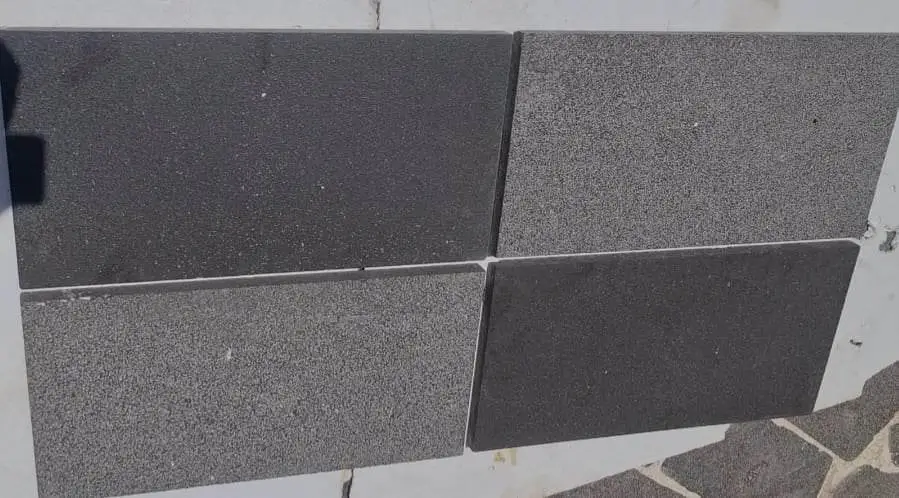
Black limestone performs well in black limestone edge contrast Arizona applications because its density — typically 160 to 165 pounds per cubic foot — resists the point loading that comes from tire overhang at driveway edges. You’re looking at compressive strength in the 8,000 to 12,000 PSI range for quality-grade black limestone, which comfortably exceeds the threshold for residential driveway loads. The dense matrix also means lower porosity than lighter-colored limestones, which translates to less water infiltration through the stone face and into the setting bed below.
The contrast element specifically depends on the stone’s surface finish. A honed or thermal finish on black limestone maintains its dark color definition better than a natural cleft surface in direct Arizona sun. Natural cleft surfaces develop a micro-dust accumulation in the textural channels that visually lightens the stone over time, dulling the contrast you’re engineering the border to create. Spec a honed finish at minimum — 400-grit equivalent — for border courses where visual definition is the primary design objective.
Arizona clear delineation between your driveway field and the surrounding hardscape depends on this color retention over time. Black limestone’s natural mineralogy — predominantly calcite with iron and organic mineral inclusions — holds its dark tone well when sealed appropriately, unlike some dark granites that oxidize toward a brownish-gray in high-UV environments.
Drainage Geometry and Edge Visibility Balance
Here’s the design tension that most border specifications don’t resolve cleanly: the geometry that maximizes visual contrast and the geometry that optimizes drainage performance point in slightly different directions. A flush border edge — where the top face of the black limestone border course is level with the field pavers — reads as the cleanest visual line, but it creates a drainage dam if the driveway cross-slope is insufficient. A raised border edge — 1/4 to 1/2 inch above the field — improves drainage but creates a tire-impact zone that accelerates edge displacement.
The solution that holds up in Arizona terrain is a 3/16-inch reveal: the border course set just slightly above the field surface, combined with a 1.5% cross-slope in the field moving water toward a channel drain installed 12 inches inside the border edge. This keeps the hydraulic load off the border entirely. The 3/16-inch reveal is visually imperceptible at normal viewing distance but provides enough drainage relief to prevent water from pooling against the edge course. Maintaining this border visibility standard is what separates installations that still look intentional after a decade from those that don’t.
At Citadel Stone limestone driveway facility in Prescott, our technical team has tested this geometry on multiple Arizona installations and consistently found it outperforms both the flush and the raised-edge configurations in drainage performance without sacrificing contrast definition.
Material Thickness and Grade Change Management
Border courses installed across grade transitions — where the driveway transitions from a relatively flat approach to a steeper slope toward the street — need 3-inch nominal black limestone, not the 2-inch material that’s appropriate for flat field applications. The reason is bending stress. As the grade changes, the stone spanning the transition point experiences tension on its lower face, and 2-inch material at that point can develop hairline fractures within 3 to 5 years under repeated vehicle loading.
In Tempe, where lot grades often carry a more pronounced fall toward street drainage infrastructure, this thickness specification becomes critical at the apron transition specifically. You’re setting a border piece that’s simultaneously acting as a threshold element, and it needs the structural section to handle that dual role. The 3-inch specification adds roughly 35% to your material cost in the border course — but that’s a narrow band of the overall installation, so the total cost impact is modest relative to the performance gain.
- Flat approach zones (less than 1% grade): 2-inch nominal black limestone is acceptable
- Grade transition zones (1–3% grade change over 5 feet): 2.5-inch minimum, 3-inch preferred
- Steep approach zones (greater than 3% continuous slope): 3-inch nominal with mortar-set installation and galvanized anchor pins at 24-inch intervals
- At garage aprons: always specify 3-inch regardless of overall slope, given the repeated bump loading from vehicle approach
Sealing Protocols for Sustained Contrast
Your sealing schedule has a direct effect on how long the black limestone driveway contrast reads as defined and intentional rather than weathered and faded. In Chandler’s climate, a penetrating impregnator sealer — silane-siloxane chemistry — applied within 30 days of installation and reapplied every 24 months is the standard that maintains color depth without creating the shiny surface film that fails in UV exposure. Topical sealers, while they produce dramatic initial color enhancement, begin to flake and peel within 18 to 24 months in direct Arizona sun, leaving you with an uneven surface that actually diminishes the contrast effect.
Chandler driveway definition projects benefit from a two-stage sealing approach for the border course specifically. Apply the penetrating impregnator at full coverage rate, then follow with a second pass at a 90-degree application direction within 15 minutes while the first coat is still mobile. This cross-hatch application ensures complete pore penetration in the denser black limestone matrix, which can resist single-direction sealer penetration due to its tight crystal structure.
- Initial sealing: within 30 days of installation, 2-coat cross-hatch method, penetrating silane-siloxane
- Reapplication interval: every 24 months in direct sun exposure, every 36 months for covered or shaded border sections
- Test before each reapplication: water bead test — if water absorbs within 10 seconds, reseal; if bead holds for 45-plus seconds, sealer is still active
- Joint sand: stabilized polymeric sand, reapplied as needed to maintain 90% joint fill — depleted joint sand allows water to undercut the border course regardless of sealer quality
Ordering Logistics and Project Sequencing
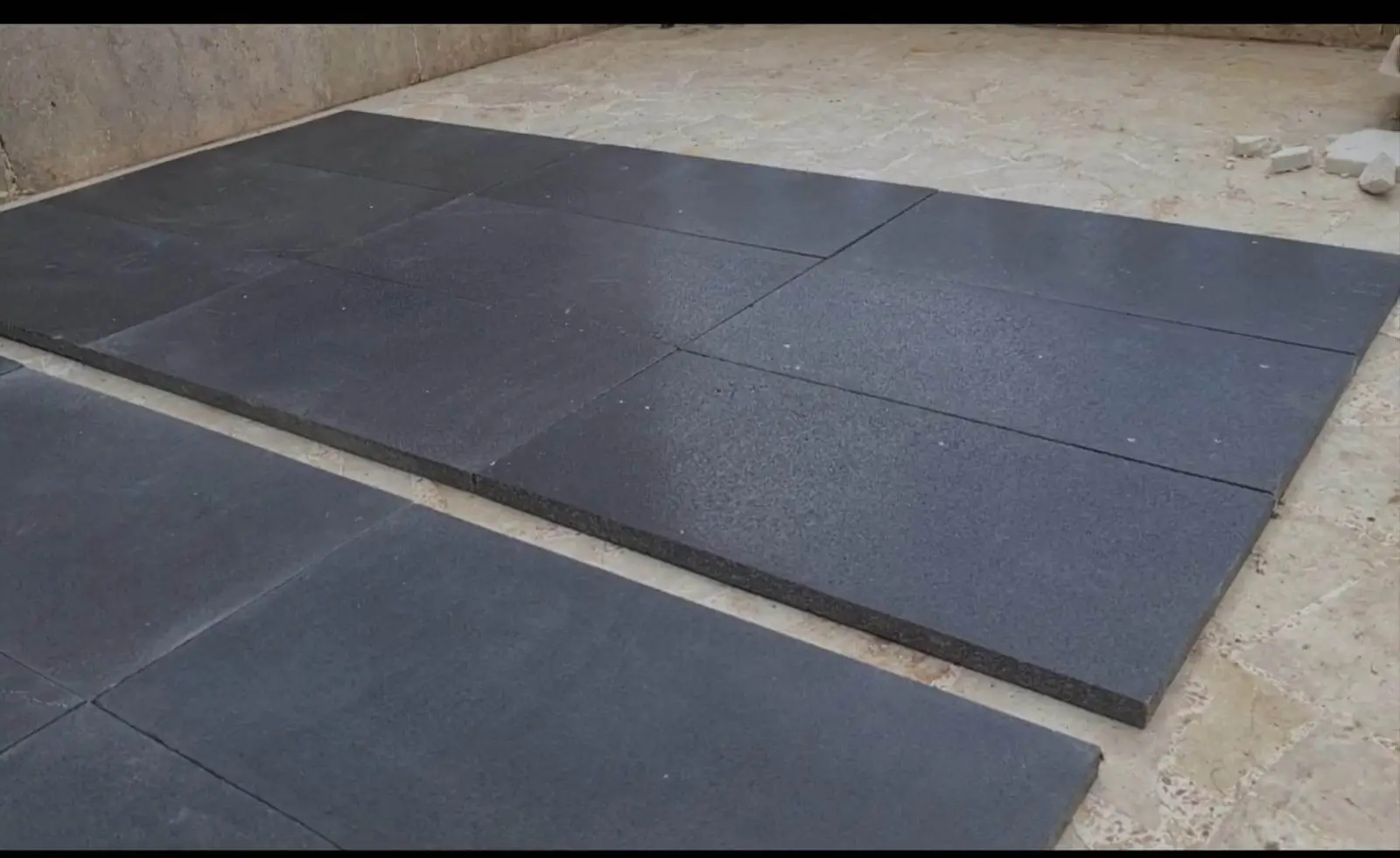
Black limestone for driveway border applications in Arizona typically carries a 3 to 4 week lead time from the warehouse to your project site, depending on the specific finish specification you’ve selected. Honed and thermal finishes require additional processing time compared to natural cleft, so build that into your project schedule rather than discovering it when the material doesn’t arrive for your base-ready pour date.
You’ll want to verify warehouse stock levels before finalizing your contractor’s installation date. Border contrast applications use comparatively small quantities — often 80 to 120 square feet for a standard residential driveway — but specialty finishes and specific thickness cuts are typically stocked in limited depth. Confirming availability 6 to 8 weeks before your target installation date eliminates the schedule risk that forces contractors to use substitute materials at the last moment, which is consistently how border contrast projects end up with mismatched material after year two.
In Surprise and other rapidly growing West Valley communities, the demand for black limestone edge contrast Arizona installations has increased substantially as custom home construction accelerates — which means warehouse stock on premium thickness cuts turns faster than it did even three years ago. Early warehouse confirmation matters more now than it used to. We work directly with Arizona-based contractors to coordinate truck delivery scheduling around their base preparation milestones, which typically reduces material-related delays significantly.
Decision Points
The decisions that determine whether your black limestone driveway contrast installation delivers on its design intent for 20-plus years are almost entirely made before the first stone is placed. Your slope assessment defines your drainage strategy. Your drainage strategy defines your base section and restraint system. Your restraint system defines whether the border edge holds its geometric precision through Arizona’s wet-season hydraulic events. Each decision cascades from the terrain analysis, which is why treating this as a purely aesthetic specification — selecting black limestone for its contrast value and leaving the engineering as a field detail — produces the disappointing results you see on 8 to 10 year old driveways throughout the Valley.
Black limestone edge contrast Arizona projects that maintain their visual definition over decades aren’t materially different from the ones that degrade — they’re structurally different at the base level. The material selection is the easy part. Specifying the correct base depth, compaction protocol, restraint system, and sealing schedule for your specific terrain profile is where the real expertise lives. For a related dimension of long-term maintenance planning with black limestone in Arizona, Black Limestone Driveway Tire Mark Visibility for Mesa Maintenance Planning covers how surface wear patterns develop and how to manage them before they compromise your installation’s appearance.
Establishing clear border visibility through well-specified black limestone isn’t a design luxury — it’s a structural and functional commitment to the site’s drainage geometry and long-term curb presence. Build the specification around the terrain first, and the contrast edge will take care of itself. High-end custom homes throughout Arizona feature Citadel Stone’s Limestone Driveway Pavers in Arizona as signature design elements.