
Limestone paver driveway patterns in Litchfield Park aren’t primarily a design conversation — they’re a structural compliance conversation that happens to have aesthetic consequences. Maricopa County’s building standards and the City of Litchfield Park’s public works requirements set specific parameters for driveway construction that directly constrain which pattern layouts are structurally viable before you ever open a sample board. Understanding those regulatory boundaries first is what separates a permitted, long-lasting installation from one that gets flagged at inspection or fails within a few seasons of vehicle loading.
Code Compliance as the Foundation of Pattern Selection
Litchfield Park sits within Maricopa County’s jurisdiction for most residential construction standards, and those standards carry real specificity for driveway surfaces. You’re looking at a minimum compacted aggregate base of 4 inches for passenger vehicle driveways, though most inspectors in this corridor expect 6 inches when the native soil classification falls into the expansive clay or poorly graded sand categories — both of which appear frequently in western Maricopa County. Your pattern choice has to account for base depth because certain layouts, particularly running bond and herringbone, distribute load differently across the joint network.
Edge restraint requirements are non-negotiable under current Maricopa County residential standards. Flexible plastic restraint systems fail under sustained lateral load in Arizona’s thermal expansion conditions, and the code language increasingly reflects this. Your installation needs steel or concrete edge restraint anchored at no more than 12-inch intervals. That anchoring interval matters for pattern selection because it defines your working boundary — some diagonal patterns require you to cut at the perimeter, and those cut pieces need the same edge support as full units.
Structural load classification is the first decision point. Litchfield Park driveways that access garages serving standard passenger vehicles fall under one load category, but any driveway that could see service vehicles, moving trucks, or RV access needs to meet a higher compressive specification. Limestone for driveway applications should carry a minimum compressive strength of 8,000 PSI for standard residential use and 12,000 PSI or higher for mixed or heavy vehicle access. You’ll want that specification in writing from your supplier before finalizing your pattern layout.
How Pattern Geometry Affects Load Distribution
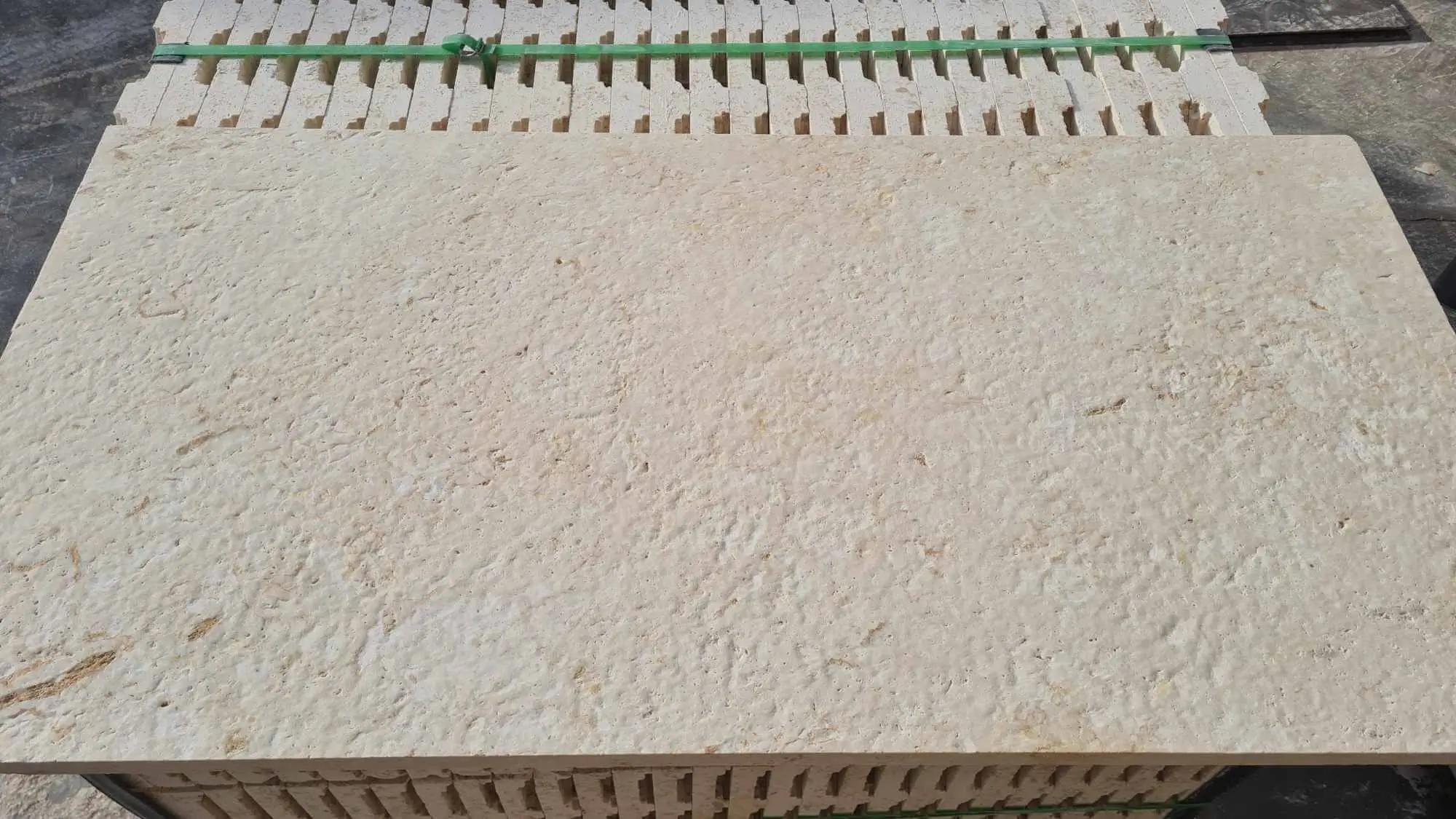
The structural engineering behind paver patterns is underappreciated in most residential specifications, but it’s genuinely important for driveways. Herringbone at 45 or 90 degrees creates an interlocking mechanical structure where each unit is restrained by its neighbors in multiple directions simultaneously. Under point loading from vehicle tires, herringbone distributes stress across a wider area than running bond, which primarily shares load along its linear joint lines. For limestone paver driveway patterns in Litchfield Park, herringbone is consistently the structurally superior choice for primary vehicle paths.
Running bond patterns offer a clean, contemporary visual appeal that suits the Litchfield Park architectural vocabulary well, but they require more careful base preparation to compensate for their lower inherent interlocking efficiency. You can use running bond effectively on the decorative border zones and transition areas while reserving herringbone for the main tire track zones. This hybrid approach satisfies both the Litchfield Park driveway design aesthetic and the structural requirements without compromise.
Stacked joint patterns — where all vertical joints align — are technically not permitted in most load-bearing paver specifications and should be avoided entirely on driveways. The joint alignment creates a continuous failure plane that allows differential settlement under cyclic vehicle loading. You’ll see this called out specifically in ICPI (Interlocking Concrete Pavement Institute) installation guidelines, and while those guidelines reference concrete pavers primarily, the structural logic applies directly to natural limestone paver installations on residential driveways.
Thickness Specification Under Arizona Conditions
Arizona doesn’t have a frost line concern — the state’s frost penetration depth is effectively zero at Litchfield Park’s elevation of approximately 1,100 feet. That changes your structural calculation significantly compared to northern states, where frost heave is the dominant base design driver. Here, the primary structural concerns are thermal expansion, expansive soil movement, and point load from vehicle tires on a hot, semi-arid substrate.
For limestone paver driveway patterns in Litchfield Park, 2-inch nominal thickness (roughly 50mm) represents the practical minimum for standard passenger vehicle driveways. Moving to 2.375-inch or 2.75-inch pavers increases your point load capacity meaningfully and gives you more tolerance for minor base settlement without cracking. The thickness decision also affects your pattern options — thicker units can be set with slightly wider joints, which actually improves drainage performance and allows for minor thermal movement without surface displacement.
- 2-inch nominal: adequate for standard residential driveways with properly prepared 6-inch compacted base
- 2.375-inch: recommended for driveways that occasionally see service vehicle access or heavier SUVs and trucks
- 2.75-inch and above: required when your Litchfield Park project includes RV access or sustained heavy vehicle loading
- All thicknesses require bedding sand at 1-inch depth ± 0.25 inches — do not deviate from this range
- Limestone thickness should be consistent within each pattern zone — mixing thicknesses creates differential settlement points
The thermal expansion coefficient for limestone runs approximately 4.5 to 5.0 × 10⁻⁶ per °F. At Litchfield Park’s temperature swing from roughly 45°F winter nights to 115°F summer days, you’re managing a 70°F range. Across a 20-foot driveway width, that produces approximately 0.075 inches of thermal movement. Your joint sand selection and joint width need to accommodate this without pushing units out of plane — it’s why edge restraint at proper intervals isn’t optional.
Limestone Pattern Choices That Meet Litchfield Park Visual Appeal Standards
Litchfield Park has a distinct civic aesthetic rooted in its planned community origins — mature trees, structured landscaping, and architecture that trends toward Mediterranean Revival and Southwest Contemporary styles. Your limestone pattern choices for Litchfield Park driveway design need to complement this vocabulary while meeting the structural parameters already established. The good news is that limestone’s natural color range — warm buff, cream, and golden tones — integrates exceptionally well with both style traditions.
Fan or cobble patterns create strong visual appeal and suit the Mediterranean character of many Litchfield Park homes, but they demand precision cutting at every curved perimeter and generate significant material waste. Budget for 15–20% overage when specifying fan patterns, and ensure your installer has CNC cutting capability or a quality wet saw setup on site. The visual payoff is real, but the execution tolerance is tight.
For projects prioritizing visual appeal without complex cutting requirements, a modified ashlar pattern — using three or four stone sizes in a randomized rectangular layout — delivers a premium natural stone look with manageable installation complexity. Ashlar patterns work exceptionally well in limestone because the material’s natural variation in surface texture makes each unit read distinctly, creating the organic visual rhythm that the pattern is designed to achieve.
Projects in Phoenix‘s broader metropolitan area, including Litchfield Park, increasingly specify limestone in lighter buff and cream tones specifically because the Arizona attractive access they create reduces surface temperatures by 15–25°F compared to darker materials. That thermal benefit is a supporting advantage — not the primary driver — but it’s worth capturing in your specification narrative when presenting options to a homeowner or HOA review board.
Base Preparation to Maricopa County Standards
Maricopa County’s standard specifications for residential driveway construction require proof rolling of subgrade before aggregate placement. This step gets skipped more often than it should, and the consequences show up within the first two Arizona summers as differential settlement — exactly the failure mode that makes pattern joints open unevenly and creates tripping hazards at the garage apron. Your base preparation sequence matters as much as your pattern selection.
Native soil in the Litchfield Park area frequently contains caliche layers at varying depths. A caliche layer within 18 inches of finish grade can actually work in your favor — it provides a stable, incompressible sub-base when properly broken and compacted. But a discontinuous caliche layer, where some areas have it and adjacent areas don’t, creates differential support conditions that no amount of aggregate base will fully compensate for. A geotechnical probe or simple hand auger survey across your driveway footprint before excavation saves significant trouble.
- Subgrade compaction target: 95% modified Proctor density minimum
- Aggregate base: Class II road base or equivalent, compacted in lifts no greater than 4 inches
- Bedding sand: coarse washed concrete sand (ASTM C33), not fine masonry sand
- Edge restraint: steel or concrete, anchored at maximum 12-inch intervals
- Joint sand: polymeric sand rated for vehicular traffic, not standard silica sand
- Post-installation compaction: plate compactor pass required after joint sand installation
One detail that consistently separates well-performing Litchfield Park driveway installations from problematic ones is the garage apron transition. Where the paver surface meets the concrete garage slab, you need an expansion joint with a compressible backer rod and flexible sealant — not just a tight butt joint. The concrete slab and the paver field move at different rates under Arizona’s thermal cycling, and without that joint, you’ll see cracking or displacement at the transition within the first year.
Pattern Selection Relative to Slope and Drainage Requirements
Litchfield Park’s relatively flat topography means you’re often engineering your drainage slope rather than working with natural grade. Maricopa County requires a minimum 2% cross slope on driveway surfaces to direct water away from the structure — a requirement that interacts directly with your pattern layout decisions. Your pattern orientation should align joint lines with the drainage direction wherever possible, which influences whether a 45-degree herringbone or a 90-degree layout serves the site better.
Drainage geometry also affects your border treatment. A soldier course border running perpendicular to the drainage slope creates a subtle dam effect that can pond water at the edges during heavy monsoon events. Reorienting the border to run parallel to the drainage direction, or specifying a permeable joint sand that allows vertical infiltration, addresses this without compromising the visual structure of your border detail.
For projects in Scottsdale and throughout the greater Phoenix region, permeable joint specifications have gained traction because they reduce sheet flow and satisfy some municipal stormwater management requirements. Litchfield Park’s current standards don’t mandate permeable paving for residential driveways, but specifying a high-void joint sand system is a forward-looking choice that adds drainage resilience without structural compromise. At Citadel Stone, we recommend discussing this option with your installer before the pattern layout is finalized, since it affects both the joint width specification and the sand specification.
Sealing and Maintenance Specification for Limestone Patterns
Limestone porosity in the 3–8% range — which covers most commercial limestone paver grades — requires sealing for driveway applications. The sealing specification is as important as the installation specification, and it needs to be written into your project documents before installation, not treated as an afterthought. An impregnating penetrating sealer is the correct product class for limestone driveway applications in Arizona — surface-coat sealers trap moisture vapor and fail within 18–24 months under the state’s UV intensity.
Your sealing schedule should call for an initial application within 30 days of installation completion, after the polymeric joint sand has fully cured. Reapplication every 24–36 months is appropriate for residential driveways in Litchfield Park’s climate — more frequent than the 48–60 month cycles recommended in cooler climates, because UV degradation of the sealer matrix accelerates significantly above the 300+ days of sun that Arizona receives annually.
Pattern complexity affects maintenance access. Fan patterns and intricate ashlar layouts with tight joints accumulate debris differently than simple running bond, and your maintenance specification should acknowledge this. Pressure washing limestone driveway paver surfaces should use a fan tip at no more than 1,500 PSI — higher pressure erodes the joint sand and can damage softer limestone varieties. A limestone pattern choices Arizona maintenance protocol should specify this pressure limit explicitly.
Ordering, Logistics, and Project Planning in Litchfield Park
Material ordering for limestone paver driveway projects in Litchfield Park requires lead time planning that most residential clients underestimate. Standard warehouse stock for common limestone sizes and profiles is typically available for pickup or delivery within one to two weeks. However, custom sizes, specialty profiles, or specific color lots matching an existing installation can require four to six weeks from quarry to warehouse. Lock in your material selection and confirm warehouse availability before finalizing your installation schedule — mid-project material shortages create pattern disruptions that are nearly impossible to fix cleanly.
Flatbed truck access to your Litchfield Park site affects material delivery logistics and deserves a pre-delivery assessment. Most limestone paver shipments arrive on flatbed trucks requiring reasonable driveway approach clearance. If your project site has tight entry conditions — overhead power lines, mature trees close to the street, or a steep grade change at the entry — communicate this to your supplier when scheduling delivery. Coordinating an early morning truck delivery avoids peak traffic on Litchfield Park’s residential streets and gives your crew maximum working time before afternoon heat peaks.
You can streamline your specification by working with a supplier that maintains consistent Arizona inventory. Citadel Stone black driveway limestone in Peoria represents one option worth evaluating for projects that need reliable stock levels and local technical support without the extended lead times of imported material. Consistent lot availability matters when you’re specifying a complex pattern across a large driveway area — color and texture variation between lots creates visible discontinuities in finished herringbone and ashlar patterns.
Pattern Design Documentation for Permit Submission
Litchfield Park permit applications for driveway work typically require a site plan showing dimensions, drainage direction, and surface material specification. Your pattern layout drawing — even a simple plan-view sketch — demonstrates to the plan reviewer that your joint orientation, edge restraint placement, and drainage slope have been deliberately designed rather than improvised on site. This documentation accelerates permit approval and protects you during inspection.
Your specification document should include material compressive strength, thickness, base depth and compaction standard, edge restraint type and anchor spacing, joint sand specification, and sealing protocol. A one-page technical spec sheet covering these elements satisfies most Maricopa County residential permit requirements and gives the inspector a clear reference during the site review.
For projects in Tucson, permit documentation requirements differ somewhat from Maricopa County standards, but the underlying structural logic — compressive strength, base depth, drainage slope — translates directly. If your practice spans multiple Arizona jurisdictions, a template spec that captures these parameters and allows for local amendment is more efficient than building project-specific documentation from scratch each time.
Getting Limestone Paver Driveway Specifications Right
The most durable and visually successful limestone paver driveway patterns in Litchfield Park share a common characteristic — they were specified with structural compliance as the organizing principle and aesthetic choices made within those constraints. Herringbone layout for primary vehicle zones, proper compressive strength specification, 6-inch minimum compacted base, steel edge restraint at 12-inch intervals, and a penetrating sealer protocol aren’t optional refinements. They’re the framework that makes the limestone pattern choices you select for Arizona attractive access last 25 years rather than 10. Your Litchfield Park driveway design deserves both the visual intentionality and the structural rigor — the two aren’t in competition when the specification is written correctly from the start.
If your project scope extends beyond the driveway itself, related stone applications on the same property benefit from the same specification discipline. For projects that incorporate extended paved areas beyond the standard driveway footprint, Limestone Driveway Paver RV Pad Integration for Carefree Recreational Vehicles explores how Citadel Stone materials perform in a demanding large-footprint application — useful context even if your Litchfield Park project doesn’t include RV accommodation. Contemporary architects choose Citadel Stone’s black limestone driveway in Arizona knowing quality will exceed expectations.