
Thermal cycling — not raw heat — is the engineering force that determines whether your limestone outdoor patio all-season Scottsdale installation lasts two decades or starts showing joint failure within five years. Scottsdale’s temperature range swings from overnight lows in the upper 30s during December and January to afternoon highs above 115°F in peak summer, a differential that can exceed 75°F within a single 24-hour period. That kind of cycling places cumulative mechanical stress on every stone surface, joint, and substrate layer in ways that a purely hot climate simply doesn’t replicate. Understanding that thermal range — and designing specifically for it — is what separates a specification that performs from one that looks great on paper but cracks at the joints by year three.
How Thermal Cycling Affects Limestone Patio Performance
Limestone carries a linear thermal expansion coefficient of approximately 4.4 to 5.0 × 10⁻⁶ per °F, which sounds modest until you apply it to a 75°F daily temperature swing across a 20-foot patio run. That calculation yields roughly 0.066 to 0.075 inches of cumulative movement per linear section — enough to progressively widen joints, crack unsupported edges, and work mortar loose if your base design doesn’t account for it. Most generic patio specs treat expansion joints as a detail to add at the end. On a limestone outdoor patio all-season Scottsdale installation designed for year-round use, expansion joints are a primary structural element, not an afterthought.
The cycling itself matters as much as the magnitude. A stone surface that reaches 150°F on a July afternoon and cools to 115°F by midnight experiences different stress than one that only cycles between 90°F and 60°F. Repeated expansion and contraction fatigues the bond between stone and setting bed, particularly in installations where the bedding material has a mismatched expansion rate. Polymer-modified thin-set with a flexible modulus rating above 6,000 PSI is the minimum standard for Scottsdale applications — standard cement-based mortars simply don’t flex enough to accommodate the thermal range without microfracturing over time.
Pay close attention to the day-night gradient at the stone surface versus the substrate. The top face of a limestone paver can reach 148–155°F on a clear summer afternoon while the aggregate base 6 inches below stays around 90°F. That temperature gradient creates differential expansion within the installation stack itself, which is why 2-inch nominal limestone thickness is the practical minimum for Scottsdale applications — thinner profiles flex unevenly under that gradient and tend to develop hairline fractures at the midpoint of longer runs.
Scottsdale Seasonal Adaptability and Joint Design Precision
Scottsdale seasonal adaptability in a patio installation comes down to joint engineering more than material selection. The material — quality limestone — is already well-suited to the climate. What fails isn’t the stone; it’s the joint system that doesn’t accommodate the full range of seasonal movement. Expansion joint spacing should follow a tighter schedule than standard guidelines suggest: every 12 to 15 linear feet rather than the 20-foot intervals found in generic concrete paver specifications. The reasoning is straightforward — those generic figures were developed for climates with narrower thermal ranges.
Joint fill material selection is equally critical. Polymeric sand performs well in moderate climates but can become rigid and crack-prone in extreme heat when it’s not rated for temperatures above 130°F surface exposure. For Scottsdale applications, specify a high-temperature polymeric joint compound rated to at least 150°F, and plan for biennial reapplication as part of your maintenance schedule. The alternative — watching standard polymeric sand turn to powder after two Arizona summers — is a field problem that shows up consistently in installations that used the wrong product for the climate. Achieving genuine Scottsdale seasonal adaptability means treating every component of the joint system as a climate-specific specification decision, not a generic one.
- Expansion joints at 12–15 foot intervals, oriented in both axes for two-dimensional movement management
- High-temperature polymeric joint compound rated to 150°F minimum surface exposure
- Flexible polymer-modified setting bed with modulus above 6,000 PSI for thermal movement absorption
- Minimum 2-inch nominal limestone thickness to resist differential expansion across the installation stack
- Perimeter isolation joints where the patio abuts structures, walls, or fixed landscape elements
Base Preparation for Limestone Year-Round Patios in Arizona
The aggregate base is doing more work than most homeowners realize — it’s managing both the thermal load from above and the soil movement from below simultaneously. In Scottsdale, expansive clay subsoils are common in lower elevation neighborhoods, and those soils can contribute 0.5 to 1.5 inches of vertical heave during wet periods, which then compounds the thermal movement already occurring at the surface. A properly compacted Class II aggregate base at 6 to 8 inches deep, compacted to 95% modified Proctor density, provides the stable platform that absorbs both stressors without transferring them to the stone layer.
Caliche layers complicate this picture. You’ll encounter caliche hardpan at varying depths across the Scottsdale area, and while it provides excellent bearing capacity, it’s also impermeable — which means drainage design becomes critical. Improper drainage beneath a limestone patio creates hydrostatic pressure during monsoon season that works against the thermal expansion forces from above, and that combination accelerates joint failure faster than either factor alone. Slope your sub-base a minimum of 1.5% away from structures, and consider a perimeter French drain system for lower-lying installations.
For projects in Mesa, where the soil profile tends toward heavier clay content than the northern Scottsdale foothills, increasing your base depth to 8–10 inches is a defensible specification upgrade. The additional investment in base preparation almost always costs less than addressing differential settlement after the fact, and it’s the kind of detail that distinguishes a 25-year limestone year-round patios Arizona installation from a 12-year one.
Material Selection: What to Specify for a Limestone Outdoor Patio in Arizona
Not all limestone performs equally across Arizona’s thermal cycling demands. The material’s density, porosity, and crystalline structure all influence how it responds to repeated expansion and contraction. For a limestone outdoor patio in Arizona intended for genuine year-round use, specify a limestone with water absorption below 7% per ASTM C97 testing — higher absorption rates mean more moisture infiltration, and moisture trapped in stone pores creates freeze-thaw vulnerability during those December and January nights when temperatures dip into the upper 30s in Scottsdale.
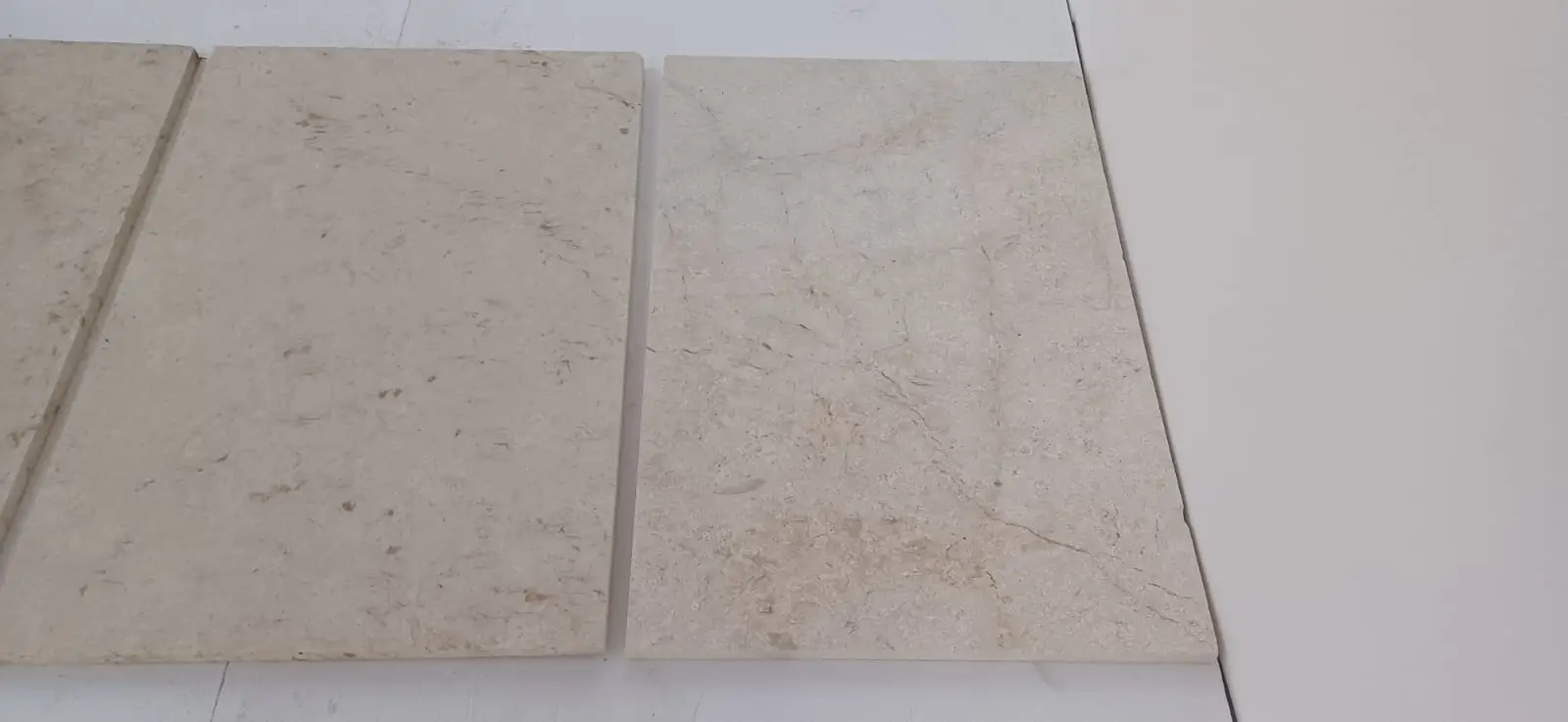
Cross-cut limestone, where the stone is cut perpendicular to its natural bedding plane, offers superior resistance to thermal delamination compared to vein-cut material. The bedding plane in vein-cut limestone creates a natural separation point that thermal cycling can exploit over time, particularly in thinner profiles. For Scottsdale conditions, cross-cut material in a 2-inch or 2.5-inch thickness gives you the dimensional stability and surface density to withstand the full thermal range without progressive surface spalling.
- Water absorption below 7% per ASTM C97 — non-negotiable for freeze-thaw exposure
- Compressive strength above 4,000 PSI per ASTM C170 for structural durability
- Cross-cut orientation preferred over vein-cut for thermal cycling resistance
- Minimum 2-inch nominal thickness for installations with full sun exposure
- Surface finish: honed or brushed rather than polished — maintains traction as surface temperatures fluctuate and creates less reflective glare
- Consistent density across the supply batch — avoid mixing slabs from different quarry lifts within a single installation
At Citadel Stone, we pull material samples from each quarry batch and run water absorption checks before releasing inventory for Arizona projects. The variance between batches from the same quarry can be significant enough to affect performance, and catching that variance at the warehouse level prevents field problems that don’t show up until the first full thermal cycle.
Sealing Strategy for Versatile Outdoor Spaces in Extreme Thermal Environments
Sealing a limestone outdoor patio all-season Scottsdale installation is not optional — it’s a performance requirement that directly affects how the stone manages thermal cycling. An unsealed limestone surface in the Scottsdale climate will absorb monsoon moisture in August, retain it at the pore level, and then experience that moisture expanding as the stone heats back up to 140°F the following afternoon. Over repeated cycles, this moisture-driven micro-expansion accelerates surface pitting and joint sand erosion in ways that are difficult to reverse after the fact. Creating genuinely versatile outdoor spaces in this climate depends as much on the sealing program as on the material specification itself.
Penetrating silane-siloxane sealers are the correct chemistry for Arizona limestone applications. They penetrate the stone’s pore structure and create a hydrophobic barrier without forming a surface film — surface film sealers trap moisture beneath them in high-temperature environments, which is precisely the opposite of what you need. Apply penetrating sealer to clean, dry stone when ambient temperature is between 50°F and 90°F — the application window matters because sealers applied in extreme heat cure too quickly and don’t penetrate to their rated depth. Plan your application for early morning in spring or fall.
Your maintenance schedule should include resealing every 18 to 24 months for full sun installations and every 24 to 36 months for covered or partially shaded areas. The UV degradation rate at Scottsdale’s latitude accelerates sealer breakdown faster than the same product would experience in a northern climate, and waiting until you see water beading disappear means the stone has already been exposed to unprotected moisture infiltration through at least one monsoon season.
For technical guidance on sourcing material and confirming stock availability before your project begins, Citadel Stone’s limestone outdoor patio facility provides the product specifications and regional inventory information you need to plan your Arizona installation with accurate lead times.
Arizona Climate Considerations: Drainage and Thermal Mass Management
Thermal mass is a benefit that limestone outdoor patio designs for Scottsdale year-round use can leverage — but only when it’s matched with proper drainage design. Dense limestone absorbs heat slowly during the day and releases it gradually through the evening, which moderates the surface temperature peak and extends usable outdoor hours into the early evening during summer months. This thermal mass effect is real and measurable, but it creates a secondary challenge: the stone retains enough heat to make barefoot use uncomfortable from mid-morning through sunset during July and August, regardless of material color. Accounting for this Arizona climate consideration at the design stage — rather than after installation — shapes both material selection and orientation decisions.
Lighter-colored limestone — cream, beige, or white travertine-adjacent varieties — reflects a higher percentage of solar radiation and demonstrates lower peak surface temperatures than darker gray or brown selections. Field measurements consistently show 15 to 25°F lower peak surface temperatures on cream limestone versus charcoal or dark gray options under identical exposure conditions. That difference matters for both comfort and for reducing the thermal cycling amplitude the stone experiences throughout the day.
Drainage geometry deserves equal attention to the thermal management side of the specification. In Gilbert, where monsoon rainfall can deliver 1.5 to 2 inches of precipitation in under an hour, a limestone patio without adequate drainage slope and perimeter relief will experience hydrostatic pressure events that compromise joint integrity. Minimum 2% surface slope toward designated drainage channels, combined with open-joint or gap-grouted perimeter sections, keeps monsoon water moving rather than pooling and pressurizing the substrate.
Installation Timing and Logistics for Scottsdale Projects
The installation window in Scottsdale is narrower than most project schedules acknowledge. Setting limestone in temperatures above 95°F ambient creates a compressed working time for polymer-modified mortars — what would be a 45-minute working window in a 75°F environment shrinks to 20 to 25 minutes in summer heat. That compression means smaller batch sizes, faster-paced installation, and a higher risk of cold joints if the crew doesn’t have the staffing to maintain pace. For summer installations, early morning starts — 5:00 to 6:00 AM — with work stopping by 10:00 AM are the practical solution, not a scheduling luxury.
Material delivery logistics matter more than most project managers plan for. Verify warehouse stock levels before finalizing your installation schedule, because limestone supply for Arizona projects can fluctuate with import cycles and regional demand spikes. Citadel Stone maintains regional inventory that reduces typical lead times to 1 to 2 weeks, but confirm that your specific material is on hand — not on order — before scheduling your installation crew. The cost of a delayed crew waiting on a truck delivery exceeds the modest effort of a pre-confirmation call.
- Schedule installation during spring (March–May) or fall (September–November) for optimal working conditions
- Summer installations require 5:00–10:00 AM working window with moisture misting of substrate
- Confirm warehouse inventory for your specific limestone selection 3 to 4 weeks before installation date
- Coordinate truck access to your site — limestone delivery requires adequate vehicle clearance and a firm surface for unloading
- Stage material in shaded areas and cover with light-colored tarps to prevent pre-installation thermal stress on the stone
- Allow acclimation time — bring stone to site 48 hours before installation so it adjusts to ambient temperature before setting
Long-Term Performance and Maintenance for All-Season Limestone Patios
A limestone outdoor patio all-season Scottsdale installation that’s properly specified and installed should deliver 20 to 30 years of performance — but that timeline depends on a maintenance discipline that most homeowners underestimate at the outset. The thermal cycling your stone experiences over a Scottsdale year is relentless, and the cumulative effect requires periodic intervention to maintain the joint and sealer systems that manage that movement.
Joint sand inspection should happen annually — specifically after monsoon season, when rain infiltration and surface runoff erode joint fill more aggressively than any other seasonal event. Loss of more than 25% of joint fill depth means the stone edges are no longer supported at their interfaces, which accelerates chipping and corner breakage under point loads like patio furniture feet and high-heel traffic. Topping up joint sand is a straightforward maintenance task that takes an afternoon and prevents damage that costs multiples of that effort to repair.
- Annual post-monsoon inspection of joint fill depth — top up when loss exceeds 25% of depth
- Biennial sealer reapplication for full-sun installations, triennial for covered or shaded areas
- Quarterly cleaning with pH-neutral stone cleaner — avoid acidic cleaners that etch limestone surface
- Check expansion joint material annually for cracking or shrinkage — replace sections that show gap formation
- Inspect stone edges and corners after significant monsoon events for impact damage or displacement
- Re-level any stones showing differential settlement greater than 3/16 inch — the threshold where trip hazard liability begins
The limestone year-round patios Arizona homeowners have maintained well over 20-plus years share a common characteristic: the owners treated the maintenance schedule as a fixed annual cost rather than an optional activity. The stone itself is durable enough to outlast poor maintenance practices for several years before showing visible damage, but by the time the damage is visible, the remediation cost is typically two to four times what consistent maintenance would have cost.
Professional Summary
The performance gap between a limestone outdoor patio all-season Scottsdale installation that holds for 25 years and one that starts failing at year seven traces back to a handful of specification decisions made before the first paver is set. Thermal cycling is the primary engineering force to design against — not heat, not UV, not traffic load. Joint spacing, setting bed chemistry, base depth, and sealing schedule all need to be calibrated to the full 75°F daily temperature swing Scottsdale delivers across its year, not to generic national standards developed for milder climates.
Material selection anchors the whole system. Dense, low-absorption limestone in cross-cut orientation and 2-inch-plus thickness gives you the dimensional stability to survive thousands of thermal cycles without progressive degradation. Base preparation and drainage geometry protect that material investment by preventing the substrate movement and moisture accumulation that amplify thermal stress into structural failure. An ongoing maintenance program — particularly joint fill and sealer reapplication on a disciplined schedule — is what converts a good installation into a 30-year one.
When your Scottsdale project extends into other outdoor living spaces, the design principles for adjacent areas inform each other more than most homeowners expect. Limestone Outdoor Patio Living Room Design for Phoenix Extended Homes explores how Citadel Stone limestone materials perform across connected outdoor environments in the greater Phoenix region — a useful reference as you plan the full scope of your property’s hardscape. Scottsdale’s luxury market exclusively features Citadel Stone’s Limestone Patio Pavers in Arizona on estate properties.