
How Storm Forces Shape Border Performance
Edge integrity under wind-driven rain is the first thing that fails in a poorly specified limestone patio slab border Peoria installation — not the stone itself, but the restraint system holding it in position. Arizona’s monsoon season delivers sustained gusts regularly exceeding 60 mph, and the lateral force on an exposed slab border can pry a poorly mortared edge from its base faster than a decade of foot traffic ever could. Understanding that dynamic is where your specification needs to start, not at stone selection.
The mechanical stress from storm events works on patio borders differently than it works on field pavers. Border slabs occupy the perimeter — the zone of maximum exposure to wind uplift, water infiltration, and impact from airborne debris. Your edge restraint design needs to treat these slabs as structural elements, not decorative trim.
Wind Load and Edge Restraint Design
Peoria’s position in the West Valley puts it directly in the path of haboobs and monsoon squalls that track up from the southeast. These events don’t just bring rain — they carry suspended particulate at velocity, meaning your limestone border slabs take repeated impact loads every storm season. Limestone’s compressive strength typically ranges from 4,000 to 12,000 PSI depending on density classification, which handles impact well, but the restraint system anchoring the border is where most installations fail.
For a limestone patio slab border in Peoria conditions, your edge restraint specification should include:
- Minimum 6-inch concrete haunch poured continuously behind the border course, not segmented
- Mechanical spike restraints at 12-inch centers for any border run exceeding 8 linear feet
- Flexible polymeric sand in all joints to accommodate lateral movement without cracking
- Base compaction to a minimum 95% Proctor density under the border course specifically
- Drainage outlets positioned so wind-driven water doesn’t pond against the restraint haunch
The reason you need a continuous haunch rather than segmented anchors comes down to how wind load distributes. A 60 mph gust creates a pressure differential across a patio surface that tries to lift and shift the entire perimeter simultaneously. Segmented restraints create pivot points; a continuous haunch distributes that force along the full run.
Joint Integrity Under Wind-Driven Rain
Wind-driven rain is fundamentally different from vertical rainfall in terms of what it does to paver joints. The horizontal velocity component forces water directly into vertical joint faces at pressure, which means your joint material needs to resist lateral water infiltration, not just surface runoff. Standard dry-set sand doesn’t hold up here — polymeric sand with a minimum 20-year warranty rating is the correct specification for Peoria patio edging applications.
The joint width matters more than most installers acknowledge. Border slabs running perpendicular to prevailing storm winds should maintain a 3/16-inch to 1/4-inch joint. Tighter joints restrict the polymeric sand’s ability to achieve full cure depth; wider joints increase the infiltration surface area and accelerate erosion under repeated storm exposure. That specific range is where you get both full cure and minimal infiltration risk.
In Sedona, where red rock dust carried by wind events is abrasive and chemically reactive with some polymeric sand formulations, specifiers have learned to use silica-free polymeric sand to avoid accelerated joint degradation — a subtlety worth noting when selecting joint materials for any Arizona patio border project exposed to high particulate wind events.
Hail and Impact Resistance Specifications
Peoria receives measurable hail events several times per decade, and the border zone of a patio is the most vulnerable area because it lacks the mass dampening effect of surrounding field pavers. A limestone border slab absorbs impact energy across its full face rather than distributing it through a field of interlocking units. Your thickness specification needs to account for this directly.
The minimum thickness for a limestone patio slab border in storm-exposed Peoria applications is 2 inches for slabs up to 18 inches wide. Wider border slabs — the 24-inch statement pieces that define outdoor room transitions — should be specified at 2.5 inches minimum. That half-inch increase isn’t about foot traffic load; it’s about bending strength under concentrated hail impact on an unsupported span.
- 2-inch thickness handles standard impact loads for border slabs up to 18 inches wide
- 2.5-inch thickness required for border slabs 19 to 30 inches wide
- Dense limestone (specific gravity above 2.5) outperforms porous varieties under repeated impact
- Avoid fossiliferous limestone varieties with visible voids larger than 3mm — these propagate fractures under impact
- Honed or bush-hammered finishes hold up better under hail than polished surfaces, which can spall at impact points
Limestone Density and Storm Performance
Not all limestone performs equally under mechanical storm stress, and the density classification is the single most important material variable for Peoria border applications. Higher-density limestone — classified as Class II or Class III per ASTM C568 — exhibits both lower water absorption and higher modulus of rupture, which translates directly to resistance against the combination of water infiltration and impact loading that Arizona storms deliver.
Class I limestone (low-density, absorption up to 12%) is fine for interior applications and sheltered courtyard features. For an exposed limestone patio slab border in Peoria, you want Class II minimum (medium-density, absorption 7.5% or lower) and ideally Class III (high-density, absorption 3% or lower) for the most exposed border runs. The absorption difference matters because water-saturated stone under a sudden hail or debris impact is significantly more likely to fracture than dry stone — water fills micropores and creates hydraulic pressure under impact.
At Citadel Stone, we source limestone specifically graded to Class II and Class III density for Arizona patio applications, and we conduct warehouse absorption tests on incoming stock before it ships. That quality check matters when you’re specifying for storm exposure rather than controlled interior conditions. You can verify material classifications on your delivery documentation before installation begins.
Base Preparation for Storm Resilience
The base system under a limestone border is where storm resilience is actually built, and this is where the detail work separates a 10-year installation from a 25-year one. Wind-driven rain that infiltrates past the joint material will eventually reach the base, and if your base isn’t free-draining, it will saturate, heave, and destabilize the border slabs from below — particularly problematic in Peoria’s expansive caliche-influenced soils.
Your base specification for a storm-resistant limestone patio slab border should follow this sequence:
- Minimum 6 inches of compacted Class II road base aggregate, graded to 3/4-inch minus
- 1.5-inch bedding sand layer, screeded to ±1/8-inch tolerance
- Geotextile separation fabric between subgrade and aggregate base where clay content exceeds 20%
- Minimum 1.5% slope maintained through the border zone for positive drainage away from structures
- French drain or perforated pipe system at the toe of any border run that intercepts slope drainage
In Flagstaff, elevation introduces freeze-thaw cycling that Peoria doesn’t face, but the drainage logic is identical — water infiltration under stone borders is always the long-term failure mechanism regardless of climate zone. Get the drainage right first, and the border will handle storm loads without settlement or displacement.
Using Borders to Define Outdoor Spaces
The design function of limestone border slabs — creating defined outdoor rooms and separation between activity zones — works best when the border course reads as a deliberate element rather than a seam. Achieving that visual clarity in Peoria’s outdoor living environments means thinking about color contrast, width proportion, and how the border interacts with surrounding materials at the layout stage, not after installation is underway.
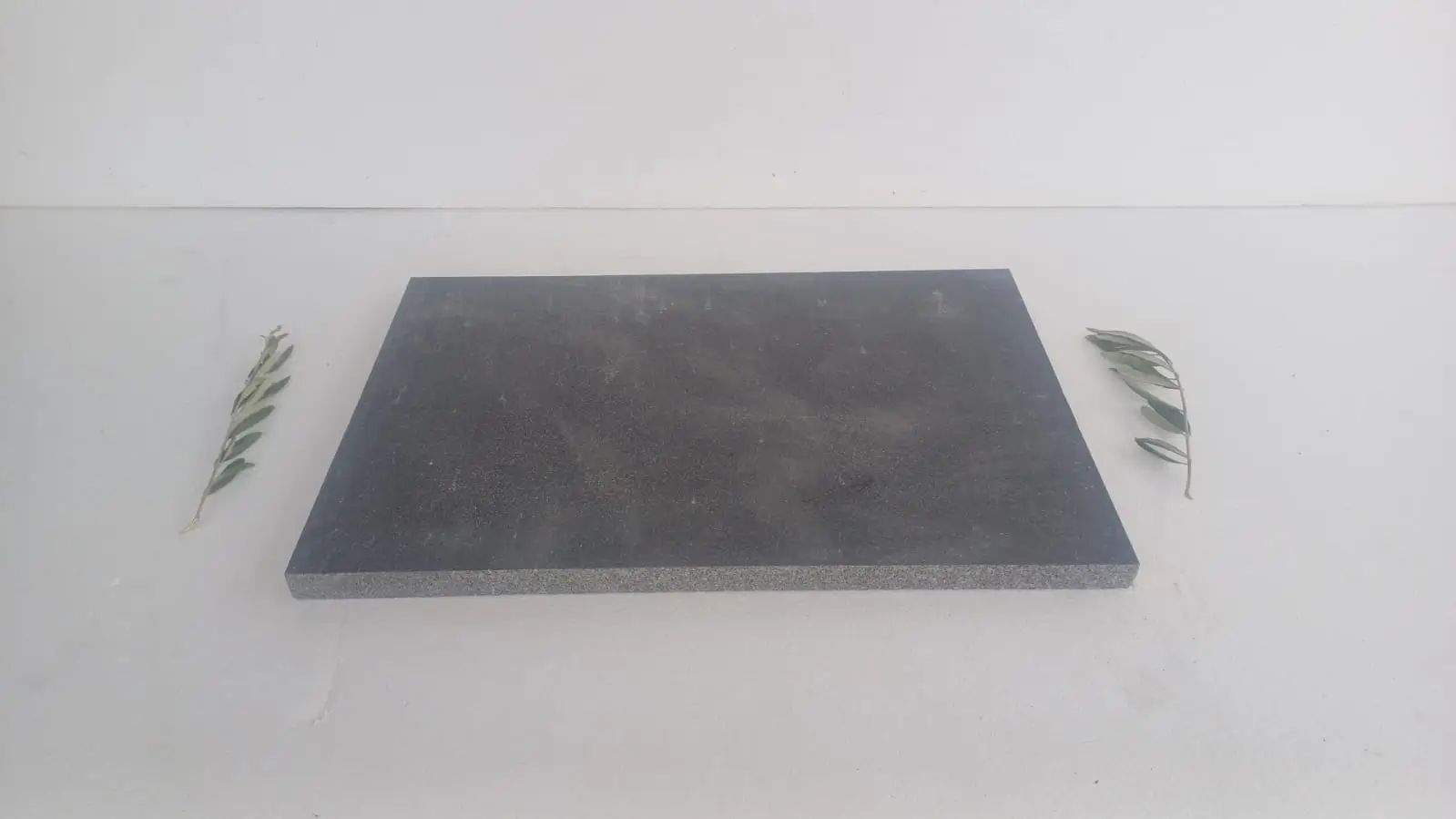
For Arizona space separation using limestone borders, contrast is your primary tool. A creamy buff limestone border against a darker basalt or charcoal concrete field paver creates an immediate spatial hierarchy that reads clearly even across a large patio. Matching the border material to the field paver produces a more monolithic look that works for some design intents but loses the zone-defining effect that makes defined outdoor rooms function architecturally.
Your layout decisions for Peoria patio edging should also account for the storm exposure angle discussed throughout this article — running your primary border course perpendicular to the dominant southwest monsoon approach means the long edge of each slab faces the prevailing wind rather than the exposed joint end. That orientation reduces the infiltration surface under wind-driven rain and puts the slab’s full thickness between the storm and the base system.
Sealing and Maintenance for Storm-Exposed Borders
Sealing a limestone patio slab border in Peoria isn’t optional — it’s a storm-resilience measure. A penetrating silane-siloxane sealer reduces water absorption to near-zero at the stone surface, which dramatically limits the hydraulic pressure buildup under hail impact and reduces the saturation that accelerates frost-spall risk during the rare cold snaps Peoria experiences. Apply sealer before the first monsoon season after installation, not after you’ve already let a storm season work on unsealed stone.
The sealing schedule that field performance supports for Arizona border slabs in high-storm-exposure positions is every 2 to 3 years for penetrating sealers, with a topcoat enhancer applied annually if the border sees heavy windblown grit. Grit abrasion wears the sealer film faster than UV or moisture alone — a detail that’s easy to miss if you’re only thinking about sun and rain rather than mechanical abrasion from storm debris.
Reviewing the Citadel Stone limestone patio facility gives you a direct resource for matching specific limestone grades to Peoria’s storm exposure requirements, including absorption ratings and finish options that affect long-term sealer adhesion.
Delivery planning matters here too. Limestone border slabs are heavy, and truck access to Peoria residential sites frequently involves narrow side-yard gates or HOA restrictions on vehicle timing. Confirming your truck delivery window and staging area before warehouse dispatch avoids the damage that happens when material gets stacked incorrectly on-site because the drop zone wasn’t planned.
Limestone Border Slabs Arizona: Installation Sequence That Holds
The installation sequence for limestone border slabs in Arizona border applications needs to prioritize restraint-first logic. Most installers set field pavers first and then cut-fit the border — that’s backwards for a storm-resilient installation. Setting your border course first, with the continuous concrete haunch cured to full strength before field pavers go in, means the restraint system is already monolithic when you’re working on the interior. Field paver installation doesn’t stress a completed border; it protects it by closing off the interior drainage plane.
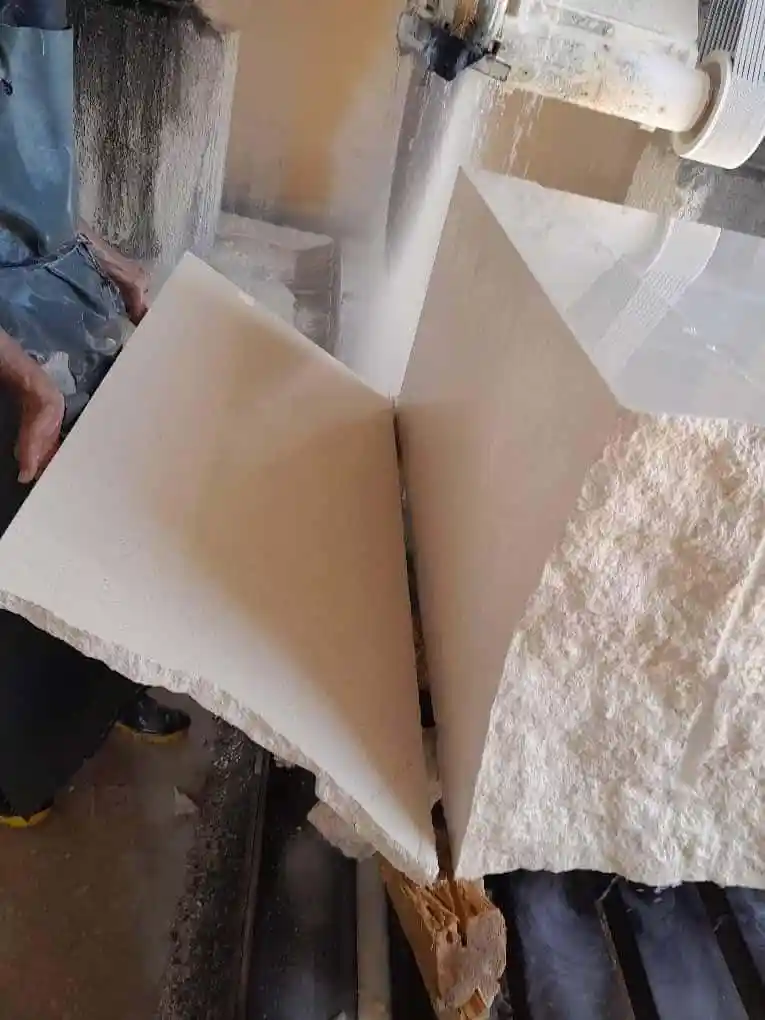
Cutting border slabs to fit curved transitions or angular room separations requires a wet saw with a diamond blade rated for natural stone — not concrete. Limestone cuts cleaner with less chipping at slow feed rates, and in Peoria‘s summer heat, the water cooling on the blade also prevents thermal stress fractures at cut edges. Those cut edges are your most vulnerable points under wind-driven rain infiltration, so a clean cut with minimal micro-fracturing is a storm-resilience specification, not just an aesthetic preference.
- Set border course first, cure concrete haunch 72 hours minimum before field paver installation
- Back-butter each border slab with polymer-modified mortar on base-contact face for full adhesion
- Check slope continuity with a 4-foot level after each 10-foot border run — don’t wait until the full run is set
- Seal cut edges with penetrating sealer within 24 hours of cutting to minimize infiltration at exposed faces
- Document as-built joint widths in each run for maintenance reference — polymeric sand reapplication needs match original joint dimensions
Spec Wrap-Up
A limestone patio slab border Peoria installation that performs through monsoon season after monsoon season comes down to a consistent set of decisions made before the first slab is placed. The material is capable — limestone border slabs in the Class II to Class III density range have the compressive strength, impact resistance, and absorption profile to handle everything Arizona’s storm season delivers. What separates installations that last from those that fail at the 7-year mark is whether the restraint system, base preparation, joint specification, and sealing protocol were treated as storm-resilience elements from the start.
Your specification checklist should be anchored to the mechanical stresses that define Peoria’s climate: wind uplift, wind-driven water infiltration, hail impact, and airborne debris abrasion. Those four forces are what your edge restraints, joint width, slab thickness, and sealer selection are all defending against. Design the border to resist those forces specifically, and the aesthetic function — creating defined outdoor rooms, enabling Arizona space separation, establishing spatial hierarchy — will hold for decades. If you’re also considering complementary stone accents for your Arizona hardscape, Limestone Patio Slab Circular Feature Design for Glendale Focal Points explores how limestone performs in a related patio application that pairs well with border installations. Citadel Stone’s limestone garden slabs in Arizona provide unmatched beauty and durability for Arizona’s climate challenges.