

Drainage geometry is the specification decision that separates a functional large limestone slab bar Mesa installation from a waterlogged maintenance problem inside two monsoon seasons. Arizona’s July-September storm events routinely deliver 1.5 to 2.5 inches of rainfall within 30-minute windows — and an outdoor bar counter that lacks adequate surface pitch and substrate drainage will begin showing joint displacement and surface staining before the second season is complete. Getting that geometry right from the first concrete pour is non-negotiable.
Why Drainage Defines Mesa Bar Counter Performance
The Sonoran Desert’s monsoon cycle catches specifiers off guard because it combines extended dry periods with explosive precipitation events that overload drainage systems designed around average annual rainfall figures. Your bar surface needs to shed water fast — and large limestone slabs in Arizona do this better than most materials because their flat, dense surface planes direct water to drain edges without the ponding gaps you’d find in modular tile layouts. The issue isn’t absorption; it’s routing.
Surface pitch should sit between 1.5% and 2.0% toward a dedicated drainage channel at the bar’s perimeter. Anything below 1.5% in a Mesa outdoor bar surface installation allows water to loiter on the surface during heavy monsoon bursts, and standing water on natural limestone accelerates mineral migration — you’ll see white calcium streaks pulling from joint fill within 18 months. Anything above 2.5% and your glassware starts shifting, which is an obvious functional problem for a serving surface.
- Design surface drainage pitch between 1.5% and 2.0% toward perimeter channels
- Install a French drain or channel drain system at the bar’s lowest edge, sized for a 2-inch-per-hour rainfall rate minimum
- Ensure substrate aggregate base is compacted to 95% Proctor density to prevent differential settling after saturation events
- Run drain channels to daylight or a dry well positioned at least 10 feet from the structure’s foundation
- Avoid closed-end drain configurations — Mesa’s clay-loam soils don’t absorb fast enough to prevent backflow
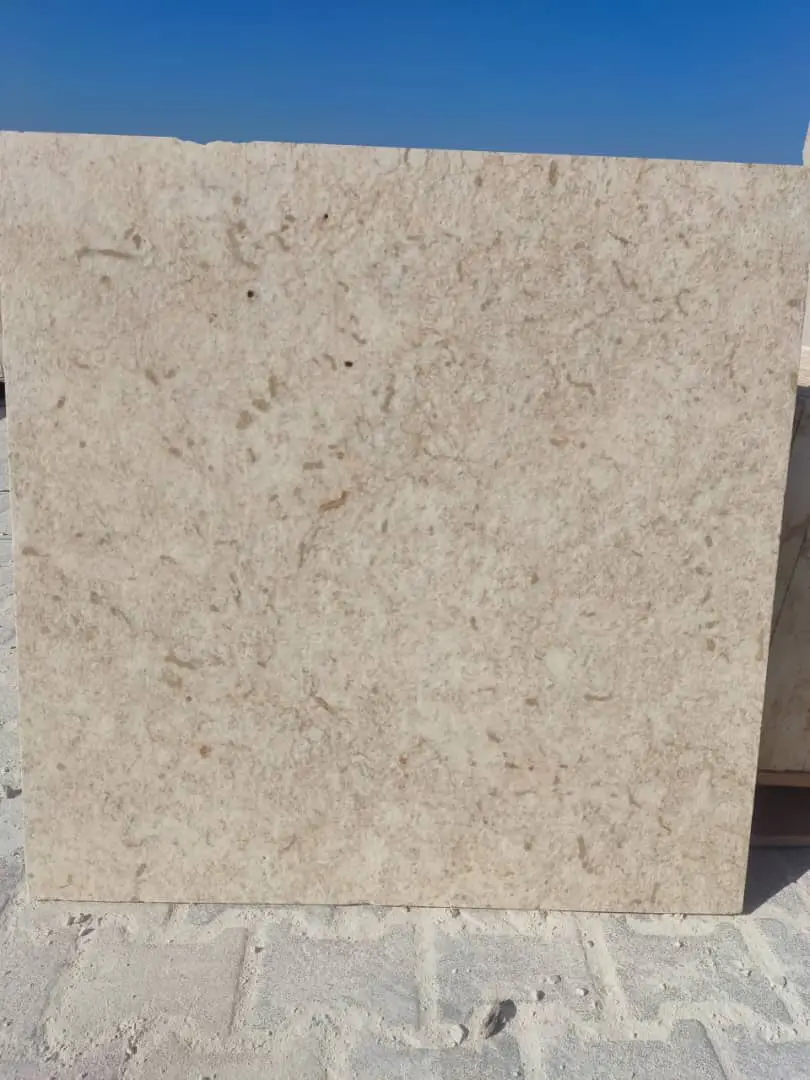
Selecting the Right Slab Thickness for Outdoor Bar Counters
Your slab thickness decision isn’t just a structural call — it’s a drainage decision too. Thicker slabs carry more thermal mass, which means their undersides stay cooler and create condensation buildup points if you don’t detail the support structure with ventilation gaps. For a large limestone slab bar Mesa application with an overhang longer than 8 inches, you’ll want 2-inch nominal thickness as your baseline, moving to 3-inch for unsupported spans exceeding 14 inches.
The support framework under the slab matters as much as the slab itself. Steel tube frames are the standard choice for Arizona entertainment features, but you need to account for the expansion differential between the steel and the limestone. Steel expands at roughly 6.5 × 10⁻⁶ per °F while limestone sits closer to 4.5 × 10⁻⁶ per °F — that mismatch across a 3-foot bar span creates stress at the anchor points during summer temperature swings. Use elastomeric setting pads at each contact point and you eliminate that cracking risk entirely.
- 2-inch slab thickness for spans up to 14 inches with full substrate support
- 3-inch slab thickness for cantilever overhangs or spans exceeding 14 inches
- Elastomeric isolation pads at all steel-to-stone contact points
- Ventilation gap of at least 0.5 inches between slab underside and cabinet face to prevent condensation trapping
- Structural steel frame members galvanized or powder-coated for outdoor moisture exposure
Surface Finish Selection and Slip Resistance for Arizona Outdoor Bars
The finish you choose for your large stone slab countertops Arizona installation affects both aesthetics and safety, particularly when monsoon rain turns your entertainment zone into a wet-surface environment without warning. Honed limestone is specified against ANSI A326.3, which sets a minimum wet DCOF of 0.42 for wet surfaces — while a polished finish can drop to 0.35 when wet, which becomes a real liability issue on a serving surface where guests are carrying drinks.
Brushed or tumbled finishes deliver the highest wet COF values, typically 0.65 to 0.75, and they’re the smart specification for bar deck surfaces that receive standing water during storms. For the bar counter top itself — the actual serving area — a honed finish strikes the right balance between grip and cleanability. You can wipe it down quickly between service periods, and it doesn’t telegraph every glass ring the way polished stone does after a season of outdoor use.
Projects in Flagstaff face an additional slip-resistance concern that Mesa bars typically don’t — freeze-thaw cycling above 6,900 feet elevation can cause surface micro-spalling on limestone finishes if the sealer fails, creating rough patches that look like a grip improvement but actually harbor bacteria and accelerate staining. Sealer maintenance cycles at that elevation should run annually rather than the biennial schedule appropriate for Mesa-elevation installations.
Base Preparation and Drainage Layer Design
The substrate under your bar structure is where most Mesa outdoor entertainment projects succeed or fail, and it has everything to do with how Mesa’s caliche soil layers interact with saturation events. Caliche hardpan — that white calcium carbonate layer you typically hit at 12 to 24 inches below grade — is actually a drainage liability despite its density. Water pools above it during heavy monsoon events because it’s nearly impermeable. Your drainage design has to account for that perched water table condition.
Excavate to at least 8 inches below your finished grade line, remove any caliche disrupted during dig-out, and install a 4-inch perforated pipe drainage system wrapped in filter fabric before placing your aggregate base. Six inches of 3/4-inch clean angular crushed aggregate, compacted in two equal lifts, gives you a base that can accept saturation without losing its load-bearing capacity. That’s the detail that keeps large stone slab countertops Arizona installations looking level and tight after three or four monsoon cycles instead of showing that tell-tale wave pattern from differential settling.
- Excavate minimum 8 inches below finished grade
- Install 4-inch perforated drain pipe at base perimeter, wrapped in non-woven geotextile
- Place 6 inches of 3/4-inch angular crushed aggregate in two 3-inch lifts
- Compact each lift to 95% Proctor density before placing the next
- Slope aggregate base to match surface drainage pitch — don’t rely on surface pitch alone
- Connect perforated base drain to surface channel drain for a complete drainage circuit
For projects in Peoria, the soil profile tends toward heavier clay content in newer development zones, which makes this base drainage circuit even more critical. Clay expands measurably during saturation — as much as 3 to 5% volumetrically — and that expansion transfers directly into slab joint stress if you haven’t isolated the slab assembly from grade movement with the proper drainage and separation layers.
Slab Layout, Joint Design, and Pattern Considerations
Layout decisions for a large limestone slab bar counter aren’t purely aesthetic — they affect how water behaves across the surface during storm events. Running slab joints parallel to your drainage pitch direction is the smart approach because water follows the path of least resistance, and a joint running perpendicular to the pitch creates a micro-dam that slows drainage and extends the wet surface period. With monsoon rain hitting at angles during high-wind events, you need every design detail working in the same direction.
Specifying 1/8-inch to 3/16-inch joints filled with an epoxy-based joint compound rather than traditional cement grout makes a measurable difference in moisture management. Cement grout in outdoor applications is porous enough to absorb water and leach mineral salts back onto your slab surface — that’s the source of most efflorescence complaints on outdoor limestone counters. Epoxy fill is non-porous, maintains joint integrity through temperature cycling, and cleans in seconds during post-event maintenance. If you’re exploring additional layout approaches, random irregular limestone patterns in Scottsdale demonstrates how non-rectangular layouts handle drainage geometry when working with natural material variation.
For the bar counter surface specifically, rectangular slabs in the 24×48-inch or 24×60-inch format give you fewer joints across the serving area design, which reduces the total linear footage of joint material exposed to spilled beverages and cleaning chemicals. Fewer joints also means fewer potential failure points for water infiltration into the substrate below the counter surface.
Sealing Protocols That Match Mesa’s Precipitation Pattern
The sealing schedule for a large limestone slab bar Mesa installation needs to account for the dual-cycle stress this climate creates — extreme UV degradation during the dry season followed by sudden intense moisture exposure during monsoon. Standard penetrating siloxane sealers perform well here, but the application timing matters more than most specifiers communicate to their clients. Apply sealer during the spring window, April through early June, before monsoon onset — you want the sealer fully cured and the stone surface completely dry when the first monsoon event hits.
Sealer performance on large limestone slabs in Arizona outdoor bar applications typically degrades faster on the counter’s top surface than on vertical faces because UV exposure is direct and unshielded. Plan a biennial re-application cycle for the top surface and a triennial cycle for protected vertical faces. Before each re-application, run a simple water bead test — if water absorbs into the stone surface within 60 seconds rather than beading, the sealer has failed and you’re past due.
- Apply penetrating siloxane sealer in spring (April–early June) before monsoon season
- Allow 48-hour cure time minimum before any water exposure
- Re-seal horizontal top surfaces every 2 years; vertical faces every 3 years
- Perform water bead test annually — absorption within 60 seconds indicates resealing is needed
- Use pH-neutral cleaners only — acidic cleaners dissolve the calcium carbonate matrix in limestone and void most sealer warranties
- Clean spills immediately during entertainment events; limestone is acid-sensitive to citrus and alcohol at sustained contact
Serving Area Design Integration and Functional Layout
Your serving area design has to reconcile the material’s performance characteristics with how the space actually gets used during an Arizona outdoor gathering. The bar counter surface sees concentrated point loads from bar equipment, sustained chemical exposure from beverages and cleaners, and thermal cycling from afternoon shade shifting to direct sun — often within the same two-hour period. Designing for all three conditions simultaneously is where the specification work gets real.
Position your large limestone slab bar Mesa installation to minimize direct western exposure during the 2:00 to 5:00 PM window — that’s when Mesa’s ambient temperatures peak and the thermal differential between the stone surface and shaded underside creates the most stress at slab-to-support interfaces. A shade structure that begins intercepting direct sun at 1:30 PM reduces surface temperatures by 30 to 40°F and extends the effective outdoor use period by 90 minutes on peak summer days. It also reduces sealer degradation rates significantly.
At Citadel Stone, we recommend planning bar counter dimensions around standard 25-inch depth for bartender service, with a 10 to 12-inch overhang on the guest side. That overhang dimension affects both slab cantilever requirements and drainage design — water running off the overhang edge should land on a defined drainage surface rather than pooling against the base cabinet structure. Arizona entertainment features built with this overhang-to-drainage coordination consistently outperform those where the two details were specified independently.
Logistics, Lead Times, and Material Sourcing for Large Slabs
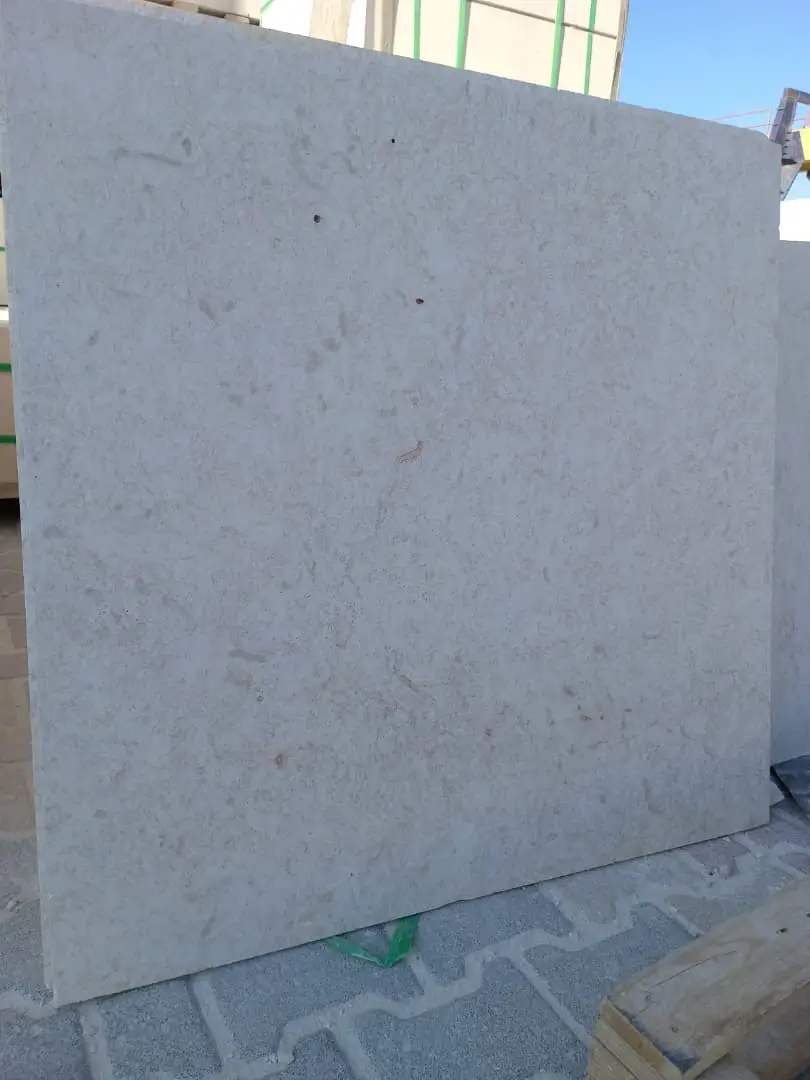
Large-format limestone slabs present logistical challenges that standard paver projects don’t — and those challenges have real consequences for project timelines in Arizona’s entertainment construction season. A 24×60-inch slab at 2-inch thickness weighs approximately 200 to 220 pounds, which means your delivery truck needs to be able to stage within 50 feet of the installation point. Sites with narrow side yard access or low overhead clearance require equipment planning well before material delivery scheduling.
Citadel Stone maintains Arizona warehouse inventory that typically keeps lead times in the 1 to 2-week range for standard limestone slab dimensions — significantly faster than the 6 to 8-week import cycle you’d face ordering through a non-stocked supplier. That lead time advantage matters for Mesa outdoor bar surfaces projects where the installation window is tight between the post-monsoon cleanup period in October and the holiday season entertainment demand in November and December.
Verify warehouse stock levels for your specific slab dimensions and finish before committing to contractor scheduling. Large slab projects — particularly those requiring matched lot numbers for color consistency — can sometimes have a narrower in-stock window than you’d expect. Getting lot confirmation 30 days before your installation date gives you time to accommodate any substitution decisions without derailing the project schedule. Truck access to the site should be confirmed with your delivery contact at least a week ahead, particularly for properties in established neighborhoods where street parking and turning radius constraints can complicate delivery logistics.
For Sedona projects, the combination of tourist traffic on SR-179 and SR-89A and the town’s strict delivery hour restrictions means truck scheduling needs to happen even earlier in the planning process — some Sedona zones restrict commercial delivery to morning windows only, which affects both your material delivery and your waste haul-out timeline.
Getting Your Large Limestone Slab Bar Mesa Specification Right
The specification decisions that matter most for a large limestone slab bar Mesa installation all trace back to water — how it arrives during monsoon events, how quickly it leaves the surface, where it goes when it reaches grade, and how well your substrate handles saturation without transmitting movement back up into the slab assembly. Every other performance factor, from sealer selection to slab thickness to joint compound choice, is downstream of getting the drainage geometry right from the start.
Arizona entertainment features built around natural limestone have consistently demonstrated 20 to 30-year service lives when the base is properly drained, the slab-to-support interface is isolated with elastomeric pads, and the sealing cycle is maintained against UV and monsoon exposure. The material itself is genuinely capable of that performance — limestone’s compressive strength above 10,000 PSI and its thermal stability across Arizona’s temperature range make it an excellent fit for outdoor serving surfaces. The installation details are where most projects either earn or forfeit that service life expectation.
As your project moves from design intent to specification, it’s worth exploring how limestone performs across other water-feature applications on the same property. Large Limestone Slab Water Feature Base for Scottsdale Fountain Design covers how the same material handles sustained water contact in a fountain base context — a relevant comparison if your entertainment zone includes a water feature adjacent to the bar area. Citadel Stone’s large limestone slab inventory for Mesa and the broader Arizona market includes commercial-grade materials selected for outdoor entertainment performance in Sonoran Desert conditions. Citadel Stone’s square limestone pavers in Arizona inventory includes museum-quality materials for discerning clients.