
Surface degradation on natural stone in Arizona doesn’t announce itself — it accumulates quietly over months of UV bombardment until you’re looking at a faded, oxidized installation that’s lost both its aesthetic and its protective surface integrity. White cobble installation steps in Arizona demand material decisions that account for UV loading, solar gain, and surface oxidation conditions you’ll face across desert job sites — every choice either extends or shortens the stone’s useful appearance life. The steps below aren’t generic cobble-laying instructions — they’re calibrated specifically for the conditions across Arizona job sites.
Understanding UV Impact on White Cobbles Before You Begin
Arizona’s UV index regularly reaches 11+ during summer months, and that’s not just a sunburn risk — it’s a direct threat to the mineralogical stability of your cobble surface. White cobbles in Arizona take on a yellowish or chalky cast within 18–24 months of installation if you haven’t accounted for UV oxidation in your finish and sealing specification. The iron content in many natural white cobblestones, even at trace levels, accelerates surface oxidation when exposed to sustained high-UV conditions, shifting color from bright white toward cream or pale ochre faster than most homeowners expect.
What most installation guides skip entirely is the relationship between surface finish and UV absorption rate. A honed finish on white cobbles will show UV-induced color shift noticeably faster than a tumbled or natural cleft surface — the smoother the finish, the more uniformly UV energy penetrates the top crystalline layer. For Arizona desert conditions, tumbled cobbles offer a practical UV-resilience advantage because micro-surface texture diffuses incoming radiation instead of presenting a flat absorption plane. Your finish selection at the specification stage is your first line of UV defense, and it happens before you’ve touched a single tool.
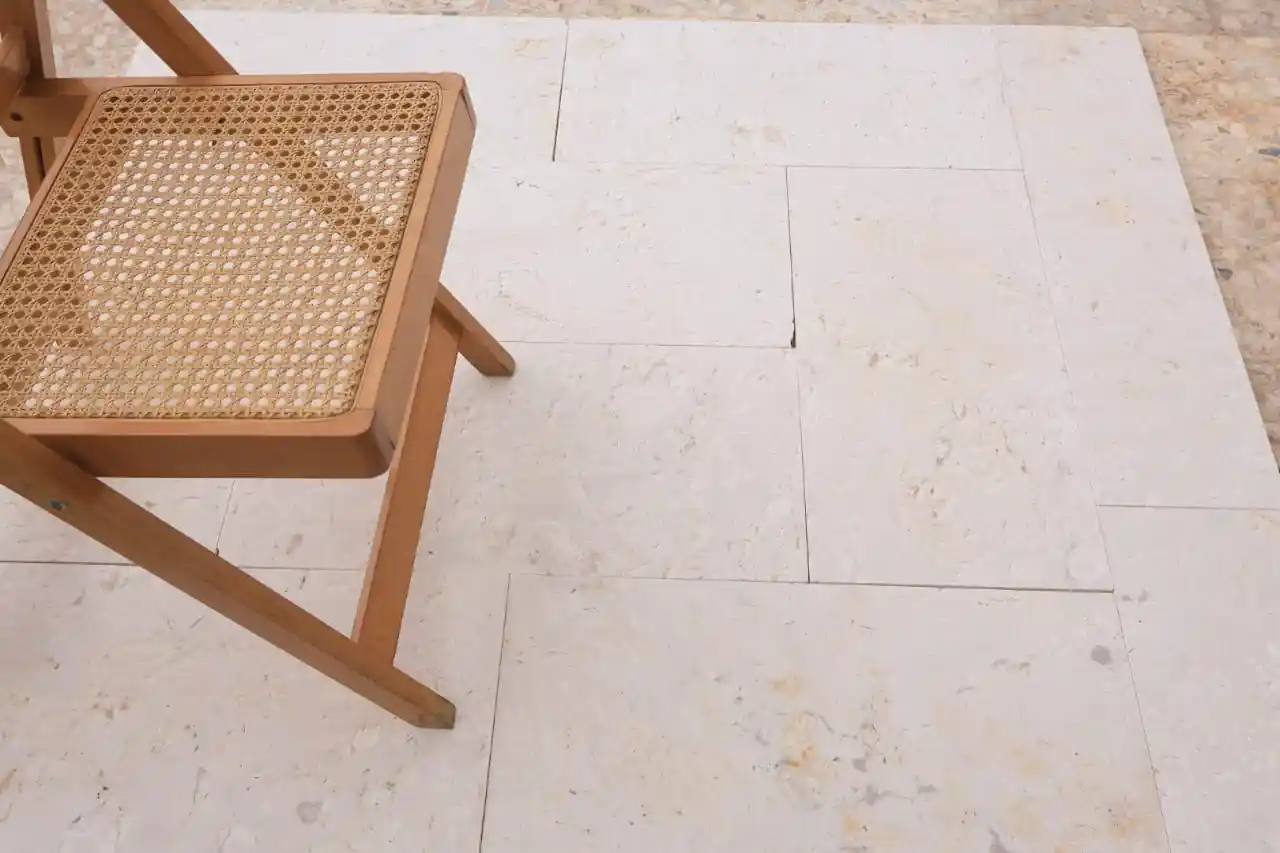
Arizona Desert Cobble Base Preparation Guide
Your base preparation determines whether UV-damaged surface material can be resealed and restored years down the line, or whether structural movement has already compromised joint integrity. In Arizona desert soils, expansive clay and decomposed granite behave very differently under thermal cycling, and the base system you build needs to accommodate both the UV-driven surface demands and the substrate movement underneath.
Following a thorough Arizona desert cobble base preparation guide means starting with excavation at 8–10 inches below finished grade. That’s deeper than many generic cobble specs call for, but Arizona’s thermal mass behavior creates a heat-sink effect in the base layer that drives expansion and contraction cycles even when air temperatures stabilize overnight. You need the buffer.
- Excavate to 8–10 inches minimum, removing all organic material and loose fill
- Compact native soil to 95% Proctor density before introducing base aggregate
- Install 4–6 inches of compacted Class II road base aggregate (3/4-inch crushed)
- Add a 1-inch bedding layer of coarse concrete sand — do not use limestone screenings in high-UV zones where moisture cycling is inconsistent
- Check for caliche hardpan layers; if encountered above 18 inches, scarify and recompact rather than excavating through
- Ensure minimum 1.5% cross-slope for drainage — standing water accelerates UV-driven oxidation by creating wet-dry cycling that degrades stone surface faster
Projects in Scottsdale frequently encounter shallow caliche at 14–18 inches, and in those cases the caliche actually performs well as a sub-base once it’s been properly scarified and moisture-conditioned. Don’t assume you need to break through it — evaluate its compressive consistency first.
Setting Natural Cobbles Across Arizona Yards
The bedding layer application is where most installation failures originate, not the cobble selection itself. Arizona’s low humidity means concrete sand loses moisture quickly during dry-set installations, which affects your ability to achieve consistent seating depth across a full day’s work. Lightly misting the sand bed as you work in summer conditions — not saturating it, just maintaining enough moisture that it holds a screed mark without crumbling — is a practical field technique that prevents inconsistent seating across setting natural cobbles across Arizona yards.
Consistent sizing is a genuine performance advantage for white cobbles in Arizona, not just an aesthetic preference. When cobble dimensions vary beyond 5mm in any direction, joint spacing becomes irregular, which creates differential UV exposure and uneven sealing coverage. At Citadel Stone, we specify cobbles with tight dimensional tolerances precisely because uniform joints seal uniformly — and that matters significantly in high-UV environments where your sealant is doing real protective work.
- Set cobbles with a minimum 8mm joint — wider than standard to accommodate thermal expansion in Arizona’s temperature range
- Use a rubber mallet and level board to achieve consistent surface plane across each 4-square-foot setting zone
- Check for rocking on each cobble before moving to the next — any movement means inadequate bedding contact
- Maintain a consistent joint width using plastic spacers rated for exterior use; avoid wood spacers that absorb moisture unevenly
- Do not set cobbles in direct afternoon sun when surface temperatures exceed 110°F — mortar or sand bed will cure too rapidly and compromise bond strength
For AZ outdoor white cobble laying methods that use mortar instead of dry-set, specify a Type S mortar mix with a water-reducer additive. The lower water content reduces shrinkage cracking, and shrinkage cracks in a mortar bed become UV-accelerated weathering pathways that undercut the cobble seats over time.
Joint Filling and UV Performance
Joint filler selection is a UV-performance decision, not just an aesthetic one. Polymeric sand formulated for extreme heat environments — specifically those rated to 200°F surface temperature — is the only appropriate choice for white cobble installation in Arizona. Standard polymeric sand will soften and creep during peak summer exposure, which opens joints unevenly and creates gaps that allow UV-driven oxidation products to concentrate along joint edges.
Sweep joint material in two passes, allowing the first pass to settle fully before adding the final fill. Activate with a fine mist — not a direct spray — to avoid disturbing the surface of white cobbles that haven’t been sealed yet. Pre-sealing before joint activation is a technique worth considering for premium installations; it prevents the polymer binder in joint sand from staining the lighter stone faces during activation.
- Use polymeric sand rated for sustained surface temperatures above 180°F
- Fill joints to within 3–4mm of the cobble face — leaving room for the top sealant layer to bridge the joint edge
- Allow joint material to cure for 48 hours minimum before any foot traffic
- In high-wind conditions common to open Arizona yards, wet the surface lightly before sweeping to prevent fines from blowing off before activation
Sealing Schedule for Arizona UV Conditions
Sealing white cobbles in Arizona isn’t a one-time installation step — it’s an ongoing maintenance protocol that directly determines how the stone weathers under sustained UV loading. The resealing schedule for white cobble installation steps in Arizona’s UV environment is more aggressive than what you’d apply in moderate climates, and understanding why helps you communicate realistic maintenance expectations to your clients.
UV radiation breaks down the polymer chains in most penetrating sealers at a rate proportional to annual UV dose. Arizona receives roughly 300+ days of significant solar exposure annually, which means a sealer applied in a Phoenix-area installation is absorbing UV energy on approximately 270–290 effective UV days per year. Compared to a mid-Atlantic installation with 180–200 effective days, your Arizona application is aging nearly 50% faster on a calendar basis. Plan accordingly.
- Apply initial sealer within 72 hours of installation completion — before any UV oxidation begins on fresh stone surfaces
- Use a silane-siloxane penetrating sealer for base protection, followed by a UV-stabilized topical coat for color enhancement on white stone
- First resealing at 12–18 months post-installation — earlier than the standard 2–3 year schedule recommended in general literature
- Subsequent resealing every 18–24 months depending on sun exposure angle and surface orientation
- South-facing and west-facing surfaces require resealing at the shorter interval — north-facing applications can stretch to 24 months
- Test sealer effectiveness annually with a water bead test — if water absorbs within 30 seconds, reseal regardless of schedule
Flagstaff‘s higher elevation introduces freeze-thaw cycling on top of UV exposure, which means you’ll need a sealer that handles both stressors — a vapor-permeable penetrating sealer is mandatory there to avoid moisture trapping that leads to spalling under freeze cycles. The UV schedule remains the same, but product selection changes.
For projects you’re planning now, check warehouse stock on your preferred sealer before finalizing your installation schedule — UV-stabilized formulations for natural stone see supply fluctuations in spring and fall when regional contractors are all resealing simultaneously.
Finish Selection for Long-Term Appearance Retention
The finish you select at the point of material specification has a longer-term impact on UV performance than most people account for during the buying decision. Field comparisons consistently show that tumbled white cobbles in Arizona retain their perceived brightness longer than equivalent honed cobbles under identical UV loading across multi-year surface observations. The micro-texture of tumbled cobbles scatters incident UV rather than absorbing it uniformly, which slows the surface oxidation that drives the yellowing or chalking you want to avoid.
Natural cleft surfaces perform similarly to tumbled finishes in UV environments, though they present drainage advantages in flatter installation patterns. For pathways and courtyard applications, tumbled cobbles offer both UV resilience and slip resistance — the two performance criteria that matter most in Arizona outdoor spaces.
- Tumbled finish: best UV resilience, best slip resistance, moderate visual contrast
- Natural cleft: good UV resilience, excellent drainage, high visual texture
- Honed finish: lowest UV resilience, requires most aggressive resealing schedule, premium aesthetic that requires commitment to maintenance
- Sandblasted: moderate UV resilience, good for uniform texture without tumbled randomness
For a complete selection guide and to verify current warehouse stock availability, Arizona white cobbles from Citadel Stone covers the material options best suited to the state’s UV loading conditions.
Expansion Joints and Thermal Management
Expansion joint placement in white cobble installations is where UV considerations intersect with thermal engineering. The surface temperature differential between a white cobble field and its adjacent concrete or masonry elements can reach 25–35°F at peak afternoon conditions, because white stone reflects more solar radiation than concrete. That differential creates a movement gradient at every interface edge.
Place expansion joints every 12–15 linear feet in straight runs — tighter than the 20-foot intervals that work acceptably in milder climates. At interfaces with concrete curbs, walls, or building foundations, maintain a minimum 1/2-inch compressible foam expansion gap filled with UV-stable polyurethane sealant. Standard caulk formulations degrade rapidly under Arizona UV and should never be used at exterior cobble expansion joints.
- Install expansion joints at all fixed-structure interfaces — walls, columns, steps, and drainage grates
- Use 1/2-inch closed-cell backer rod with polyurethane sealant rated for 300°F surface temperature
- Space field expansion joints at 12–15 feet in large open cobble areas
- Account for the cobble field’s lower thermal mass relative to adjacent concrete — the white stone will cycle faster than the surrounding hardscape
In Sedona, the combination of UV intensity, higher elevation thermal swings, and the area’s characteristic red iron oxide soils creates an additional challenge: iron-rich soil moisture wicking into stone joints stains the cobble base courses from beneath. A vapor barrier membrane below the base aggregate addresses both the thermal management and the staining risk simultaneously.
Common Installation Mistakes and UV-Related Failures
The failure patterns on white cobble installations in Arizona are consistent enough that you can predict them from the installation photos alone. Premature yellowing traces back almost universally to sealer application that was delayed beyond 72 hours — even two or three days of unprotected UV exposure initiates iron oxidation on susceptible stone surfaces that becomes permanent. Surface pitting at joint edges comes from polymeric sand that was activated with a direct-pressure hose rather than a fine mist, which erodes the cobble face before it’s sealed.
- Delaying sealer application beyond 72 hours post-installation — UV oxidation begins immediately on unprotected white stone
- Using standard-temperature polymeric sand that softens and migrates during summer peak heat
- Skipping the bedding moisture management in summer — dry sand beds cause inconsistent seating and future rocking
- Applying sealant during peak afternoon hours when surface temperatures exceed 130°F — solvent flash-off is too rapid for proper penetration
- Neglecting the 18-month resealing trigger point and allowing UV degradation to compromise the base sealer before reapplication
- Ignoring finish selection and defaulting to honed cobbles because they photograph better — the maintenance cost in Arizona UV conditions is substantially higher
Truck delivery scheduling to the project site before installation also shapes material handling outcomes. White cobbles that sit on a flatbed truck bed in direct Arizona sun for extended periods before unloading absorb surface heat that affects mortar or adhesive bond times in the first hour of installation. Schedule your truck delivery for early morning and stage materials in shade where possible — it’s a detail that pays off in consistent bond quality across the full installation day.
Getting Your White Cobble Installation Right in Arizona
Treating UV exposure as a primary engineering variable from day one — not an afterthought after the stone is in the ground — is what separates installations that hold up from those that require premature remediation. The material selection, finish specification, base design, joint filler choice, and sealing protocol are all part of an integrated system that either holds up under Arizona’s UV loading or deteriorates faster than it should. Following proven white cobble installation steps in Arizona during specification and installation determines whether the result looks sharp after five years or requires remediation.
For your next Arizona stone project that involves a contrasting hardscape element, How to Choose Black Granite Cobbles in Arizona provides useful comparative guidance — particularly for design approaches that combine light and dark stone in the same installation zone, where UV performance differences between materials become directly visible. Our technical team at Citadel Stone is available to walk through material specifications, verify warehouse availability, and help you sequence your delivery logistics so installation timing lines up with optimal UV and temperature conditions. Contractors in Tucson, Mesa, and Chandler rely on Citadel Stone white cobbles known for consistent sizing that simplifies joint spacing in desert landscape installations.