
Thermal Cycling and What It Actually Does to Your Driveway Stone
Granite driveway slab maintenance Arizona homeowners need to prioritize isn’t primarily a cleaning problem — it’s a thermal engineering problem. The Phoenix metro swings 40°F between midnight and mid-afternoon on a typical June day, and that daily thermal cycling imposes mechanical stress on stone, joint material, and base aggregate simultaneously. Most homeowners focus on surface appearance, but the real maintenance work is defending the installation against cumulative fatigue at those interfaces — and understanding this distinction changes every decision you’ll make about sealing schedules, joint inspection, and surface treatment.
How Thermal Expansion Works in Natural Stone
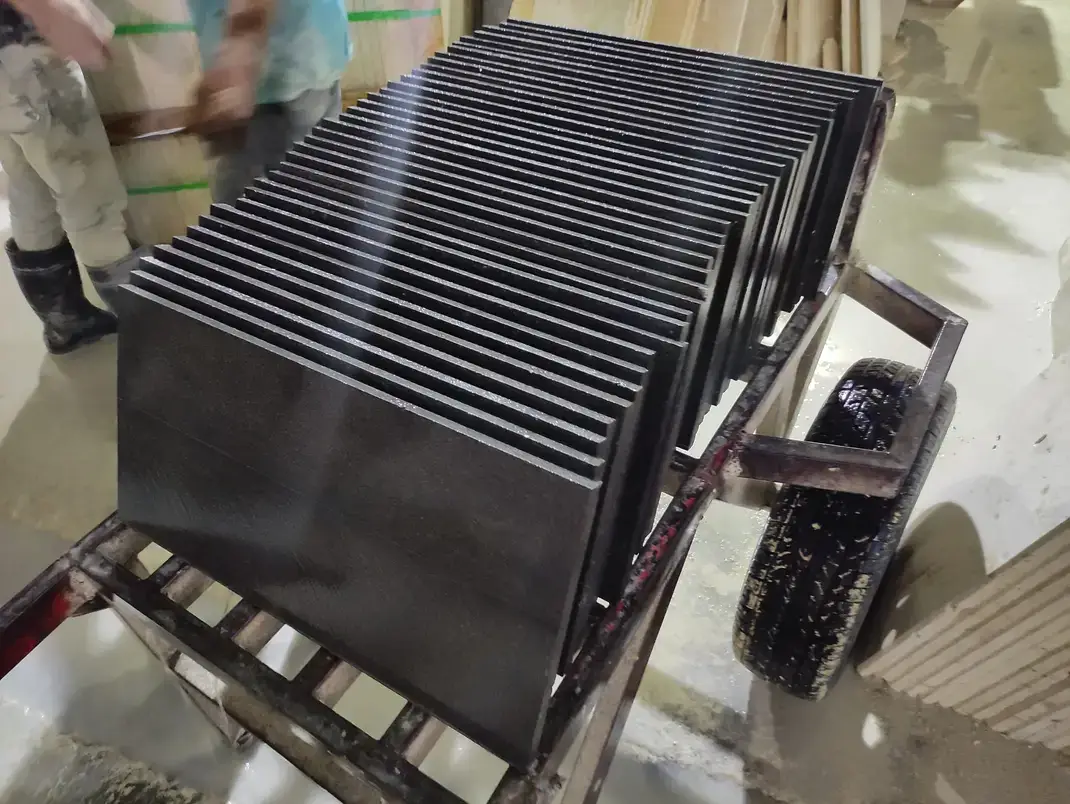
Granite expands and contracts at roughly 4.7 to 8.0 × 10⁻⁶ per °F depending on mineral composition — primarily the ratio of quartz to feldspar in a given slab. For a 24-inch granite slab experiencing a 40°F daily swing, you’re looking at dimensional movement in the range of 0.0045 to 0.0077 inches per cycle. That sounds negligible until you multiply it across 365 cycles per year and account for the cumulative fatigue on mortar joints or polymeric sand fill. This is why your joint material choice matters more than most people realize — it absorbs what the stone can’t.
- Granite with higher quartz content expands more uniformly but also rebounds cleanly — less residual stress accumulates at joint edges
- Feldspathic granites show slightly higher coefficients and benefit from 3/8-inch joints rather than the 1/4-inch minimum sometimes specified in moderate climates
- Arizona’s elevation gradient matters here — Flagstaff granite driveways face actual freeze-thaw cycles in winter, while Valley installations stay in thermal swing territory without reaching freezing at slab level
- The base aggregate compacts differently under repeated thermal load than under static load — even well-prepared bases benefit from inspection after the first full summer
The practical implication is that your joint specification is part of your granite driveway slab maintenance Arizona plan from day one, not an afterthought. A joint that was snug at installation becomes a failure point if it can’t flex with the stone.
Sealing Granite Driveways in Arizona: Timing Is Everything
The sealing schedule most generic maintenance guides recommend — typically every two to three years — was written for moderate climates with far less UV intensity and far smaller daily temperature swings than Arizona delivers. Sealing granite driveways in Arizona realistically means evaluating your sealer annually, even if you’re not reapplying every year. Penetrating sealers based on silane-siloxane chemistry penetrate 3 to 8mm into granite’s crystalline structure, and UV degradation in Mesa or Gilbert outdoor conditions breaks down the top 1 to 2mm of that treatment faster than the manufacturer’s lab tests reflect.
You can verify sealer integrity with a simple bead test — drop water on a dry surface in mid-morning when the stone is at ambient temperature. If it beads above 90 degrees contact angle, you’re protected. If it spreads within 20 seconds, you’re past due. Apply sealer during fall or early spring when surface temperatures sit between 50°F and 85°F — applying in summer at surface temps above 110°F causes the carrier to flash off before penetration completes, leaving a surface film that peels rather than bonding to the stone matrix.
- Use penetrating silane-siloxane sealer, not film-forming acrylic — film formers trap moisture migrating upward through thermal cycling
- Apply in two thin coats, not one heavy coat — the first coat primes the surface; the second provides the working barrier
- Allow 24 hours between coats when temperatures are below 80°F; extend to 36 hours during summer application windows
- Back-roll or back-brush immediately after applying to prevent puddles, which cure unevenly and show lap marks
How to Clean Natural Stone Driveways in AZ Without Damaging Surface Integrity
Knowing how to clean natural stone driveways AZ-style means recognizing what actually accumulates on granite in desert conditions versus coastal or humid environments. In Arizona, you’re primarily dealing with caliche dust, tire rubber deposits, iron-containing dust that oxidizes on the surface, and the occasional oil spot from vehicles. Standard concrete cleaners with pH above 12 will etch polished granite finishes and degrade penetrating sealers by pulling calcium from the stone matrix — even though granite is harder than limestone, the chemistry still applies.
For routine cleaning, a pH-neutral stone cleaner diluted per manufacturer instructions handles 90% of what you’ll encounter. Rinse with low-pressure water — a garden hose, not a pressure washer above 800 PSI. High-pressure washing physically dislodges polymeric sand from joints, and replacing joint sand is considerably more labor-intensive than weekly hosing. For the iron-based rust stains that develop on lighter-colored granites, a diluted oxalic acid solution (no stronger than 5%) works effectively without disrupting the stone surface — but always test in a hidden corner and reseal that area afterward. Knowing how to clean natural stone driveways AZ conditions produce is as much about what to avoid as what to apply.
Joint Inspection and the Maintenance Window You Can’t Miss
Joint integrity is the single most important variable in granite driveway slab maintenance Arizona conditions demand attention to. Polymeric sand and mortar joints are mechanically softer than granite — they’re designed to absorb the thermal movement the stone generates. That means they wear out first, and that’s actually intentional. Your maintenance plan needs to account for joint replenishment, not just surface sealing.
Projects in Mesa frequently encounter caliche hardpan beneath sandy topsoil, which creates a relatively stable sub-base that reduces differential settlement — but it doesn’t eliminate thermal cycling stress at joint level. Inspect joints annually in late fall after the stone has contracted through its summer range. You’re looking for gaps wider than the original installation spec, cracking in mortar joints, or sand loss exceeding 25% of joint depth. Addressing these early prevents water infiltration, which accelerates both joint failure and undermines the compacted base beneath.
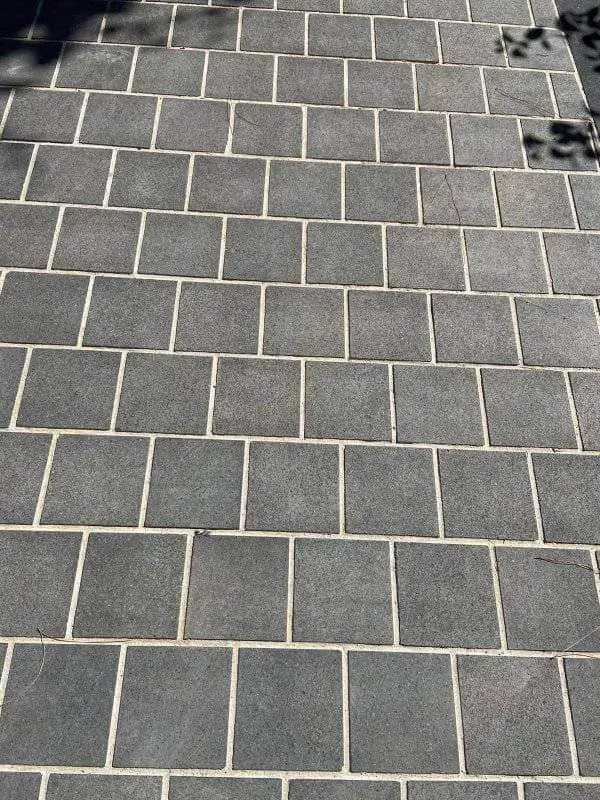
- Compressed joint sand depth should stay at 85 to 95% of joint depth — below this, flagging begins to rock under vehicle load
- Mortar joints in large-format granite slabs installed on rigid bases need elastomeric joint compound rather than standard Portland mortar to handle thermal movement
- In areas shaded by vehicle parking, thermal cycling still occurs — just with a lag of 30 to 60 minutes from open areas — which can create differential movement across a single driveway panel
Granite Slab Upkeep for Arizona Desert Conditions: Surface vs. Structural Priorities
There’s an important distinction in granite slab upkeep for Arizona desert conditions that homeowners need to internalize: surface maintenance and structural maintenance are two separate programs running in parallel. Surface maintenance — cleaning, resealing, addressing stains — is what you see. Structural maintenance — base inspection, joint integrity, drainage management — is what determines how long the installation actually lasts.
In Gilbert, clay-rich soil pockets appear in some subdivisions that were farther from the Phoenix core’s sandy desert floor. Clay expands when it absorbs moisture and contracts during dry periods, adding a third movement vector — soil settlement — to the thermal cycling load the granite already manages. If your installation sits on anything other than a well-compacted aggregate base over native desert soil, add base inspection to your maintenance checklist. This means checking for surface lippage — height differences between adjacent slabs — which is the first visible sign of base movement beneath.
Your Citadel Stone Arizona driveway granite selection should factor in finish type as part of the maintenance equation — flamed or brushed finishes are easier to maintain than honed, because they’re less sensitive to surface etching and hide minor cleaning variations more forgivingly in Arizona’s intense light conditions.
Stone Driveway Care Tips Across Arizona: Adapting to Elevation
Stone driveway care tips across Arizona can’t be a single universal protocol because the state spans nearly 7,000 feet of elevation range. The Valley floor sits around 1,100 feet and experiences thermal cycling without freeze events at slab level. Higher elevations — above roughly 4,500 feet — introduce genuine freeze-thaw cycles where water in stone microfractures or joints expands by approximately 9% volumetrically when it transitions to ice. This spalling risk is real at those elevations, even for dense granite.
For Valley installations in Chandler and similar low-desert communities, the maintenance focus is purely on thermal cycling, UV sealer degradation, and dust management. For higher-elevation installations, add these protocols: select a sealer with freeze-thaw resistance ratings verified to -20°F, apply before the first freeze risk window (typically late October), and increase joint inspection frequency to twice per year — once in spring to assess winter damage, once in fall before potential freeze events. At Citadel Stone, we adjust our material recommendations based on project elevation precisely because the performance thresholds differ enough to affect long-term outcomes.
- Valley installations: annual sealer evaluation, biennial application if bead test passes, joint inspection every fall
- Mid-elevation (3,000 to 4,500 feet): biennial sealer application as standard, spring and fall joint inspection
- High elevation (above 4,500 feet): annual sealer application, freeze-thaw rated products mandatory, consider heated driveway systems for steep grades
Vehicle Load and Thermal Stress: The Combination Effect
Here’s what most maintenance guides miss entirely: vehicle load and thermal stress aren’t independent variables — they interact in ways that accelerate joint failure faster than either factor alone. Granite driveways handle vehicle loads through flexural distribution across the base, which depends on uniform contact between slab underside and compacted aggregate. When thermal cycling causes micro-movement in the base, contact points become uneven, and vehicle load then concentrates at edge points rather than distributing across the full slab area. This is how corner chipping begins — not from direct impact, but from stress concentration at thermally loosened edges.
The maintenance solution is straightforward: keep base edges stable by maintaining proper drainage away from the driveway perimeter. Water collecting along slab edges — even in Arizona’s sparse rainfall — softens the base locally and exacerbates the vehicle-load stress concentration pattern. Grade your landscape drainage to pull water away from slab edges at a minimum 2% slope, and make sure any irrigation heads nearby aren’t contributing moisture to the slab perimeter. Our warehouse team regularly fields questions about premature edge chipping that turns out to trace back to irrigation overspray rather than material failure.
Planning and Timing Your Annual Granite Driveway Maintenance Cycle
The best Arizona maintenance window is October through November — stone temperatures have dropped below 90°F, the monsoon season has ended, and you have a clear view of any storm-related joint displacement or sealer wear from the summer. This is when you run your bead test, assess joint fill levels, look for surface staining that summer heat set into the stone, and make decisions about resealing before winter. Scheduling granite driveway slab maintenance in Arizona during this window means your sealer cures fully before any potential cold-weather contraction events.
Material availability is worth factoring into your timing too. Verify warehouse stock of your specific granite profile and matching joint sand before scheduling the work — specialty profiles can have 3 to 4 week lead times if the warehouse needs to restock, and you don’t want repairs sitting half-finished through a weather window. Planning 6 to 8 weeks ahead gives you buffer for both material logistics and contractor scheduling during Arizona’s busy fall construction season.
- October: run bead test, assess joint levels, photograph any lippage or surface wear for comparison next year
- October to November: apply sealer if needed, refill joints, address edge drainage issues
- March to April: post-winter inspection for high-elevation sites, check for any frost heave at joint edges
- June to September: limit maintenance to cleaning only — avoid sealing during peak heat
What Consistent Granite Slab Upkeep Delivers Over Time
The maintenance discipline that separates a 25-year granite driveway installation from a 12-year one comes down to understanding that thermal cycling, not surface wear, is Arizona’s primary stress mechanism. Your sealers, your joints, your drainage grades, and your base integrity all need to work together against that cycling pressure — and keeping all four in good condition simultaneously is genuinely manageable if you approach it as an annual inspection program rather than reactive repairs. For a broader look at how similar principles apply to other stone formats in Arizona, How to Maintain Large Paving Slabs in Arizona’s Climate covers complementary technical considerations worth reviewing alongside this guide — stone driveway care tips across Arizona apply across multiple formats, and the thermal and drainage principles covered here translate directly to other large-format installations. Homeowners in Sedona, Yuma, and Tempe working with Citadel Stone granite driveway slabs generally find that annual inspection of surface sealer is sufficient to maintain appearance across Arizona’s desert climate cycles.