
Arizona’s thermal cycling is the defining engineering variable that separates a well-specified dark grey paving installation from one that requires costly remediation within five years. This dark grey paving cost Arizona guide is built around one core insight: the desert doesn’t just get hot — it swings. Flagstaff can drop from 75°F at midday to 28°F overnight, and even Scottsdale’s Sonoran Desert corridor regularly sees 50°F daily differentials during shoulder seasons. Understanding how those cycles interact with stone density, joint material, and base compaction determines whether your investment holds up across decades or starts showing stress fractures in year three.
Why Thermal Cycling Matters More Than Heat
The common assumption is that Arizona’s biggest paving challenge is peak heat. That’s partly true — surface temperatures on dark stone can reach 140°F under full midday exposure. But the structural damage rarely happens at the peak. It happens in the transition: repeated expansion and contraction cycles that work mortar beds, grout joints, and sub-base aggregates in ways that steady-state heat exposure never does.
Dark grey natural stone — basalt, bluestone, and dark limestone variants — carries a linear thermal expansion coefficient in the range of 4.5 to 6.0 × 10⁻⁶ per °F. Across a 4-foot slab exposed to a 55°F daily swing, you’re looking at roughly 0.013 inches of movement per cycle. That sounds negligible, but multiply it across 300 cycles per year, across 20 feet of continuous paving without a relief joint, and you have a progressive stress accumulation that most base specs don’t account for.
Your specification needs to treat Arizona not as a high-heat environment but as a high-cycle environment. That’s a fundamentally different engineering brief.
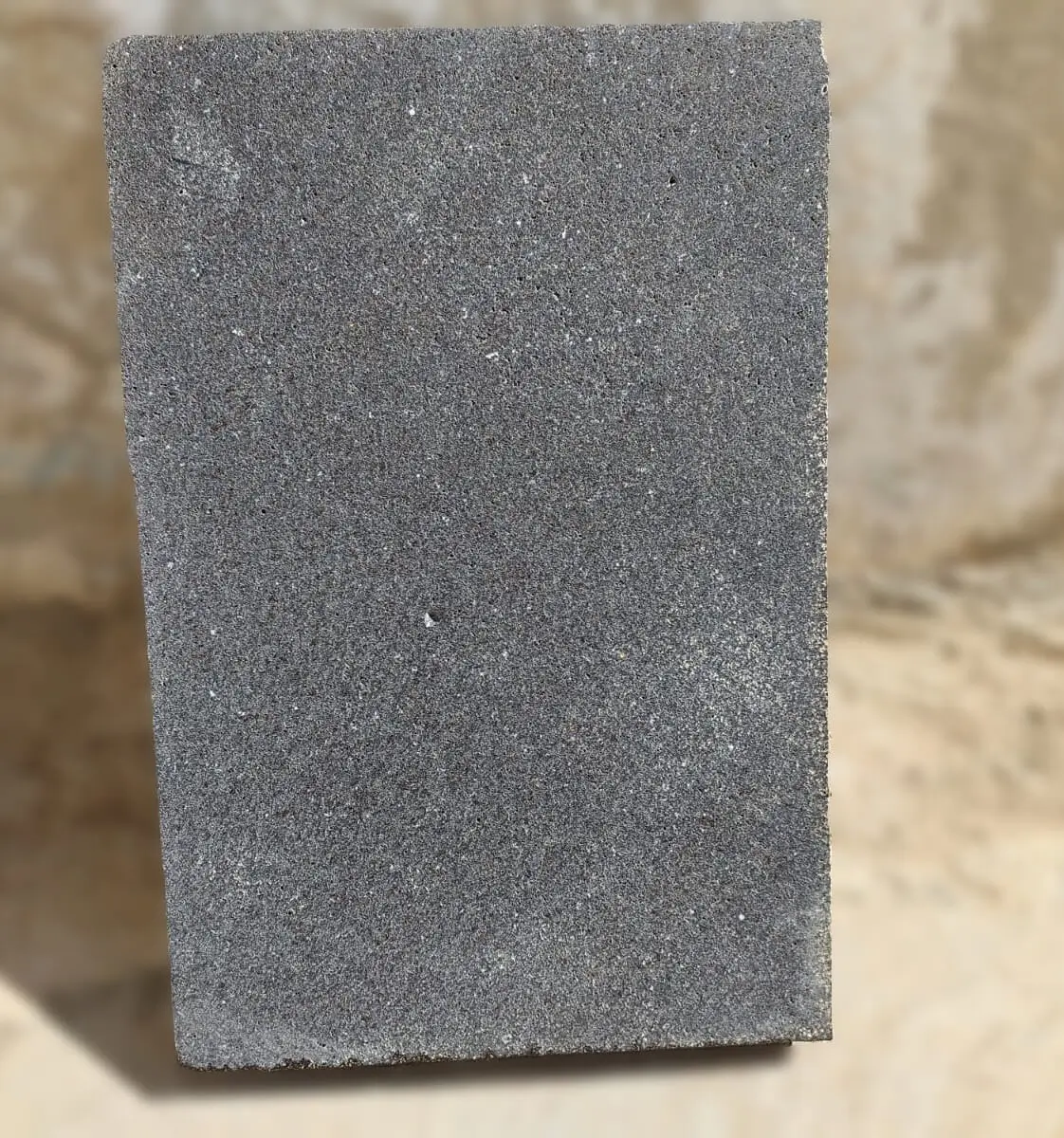
Dark Grey Paving Price Per Square Foot in Arizona
Cost is the first question most homeowners ask, and the honest answer is that the dark grey paving price per square foot in Arizona ranges considerably depending on stone type, slab thickness, and whether you’re budgeting for material alone or total installed cost. Here’s how the numbers actually break down in the current market.
- Entry-level dark grey concrete or manufactured pavers: $4–$7 per square foot for material only
- Natural dark basalt or bluestone pavers, 1.25-inch nominal: $9–$14 per square foot for material
- Thick-cut natural stone (2-inch+), premium quarry grades: $15–$22 per square foot for material
- Total installed cost (material + base + labor): typically 2.5–3.2× the material cost in Arizona markets
- For a 500 sq ft patio using mid-grade natural dark stone, expect $11,000–$19,000 fully installed
Those ranges shift based on project access, base condition, and distance from distribution centers. Truck delivery surcharges to remote sites outside Phoenix metro can add $150–$400 per load, which matters when you’re ordering enough stone for a large driveway or courtyard. Verify warehouse stock levels before locking in your timeline — Arizona construction demand tends to spike in fall and spring, and lead times from local warehouses can stretch from the usual one to two weeks out to four or five during peak seasons.
Stone Type and Cost-Performance Trade-Offs
Not all dark grey paving in Arizona performs equally in high-cycle thermal environments. The material you choose directly affects both your upfront cost and your long-term maintenance expenditure. Here’s how the main categories compare.
Natural Basalt Pavers
Basalt is the highest-performing option for Arizona’s thermal cycling conditions. Its density — typically 2,900–3,050 kg/m³ — gives it a lower porosity than most sedimentary stones, which means less water infiltration and less freeze-thaw damage at elevation. In Flagstaff, where overnight temperatures can drop below freezing on 80+ nights per year, basalt’s closed pore structure is a genuine advantage over more porous alternatives. You’ll pay $12–$18 per square foot for material, but the reduction in sealing frequency and joint replacement over a 15-year period often offsets that premium.
Dark Limestone Pavers
Dark limestone sits in the middle of the cost-performance spectrum, usually running $9–$13 per square foot for material. It’s more workable on site than basalt and provides a warmer, slightly more textured aesthetic. The trade-off is higher porosity — absorption rates of 3–7% are common in lower-grade cuts, which demands consistent sealing on a 12–18 month cycle in high-UV zones. Your specification should call for a Grade I or Grade II classification per ASTM C568, which corresponds to absorption below 3% and flexural strength above 1,000 psi.
Bluestone and Slate Alternatives
Bluestone performs well in moderate climates, but Arizona’s combination of UV intensity and thermal cycling stresses its laminar structure over time. Delamination along natural cleavage planes is a real field issue in sun-belt applications — not a theoretical concern. You can mitigate this with proper sealing and a deeper aggregate base, but the ongoing maintenance cost means bluestone rarely wins on total cost of ownership for large Arizona projects.
Budgeting for Outdoor Paving Across Arizona
Budgeting for outdoor paving across Arizona requires thinking in two separate cost buckets: initial installation and long-term ownership. Most homeowners focus only on the first number, which is exactly how projects end up over budget by year eight when joint sand washout, thermal cracking, or surface degradation demands costly intervention.
- Base preparation: $2.50–$5.00 per square foot depending on existing soil conditions and compaction requirements
- Setting bed (sand or dry-pack mortar): $1.00–$2.50 per square foot
- Stone material: $9–$22 per square foot depending on grade and thickness
- Joint material and sealing: $0.75–$1.50 per square foot initial, $0.50–$1.00 per square foot for biennial resealing
- Labor in Phoenix metro: $6–$11 per square foot; Scottsdale premium projects often run higher due to design complexity
- Contingency for caliche or unexpected sub-base remediation: 10–15% of total budget
The contingency line deserves specific attention. In Scottsdale, caliche hardpan layers appear at varying depths and require either mechanical breaking or chemical treatment before you can achieve the 95% Proctor density your base spec demands. Discovering that layer mid-project without budget reserves is a common reason Arizona paving projects run over cost.
Thermal Expansion Joint Spacing for Arizona Conditions
Here’s where most specifications written for generic national standards fail Arizona installations: expansion joint spacing. Standard recommendations derived from mid-Atlantic or Pacific Northwest climates are built around 40–50°F seasonal differentials. Arizona’s daily differential in shoulder seasons runs 45–60°F — effectively compressing a full seasonal cycle into a single day, every day, for months at a time.
Your expansion joint spacing should be calculated using a maximum restraint length formula: L = (allowable joint movement) ÷ (coefficient of expansion × temperature differential). Using a 55°F daily differential, a dark basalt expansion coefficient of 5.0 × 10⁻⁶/°F, and an allowable joint compression of 0.030 inches, you land at a maximum panel length of roughly 109 inches — call it 9 feet. Standard national guidelines suggest 15–20 feet. That difference is consequential in Arizona.
For field application, plan relief joints at 8–10 foot intervals in both directions, filled with a polyurethane sealant rated for 50% movement capacity. The additional joint material cost — maybe $0.25–$0.40 per linear foot — is insignificant against the cost of replacing buckled or cracked stone three years into an installation.
Base Depth Requirements by Application
Arizona’s soil variability is significant enough that a single base specification doesn’t cover the whole state. Sandy desert soils in the low desert compact differently from the expansive clay soils found at higher elevations, and both require different approaches than the caliche-dominated profiles common across the Scottsdale and Phoenix metro area.
- Pedestrian patios on stable sandy soils: 4 inches compacted Class II base, 1-inch sand setting bed
- Pedestrian patios on expansive soils: 6 inches compacted base with geotextile separator fabric
- Residential driveways (standard vehicle loads): 8–10 inches compacted aggregate base, 2-inch nominal stone thickness minimum
- Driveways with regular truck or RV access: 12 inches base minimum, 2.5-inch nominal stone thickness, consider dry-pack mortar setting bed
- Pool surrounds with subsurface irrigation: 6-inch base with positive drainage slope of 1.5% minimum away from structure
One field detail that often gets skipped in Arizona projects: the base aggregate itself needs to be well-graded crushed stone, not desert sand fill. Desert sand has excellent load distribution in compression but minimal lateral stability, which means it migrates under thermal cycling stress exactly the way your joints don’t want. Class II ¾-inch crushed aggregate, compacted in 3-inch lifts to 95% Modified Proctor, is the standard you should hold your contractor to.
For detailed breakdowns on material grades and associated square-foot pricing, you can reference our dark grey paving cost guide Arizona, which walks through slab classifications alongside current regional pricing.
What Makes a Dark Grey Stone Specification Worth the Investment
Affordable stone paving solutions AZ homeowners trust aren’t necessarily the cheapest per-square-foot options — they’re the specifications that deliver low total cost over a 15–25 year horizon. The difference between a $10 per square foot stone that needs joint replacement every four years and a $16 per square foot stone that performs maintenance-free for eight years is easy to calculate, but harder to communicate to a homeowner focused on initial budget.
The performance metrics that matter for Arizona’s thermal cycling conditions are compressive strength, water absorption, and flexural strength under repeated loading. For dark grey natural stone in Arizona applications, target these minimums:
- Compressive strength: 8,000 psi minimum; 12,000+ psi for driveway applications
- Water absorption: below 3% for low-desert applications; below 1.5% for Flagstaff elevations
- Flexural strength: 1,200 psi minimum per ASTM C880 testing protocols
- Freeze-thaw resistance: ASTM C880 or C97 testing confirmation for any stone specified above 4,500-foot elevation
- Slip resistance: DCOF (Dynamic Coefficient of Friction) above 0.42 wet for pool and entry applications per ANSI A326.3
At Citadel Stone, we source dark grey stone directly from quarries that provide batch-specific test data for compressive strength and absorption. That documentation matters when you’re writing a specification that a contractor will actually be held to.
Sealing and Maintenance Costs in Arizona Conditions
UV intensity in Arizona degrades penetrating sealers faster than the application instructions suggest. Most penetrating silane-siloxane sealers are rated for 3–5 year reapplication cycles under normal conditions. In southern Arizona’s high UV environment, you’ll see meaningful surface degradation in 18–24 months on unshaded installations — which makes your initial sealer selection and maintenance budget critical components of the true cost calculation.
For dark grey stone specifically, the sealing protocol has both a functional and aesthetic dimension. Natural stone sealers fall into two categories: color-enhancing (which deepens the dark grey tone and brings out surface variation) and natural-finish (which maintains the original quarry appearance). Color-enhancing sealers tend to require more frequent reapplication because UV breaks down the resin carriers faster, but they deliver a richer visual result that most homeowners prefer.
- Initial sealing cost at installation: $0.75–$1.25 per square foot for professional application
- Biennial resealing on a 500 sq ft installation: $400–$650 per application cycle
- Joint sand stabilization (polymeric sand): $0.40–$0.60 per square foot at installation; reduces long-term joint maintenance significantly
- Efflorescence treatment (relevant for limestone and some basalt): $0.20–$0.50 per square foot as needed
In Tucson, monsoon season introduces a specific maintenance variable that northern Arizona projects don’t face as intensely: rapid-onset storm water carrying soil particulates across sealed stone surfaces. That sediment load, if not cleared promptly, etches into insufficiently sealed surfaces. Your maintenance schedule should include a post-monsoon cleaning and inspection cycle as a line item, not an afterthought.
Project Planning and Lead Times
Your project timeline needs to account for the Arizona construction calendar, not a generic national schedule. The optimal installation windows for dark grey paving in Arizona are October through December and February through April — periods where daytime temperatures in the 60–80°F range allow proper mortar cure times and give your joints time to stabilize before the first high-cycle thermal season.
Summer installations aren’t impossible, but they require modified practices: early morning pours before surface temperatures climb above 90°F, extended curing periods, and shading of freshly installed stone during the first 72 hours. These adaptations add labor cost and time, typically increasing your per-square-foot installation cost by $1.50–$2.50 in summer conditions.
For material ordering, build your schedule around these realistic lead times:
- Standard warehouse stock (common dark basalt and limestone profiles): 1–2 weeks in off-peak seasons
- Fall and spring peak season warehouse availability: allow 3–5 weeks minimum
- Custom or non-standard slab sizes: 6–10 weeks from quarry order confirmation
- Truck delivery scheduling to remote sites: add 3–7 days for route logistics outside metro areas
Confirming truck access to your site before finalizing the order matters more than most homeowners realize. Articulated delivery trucks carrying full pallets of 2-inch stone need a minimum 12-foot clearance width and firm surface bearing. Sites with gated entries, low-hanging tree canopies, or soft soil approaches may require smaller split deliveries, which adds cost and extends your timeline.
Before You Specify
Arizona’s thermal cycling conditions reward careful specification work done before installation begins — not adjustments made after problems surface. The decisions you make on stone density, joint spacing, base depth, and sealing protocol in the planning phase determine whether your dark grey paving installation looks excellent at year five or starts showing stress fractures at year three. These aren’t minor details you can revisit after the fact; once the stone is set and the base is compacted, your options narrow considerably.
Approaching this dark grey paving cost Arizona guide as a total-project cost exercise — rather than a material-only comparison — is what separates well-budgeted projects from those that run over by year eight. Run your numbers across a 15-year ownership window: initial installation, biennial sealing, joint maintenance, and any remediation contingency. The affordable stone paving solutions AZ homeowners trust most in this climate are built on dense, low-absorption stone, properly spaced relief joints calculated for Arizona’s daily thermal differential, and base depths that match actual soil conditions rather than generic national minimums. For the practical mechanics of putting this specification into the ground, How to Install Dark Grey Paving in Arizona covers the field execution sequence in detail. Homeowners across Scottsdale, Flagstaff, and Peoria can reference Citadel Stone’s dark grey paving range to compare slab grades and associated per-square-foot costs before committing to an Arizona project.