
The Freight Cost Reality for Buckeye Projects
Large format limestone transport Buckeye contractors need to budget honestly starts with a number most project managers underestimate by 20 to 35 percent — the per-unit freight cost when you’re moving slabs in the 24×24 inch or larger range across Arizona’s western corridor. The weight concentration on a standard flatbed changes the entire delivery equation compared to conventional paver loads, and Buckeye’s position at the far west edge of the Phoenix metro means you’re absorbing real mileage from most stone suppliers. Getting that number right early protects your contingency fund for the things you can’t plan around.
The delivered cost for large format stone in this region typically runs 12 to 18 percent higher than comparable material delivered to central Phoenix ZIP codes. That delta isn’t just fuel — it’s the specialized equipment required, the access constraints on newer Buckeye construction sites, and the limited return-load opportunities that push carriers to price the haul at premium rates. Your project budget needs to reflect that reality before you ever place a material order.
Local Material Availability and What It Means for Your Budget
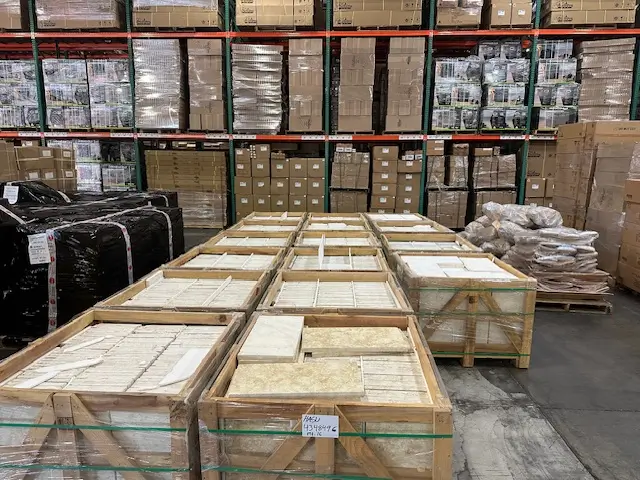
Arizona’s stone supply chain is more nuanced than it appears. The Phoenix metro has reasonable inventory depth for standard 12×12 and 16×16 pavers, but large format limestone in the 24×24 to 36×36 range sits in a much thinner inventory tier. Most distributors stock it in limited quantities because the warehouse footprint per unit is significantly higher — a pallet of 24×24 slabs at 2 inches nominal thickness occupies roughly three times the floor space of an equivalent square footage order in standard format.
That inventory gap creates a practical consequence for your project timeline. You’ll often face a 3 to 5 week lead time on large format orders compared to 1 to 2 weeks for standard sizes. Citadel Stone maintains dedicated warehouse inventory of large format limestone in Arizona, which compresses that lead time considerably — but you still need to coordinate your delivery window with your site’s readiness, because staging large slabs on an unprepared site introduces damage risk that standard pavers don’t carry at the same level.
- Verify slab inventory counts before finalizing your project start date — stock levels fluctuate with commercial project cycles in the region
- Ask specifically about thickness consistency across your order lot — large format slabs from different quarry cuts can vary by 3 to 5mm, which affects your setting bed depth
- Factor in 5 to 8 percent overage on your material order to account for cuts at site perimeter and any transit damage on large slabs
- Confirm that your supplier’s warehouse can stage your full order in a single lot — split deliveries on large format material add truck costs that compound quickly
Transportation Planning for Buckeye Site Conditions
Buckeye oversized stone delivery logistics differ from east Valley deliveries in ways that aren’t immediately obvious from a map. The city’s rapid residential and commercial expansion means you’re frequently working in subdivisions where the street infrastructure is brand new but the turning radii and cul-de-sac designs weren’t engineered with full flatbed deliveries in mind. A 48-foot flatbed carrying large format limestone can’t navigate a tight cul-de-sac at all — and discovering that constraint on delivery day costs you demurrage charges, re-delivery fees, and a full day of schedule disruption.
For projects in Buckeye‘s newer subdivisions west of Miller Road, the right approach is a pre-delivery site survey conducted specifically for truck access — not just a general site walkthrough. Measure your entry point width, check overhead utility clearance, and confirm the pavement load rating on any temporary roads or compacted gravel access points. Large format limestone on a full flatbed can approach 40,000 to 45,000 pounds gross, and soft shoulders on unfinished subdivision roads don’t forgive that kind of axle load.
- Request a lowboy or drop-deck trailer when your site entry requires clearance below 13 feet 6 inches — standard flatbeds sit higher and won’t clear low overhead obstructions
- Identify your unloading zone before the truck arrives — large format slabs require a forklift or telehandler, and maneuvering room matters as much as access
- Confirm with your carrier whether the delivery includes crane offload or requires your equipment on site
- Factor in potential overtime charges if your delivery window falls outside standard hours due to HOA or municipal restrictions on Buckeye construction sites
Large Paver Logistics Across Arizona’s Western Corridor
The logistics picture for large paver logistics Arizona-wide shows a clear pattern — projects within 20 miles of central Phoenix receive the widest carrier competition and the most flexible scheduling. Move west toward Buckeye, Goodyear, or Avondale, and that carrier pool shrinks. Fewer carriers means less rate flexibility, and you’ll find that the standard freight quotes you’re used to from east Valley projects don’t transfer directly to western corridor deliveries.
That dynamic has a practical budget implication. For a project requiring 4 to 6 truck loads of large format limestone, the freight premium over central Phoenix rates can add $1,800 to $3,200 to your total delivered cost depending on load size, scheduling complexity, and carrier availability on your required delivery dates. That’s real money, and it belongs in your pre-bid estimate rather than in your contingency. Experienced specifiers in this region build western corridor freight into their standard regional pricing templates rather than treating it as a one-off variable.
Value Engineering: Balancing Material and Labor Costs
Large format limestone transport Buckeye projects reveal an interesting economic argument that flips the conventional cost narrative. Large format pavers — particularly in the 24×24 range — reduce your installation labor hours meaningfully. A skilled crew can lay roughly 400 square feet per day in 12×12 format. The same crew working in 24×24 format reaches 550 to 600 square feet per day under comparable site conditions, because each piece covers four times the area with equivalent handling effort.
In Arizona’s current labor market, that efficiency gain is worth real dollars. Commercial masonry labor in the Phoenix metro runs $55 to $75 per hour for experienced stone installers, and residential project rates aren’t far behind. Shaving 15 to 20 percent off your installation labor hours on a 2,000 square foot project offsets a significant portion of the freight premium you’re absorbing on the western corridor delivery. The net cost differential between large format and standard format, fully loaded with material and labor, is closer than the raw material price comparison suggests.
- Run a full material-plus-labor comparison before defaulting to standard format pavers based on unit price alone
- Account for the reduced grout joint linear footage in large format installations — less jointing material and less labor time on that phase
- Large format slabs require a flatter, more precisely graded setting bed — budget for the additional base preparation that entails
- Consider your project’s deadline pressure: faster daily coverage rates in large format can compress your installation schedule by 3 to 5 days on mid-size projects
How Sourcing Decisions Drive Total Project Cost
Your sourcing decision for large format limestone isn’t just a material selection — it’s a logistics and cost structure decision. Buying from a distributor who sources directly from domestic quarries versus one who imports from overseas stock creates meaningfully different lead time profiles, price volatility exposure, and quality consistency patterns. At Citadel Stone, we source our large format limestone inventory through verified quarry relationships and run dimensional tolerance checks at the warehouse before stock ships to project sites — because a 3mm thickness variance across a large format installation creates leveling problems that cost far more to fix than the material savings justified.
Peoria and the northwest Valley commercial market has pushed significant volume of large format stone projects in recent years, and the pattern we see there applies to Buckeye as well — projects that shortcut on sourcing validation to save $0.40 per square foot on material end up absorbing $2 to $4 per square foot in installation corrections. That math doesn’t work, and it shows up in project budgets with painful clarity when you’re sorting out lippage issues on a completed driveway or patio field. Invest in verified sourcing and dimensional consistency upfront.
The sourcing conversation also intersects with your payment and draw schedule. Large format limestone orders often require a deposit to hold warehouse inventory against your project timeline. Build that into your cash flow planning — it’s not unusual to commit 40 to 50 percent of the material cost 3 to 4 weeks before your delivery date on orders above 1,000 square feet.

Site Access, Staging, and Damage Risk Management
Staging large format limestone on an active construction site requires more deliberate planning than standard paver staging. Each slab in the 24×24 to 36×24 range weighs 80 to 140 pounds depending on thickness, and they stack in fewer layers than standard pavers — typically 4 to 6 layers maximum before stack stability becomes a concern. Your staging area needs to be level, compacted, and sized to allow forklift access from at least two sides without requiring repositioning between each pallet pull.
Projects in Flagstaff deal with a different staging challenge — elevation and temperature swings that can affect slab behavior during storage if your timeline extends beyond 2 weeks. In Buckeye’s desert valley conditions, by contrast, your primary staging concern is UV exposure on lighter-colored limestone and the thermal mass effect on slab edges when stacked in direct sun. Slab-to-slab contact under high heat can cause micro-chipping at edges if your stacking separators aren’t in place. Use 3/8-inch plywood shims between slab layers — it’s a small investment that prevents finish damage on expensive large format material.
- Confirm your staging area can bear 8,000 to 12,000 pounds per pallet position before your truck arrives
- Mark your unloading sequence in advance — large format pallets should be staged nearest to their installation zones to minimize secondary handling
- Inspect each slab at delivery for transit damage before signing the delivery receipt — edge chips on large format slabs are difficult to repair invisibly
- Keep staging areas shaded or covered when possible to reduce thermal stress on slab edges during storage periods longer than 5 days
Arizona Regional Pricing Dynamics You Need to Understand
The Arizona stone market prices large format limestone at a premium over standard sizes for reasons that go beyond simple material cost. Quarry yield for large format slabs is lower — more material gets cut away in the squaring process, and rejection rates for cosmetic consistency run higher on larger faces. That upstream cost reality flows through to your delivered price, and it’s legitimate rather than artificial margin stacking.
Regional pricing in the Phoenix metro also reflects seasonal demand cycles that Buckeye projects should account for. The October through March construction window drives peak demand for hardscape materials across the Valley. Pricing during that window can run 8 to 14 percent above summer rates, and lead times extend because distributor warehouse inventory turns faster. If your Buckeye project timeline allows it, securing your large format limestone order in late summer — even if delivery is scheduled for fall — locks in better pricing and guarantees your inventory position before the seasonal rush compresses availability.
For commercial projects in the Buckeye area, Sedona‘s high-end residential market offers a useful pricing reference — that market consistently absorbs premium large format limestone at full value, signaling that the material’s cost-to-performance ratio justifies specification in demanding Arizona applications. The value proposition holds in Buckeye’s commercial and upscale residential segments equally well when the total project economics are evaluated correctly.
You’ll also want to understand the currency exposure on imported limestone. When the dollar weakens against the euro or Turkish lira, imported stone prices adjust with a 60 to 90-day lag — long enough to catch a project mid-specification if you’re not watching the trend. Domestic limestone sources provide pricing stability that imported material can’t match during volatile exchange rate periods, and that stability has real value in fixed-bid commercial work.
Spec Wrap-Up: Large Format Limestone Transport Buckeye Budget Essentials
Large format limestone transport Buckeye project planning rewards the specifiers and contractors who treat logistics as a first-tier budget variable rather than a line item they’ll figure out later. The freight premium, the site access complexity, the staging requirements, and the inventory lead times all carry real dollar values that belong in your estimate from day one. Getting those numbers right is what separates a project that delivers on budget from one that erodes margin in the back half of construction.
The material-to-labor cost ratio argument for large format stone is genuine and worth running on every project where it’s applicable — the coverage rate efficiency offsets a meaningful portion of the freight and material premium when your labor market is as active as Arizona’s currently is. For complementary Arizona stone project specification detail, Large Format Limestone Paver Grout Line Minimization for Avondale Seamless Look covers the jointing considerations that directly affect finished appearance and long-term performance in large format installations. You can also explore Citadel Stone’s brick-sized limestone pavers to understand the full range of large format options available for Arizona projects before you finalize your specification. Citadel Stone’s large format limestone transport and supply capabilities for Buckeye project sites are backed by direct quarry sourcing and hands-on logistics expertise across the Arizona market.