
Thermal Cycling Is the Real Test for Cave Creek Stone Installations
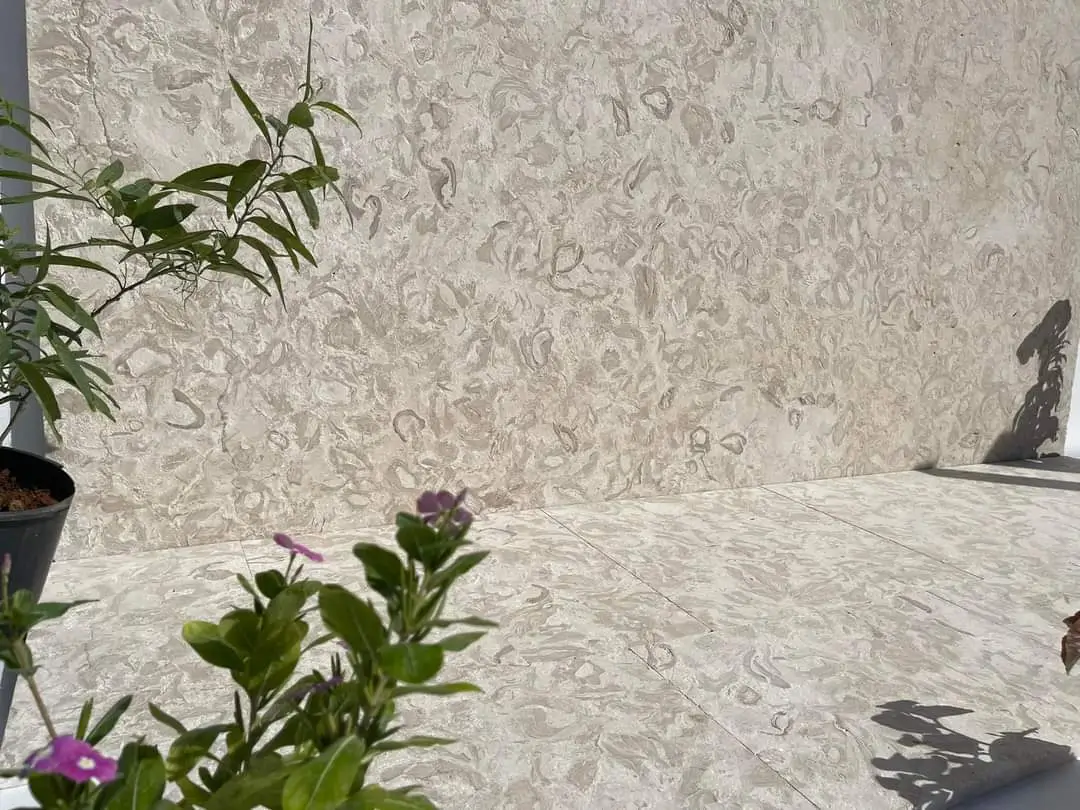
Large limestone paver weather resistance in Cave Creek hinges far more on temperature cycling than on peak heat alone — and that distinction changes how you specify everything from joint width to base depth. Cave Creek regularly swings 40°F to 50°F between pre-dawn lows and mid-afternoon highs, and that daily mechanical stress accumulates across thousands of cycles over a paver’s service life. You’re not just selecting a stone that can handle heat; you’re selecting one that can repeatedly contract and expand without fracturing at joints, spalling at edges, or losing bond at the bedding layer.
The thermal expansion coefficient of quality limestone runs approximately 4.4 × 10⁻⁶ per °F — lower than most concrete alternatives and meaningfully lower than porcelain tile. For a 24-inch paver, that translates to roughly 0.05 inches of dimensional change across a 50°F swing. That number sounds minor until you’ve watched a tightly-butted installation pop a corner or open a random crack three seasons in. Proper joint spacing of 3/16 to 1/4 inch for large-format units is the spec decision that determines whether your installation absorbs that movement or fights it.
How Cave Creek Monsoon Mechanics Actually Stress Your Pavers
Cave Creek monsoon durability is a function of how fast water loads and drains, not just how much water falls. The North Sonoran monsoon pattern delivers intense convective storms — often 0.5 to 1.5 inches in under 30 minutes — onto surfaces that have been baking at 140°F to 160°F surface temperatures. That thermal shock at the stone surface is measurable. Dense limestone with absorption rates below 3% (by ASTM C97 standards) handles this transition far better than higher-porosity alternatives because there’s simply less matrix saturation occurring in those critical first minutes of contact.
What most specifications miss is the subsurface behavior during monsoon events. Saturated base layers create hydrostatic pressure that can lift and shift pavers, particularly large-format units that don’t flex. Your compacted aggregate base — typically 4 to 6 inches of 3/4-inch crushed stone for residential applications in this region — needs to drain laterally faster than it absorbs vertically. A 1% minimum cross-slope on the bedding surface isn’t just a recommendation; it’s the mechanism that keeps your installation stable after 20 consecutive monsoon events.
Day-to-Night Temperature Swings: The Engineering Impact on Joints and Base
The freeze-thaw dynamic that defines performance in northern climates has a thermal-cycling analog in Cave Creek’s elevation range. While hard freeze events are infrequent, Cave Creek’s position in the New River area — sitting at roughly 2,100 feet — produces winter nights that dip below 32°F with enough regularity to matter for specification. You’ll encounter true freeze-thaw cycles eight to fifteen times per year in an average winter, which is more than sufficient to exploit any compromised joint or microcrack network that developed during the summer thermal cycling season.
Limestone’s crystalline structure matters here. High-density limestone with a compressive strength above 8,000 PSI (ASTM C170) and low absorption rates resists the expansion pressure of water transitioning to ice within pore spaces. The mechanism is straightforward: water expands approximately 9% when it freezes, and if it’s trapped in a pore or joint cavity, that pressure fractures the surrounding matrix over repeated cycles. Your specification should require absorption below 3% and verify that number with quarry certification data, not just supplier claims. At Citadel Stone, we pull absorption test documentation directly from the quarry batch — not just from general product spec sheets — because batch variation in natural stone is real and consequential.
- Specify limestone with ASTM C97 absorption below 3% for Cave Creek thermal-cycling conditions
- Require ASTM C170 compressive strength documentation above 8,000 PSI minimum
- Design joint widths of 3/16 to 1/4 inch for large-format units to accommodate dimensional movement
- Confirm freeze-thaw durability rating per ASTM C1352 for any installation at Cave Creek’s elevation
- Base thickness should increase to 6 inches minimum where seasonal freeze events are anticipated
Large-Format Paver Sizing Decisions for Arizona Climate Resilience
Arizona climate resilience in large-format paver installations requires you to think about the relationship between unit size and base stiffness differently than you would in a moderate climate. Larger pavers — 24×24 inches and up — distribute point loads more effectively, which is genuinely beneficial. But they also behave as rigid plates over any base unevenness, meaning edge rocking and corner cracking become your primary failure mode when base preparation is inconsistent. In Cave Creek’s native soil conditions, which frequently include caliche layers and expansive clay pockets, a rigid plate sitting on an inconsistent base will find its weakest support point during each thermal cycle.
The solution isn’t to avoid large-format units — it’s to be precise about bedding sand depth and consistency. A 1-inch nominal bedding layer of coarse concrete sand (ASTM C33) provides the slight conformance that large plates need without introducing the settlement risk that comes from over-thick sand beds. Projects in San Tan Valley deal with similar expansive soil challenges, and the installations that perform there consistently over decades are the ones where installers checked bedding uniformity with a screed rather than eyeballing it. That single step separates 10-year installations from 25-year ones.
For your project planning, verify warehouse stock on large-format units before locking in a timeline. Large-format limestone slabs in 24×24 and 24×36 nominal sizes move through inventory faster during spring and fall build seasons, and substituting a different size mid-project to hit a deadline creates the kind of joint-line discontinuity that shows up immediately in thermal cycling performance.
Large Paver Storm Protection Through Drainage Design
Large paver storm protection in Arizona isn’t about the stone’s ability to handle water impact — it’s about whether your drainage geometry can remove water fast enough to prevent ponding, saturation, and the structural consequences that follow. Cave Creek’s terrain creates natural drainage channels, but residential installations often interrupt those channels in ways that create unintended retention zones. Field performance data on large limestone pavers across Arizona desert climates consistently shows that drainage geometry failures, not material failures, are responsible for the majority of premature installation deterioration.
Your design should incorporate a minimum 1.5% surface slope across the entire paved area, with positive drainage directed away from structures and toward defined collection points. For large-format units, the joint network actually contributes meaningfully to surface drainage — 3/16-inch joints across a 500-square-foot patio provide roughly 6 to 8 square inches of drainage cross-section, which handles normal rainfall effectively. During a monsoon event delivering an inch in 20 minutes, that’s not sufficient on its own, which is why surface slope is non-negotiable. Check the joint sand specification while you’re at it — polymeric sand with a permeability rating allows drainage while resisting washout, whereas standard joint sand scours out after two or three significant storm events and leaves your base exposed.
Browse our rectangular paver selection to review dimensional options and drainage geometry considerations for large-format limestone units suited to Arizona storm conditions.
Sealing Protocols That Account for Thermal Expansion
Sealing limestone pavers in a high-thermal-cycling environment requires a product formulation decision that most general sealing guides skip entirely. Standard film-forming sealers — acrylics and polyurethanes — develop micro-stress points at the stone surface during repeated expansion and contraction cycles. Over three to four seasons in Cave Creek conditions, you’ll see that manifest as sealer haziness, peeling at edges, and in some cases, surface spalling where the sealer has trapped moisture beneath it. A penetrating impregnator sealer (silane-siloxane chemistry) is the correct specification for large-format limestone in this climate because it doesn’t create a surface membrane to fail.
- Use penetrating impregnator sealers, not film-forming acrylics, for thermal-cycling environments
- Apply sealer at surface temperatures below 90°F — sealer applied to hot stone flashes before penetrating properly
- Reapplication schedule in Cave Creek conditions: every 18 to 24 months for high-traffic areas, 24 to 36 months for low-traffic zones
- Test water beading annually — a simple hose test tells you whether the sealer is still active
- Clean stone thoroughly before reapplication; residual organic material from monsoon debris creates bonding failures in the sealer layer
Yuma installations operate in a different sealing calculus — lower elevation, fewer freeze events, but more sustained UV intensity. For projects in Yuma, UV degradation of the sealer surface is the primary failure mechanism, which means reapplication frequency increases even though the freeze-thaw stress is lower. Same product, different interval — Cave Creek is every 24 months, Yuma is closer to 18.
Base Preparation Standards That Handle Arizona’s Soil Variability
Your base preparation strategy for large limestone pavers in Arizona needs to account for soil types that vary dramatically across relatively short distances. Cave Creek’s terrain includes granitic decomposed granite, caliche formations, and occasional alluvial deposits — each requiring a different sub-base approach. Decomposed granite compacts predictably and provides excellent drainage but has low cohesion. Caliche is dense and non-expansive, making it an excellent sub-base when properly scarified and leveled. Alluvial soils can contain organic material that consolidates under load and creates differential settlement.
For most Cave Creek residential projects, the practical specification is 4 inches of compacted 3/4-inch crushed aggregate over native soil that has been proof-rolled and approved. Where caliche is present within the top 12 inches, you can reduce aggregate depth to 3 inches because the caliche itself provides structural support. Where expansive clay is identified — a soil test before you excavate is worth the $200 — increase aggregate to 6 inches and consider a geotextile separation fabric between native soil and aggregate. The fabric prevents clay migration into your drainage layer during the wet-dry cycling that Cave Creek monsoon seasons create.
How to Evaluate Weather Proof Stone for the Sonoran Desert Climate
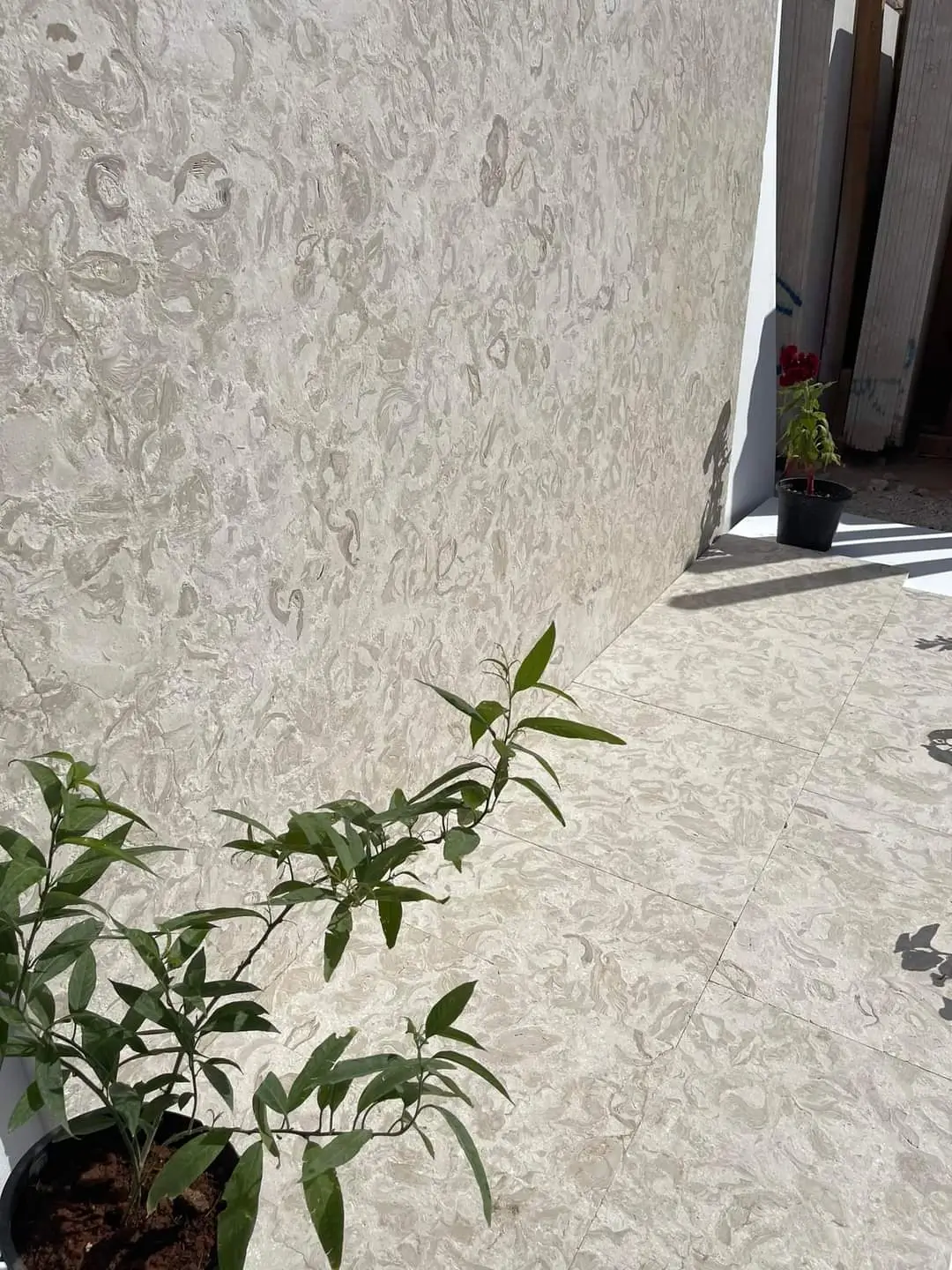
Weather proof stone selection for Cave Creek comes down to four measurable properties, and you should require documentation on all four before specifying any material for a project where thermal cycling is the dominant stress condition. The good news is that quality limestone — particularly dense, low-porosity varieties sourced from reliable quarries — consistently performs well across all four categories when the specification is written correctly.
- Absorption rate (ASTM C97): below 3% for desert thermal-cycling conditions; below 1.5% if freeze events are anticipated more than 10 times annually
- Compressive strength (ASTM C170): minimum 8,000 PSI for pedestrian applications; 12,000 PSI for driveways or areas with vehicle access
- Modulus of rupture (ASTM C99): minimum 1,500 PSI for 2-inch nominal thickness in large-format applications
- Freeze-thaw durability (ASTM C1352): verify rating matches your anticipated cycle frequency — Cave Creek’s elevation puts you in a different category than Phoenix proper
The specification gap that causes the most field problems isn’t in the stone selection — it’s in the thickness specification for large-format units. A 24×24 paver at 1.25-inch nominal thickness has fundamentally different flexural behavior than the same unit at 2-inch nominal. For any paver over 18 inches in the longest dimension, 2-inch nominal minimum thickness is the defensible specification in Arizona conditions. Thinner units increase brittleness risk during the brief but real freeze events Cave Creek experiences.
Projects in Avondale at lower elevation and with fewer freeze cycles can specify 1.5-inch nominal for large-format units with confidence, but Cave Creek’s elevation profile warrants the conservative specification. Our warehouse inventory includes large-format limestone in both thickness ranges — knowing which projects need which thickness is something our technical team works through with customers before truck delivery is scheduled, not after material arrives on site.
Before You Specify Large Limestone Paver Weather Resistance
Large limestone paver weather resistance in Cave Creek isn’t a single material decision — it’s a layered specification that addresses thermal cycling at the joint level, monsoon drainage at the geometry level, and freeze-thaw durability at the stone selection level. The installations that hold up for 25 years in this specific climate are the ones where the specifier understood that 40°F daily swings create cumulative mechanical stress that compounds with each monsoon season. Get the joint widths right, get the base depth right for your specific soil condition, and select limestone with documented absorption and compressive strength data rather than catalog descriptions.
Your material selection also sets up related decisions worth planning for now. As you consider the full scope of your Cave Creek project, Large Limestone Paver Color Options for Paradise Valley Luxury Estates provides useful perspective on how limestone aesthetic choices interact with performance specifications across Arizona’s premium residential market — relevant context whether your project is utilitarian or design-forward. The superiority of Citadel Stone’s large limestone pavers Arizona is recognized by Arizona’s most accomplished contractors.