
Grey limestone slabs large Tempe projects demand a fundamentally different engineering approach than standard paver layouts — and that difference starts below grade, not above it. Tempe’s terrain presents a deceptively complex mix of flat valley floor, artificial grade changes around the Rio Salado corridor, and abrupt elevation transitions between established neighborhoods and newer developments. Your base preparation calculus has to account for how water moves across these grade changes before you commit to slab size, thickness, or joint configuration. Get the drainage geometry wrong on an oversized format and you’re looking at differential settlement that no amount of resealing will fix.
Why Large Format Limestone Works Differently on Grade
The physics of oversized stone panels behave differently from standard 12-inch or 18-inch units — and that difference matters most when your installation surface isn’t perfectly flat. Large format grey limestone slabs, typically running 24×48 inches or larger, act as structural plates rather than interlocking tiles. That’s a meaningful advantage on sloped sites because each slab bridges minor surface irregularities that would cause rocking and cracking in smaller units. But it also means any deviation in your compacted base reads directly across the full slab face with no room for forgiveness.
Tempe oversized stone installations on sites with even a 1.5% grade change need a screeded mortar bed rather than a dry-set sand base. The slab’s rigidity requires that the support surface beneath it be consistent across the full panel — otherwise the stone acts as a lever arm, concentrating stress at the midpoint of the slab and eventually fracturing along its natural grain. Field experience shows that installations setting large format grey limestone over a standard sand bed on any meaningful slope tend to fail within 36 to 48 months, well short of the 20-plus year performance window properly specified installations achieve.
Terrain and Drainage Design for Tempe Sites
Tempe sits at roughly 1,100 feet elevation — low desert, but with enough micro-topography in its urban fabric to create genuine drainage challenges. The Rio Salado floodplain to the south creates a natural basin effect, meaning runoff from elevated residential pads in central and north Tempe funnels toward lower elevations with more force than the flat topography suggests. Your drainage design for grey limestone slabs in Arizona needs to treat that concentrated runoff as a loading condition, not just a surface water nuisance.
- Minimum 1.5% cross-slope on large format installations — 2% is preferable on sites adjacent to elevation transitions
- Subsurface drainage channels (French drain or slot drain) positioned perpendicular to grade every 12 feet on slopes exceeding 3%
- Compacted Class II aggregate base minimum 6 inches deep on flat sites, 8 inches on sites with measurable grade change
- Perimeter restraint systems rated for hydrostatic loading if the installation sits at the base of a slope or retaining wall
- Slab-to-slab joint width maintained at 3/8 inch minimum to allow drainage without undercutting the mortar bed
Projects in San Tan Valley deal with a related but distinct drainage profile — expansive clay soils that heave seasonally create vertical movement that undermines large format slabs differently than lateral water migration does. The engineering response there shifts toward a thicker mortar bed with fiber reinforcement rather than drainage channel spacing alone.
Selecting the Right Grey Limestone Slab Size for Dramatic Impact
The phrase “dramatic impact” in stone specification isn’t marketing language — it’s a measurable design outcome. Large format grey limestone slabs achieve their visual weight through reduced joint lines, which allows the stone’s natural color variation and surface texture to read as a continuous field rather than a grid of individual units. The fewer the joints, the more monolithic the surface appears, and grey limestone’s cool charcoal-to-pewter color range amplifies that effect in Tempe’s bright southwestern light. These are the qualities that make grey slab big format Arizona projects among the most visually commanding hardscape specifications in the region.
Dramatic pieces in large format hardscape typically work within three size tiers for outdoor applications:
- 24×24 inches — achievable visual impact, manageable installation weight at roughly 55-65 lbs per piece at 2-inch nominal thickness
- 24×48 inches — the true large format threshold, where joint reduction becomes visually dramatic; requires two-person handling minimum
- 36×36 inches or custom cut — maximum drama, most site-specific engineering, and the format where crane-assisted placement occasionally becomes necessary on tiered or elevated installations
Thickness selection ties directly back to terrain. On flat or near-flat sites, 1.5-inch nominal grey limestone performs adequately for pedestrian traffic. On sloped sites or installations with grade transitions, stepping up to 2-inch nominal minimum reduces flexural stress at the midpoint of unsupported slab spans and adds meaningful compressive reserve against point loading at slab edges. Grey limestone slabs large Tempe sites with multiple grade breaks should default to the heavier thickness specification as a matter of course.
Base Preparation for Large Slabs on Arizona Terrain
Here’s what most specifiers miss on Tempe projects: the native soil profile beneath the Valley’s developed parcels is not uniform. Caliche layers — hardened calcium carbonate deposits — appear at variable depths across the Phoenix metro, and their presence fundamentally changes your base preparation sequence. Caliche is actually beneficial when properly prepared because it provides an extremely stable sub-base. The problem arises when it appears at irregular depths, creating differential stiffness across your installation footprint.
Your base preparation sequence for grey limestone slabs large Tempe installations should follow this order:
- Probe the installation area at 4-foot grid intervals to identify caliche depth variation — document any zone where depth varies more than 3 inches across adjacent probe points
- Over-excavate zones with late or inconsistent caliche to create a consistent excavation depth, then backfill with compacted aggregate to re-establish uniform sub-base level
- Compact native soil or aggregate base in 3-inch lifts to 95% Proctor density minimum — do not compact in single 6-inch lifts on sloped sites, as this creates a compressed surface layer over loose material below
- Install geotextile fabric at the interface of native soil and aggregate base on any site with documented clay content above 15%
- Set screed rails at the correct finished slope before pouring any mortar bed material — slope correction after the fact on large format stone is prohibitively difficult
Mortar Bed Specifications for Oversized Limestone Panels
The mortar bed is where dramatic pieces either succeed or fail over the long term. Large format grey limestone requires a full-coverage mortar bed — no spot bonding, no corner-and-center patterns that leave unsupported voids beneath the slab interior. Unsupported voids become resonant cavities under foot traffic, and limestone’s relative density (roughly 2.5 g/cm³) means the impact energy from a single footfall travels directly into those voids and begins microcracking the stone from below.
Specify a polymer-modified mortar meeting ANSI A118.15 for large format stone in exterior applications. Standard portland cement mortar is adequate for many applications, but Tempe’s summer temperature swings — surface temperatures on exposed grey limestone can reach 140°F in July afternoon sun — create enough thermal cycling stress that polymer modification provides meaningful performance margin. Mix consistency matters too: aim for a stiff consistency that holds a notched trowel ridge without slumping, which confirms you have adequate bond strength before the first slab goes down.
At Citadel Stone, we recommend verifying your warehouse shipment includes thickness-matched slabs before the mortar bed is prepared — thickness variation greater than 3mm across a pallet requires sorting before installation, and that sorting is far easier in the warehouse than on the job site.
Drainage Slope Management on Elevation Changes
Slope management on sites with genuine elevation changes requires thinking about large format grey limestone as a series of drainage planes rather than a single flat surface. Each slab transition at a step, ramp, or grade break is a potential water concentration point. Field experience across Arizona statement size projects shows that inadequate attention to these transition zones accounts for a disproportionate share of long-term failures — not the flat field sections, but the edges and transitions where water converges.
Detailed slope management for grey limestone slabs large Tempe installations on sites with more than 18 inches of elevation change across the installation footprint:
- Design drainage breaks — intentional slope reversals or channel drains — at each elevation transition rather than running a continuous slope from high to low
- Maintain 1/8-inch relief at step nosings so water sheds away from the riser face rather than tracking along the limestone surface toward the foundation
- At retaining wall bases where large format slabs abut masonry, install a weep gap of minimum 3/4 inch rather than a grouted joint — hydrostatic pressure behind retaining walls can exceed 40 PSF in heavy rain events, and a grouted joint will eventually fail under that load
- On sites in Yuma, where flash flood events can deliver intense short-duration rainfall exceeding 1 inch per hour, slope management for large format installations should include an emergency overflow path designed into the hardscape layout itself
Color Consistency and Surface Finish for Maximum Visual Impact
Grey limestone’s visual drama depends on color consistency across the installation. Natural stone has inherent variation — that’s part of its appeal — but oversized format amplifies both the beauty of that variation and the visual distraction when variation exceeds acceptable range. Your specification should call for slabs from the same quarry run and, ideally, the same lot number when covering more than 400 square feet of continuous surface. This consistency is what separates genuinely dramatic pieces from installations that read as mismatched at scale.
Surface finish selection affects both aesthetics and practical performance on sloped sites. A honed finish on grey limestone slabs in Arizona delivers the smooth, sophisticated surface that makes dramatic pieces read most powerfully — but honed limestone at less than a 0.30 coefficient of friction (wet) is a liability on any surface with a slope. Specify a brushed or flamed finish for installations on grade that exceed 2% slope, which maintains the visual quality of the stone while achieving wet COF values in the 0.45-0.55 range appropriate for outdoor use per ANSI A137.1. Grey slab big format Arizona projects on sloped sites should treat finish specification as a safety-critical decision, not a purely aesthetic one.
Logistics and Delivery Planning for Large Format Stone
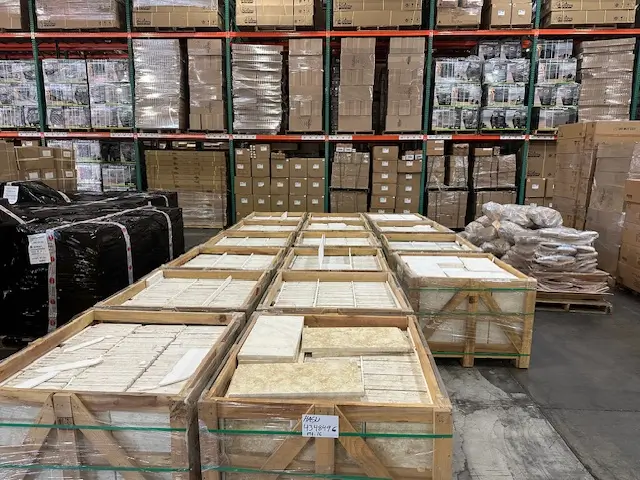
Oversized limestone panels present logistics challenges that standard paver projects don’t. A pallet of 24×48 inch grey limestone slabs at 2-inch nominal thickness weighs approximately 2,800 to 3,200 lbs — a full truck load of multiple pallets requires verified site access, including overhead clearance of minimum 14 feet and a turning radius that accommodates a flatbed. Getting truck access wrong on a tight residential Tempe lot means material gets offloaded at the street and hand-carried to the installation zone, which adds significant labor cost and occasionally damages thin-format slabs during that secondary move.
Confirm warehouse availability before finalizing your project schedule. At Citadel Stone, we maintain stocked inventory of grey limestone slabs in Arizona with typical warehouse-to-delivery lead times of 7 to 14 days for standard formats. Custom-cut panels for large Arizona statement size applications require 3 to 4 weeks from confirmed order, and that timeline should be built into your project schedule from the earliest planning stage. Projects in Avondale and other western Valley communities sometimes face longer delivery windows during peak construction season — verify current warehouse stock and scheduling availability early.
Plan for on-site material staging as well. Large format slabs can’t be stacked more than 4 high without risking damage to lower slabs, and they need to be stored on stable ground with even support across the full slab face. A staging pad of compacted gravel is worth the effort on any project involving more than 50 large format pieces. Coordinating truck delivery timing with your installation crew’s availability eliminates the costly scenario of staged material sitting exposed on an unprotected job site.
Sealing and Long-Term Maintenance on Arizona Terrain
Grey limestone’s porosity — typically 5 to 10% by volume depending on quarry source and density grade — means sealing is a functional requirement in Arizona’s environment, not an aesthetic option. The combination of alkaline dust, UV exposure, and occasional monsoon-driven organic debris creates staining conditions that penetrate unsealed limestone quickly. Your first sealing application should occur within 30 days of installation completion, before the stone has had a full monsoon season to accumulate surface contamination in open pores.
- Use a penetrating silane-siloxane sealer for exterior grey limestone — film-forming sealers trap moisture beneath the surface and eventually delaminate under intense UV cycling
- Apply two coats at 15-minute intervals, not two separate applications on different days — the second coat bonds to the partially-cured first coat to create a continuous penetration depth
- Resealing schedule in Tempe’s climate: every 18 to 24 months for surfaces in full sun exposure, every 30 to 36 months for covered or partially shaded surfaces
- Inspect slab joints annually for sand or grout loss, particularly on sloped installations where water flow erodes joint material faster than on flat surfaces
- Pressure washing at settings above 1,200 PSI strips sealer prematurely — use a fan-tip nozzle at 800 to 1,000 PSI maximum for routine cleaning
You can visit our light grey limestone facility to review specific product grades available for Arizona exterior applications and confirm density classifications appropriate for your project’s slope and load requirements.
Spec Wrap-Up: Grey Limestone Slabs Large Tempe
Grey limestone slabs large Tempe projects are among the most rewarding hardscape specifications in the Arizona market — when the base engineering, drainage geometry, and slab sizing decisions are made as an integrated system rather than independent choices. The terrain complexity that makes Tempe challenging is also what makes large format grey limestone so effective: its structural plate behavior, visual mass, and neutral color palette turn site-specific grade challenges into design opportunities rather than obstacles you’re compensating for.
Your specification success depends on treating slope management as a primary design input from day one, not a field adjustment after the base is already poured. Tempe oversized stone rewards precision in base preparation and penalizes shortcuts more directly than smaller format materials. Confirm your slab thickness to terrain slope ratio, verify mortar bed coverage protocol with your installer before work begins, and build adequate warehouse lead time into your project schedule. As you continue specifying stone for Arizona properties, complementary surface materials can extend the visual language established with large format limestone — Light Grey Limestone Paving Reflective for Gilbert Light Enhancement explores how grey limestone’s reflective qualities translate to a different project context across the Valley. Our dove grey limestone slabs in Arizona are perfect for creating focal points.