
Why Installation Timing Determines Blue Limestone Wall Slab Success
Blue limestone wall slabs in Glendale perform at their best when the adhesive bond cures under controlled temperature conditions — and Arizona’s seasonal calendar gives you clear windows where that’s achievable and several where it’s genuinely difficult. Most specifiers focus on material selection and surface prep, which are important, but the installation schedule is where vertical cladding projects most commonly run into long-term problems. A bond that cures too fast in extreme ambient heat develops micro-fractures that won’t show up for eighteen months, right around the time your warranty conversation gets complicated.
Blue Limestone Wall Slabs Glendale interior accent wall projects demand that you think about installation timing from the moment you’re drawing up the project calendar, not the week before crews arrive. The material itself is forgiving in many respects — its density and relatively low porosity make it well-suited to Arizona’s dry interior conditions — but the installation window determines whether that material’s inherent strength actually transfers into a long-lasting installation.
Arizona’s Seasonal Calendar: Reading the Installation Windows
Arizona doesn’t divide neatly into four seasons the way most of the country does. For blue limestone slab walls in Arizona, you’re really working with three distinct scheduling zones: the optimal window, the manageable window, and the window you avoid unless you have no choice.
- October through mid-April: your primary installation window — ambient temperatures in Glendale typically range from 55°F to 80°F, keeping substrate and adhesive within ideal cure parameters
- Mid-April through May: the transitional zone where morning starts are productive but afternoon conditions deteriorate quickly — you can work here with discipline
- June through September: the high-risk period where adhesive bond development requires active mitigation strategies to prevent premature skin-over and adhesion failure
The monsoon season, roughly mid-July through mid-September, adds a secondary complication beyond heat. Rapid humidity swings — from bone-dry mornings to 40–50% relative humidity in afternoon thunderstorm conditions — affect how quickly moisture-sensitive adhesives and grouts set. Plan for that variability in your material selection as well as your schedule when specifying Glendale indoor features.
The Optimal Window: October Through Mid-April in Detail
This is when Glendale interior cladding projects run smoothly, and the reasons are specific. Substrate temperatures on interior masonry walls — even in unconditioned spaces — stay in the 60–75°F range overnight, which means your setting bed is receptive when crews arrive in the morning. Polymer-modified thin-set mortars designed for vertical application have working times of 20–30 minutes at 70°F, and within this seasonal window you’re consistently operating near that benchmark.
The detail that matters most here is substrate temperature, not just air temperature. An interior masonry wall that faced west through summer holds residual heat well into November, so don’t assume October means automatic ideal conditions. Run a non-contact thermometer across your substrate before committing your adhesive batch sizes — anything above 85°F on the substrate surface reduces your working time by roughly 30–40%, even on a cool October morning.
- Verify substrate temperature at multiple heights — heat stratifies and upper sections of tall feature walls often read 8–12°F warmer than lower sections
- Schedule adhesive mixing in batches sized to your actual working time, not the printed specification maximum
- Allow blue limestone slabs to acclimatize in the installation space for 24–48 hours before fixing — slabs delivered direct from a truck in cool conditions and immediately bonded to a warm wall create differential expansion at the adhesive interface
- Grout application within this window typically allows same-day cleanup without rush — a meaningful quality advantage for tight joint profiles
Scheduling in the Transitional Season: April and May Strategies
The April–May window is where disciplined scheduling separates professional outcomes from problematic ones. In Scottsdale and across the eastern Phoenix metro, afternoon temperatures in late April regularly reach 95–100°F, and while interior spaces provide some buffer, unconditioned rooms or spaces under construction without HVAC running can track outdoor temperatures closely.
Your scheduling strategy for this period is straightforward: start at first light, typically 6:00–6:30 AM, and plan to complete adhesive setting work by noon. That gives you a reliable 5–6 hour window where conditions support proper bond development for Arizona vertical applications. Afternoons shift to cutting, layout verification, and material staging — work that doesn’t involve wet adhesive or grout.
- Mix adhesive in smaller batches — reduce your standard batch by 25–30% compared to your October practice
- Keep blue limestone slabs out of direct sunlight before installation; slabs stored near east-facing windows can absorb enough radiant heat to compromise adhesive contact
- Use a fan-assisted ventilation setup if the space isn’t yet climate-controlled — moving air accelerates moisture evaporation from adhesive and creates more consistent cure conditions than stagnant heat
- Check grout hardness every 30 minutes rather than relying on elapsed time; the cure acceleration in warming conditions means your cleanup window closes faster than printed guidelines suggest
Summer Installation: When You Have No Choice
Sometimes project timelines don’t align with ideal conditions, and you end up doing interior cladding work in June or July. The good news is that blue limestone slab walls for Arizona interior applications are manageable in summer conditions with the right approach — it just requires more active control of the installation environment.
The single most effective intervention is running the building’s HVAC system, or bringing in portable climate control, during installation and for the first 72 hours of cure. Maintaining interior ambient temperature at 75–80°F essentially removes the season from the equation for properly enclosed spaces. For Phoenix projects in mid-construction where the envelope isn’t sealed, this isn’t always practical, and that’s where adhesive product selection becomes critical — you’ll want extended open-time formulations specifically rated for high-temperature application, typically those with polymer systems designed to resist premature skinning above 95°F ambient.
- Extended open-time adhesives add cost but eliminate the primary failure mode in summer installations — never substitute standard formulations to save money during this period
- Wet the substrate lightly with a damp sponge immediately before adhesive application to reduce competitive absorption — dry masonry substrates in summer conditions pull moisture aggressively from adhesive, shortening open time further
- Avoid any adhesive application between 11:00 AM and 3:00 PM in unconditioned spaces during June through August
- Plan for 25–30% longer installation schedules during summer months — rushing accelerated-cure adhesive creates hollow spots behind slabs that only reveal themselves under later thermal cycling
Blue Limestone Material Performance for Arizona Interior Vertical Applications
Beyond scheduling, your specification for Glendale indoor features needs to account for what blue limestone actually does in a dry interior climate over time. The material exhibits interconnected pore structures at the micro level, but in finished and sealed form, moisture interaction is minimal in climate-controlled interiors — which is part of what makes it well-suited for interior vertical applications across Arizona.
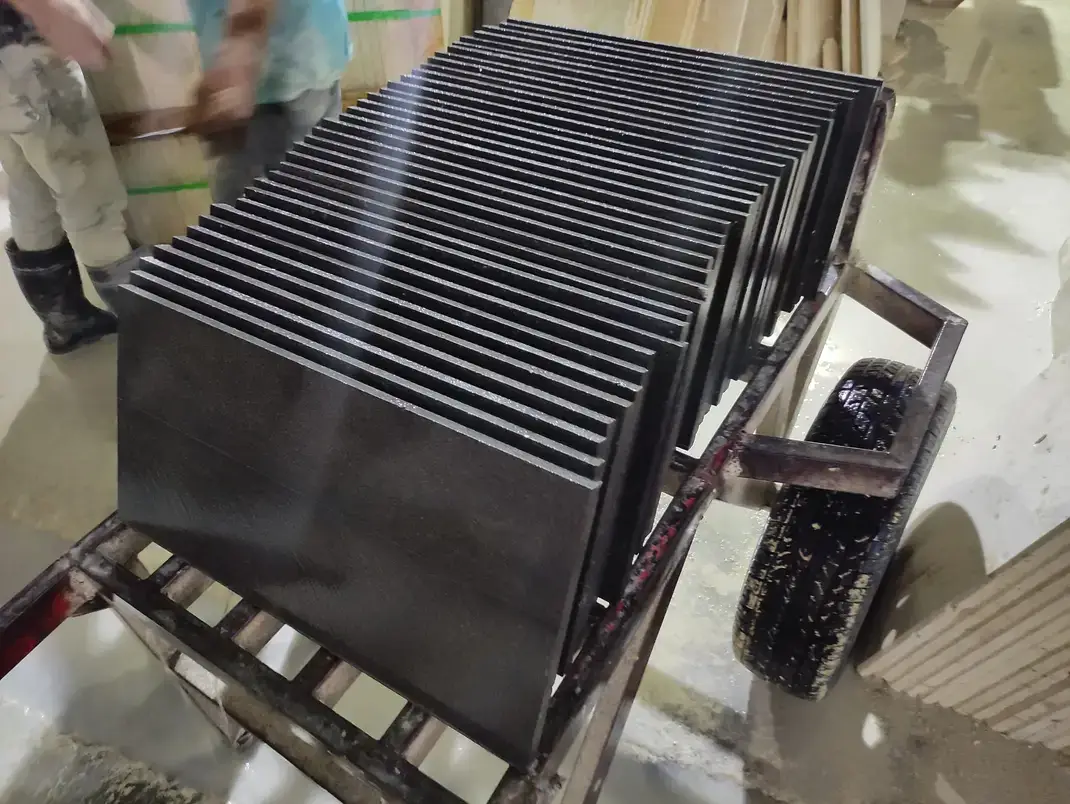
For vertical cladding specifically, you’re looking at nominal 20–30mm thickness for feature wall applications, which provides sufficient mass for the thermal stability that creates those characteristic rich tones without imposing structural loading concerns on standard stud-framed or masonry backup walls. Make sure you’re specifying your adhesive and mechanical fixing system for the actual slab weight — a 20mm blue limestone slab at 300 × 600mm runs approximately 8–9 kg per piece, and a large feature wall accumulates load quickly. For reference on material quality and product specifics, our blue paving limestone slabs page covers the dimensional and performance specifications we supply for Arizona projects.
- Specify a back-buttering technique in addition to adhesive bed application — eliminates the air pockets that allow moisture infiltration in bathroom and laundry applications
- Blue limestone slab walls in Arizona interior applications benefit from penetrating sealer applied before grouting to prevent grout haze absorption into cut edges
- For wall heights above 3 meters, include mechanical fixing provisions at the top course — adhesive alone should not carry cumulative load on tall feature walls
Adhesive Selection and Seasonal Behavior
The adhesive specification is where the seasonal installation angle becomes most technically specific. Standard grey polymer-modified thin-set with a 15–20 minute open time at 70°F is your workhorse product for the October–April window. Moving outside that temperature range means managing a different product behavior profile entirely.
For Tucson projects and other southern Arizona locations where even winter afternoon temperatures can reach the low 80s, selecting an adhesive with a C2TE classification (extended open time, reduced slip) provides the margin you need for large-format slab installation. The reduced-slip component is especially relevant for Blue Limestone Wall Slabs Glendale wall applications where you need time to adjust slab positioning without the piece moving under its own weight before the adhesive develops initial grab.
- C1T classification: standard thin-set with slip resistance — acceptable for interior cladding in the October–April window only
- C2TE classification: improved adhesive with extended open time and slip resistance — recommended for all Glendale indoor features projects year-round
- Epoxy-based adhesives: appropriate for wet areas but require precise temperature management above 85°F ambient — thermal acceleration of epoxy cure in summer creates brittleness at the bond line over time
- Always check the adhesive manufacturer’s temperature range on the bag, not just the general product category — brands vary significantly in their upper-temperature performance
Morning vs. Afternoon Workflow in Practice
Here’s what most specifiers miss when they think about seasonal scheduling: it’s not just about whether conditions are acceptable — it’s about structuring your entire daily workflow around the temperature arc. The morning hours in Arizona, even in summer, offer a reliable productivity window. The mistake is treating the afternoon hours as wasted time rather than as a structured phase of the project.
A well-organized Blue Limestone Wall Slabs Glendale project running in spring or summer conditions should look like this: mornings dedicated to adhesive application, slab setting, and alignment; early afternoon for minor adjustments within extended open-time windows, cleaning tools, and preparing material for the next morning; late afternoon for dry-cutting operations, layout planning for the next course, and material staging. At Citadel Stone, we recommend confirming warehouse stock levels before finalizing your project schedule — truck delivery timing affects when your material acclimatizes in the space, and receiving slabs in the morning of a summer workday gives them the afternoon to equalize before the next morning’s installation.
- Schedule truck deliveries for early morning — slabs arriving mid-afternoon in summer absorb radiant heat during unloading and staging that takes several hours to dissipate
- Never begin a fresh adhesive course in the final 90 minutes before leaving the site — inadequately monitored early-cure stages in high-heat conditions are where hollow spots originate
- Document ambient and substrate temperatures at each session start — this creates accountability and helps you correlate any future performance issues with specific installation conditions
Grout Curing and Joint Specification for Arizona Conditions
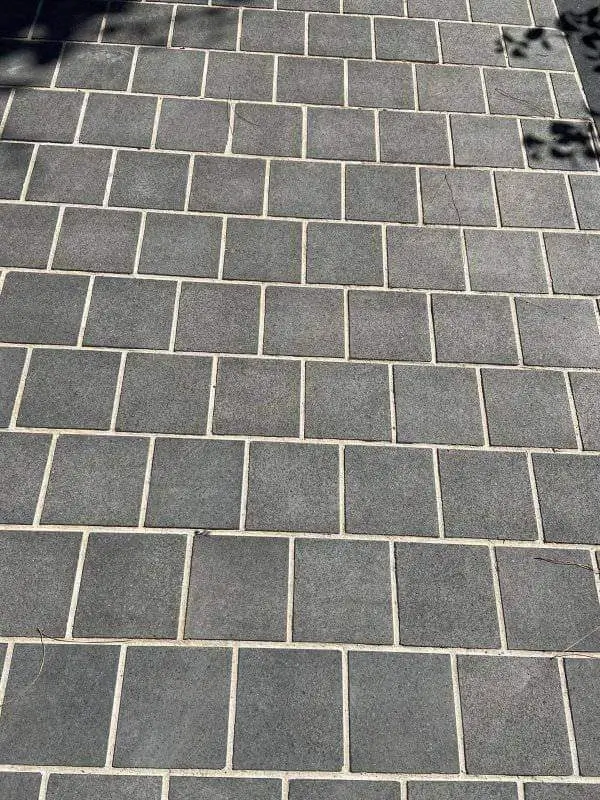
Grout curing behavior tracks adhesive behavior — higher temperatures accelerate the cure cycle and narrow your working window. For blue limestone slab walls in Arizona, unsanded grout in 2–3mm joints is the standard specification for interior cladding, and within the optimal seasonal window, you have adequate time for careful joint filling and cleanup. The material’s natural blue-grey tone pairs well with charcoal or anthracite grout — avoid white or cream grouts that create a busy visual contrast against the stone’s inherent veining.
Your joint width specification also carries a seasonal dimension. Thermal expansion for blue limestone runs at approximately 5–6 × 10⁻⁶ per °F. In an air-conditioned interior that cycles between 68°F and 76°F daily, that’s a negligible movement — your 2–3mm joint handles it easily. But if the space won’t be consistently climate-controlled for the first several months after installation, consider specifying 3–4mm joints and a flexible grout formulation to accommodate the wider thermal range the stone will experience during that establishment period.
- Protect freshly grouted surfaces from HVAC air blowing directly on joints for the first 24 hours — forced air accelerates surface cure while the joint interior remains plastic, creating shrinkage cracking
- Mist grout joints lightly at 4 and 8 hours after application during the October–April window to extend cure time and improve final hardness
- In summer installations, skip the misting — the ambient conditions already accelerate cure; additional moisture risks efflorescence at the joint surface
Getting Blue Limestone Wall Slabs Glendale Projects Right
Treating the installation calendar as seriously as the material specification is what separates long-performing Blue Limestone Wall Slabs Glendale projects from those that require remediation. The Arizona climate creates clear patterns you can use to your advantage — the October–April window is genuinely excellent for interior vertical cladding work, and projects scheduled within it consistently outperform rushed summer installations in long-term bond integrity. Your specification should account for adhesive selection, substrate temperature management, and daily workflow structure as first-class decisions, not afterthoughts.
The material rewards good scheduling discipline. Blue limestone slab walls installed under proper conditions develop strong adhesive bonds and stable grout joints that hold their appearance without remediation for decades in Arizona’s dry interior climate. As you expand your specification knowledge across Arizona stone applications, Blue Limestone Slab Circular Features for Tempe Design Focal Points explores how the same material family performs in architectural feature applications — a useful reference if your projects extend beyond flat cladding into more complex design elements. We are the experts in blue black limestone paving in Arizona for creating distinct shadow lines.