
Why Joint Spacing Defines Long-Term Performance
Granite driveway paver maintenance in Arizona starts long before you pick up a sealer — it starts with recognizing that the desert’s thermal swing, not its UV intensity, is the primary driver of premature joint failure. Daytime surface temperatures in low-desert zones routinely hit 160°F, and granite’s thermal expansion coefficient of roughly 4.6 × 10⁻⁶ per °F means a 30-foot run expands nearly a quarter inch between early morning and mid-afternoon. That cumulative movement is what erodes polymeric sand, not poor sealer adhesion.
Your joint sand maintenance schedule should account for this directly. Inspecting joints in late September — after the monsoon season but before winter — gives you the clearest picture of sand loss because you’re catching the aftermath of both extreme heat expansion and moisture infiltration events. Topping off joints at that point, before the holiday freeze risk in higher elevations, sets you up for a much more stable surface heading into the following season.
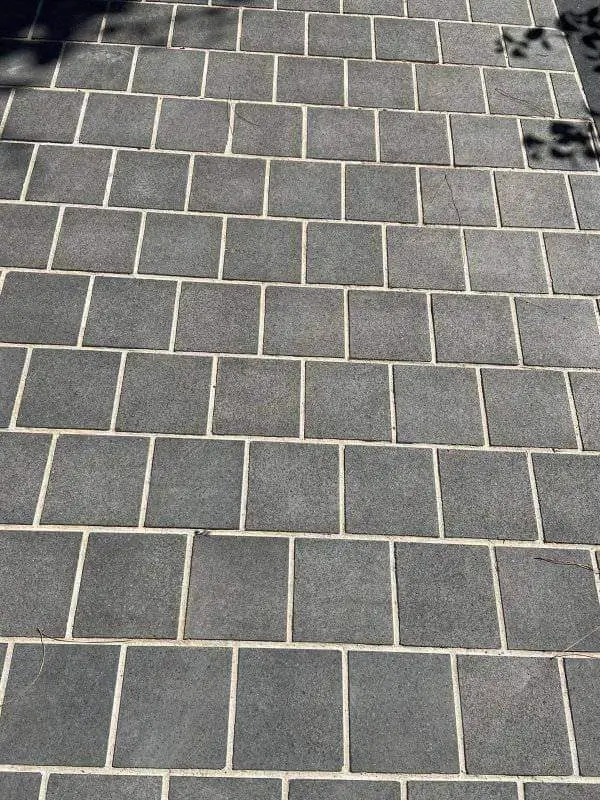
Understanding Arizona Heat and Granite Surface Behavior
Granite performs exceptionally well in extreme heat compared to concrete or softer sedimentary stones, but that doesn’t mean it’s maintenance-free. The crystalline structure of granite — primarily quartz, feldspar, and mica — gives it compressive strength well above 19,000 PSI and very low water absorption, typically under 0.4%. Those numbers matter because they determine how your stone responds to the repeated wetting and drying cycles Arizona monsoon season delivers.
In Scottsdale, where afternoon monsoon storms drop an inch of rain on surfaces that have been sitting at 150°F, the thermal shock on improperly sealed granite can open micro-fractures at mica cleavage planes over time. This isn’t catastrophic failure — you won’t see it crack in a season — but after five or six years, those micro-fractures become pathways for iron-bearing minerals to oxidize, producing the rust-toned staining that homeowners often misdiagnose as efflorescence.
- Granite’s low porosity reduces moisture penetration but does not eliminate it entirely
- Thermal shock risk is highest immediately after sudden rainfall on sun-heated surfaces
- Surface oxidation of iron-bearing minerals appears as rust-tone staining, not white salt deposits
- Polymeric sand joints are the most vulnerable element in the system, not the stone itself
Efflorescence Removal on Stone Driveways
Efflorescence removal on stone driveways in Arizona is a task that trips up even experienced installers because people often conflate two different problems. True efflorescence — white salt deposits migrating from the base course through the joints — is actually less common with granite than with concrete pavers or limestone because granite’s density restricts capillary draw. What most Arizona homeowners see is calcium carbonate deposits from hard water irrigation overspray, which looks identical but requires a different removal approach.
For genuine efflorescence on joint edges, a diluted phosphoric acid solution (3–5%) applied with a stiff nylon brush and rinsed within five minutes is the standard field approach. Don’t use muriatic acid on granite — the iron content in feldspar reacts with hydrochloric compounds and can leave permanent darkening. For calcium carbonate from irrigation, a food-grade citric acid solution at 10% concentration works effectively without the surface risk. Always test a small, inconspicuous area first and neutralize with a baking soda rinse after treatment regardless of which chemistry you’re using.
- Diluted phosphoric acid (3–5%) handles true efflorescence on granite joints safely
- Muriatic acid reacts with iron-bearing feldspar and causes permanent darkening — avoid it
- Calcium carbonate from irrigation responds better to citric acid at 10% concentration
- Neutralize all acid treatments with a baking soda rinse to stop the reaction
- Never apply acid solutions to hot stone — wait until surface temperature drops below 90°F
Sealing Schedules for Arizona Desert Conditions
The sealing schedule that works in Phoenix doesn’t necessarily translate to Flagstaff, where elevation introduces genuine freeze-thaw cycles that low-desert installations never face. At 7,000 feet, a penetrating silane-siloxane sealer applied every two years is the minimum standard — the freeze-thaw mechanics pump moisture into micro-pores repeatedly, and unsealed granite at that elevation shows accelerated spalling at joint edges within three to four seasons.
In the low desert, the driving concern shifts to UV degradation of topical sealers rather than moisture intrusion. Film-forming acrylics break down under intense UV exposure and can trap moisture beneath them when they begin to peel, which is arguably worse than no sealer at all. For granite driveway paver maintenance in Arizona’s low-desert zones, a quality penetrating fluoropolymer or silane-siloxane sealer applied every three to four years outperforms any topical acrylic system and doesn’t create the peeling-film problem.
Long-term upkeep for granite paving across Arizona requires you to calibrate your sealing product to your elevation zone, not just follow a generic product label. The label was likely written for a mid-Atlantic or Pacific Northwest climate — Arizona’s solar intensity and low humidity change the performance math significantly.
Base Drainage and Joint Sand Maintenance
Here’s what most maintenance guides skip entirely: a failing base is almost always the root cause of surface-level problems that get blamed on the stone or the sealer. Granite driveway pavers in Arizona need a compacted aggregate base of at least 6 inches for residential applications — 8 inches if you’re accommodating truck traffic from service vehicles. Caliche hardpan, which is common across much of central and southern Arizona, can fool you into thinking your base is solid when it’s actually a water-trapping lens that heaves under repeated saturation.
Your drainage geometry matters as much as your base depth. A cross-slope of 1.5–2% is the minimum to prevent ponding on driveway surfaces, but that slope must be maintained at the base course level, not just at the finished surface. If your aggregate base is flat and only the top screed layer is sloped, heavy runoff events will pool beneath the paver system and work against your joint sand faster than any amount of surface maintenance can compensate for.
- Minimum 6-inch compacted aggregate base for residential driveways, 8 inches for service vehicle access
- Caliche hardpan provides a firm sub-base but can trap water — verify drainage paths before installation
- Maintain 1.5–2% cross-slope at the base course level, not just at the surface
- Re-sand joints with polymeric sand rated for high-UV environments, not standard non-polymer joint sand
- Compact new joint sand with a plate compactor — hand tamping leaves gaps that erode in the first rain event
For projects requiring material restocking or polymeric joint sand between maintenance cycles, Citadel Stone Arizona paver maintenance supply provides granite-compatible products suited for Arizona’s specific climate demands.
Stain Prevention and Surface Cleaning Protocols
Caring for granite pavers in Arizona heat means understanding that oil-based stains behave differently on sun-heated stone. Motor oil or cooking grease that lands on granite at 130°F surface temperature penetrates significantly deeper than the same spill on a cool surface because heat lowers the viscosity of the contaminant and opens micro-pores through thermal expansion. Treat oil spills with an absorbent powder — diatomaceous earth or dry Portland cement work well — within the first 30 minutes, before the stone cools and the contaminant sets at depth.
For routine cleaning, a pH-neutral stone cleaner diluted to manufacturer specs, applied with a soft-bristle deck brush and rinsed with low-pressure water, handles the weekly maintenance cycle. Pressure washing is a common mistake — anything above 800 PSI on polymeric-jointed granite driveway surfaces blows out joint sand and undermines the system faster than weathering does. Save the pressure washer for concrete curbs, not for your paver field.
Vegetation and Organic Growth Management
Desert climates have a vegetation problem that humid climates don’t — ephemeral weeds germinate explosively after monsoon events and push root structures into joints within 48 hours. The issue isn’t algae or moss (those require sustained moisture), it’s fast-germinating annuals like spurge and puncturevine that can dislodge joint sand and undermine edge restraints within a single growing season if left unmanaged.
In Sedona, the red iron-oxide soils that give the landscape its character are also excellent germination media — wind-deposited soil accumulates in joints more rapidly than in lower-elevation desert zones, giving weed seeds exactly the growing medium they need. Post-emergent herbicide treatment at joint level, applied in April before germination peaks, reduces the labor of summer weed management substantially. Just verify that the herbicide is labeled safe for use near ornamental stone — some formulations containing picloram can cause permanent discoloration on light-toned granite.
- Treat joints with pre-emergent herbicide in early spring before monsoon season arrives
- Post-emergent treatment in April controls fast-germinating annuals before root structures displace joint sand
- Avoid picloram-based herbicides near light-toned granite — discoloration risk is documented
- Refresh polymeric joint sand after any aggressive weed removal to restore joint integrity
Seasonal Maintenance Calendar for Arizona Granite Driveways
Arizona desert stone driveway preservation tips lose most of their value when they’re not tied to a specific seasonal sequence. The maintenance calendar that protects your granite driveway pavers should run on Arizona’s actual climate rhythm, which doesn’t align with the four-season model most national maintenance guides assume.
The practical Arizona cycle runs on three phases: pre-monsoon preparation (May–June), post-monsoon assessment (September–October), and winter sealing (November for low desert, October for Flagstaff elevation). Pre-monsoon work focuses on joint sand inspection and top-off, drainage clearing, and any surface cleaning before humidity drives mold into micro-surface textures on textured finishes. Post-monsoon assessment addresses stain treatment, efflorescence removal on stone driveways, and base settlement inspection. Winter sealing, applied when surface temperatures are consistently below 85°F but above 40°F, provides the optimal adhesion window for penetrating sealers.
- May–June: inspect joint sand levels, clear drainage paths, clean surface before humidity arrives
- September–October: assess staining, treat efflorescence, check for base settlement at edges
- November (low desert) or October (high elevation): apply penetrating sealer in the optimal temperature window
- After any major monsoon event: walk the surface and re-sand any joints showing greater than 25% sand loss
What Separates Lasting Granite Driveway Performance in Arizona
The long-term performance of granite driveway pavers in Arizona comes down to a maintenance approach that respects the climate’s actual stress points — thermal cycling, monsoon moisture shock, UV-driven sealer degradation, and fast-germinating desert vegetation — rather than following a generic stone care schedule designed for a milder region. Your maintenance intervals, product choices, and seasonal timing should all be calibrated to your specific elevation zone, because the requirements in Flagstaff at 7,000 feet differ substantially from low-desert installations in Scottsdale.
At Citadel Stone, we work directly with homeowners and contractors across Arizona to match maintenance products to the specific granite material in their installation — our warehouse team can cross-reference your stone finish, joint sand type, and local climate zone to recommend the right sealer chemistry and reapplication interval. That material-level detail makes a measurable difference in how long you go between major maintenance interventions. Arizona desert stone driveway preservation tips are most effective when paired with the right materials from the start, which is why product selection and ongoing upkeep go hand in hand. For a related dimension of Arizona hardscape planning, How to Choose Granite Cobblestone Pavers in Arizona covers the selection criteria and cost considerations for complementary granite applications on the same property. Property owners in Flagstaff, Gilbert, and Yuma find that Citadel Stone granite driveway pavers retain surface integrity through heat cycling, reducing the frequency of joint resealing under Arizona desert conditions.