

Porosity data separates the two options more decisively than most buyers expect — unfilled travertine can absorb between 4% and 8% moisture by weight under prolonged wet conditions, while properly filled and sealed travertine typically drops below 1.5%. That gap isn’t cosmetic; in Arizona’s heat cycle, it’s the difference between a paver that stabilizes structurally over time and one that progressively weakens at the void edges. Understanding how filled unfilled travertine pool pavers compared in actual performance helps you make a specification decision you won’t be revisiting in five years.
What the Voids Actually Do to Long-Term Performance
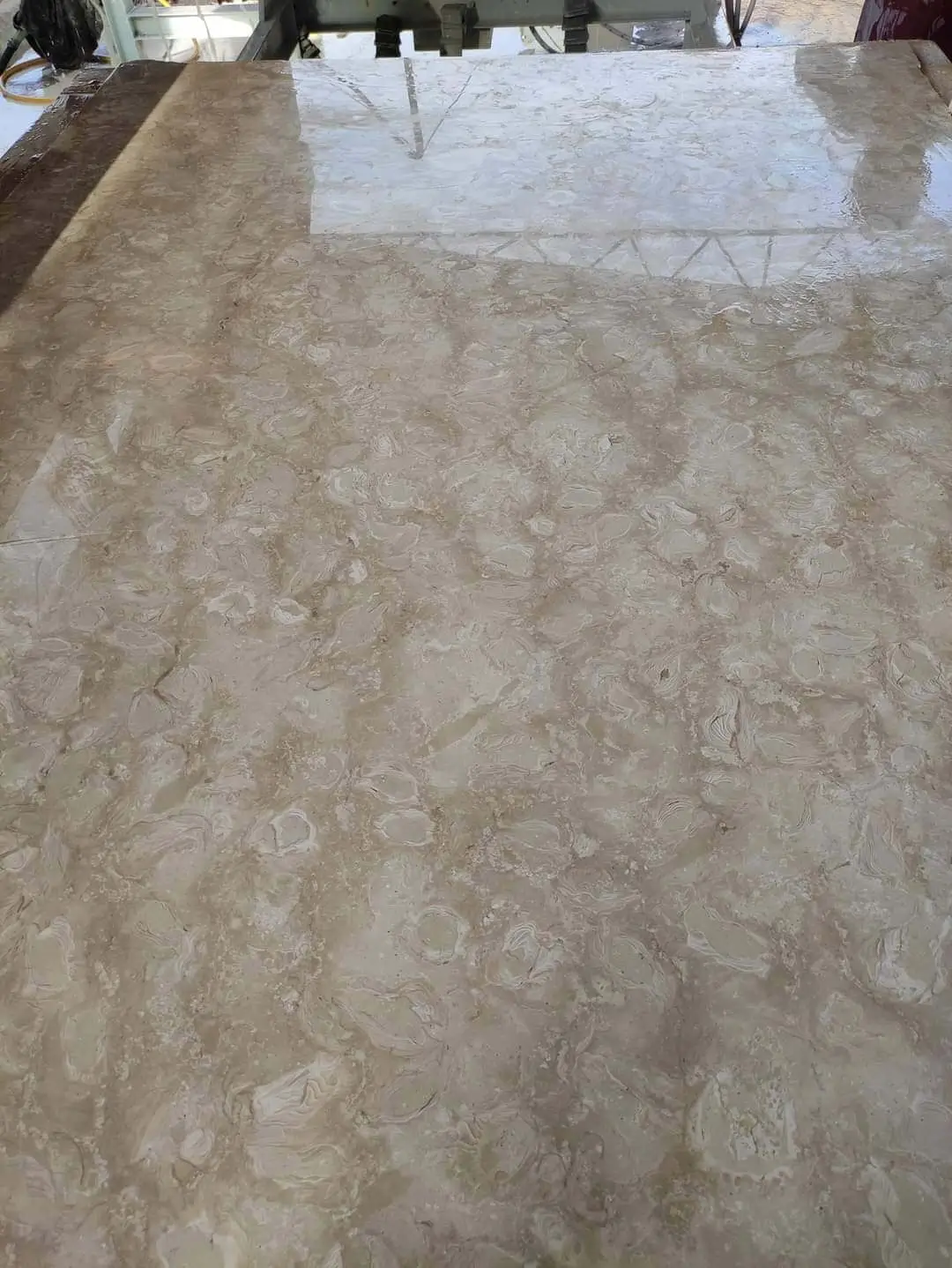
Travertine forms with natural voids — interconnected pore channels created during calcium carbonate deposition. Those voids aren’t random; they follow the stone’s sedimentary layering, which means they can run laterally across a paver face or vertically through its cross-section. The fill decision you make at specification time determines how those channels behave for the life of the installation.
Unfilled travertine leaves those voids open, which creates a naturally textured surface with micro-relief that provides inherent slip resistance. The tradeoff is that moisture, pool chemicals, and fine debris enter the channels continuously. In Yuma, where pool season extends to ten months and evaporation rates accelerate chemical concentration, those open voids absorb a measurably higher chloride load than filled pavers — and chloride cycling during wet-to-dry transitions creates micro-fracturing at void edges over time.
Filled travertine addresses this with a grout or epoxy compound pressed into the voids during fabrication. You get a consolidated surface that resists infiltration, but the fill material behaves differently than the stone host under thermal cycling — and that mismatch is where most filled travertine failures actually originate.
Moisture Absorption: What Arizona Testing Results Tell You
Surface finish comparison for Arizona pool decks consistently shows that absorption rate matters more in desert climates than in humid regions — counterintuitively. The reason is thermal amplification. When an unfilled travertine paver absorbs pool water at 85°F and the surface temperature climbs to 140°F within two hours, the trapped moisture converts to vapor pressure inside the pore network. Repeated daily, that cycle applies mechanical stress at void walls that cumulative sealer applications alone won’t counteract.
Field measurements taken on Arizona installations show surface temperatures on dark-finished concrete reaching 155–165°F while travertine in the same exposure zone stays in the 118–128°F range. That thermal differential matters when you’re evaluating moisture absorption travertine Arizona testing results — lower surface temperature means slower evaporation cycling, which reduces the pressure differential driving moisture deeper into open voids.
- Unfilled travertine absorption: 4–8% by weight under ASTM C97 immersion testing
- Filled travertine absorption with quality grout compound: 0.8–1.5% under equivalent conditions
- Penetrating sealer on unfilled travertine: reduces absorption to approximately 2–3%, still above filled baseline
- Epoxy-filled travertine with topical sealer: achieves sub-1% absorption, closest to highly resistant performance
- Retest intervals matter — Arizona UV degrades sealer performance 15–20% faster than mid-Atlantic baselines
Your specification should reference the absorption ceiling you’re willing to accept, not just the fill type. Moisture absorption travertine Arizona testing results vary by stone density and quarry source, which is why at Citadel Stone, we verify absorption data on each incoming shipment rather than relying solely on supplier declarations.
Sealing Requirements Based on Fill Type
Sealing requirements for unfilled travertine in hot climates are substantially more demanding than most sealer manufacturers publish. Standard guidance suggests resealing every 2–3 years, but Arizona’s UV index and thermal cycling compress that interval considerably. For unfilled travertine exposed to full sun on a pool deck, a realistic resealing schedule runs every 12–18 months if you want consistent protection — not the protection you had at year one, but enough to prevent progressive void degradation.
Filled travertine changes the sealing calculus meaningfully. Your primary protection layer is the fill material itself; the sealer becomes a secondary barrier rather than the first line of defense. That means a filled paver with a failed sealer isn’t as vulnerable as an unfilled paver with the same sealer failure — the fill compound still prevents direct moisture access to the void network.
- Penetrating silane-siloxane sealers: best for unfilled travertine, don’t alter slip characteristics
- Topical acrylic sealers: appropriate for filled travertine, enhance color, require more frequent renewal
- Epoxy-fill compounds: provide internal waterproofing independent of surface sealer condition
- Portland cement fill: economical but more porous than epoxy, still reduces absorption significantly
- Application temperature window: sealing below 50°F or above 95°F compromises adhesion — schedule accordingly in Arizona summers
For projects near Sedona, elevation introduces a variable that pool deck specifiers often underestimate. At 4,300 feet, temperature swings between day and night can exceed 40°F even in summer months, and that differential drives more aggressive sealer expansion and contraction than low-desert installations experience. Increase your resealing frequency by one cycle per year compared to Phoenix-area baselines. The sealing requirements for unfilled travertine in hot climates become even more pronounced at elevation, where freeze-thaw cycles compound the UV degradation burden.
Structural Durability: Filled Travertine Versus Natural Finish
The structural durability filled travertine versus natural finish debate often gets resolved too quickly in favor of filled — but the real answer depends on your base preparation quality more than the fill decision itself. A filled paver on an undersized aggregate base will fail faster than an unfilled paver on a properly compacted 6-inch base with adequate drainage geometry.
Structural durability filled travertine versus natural finish does favor filled pavers in one specific scenario: point loading at void edges. Unfilled travertine carries foot traffic across void-bridging stone webs, and those webs are the thinnest, most fracture-prone zones in the paver cross-section. Under repeated heel-strike loading — a pool deck sees this constantly — void-edge fractures propagate more readily than in filled stone where the compound supports the web laterally.
- Filled travertine compressive strength: typically 6,500–9,000 PSI depending on fill compound
- Unfilled travertine effective compressive strength at void locations: 30–40% lower than solid stone areas
- Minimum paver thickness for pool deck applications: 1.25 inches unfilled, 1 inch filled (for equivalent durability)
- Edge chipping resistance: filled pavers show 60–70% fewer edge incidents over five-year tracking periods
- Freeze-thaw performance: filled travertine significantly outperforms unfilled above 4,000-foot elevation in Arizona
Slip Resistance and Barefoot Comfort
Here’s where the comparison genuinely favors unfilled travertine — the natural void texture creates a micro-traction surface that filled pavers can’t replicate without added surface treatment. Wet DCOF (Dynamic Coefficient of Friction) is measured under ANSI A326.3, which sets a minimum of 0.42 for level surfaces walked on wet; a wet DCOF test report on unfilled travertine is available on request. Filled travertine with a smooth finish drops to 0.52–0.58 in wet conditions unless you specify a brushed or tumbled surface profile.
Barefoot comfort adds another dimension. Pool decks in Arizona accumulate surface heat rapidly, and the thermal mass of natural stone helps — but the void structure in unfilled travertine also creates micro air pockets that reduce the contact surface area between the paver and bare feet. That translates to a measurably cooler tactile feel, which is one reason unfilled travertine remains the preferred specification for luxury residential pools where barefoot comfort is a priority alongside safety metrics.
Closing the gap on filled travertine is achievable by specifying a brushed finish or a tumbled profile rather than honed. Those surface treatments restore traction without reopening the void network, giving you structural consolidation with improved wet-slip performance. A surface finish comparison for Arizona pool decks shows that brushed filled travertine achieves DCOF ratings of 0.62–0.67 — within acceptable range for residential pool edge applications. Check out our Arizona pool paver surface comparison guide for a detailed breakdown of how surface finish profiles affect both DCOF ratings and heat retention across Arizona installations.
Installation Variables That Shift the Decision
Base preparation requirements differ between fill types in ways that affect your timeline and budget. Unfilled travertine demands more precise drainage engineering because any water that infiltrates the joint system and paver voids needs a clear exit path. Your base slope should maintain a minimum 1.5% grade away from the pool structure — the standard 1% works for highly resistant surfaces but isn’t adequate for open-void stone that channels moisture laterally.
Pool pavers travertine in Arizona also face a specific grading challenge: expansive soils. Caliche and clay-heavy subgrades in the Phoenix basin and western valleys can create differential heave that’s magnified under the void network of unfilled travertine. In Mesa, where soil reports frequently show expansive clay layers at 12–24 inches, a geotextile separation fabric between the compacted aggregate and native soil is worth adding to your specification regardless of fill type — but it becomes critical with unfilled pavers where void-edge fractures can initiate from sub-millimeter base movement.
- Joint spacing for filled travertine: 3/16 inch minimum, 1/4 inch preferred for Arizona thermal cycling
- Joint spacing for unfilled travertine: 1/4 inch minimum — the void structure already absorbs some thermal movement, but joints still need capacity
- Setting bed: dry-pack mortar at 3/4-inch consistent depth outperforms thick-set for pool deck applications
- Truck delivery access affects your staging — confirm driveway load ratings before scheduling delivery of full pallet quantities
- Warehouse lead time for filled travertine in custom profiles typically runs 2–3 weeks longer than standard unfilled inventory
Cost and Maintenance Lifecycle
The upfront material cost difference between filled and unfilled travertine is often smaller than buyers expect — typically 15–25% higher for filled product depending on fill compound and fabrication quality. The lifecycle cost comparison shifts that number considerably when you factor in resealing frequency, void repair interventions, and paver replacement rates at the five- and ten-year marks.
Unfilled travertine’s lower upfront cost gets offset by higher annual maintenance spend. A realistic annual maintenance budget for an unfilled pool deck in Arizona runs $0.85–$1.20 per square foot when you account for sealer application, joint sand replenishment, and occasional void repair. Filled travertine drops that figure to $0.40–$0.65 per square foot annually — the fill compound eliminates the most labor-intensive maintenance task, which is managing open void deterioration.
- Year 1–3 cost advantage: unfilled (lower material cost, sealing deferred)
- Year 4–8 cost crossover: filled typically achieves cost parity as unfilled maintenance accumulates
- Year 9–15 advantage: filled travertine significantly lower total cost of ownership
- Resale considerations: filled travertine presents better at property sale due to uniform appearance retention
- DIY resealing feasibility: higher for filled travertine — unfilled requires more careful void-penetration technique
Citadel Stone maintains consistent warehouse stock of both fill types in standard Arizona pool deck dimensions, which means your truck delivery timeline doesn’t extend based on fill specification — both options typically ship within 5–7 business days for in-stock profiles.
Decision Points
Your final specification comes down to three criteria that need honest evaluation before you commit: how much annual maintenance your client is actually willing to perform, what the soil and drainage conditions at the site genuinely support, and whether slip resistance or surface consolidation is the priority at this specific pool edge.
For residential pools where the homeowner manages their own maintenance and the installation is at low desert elevation with well-draining sandy soils, unfilled travertine pool pavers deliver excellent long-term value with their natural texture and lower initial outlay. For commercial pools, high-use residential pools, or any site with expansive soil conditions or elevations above 3,500 feet, filled travertine’s structural consolidation and reduced maintenance burden justify the premium decisively. The filled unfilled travertine pool pavers compared framework ultimately resolves around how the site conditions interact with the void network over time — not just which option looks better in a showroom.
Beyond travertine specifications, your Arizona hardscape project may benefit from understanding how different stone materials perform across the full range of site conditions. At Citadel Stone, we work across material types and project scales throughout the region, which means comparisons across stone families are part of every technical consultation we offer. Black Basalt vs Natural Stone: Which Is Better for Arizona? offers a parallel material comparison that adds useful context for any project where multiple stone types are under consideration. Citadel Stone delivers travertine pool pavers to Arizona communities including Scottsdale, Peoria, and Flagstaff, where moisture absorption data guides buyers toward the correct fill specification for their climate zone.