
Base preparation accounts for roughly 80% of long-term basalt paver performance — yet it’s the step most homeowners shortchange. Knowing how to install basalt stone pavers in Arizona means understanding that the desert’s extreme thermal cycling, caliche soil layers, and monsoon drainage demands create a completely different installation environment than you’d face in more temperate climates. Your joint spacing, aggregate depth, and drainage geometry must be calibrated specifically for those conditions, not copied from a generic installation sheet. Get those variables right from the start, and you’re looking at 25-plus years of solid performance.
Why Basalt Performs in Arizona’s Heat
Basalt stone carries a compressive strength that typically falls between 15,000 and 20,000 PSI — well above what most residential and light commercial applications ever demand. That density also means lower porosity compared to travertine or sandstone, which matters enormously in Arizona’s monsoon season when surface saturation can happen fast. The material’s dark mineralogy does absorb more radiant heat than lighter limestone alternatives, so your surface temperature management strategy needs to account for that trade-off honestly.
The thermal expansion coefficient for basalt runs approximately 4.4 × 10⁻⁶ per °F, which is modest enough to tolerate Arizona’s 60-plus degree diurnal temperature swings without serious joint stress — provided you’ve spec’d your expansion joints at the right intervals. Field performance data on basalt stone pavers in Arizona consistently shows that installations failing before the 10-year mark almost always trace back to either inadequate drainage or under-sized expansion joints, not the stone itself.
- Compressive strength range: 15,000–20,000 PSI, suitable for driveway and heavy foot traffic
- Porosity: 0.5–2.5%, significantly lower than travertine (12–18%) or sandstone (up to 25%)
- Thermal expansion coefficient: approximately 4.4 × 10⁻⁶ per °F — stable under desert cycling
- Surface temperature: dark mineralogy absorbs more heat; shade integration or lighter joint sand color helps offset this
- Freeze-thaw resistance: excellent at lower elevations; at higher elevations above 4,500 feet, moisture infiltration management becomes critical
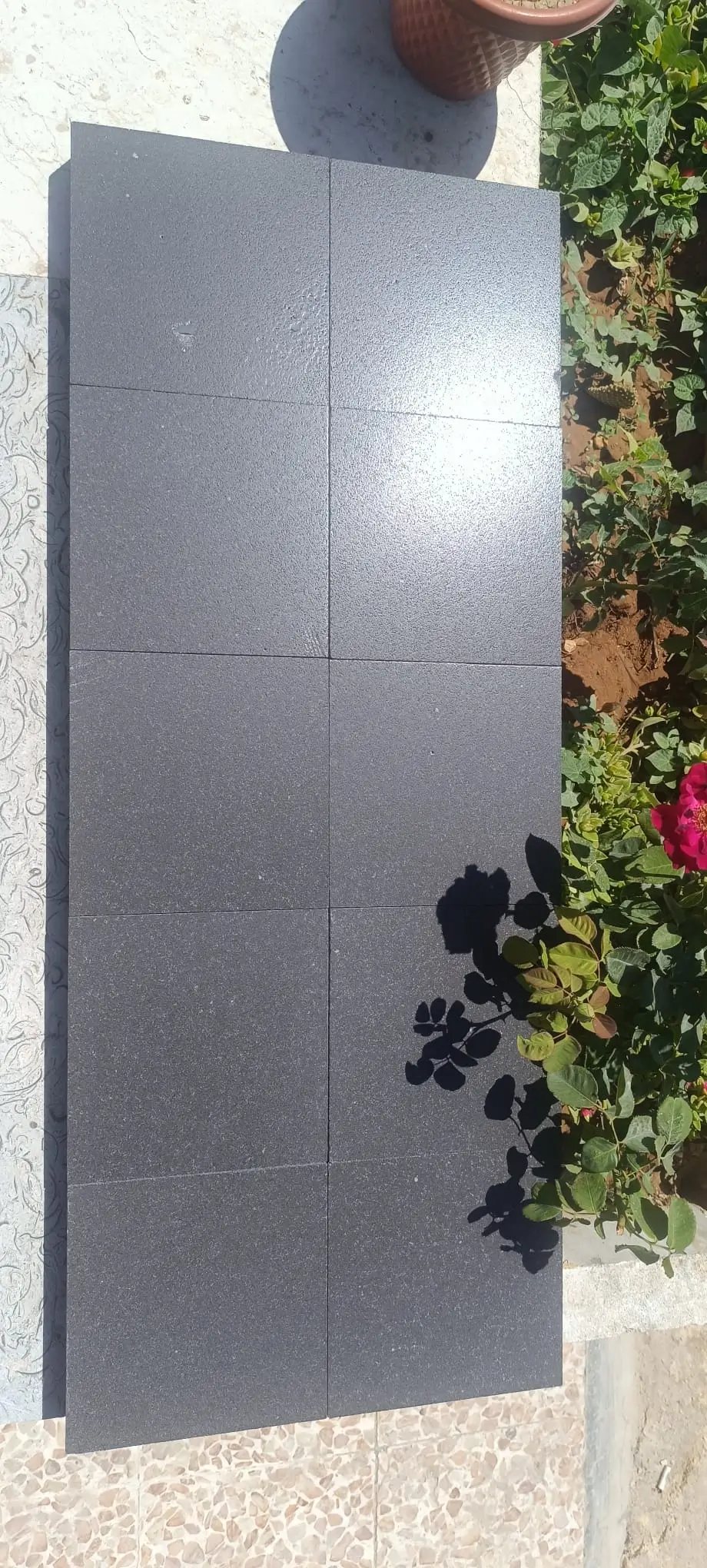
Basalt Paver Base Preparation for Arizona Homeowners
Your aggregate base depth should start at a minimum of 6 inches of compacted class II road base for pedestrian applications and move to 8–10 inches for driveway or vehicular loading. In Phoenix, the native soil is predominantly sandy loam and decomposed granite, which compacts well and drains reliably — meaning your base depth can sit at the lower end of that range when drainage is well-designed. What you cannot skip is the compaction step itself: every 3-inch lift needs to reach 95% Standard Proctor density before you add the next layer.
Caliche hardpan is a variable that changes your approach significantly. Basalt paver base preparation for Arizona homeowners working with caliche starts with a judgment call: if the caliche layer is continuous and sits within 18 inches of finished grade, it can actually serve as a stable sub-base — but you need to scarify the top 2 inches, not pour base material on top of a sealed surface. A sealed caliche layer traps water laterally and redirects it to your pavement joint, which is how you end up with heaving in spots that looked perfectly stable during dry installation.
- Minimum base depth: 6 inches compacted for pedestrian; 8–10 inches for vehicular loads
- Compaction target: 95% Standard Proctor density per lift
- Lift thickness: no more than 3 inches per compaction pass
- Caliche hardpan: scarify top 2 inches before adding base material; never pour over a sealed caliche surface
- Native sandy loam in Phoenix-area projects: drains well and compacts reliably with proper moisture content during compaction
- Sub-base geotextile fabric: recommended where fine silty soils are present to prevent base contamination over time
Proper Drainage Techniques for Desert Stone Installation
Drainage design for desert paver installations operates on a different logic than humid-climate projects. Proper drainage techniques for desert stone installation must account for intense short-duration rainfall — Arizona monsoon events can deliver 1.5 to 2 inches in under 30 minutes. Your surface must shed water fast enough to prevent ponding, which means a minimum cross-slope of 1.5% and ideally 2% toward a defined collection point. A flat or near-flat installation looks clean on paper but becomes a maintenance problem every monsoon season.
Sub-surface drainage matters just as much. A perforated pipe at the base of your aggregate layer, wrapped in filter fabric and connected to a daylight outlet or dry well, handles the water that makes it through joints and base material. Without that relief path, hydrostatic pressure builds under your paver field during heavy rain events and starts working against your joint sand. The first signs appear as sand migration from joints — and by the time that’s visible, the base material beneath has already shifted incrementally.
For projects in Tucson, the monsoon intensity combines with clay-bearing soils in some neighborhoods, creating a scenario where sub-surface drainage is non-negotiable rather than optional. A French drain running the perimeter of your paver field — perforated pipe in 3/4-inch washed gravel, filter fabric wrapped — will protect your investment against the seasonal hydrostatic loading that Sonoran Desert monsoons generate. These proper drainage techniques for desert stone installation translate directly into long-term joint stability and base integrity.
Choosing Basalt Slab Laying Patterns for Arizona Climate
Pattern selection affects more than aesthetics — it directly impacts structural performance and joint continuity. Basalt slab laying patterns for Arizona climate conditions should prioritize broken joint configurations over continuous running bond for any field larger than 150 square feet. Running bond concentrates stress along long linear joint lines, and thermal expansion in Arizona’s temperature range creates cumulative movement that a continuous joint line amplifies.
A 1/3 offset running bond, herringbone, or random ashlar pattern distributes that movement across a more complex joint network, which is why those patterns outlast basic stacked bond in high-heat climates. The herringbone pattern has a particular structural advantage for driveways and vehicular areas because the interlocking geometry resists lateral displacement — each stone locks against its neighbors in a way that a grid pattern simply doesn’t. Selecting the right basalt slab laying patterns for Arizona climate is one of the clearest differentiators between installations that hold for decades and those that require early remediation.
- Running bond (stacked): avoid for large fields — concentrates thermal stress along continuous joint lines
- 1/3 offset running bond: better stress distribution, works well for walkways and patios
- Herringbone at 45°: best structural option for driveways; interlocking geometry resists lateral shift
- Random ashlar: design flexibility with strong performance for irregular patio fields
- Expansion joint spacing: 12–15 feet in all directions regardless of pattern — Arizona’s temperature range demands this interval, not the 20-foot spacing common in milder climates
- Joint width: 3/8 to 1/2 inch for standard field joints; 3/4 inch minimum at expansion joints filled with flexible backer rod and sealant
Setting Bed Options and Material Thickness
Your choice between a dry-set mortar bed and a wet-set system hinges on application and substrate. For ground-level paver installations on a compacted aggregate base, a dry-set screeded sand bed — 1 inch of coarse bedding sand, not fine silica — gives you the most reliable result. The dry-set approach allows micro-adjustments during placement, tolerates minor base irregularities, and doesn’t lock you into a setting window the way a mortar bed does.
Wet-set mortar over concrete slab is appropriate for pool decks, elevated structures, or any installation where movement must be strictly controlled. In that context, you’re typically working with a 3/4-inch mortar bed at 5,000 PSI mix, and your basalt pavers need to be pre-wetted to prevent rapid moisture absorption from fresh mortar — a step that’s easy to skip in Arizona’s low humidity and costly when you get it wrong. Hollow spots under wet-set pavers appear within the first season when bond integrity is compromised by premature drying.
Material thickness selection should reflect your load scenario. A 1.25-inch (30mm) basalt paver handles pedestrian and residential light traffic reliably. For driveway applications or areas with occasional vehicle access, move to 1.5 to 2 inches (40–50mm) nominal thickness. You can reference our Arizona basalt stone installation resource for thickness-to-load tables that account for Arizona subgrade conditions specifically.
- Dry-set sand bed: 1 inch coarse bedding sand, screeded level; best for ground-level installations on compacted base
- Wet-set mortar: 3/4-inch bed at 5,000 PSI mix; pre-wet pavers before setting to prevent bond failure from rapid moisture loss
- Pedestrian thickness: 1.25 inches (30mm) minimum
- Vehicular/driveway thickness: 1.5–2 inches (40–50mm) minimum
- Verify warehouse stock on your chosen thickness before finalizing project schedule — 40mm basalt moves quickly in Arizona’s peak installation season (October through April)
Joint Sand Selection and Sealing Strategy
Polymeric joint sand has become the default recommendation for paver installations, and for good reason — it resists washout and discourages weed germination. The detail that matters in Arizona specifically is your activation window. Polymeric sand requires moisture to cure, and Arizona’s low relative humidity means your activation water evaporates faster than the binder compounds can cross-link. Apply activation water in sections of 100 square feet or less during the cooler parts of the day, and in summer installations, a second light misting 30 minutes after the first may be necessary.
Sealing basalt pavers in Arizona serves two functions: it reduces surface absorption and it stabilizes the stone’s natural coloration against UV bleaching. A penetrating impregnator sealer — solvent-based for better penetration in low-porosity basalt — applied 28 days after installation gives the stone time to fully cure and off-gas any residual setting moisture. Re-sealing intervals depend on traffic and UV exposure, but a 3-year schedule is a defensible minimum for Phoenix and Scottsdale installations. At Citadel Stone, we recommend testing a small section with water droplets before each re-seal: if the water absorbs rather than beads within 60 seconds, it’s time to re-apply.
- Polymeric sand activation: apply water in sections; low humidity demands careful, incremental application
- Sealer type: penetrating impregnator, solvent-based formulation for basalt’s low porosity
- Initial seal timing: 28 days post-installation minimum
- Re-seal interval: every 3 years for high-sun Arizona exposures; test water absorption annually
- Color-enhancing sealers: available and effective on basalt, but increase surface temperature slightly — factor that in for pool surround applications
Professional Installation Standards for Natural Stone Pavers
Professional installation standards for natural stone pavers in Arizona require a few practices that aren’t always obvious from manufacturer spec sheets. Thermal acclimation is one of them: basalt pallets delivered by truck in summer months can reach surface temperatures above 140°F, and installing straight from a sun-exposed pallet introduces micro-stress into setting mortar or joint sand that’s already fighting Arizona heat. Allow at least 2 hours of shade exposure before cutting or setting on days above 100°F.
Cutting basalt requires diamond blade equipment, not scoring-and-snapping tools appropriate for softer stone. The material’s hardness and tight mineral structure will fracture unpredictably under snap-cut methods, particularly in thicker formats. A wet-saw with a continuous rim or segmented diamond blade at 10 inches or larger handles field cuts cleanly and extends blade life versus the dry-cut approach some crews default to. Cut edges benefit from a quick pass with a diamond hand pad to remove any micro-fracture debris before installation — it improves both aesthetics and edge bonding integrity.
In Scottsdale, many high-end residential projects require the contractor to submit a detailed installation sequence drawing before work begins — it’s worth building that habit regardless of permit requirements because the process forces you to pre-plan your drainage slopes, expansion joint locations, and pattern starting points before the first paver is moved. Meeting professional installation standards for natural stone pavers AZ projects demand starts with that level of pre-installation planning.
Ordering, Logistics, and Project Planning
Material planning for basalt paver projects requires a 10–15% overage calculation above your net square footage to account for cuts, pattern waste, and any units rejected during quality inspection on arrival. For herringbone patterns, push that overage to 15–18% — the diagonal cuts generate more waste than orthogonal laying patterns. Order all material from a single lot number where possible; basalt color can vary subtly between quarry pulls, and a second delivery from a different lot mid-project creates visible tonal differences that are difficult to address after the fact.
Citadel Stone maintains warehouse inventory of Arizona-specification basalt product, which typically supports lead times of 1–2 weeks versus the 6–8 week import cycle that sourcing through international distributors introduces. Coordinating your truck delivery window matters — schedule delivery to coincide with base preparation completion, not in advance. Pallets stored on-site under direct Arizona sun for extended periods accumulate heat stress and create handling risks for your crew.
- Overage: 10–15% for standard patterns; 15–18% for herringbone and diagonal layouts
- Lot matching: order from single lot number to maintain color consistency across the full installation
- Delivery timing: coordinate truck arrival with base prep completion — avoid extended on-site pallet storage in summer
- Weight planning: basalt at 2-inch thickness weighs approximately 23–25 lbs per square foot; verify your truck access and off-loading equipment before scheduling
- Inspection on delivery: check for corner chips and surface cracks before signing off — damage during transit occasionally occurs and is easier to address before installation begins
What Matters Most When Installing Basalt Stone Pavers in Arizona
Every phase of learning how to install basalt stone pavers in Arizona ultimately comes back to three decisions made before a single paver is set: drainage geometry, base depth calibration for your specific soil, and expansion joint spacing appropriate to Arizona’s temperature range. Those three variables determine whether your installation performs for two decades or starts showing distress in five years. The stone itself is durable enough for Arizona conditions — the system around it is what you’re actually engineering.
Your pattern choice, sealer selection, and joint sand technique all matter, but they’re refinements layered on top of a foundation that either works or doesn’t. Take the time to evaluate your sub-grade honestly, design drainage with monsoon intensity in mind rather than average annual rainfall, and spec your expansion joints at 12–15 feet regardless of what a standard installation guide recommends. For projects involving larger-format stone, the specification decisions overlap significantly with basalt work — How to Install Large Format Pavers in Arizona provides additional technical guidance on managing slab weight, setting bed tolerances, and base requirements that apply across Arizona hardscape projects. Citadel Stone provides basalt stone pavers tested for Arizona’s elevation and temperature ranges, supporting successful installations for projects across Flagstaff, Mesa, and Chandler.