
Base depth miscalculations are the leading cause of blue black limestone slab install Tempe failures — not material defects, not adhesive choices, not even joint width errors. The compressive loads from Arizona’s clay-expansive subsoils create hydrostatic pressure that undermines even correctly specified slabs when the aggregate base falls short of the 6–8 inch minimum required for Tempe’s soil conditions. Getting this detail right before the first slab touches the ground is what separates a 25-year installation from a 7-year replacement job.
Why Blue Black Limestone Performs in Arizona Heat
Blue black limestone carries a thermal diffusivity profile that makes it genuinely well-suited for extreme heat environments. The dense crystalline matrix — typically exhibiting compressive strength in the 14,000–18,000 PSI range — absorbs and distributes heat gradually rather than spiking at surface level the way concrete does. You’ll notice the difference most acutely in mid-afternoon when adjacent concrete surfaces are pushing 160°F and blue black limestone is running 20–30°F cooler under the same exposure.
The material’s relatively low porosity, generally 1.5–3.5% by volume, reduces water infiltration under Arizona’s monsoon conditions. That matters specifically in Tempe because flash saturation events can force moisture into improperly sealed stones and accelerate spalling at joint edges. Blue black limestone’s density makes it more forgiving than lighter-colored limestones if your sealing schedule slips by a season.
- Compressive strength 14,000–18,000 PSI handles vehicular and high-foot-traffic loads without edge fracturing
- Thermal expansion coefficient of approximately 4.8–5.2 × 10⁻⁶ per °F demands accurate joint spacing in Tempe’s 100°F+ summer range
- Low porosity reduces staining absorption from pool chemicals and organic debris common to Arizona outdoor living areas
- Dark pigmentation absorbs more solar energy than white limestone, so surface orientation and shade planning affect long-term comfort performance
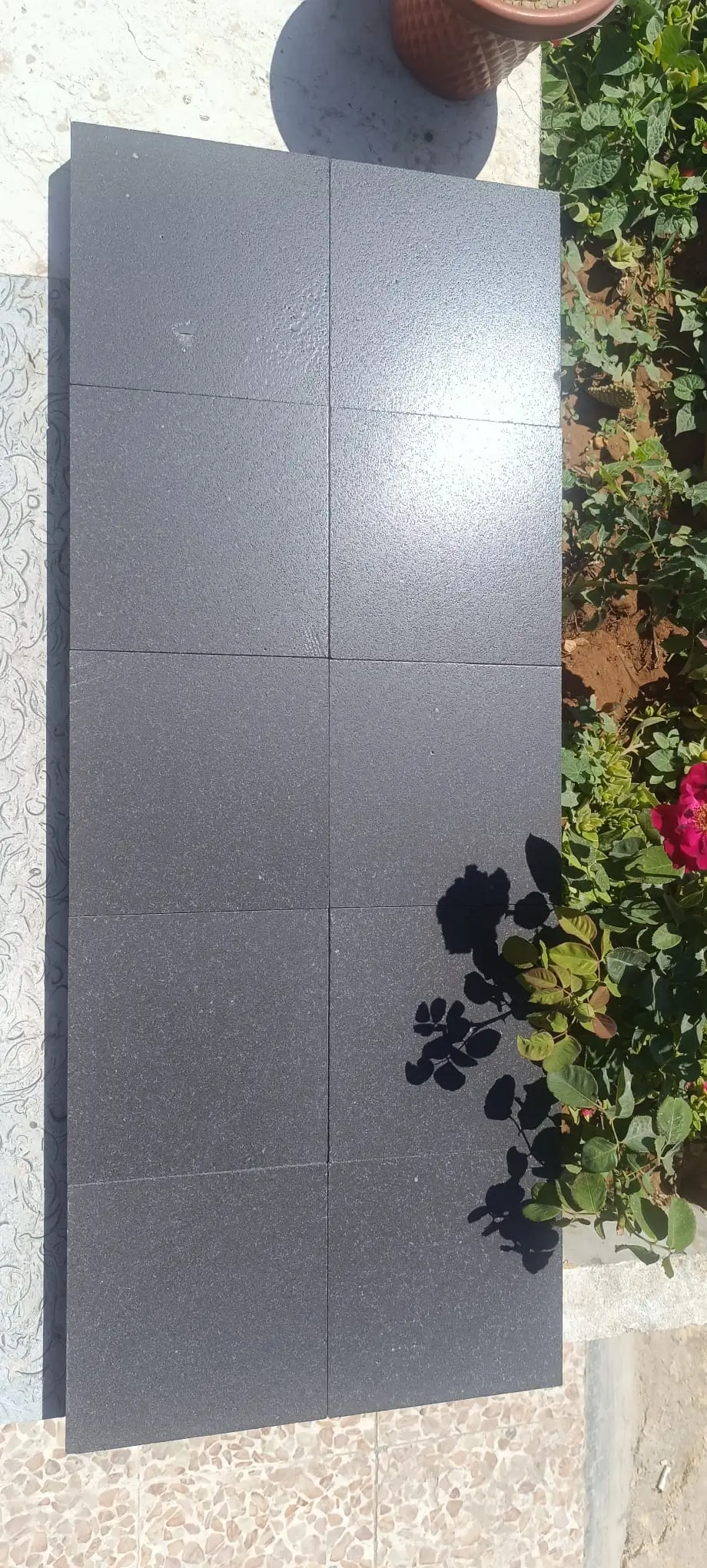
Base Preparation for Tempe Soil Conditions
Tempe’s soil profile is dominated by sandy loam with caliche intrusions in the upper 24–36 inches. Caliche provides solid sub-base support where it’s continuous, but the problem arises where caliche is patchy — you end up with differential settlement zones that telegraph directly to slab surfaces within two to three monsoon cycles. Your excavation needs to break through any discontinuous caliche layers and establish a consistent compacted aggregate base rather than relying on caliche to carry part of the load.
Aggregate base specification for a blue black limestone slab install in Tempe should target a minimum 6 inches of 3/4-inch crushed aggregate, compacted to 95% Proctor density. For pedestrian-only applications, 4 inches is technically sufficient in stable soil, but given Tempe’s clay-expansive pockets, the extra base depth functions as insurance against subsoil moisture movement. If your project borders an irrigation zone — very common in residential and commercial landscaping here — go to 8 inches without debate.
- Excavate to a minimum 10–12 inches below finished surface grade to accommodate base, setting bed, and slab thickness
- Compact native soil to 90% Proctor before introducing aggregate base layers
- Install aggregate in 3-inch lifts, compacting each lift before adding the next — single-pour compaction doesn’t achieve uniform density
- Check for caliche continuity with a probe bar before finalizing base depth decisions — don’t assume uniformity across a 500 square foot project
- A 1–1.5% cross-slope toward drainage must be established at base level, not corrected at slab surface level
Slab Thickness Selection for Arizona Applications
Thickness selection for blue black paving slab laying Arizona projects comes down to the expected load profile and the span between support points. For residential patio applications in Tempe, 20mm (¾ inch nominal) slabs perform well under pedestrian loading when the base meets the specs outlined above. Driveway applications are a different story — you need to move to 30mm (1¼ inch) minimum, and for anything accepting regular vehicle traffic, 40mm (1½ inch) eliminates the edge-fracture risk that undermines thinner profiles.
The 20mm category gives you more material flexibility on larger format slabs — 24×24 and 24×48 configurations are achievable without excessive weight per piece — but those thin large-format slabs are unforgiving of base irregularities. A 3mm deviation in your setting bed reads as a visible high point under Tempe’s low-angle winter light. For projects in San Tan Valley, where residential driveways often carry loaded trailers and RVs, the 40mm specification isn’t optional — it’s the threshold where the slab stops being the failure point and the base becomes the limiting factor instead.
- 20mm: residential patios, pool decks, covered outdoor dining — pedestrian load only
- 30mm: driveways with occasional passenger vehicle access, commercial walkways, elevated deck systems
- 40mm: regular vehicular traffic, commercial entries, loading areas with cart or equipment exposure
- Larger format slabs (24×48 and above) require 30mm minimum regardless of application to manage flex stress across unsupported spans
Setting Bed Methods and Mortar Specification
The choice between a full mortar bed and a dry-pack screed determines how much correction latitude you have during installation. Full mortar beds — 1:3 Portland-to-sand ratio at 1½–2 inch depth — give you the ability to fine-tune elevation during placement, which is critical when you’re working with large-format blue black limestone slabs where matching joints across multiple pieces requires precise surface geometry. Dry-pack screeds work well for experienced installers in controlled conditions, but Tempe’s afternoon wind events can affect moisture content faster than expected.
Proper setup with blue black limestone in Arizona means mortar workability time drops significantly once ambient temperatures exceed 95°F — which in Tempe means you’re working against the clock from about 10 a.m. to 6 p.m. in summer. Add a retarder admixture rated for high-temperature applications and reduce your batch size so no mortar sits unused longer than 20 minutes. This isn’t theoretical caution — it’s the specific adjustment that prevents hollow spots caused by premature skinning of the mortar bed before the slab achieves full contact.
- Full mortar bed provides 95%+ contact area versus 80% typical for spot-bonding — critical for large-format slabs
- Back-butter each slab with a 3mm skim coat of the same mortar mix before placing to eliminate air pockets at the bond interface
- Allow no foot traffic for 48 hours in summer conditions — mortar cures faster but gains less tensile bond strength under heat stress
- Use a heat-rated retarder (Type B or Type D per ASTM C494) when temperatures exceed 95°F at placement
Joint Spacing and Thermal Expansion in Tempe’s Climate
Tempe’s temperature swing — from roughly 30°F winter nights to 115°F summer afternoons — represents an 85°F operational range for your installed stone. Blue black limestone at a thermal expansion coefficient of 5.0 × 10⁻⁶ per °F means a 24-inch slab experiences approximately 0.010 inches of linear movement across that full range. That sounds small, but multiply it across a 400 square foot installation and you’re looking at cumulative stress that will shear unsupported edges if you haven’t built adequate relief joints into the design.
For Tempe professional installation work, minimum joint width should be 3/16 inch for field joints and ¼ inch at perimeter relief joints. The perimeter joint is where most installers cut corners — they tighten it to match the field joint width for visual uniformity and then wonder why edge cracking appears in year three. That perimeter joint does real structural work. Fill it with a flexible polyurethane sealant rather than rigid grout, and reapply when it shows cracking rather than waiting for the next full maintenance cycle. Arizona expert methods for managing thermal movement also apply when working with other natural stone types — thermal blue black limestone in Sedona covers how elevation and temperature variation influence limestone expansion in ways that directly inform your Tempe specification.
- Field joints: 3/16 inch minimum, filled with unsanded polymer grout rated for outdoor use
- Perimeter relief joints: ¼ inch minimum, flexible polyurethane sealant only — no rigid grout
- Expansion joints every 10–12 linear feet in both directions for areas exceeding 200 square feet
- Joint sand in pedestrian applications should be polymeric and recharged every 2–3 years as it migrates under monsoon wash events
Sealing Protocols for Arizona Outdoor Conditions
Blue black limestone in Arizona paving applications benefits from a penetrating impregnating sealer rather than a topical film-former. Film sealers look excellent on day one but begin peeling within 18 months under Tempe’s UV intensity — and once they start delaminating, they trap moisture underneath rather than releasing it, which actually accelerates surface degradation. A silane-siloxane penetrating sealer rated for UV exposure provides interior crystal protection without the film maintenance headache.
Application timing matters more than most project specs acknowledge. Sealers applied to stone that still carries construction moisture — particularly common when installation happens during or just after Tempe’s July–August monsoon season — won’t penetrate properly and will cloud the surface. Test moisture content with a plastic sheet taped flat to the surface for 24 hours before sealing: any condensation on the underside means you need at least another week of drying time. In Yuma, where humidity stays extremely low even during monsoon season, drying windows are shorter, but Tempe’s slightly higher relative humidity during August requires patience before sealing newly installed stone.
- First sealer application: 28–45 days after installation to allow full mortar cure and moisture release
- Reapplication schedule: every 3–5 years for penetrating sealers in full-sun Tempe applications
- Apply two coats in opposite directions — second coat applied while first is still tacky (wet-on-wet) for full matrix penetration
- Avoid sealing during afternoon heat — apply before 9 a.m. or after 5 p.m. to prevent flash-drying that inhibits penetration depth
- Shaded applications extend sealer life by 30–40% versus full-exposure surfaces at the same location
Drainage Design and Slope Management
Arizona expert methods for drainage in flatwork consistently point to the same failure pattern: installers achieve the correct 1–1.5% slope at installation but don’t account for the soil settlement that flattens it over two to three monsoon seasons. Your design needs to target 2% slope at installation so that after predictable settlement you’re landing at 1.5%, not at flat or reverse-pitch. This is especially relevant for Tempe professional installation projects near mature tree root systems, where differential heave is almost guaranteed within five years.
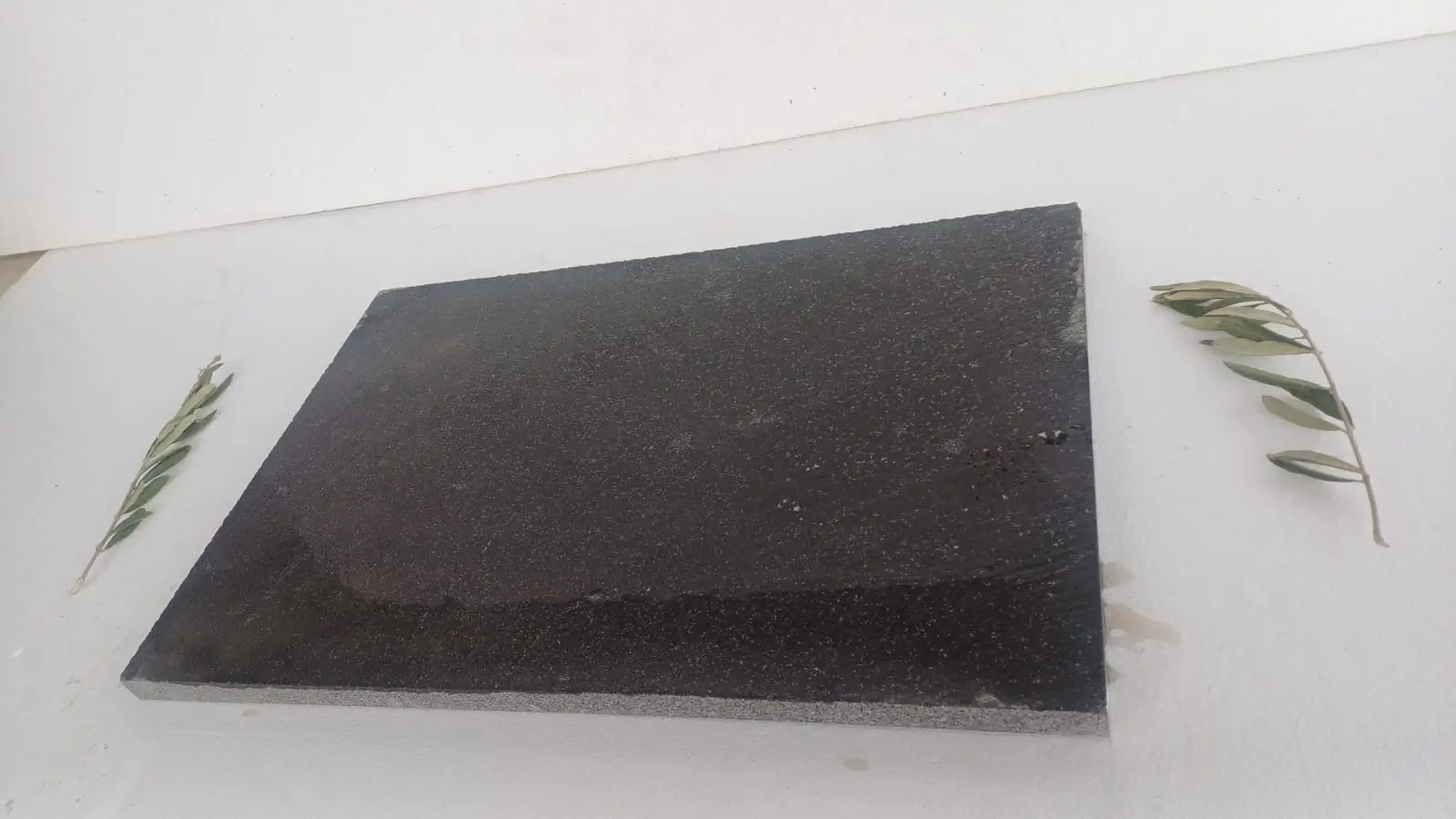
Surface drainage must connect to a defined collection point — a channel drain, area drain, or landscaped swale — not simply terminate at a grass edge. Blue black limestone’s low porosity means water sheeting is faster and more concentrated than with permeable pavers, so collection infrastructure needs to handle peak monsoon flow rates, not average rainfall. For projects in Avondale, where retention basin requirements sometimes limit where surface runoff can discharge, designing drainage geometry early in the process prevents costly redesigns after stone is already in the ground.
- Design slope at 2% to account for post-settlement flattening over 2–3 seasons
- Avoid draining toward building foundations — maintain a minimum 10-foot diversion zone with positive slope away from structures
- Linear channel drains at natural low points handle monsoon sheet flow better than point drains that can’t accept volume fast enough
- Inspect drainage outlets annually after monsoon season — sediment accumulation from Arizona dust events blocks smaller drains within a single season
Material Sourcing and Delivery Planning
Blue black limestone paving slabs in Arizona are available through several channels, but the variation in quality between sources is substantial. Quarry origin matters — Turkish and Spanish-quarried blue black limestone generally exhibit tighter color consistency and lower natural fissure rates than some Southeast Asian sources where the material gets color-enhanced to mask variation. At Citadel Stone, we source directly from verified quarries and conduct incoming warehouse inspections that check for fissure depth, flatness tolerance, and thickness consistency before material reaches project sites.
Delivery logistics for large-format slabs require attention to truck access constraints before you finalize your order schedule. A standard flatbed truck needs approximately 14 feet of overhead clearance and 40 feet of maneuvering room to stage material near the installation area. If your Tempe project site has restricted access — residential neighborhoods often do — coordinate with your supplier to determine whether a smaller delivery vehicle is available, understanding that it will affect per-delivery material volume and potentially extend your project timeline. Citadel Stone’s warehouse stock in Arizona typically supports 1–2 week lead times on standard blue black limestone slab profiles, which is considerably faster than the 6–8 week cycle for direct import orders.
- Order 10–12% overage to account for cuts, breakage, and pattern matching on large-format installations
- Request thickness certification data from your supplier — blue black limestone shipped in nominal 20mm should fall within ±1.5mm tolerance
- Verify warehouse stock levels against your project schedule at least three weeks before installation start — popular slab formats move quickly in Arizona’s active construction cycle
- Stage material in shade if delivery precedes installation by more than 48 hours — direct Arizona sun exposure can heat slab surfaces above 130°F, affecting how mortar behaves on first contact
Getting Your Blue Black Limestone Slab Install Right
A blue black limestone slab install in Tempe that performs for 20+ years comes down to decisions made before the first slab is ever placed. Base preparation depth, mortar workability management, joint width discipline, and drainage geometry are the four variables where field execution most commonly diverges from specification intent — and each one compounds the others. Getting base depth right protects joint integrity; getting joint width right protects against thermal stress; getting drainage right protects against the moisture infiltration that undermines even correctly bonded slabs.
Your project timeline should build in at least 28 days post-installation before applying sealer, and you should plan the installation window to avoid peak monsoon weeks in July and August if mortar curing is a concern. The material itself is durable and well-matched to Arizona’s demand profile — but durability is only unlocked when the installation variables align correctly. For a different perspective on how other natural stone types compare in Arizona climates, Turkish Travertine Pavers in Arizona: What the Data Shows provides useful contrast data that can sharpen your material selection reasoning for future projects. Our blue black limestone paving slabs in Arizona are inspected for fissures before leaving our yard.