
Proper slope geometry is the variable that separates functional blue limestone drainage Carefree installations from costly callbacks — and it’s the one detail most project plans underspecify. A 1% fall sounds modest on paper, but across a 20-foot paved area in Carefree’s rocky desert terrain, that translates to roughly a 2.4-inch elevation change that determines whether water sheets cleanly off the surface or pools at the grout joints. Get the slope geometry wrong and you’re fighting a physics problem that no amount of sealing or joint sand will solve.
Understanding Carefree’s Drainage Demands
Carefree sits at roughly 2,500 feet elevation, and that positioning matters significantly for Carefree water flow management planning. Your blue limestone paving slab installation here faces a double challenge — infrequent but intense monsoon events that dump 1–2 inches of rain within 90 minutes, followed by months of near-zero precipitation. That pattern creates specific stress points at the paving surface, particularly at the leading edge of slabs where runoff velocity concentrates.
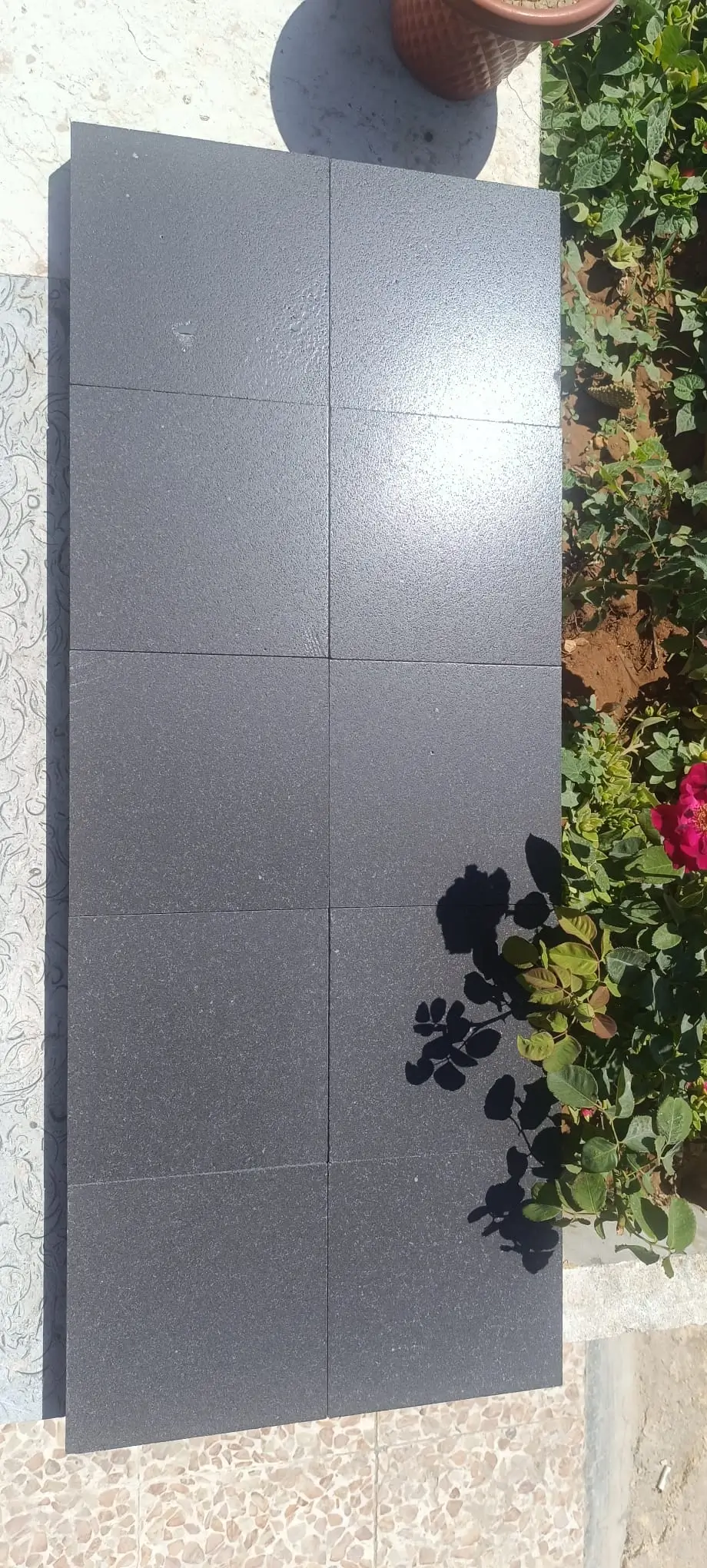
The desert hardpan common to northern Maricopa County doesn’t absorb water quickly, which means Carefree water flow events move fast across any hardscape surface. Blue limestone’s natural density — typically 2.55–2.65 g/cm³ — actually works in your favor here. The material’s low absorption rate (generally under 0.5% by weight in quality sawn stock) means water stays on the surface where drainage geometry can control it, rather than wicking into the stone body and migrating laterally beneath the slabs. That’s a real performance advantage in high-intensity rainfall zones.
Slope Specifications for Blue Limestone Drainage Carefree Projects
The industry standard for paved surfaces calls for a minimum 1% cross-slope, but for Arizona runoff solutions involving monsoon-intensity events, you’ll want to push that to 1.5–2% wherever your site geometry allows. The additional fall doesn’t compromise the level feel underfoot — most people can’t detect the difference between 1% and 2% — but it dramatically changes how quickly water clears the surface during high-volume events.
- Cross-slope minimum of 1.5% for patios and entertainment areas exposed to direct rainfall
- Longitudinal slope minimum of 1% for walkways and paths draining toward planted areas
- Maximum slope of 5% before you need to evaluate slip resistance ratings for the specific limestone finish
- Slope transitions should be gradual — abrupt changes create standing water at the inflection point
- All slopes must drain away from the building foundation — a minimum 5-foot setback zone sloping at no less than 2% is standard practice
You’ll also need to account for how the base settles after installation. Even a well-compacted crushed aggregate base will experience some degree of consolidation in the first 12–18 months. Specifying your finished slopes 0.25% steeper than the target helps compensate, so you end up at your design slope after the material finds its equilibrium.
Sub-Base Preparation and Drainage Layers
The drainage decision that carries the most weight happens before a single blue limestone paving slab goes down. Your sub-base design determines whether the entire system sheds water correctly or traps moisture between the aggregate and the native soil — a condition that accelerates heave cycles and undermines long-term stability.
In Chandler, clay-bearing soils in lower residential areas can have expansion indices above 50, which means any subsurface moisture retention creates genuine movement risk for the paver surface. For those conditions, a geotextile separation fabric between the native subgrade and the aggregate base isn’t optional — it’s the barrier that prevents fine clay particles from migrating up into your drainage layer and reducing its permeability over time.
- Minimum 4-inch compacted aggregate base for pedestrian applications; 6 inches for vehicular or heavy-use areas
- Use angular crushed stone (3/4-inch minus) — rounded gravel compacts poorly and loses its drainage capacity under load
- Compact in 2-inch lifts to 95% Proctor density — don’t try to compact a 4-inch lift in one pass
- Install a 1-inch bedding sand layer above the compacted base, screeded to your target slope
- In areas with poor native soil drainage, consider a perforated pipe drain at the base perimeter tied to a daylight outlet or dry well
Joint Design and Water Intrusion Prevention
Joint width and fill material directly control your water intrusion prevention outcomes. The temptation on premium blue limestone projects is to run narrow joints for a clean, seamless look — and you can achieve that aesthetically — but joints under 3mm create a capillary channel that actually draws water laterally under the slabs rather than allowing it to pass through and drain.
Polymeric sand remains the right choice for most residential and light commercial blue paving slab drainage Arizona applications. The binding agents in quality polymeric mixes resist washout at the flow velocities typical of Carefree monsoon events. Standard silica sand, by contrast, begins eroding at surface water velocities above roughly 0.5 m/s — a threshold easily exceeded during intense rainfall on a 2% slope. You’ll be reapplying it every season if you use standard sand without any binder.
- Maintain 3–5mm joint width for standard sawn limestone slabs in 20–40mm thickness range
- Fill joints to 90–95% of depth — underfilled joints allow water to undercut the bedding layer
- Activate polymeric sand with a controlled water mist — a full saturation rinse washes the polymers out before they cure
- Inspect and top up joints annually before monsoon season; joint material compresses gradually with thermal cycling
- For mortar-bedded installations on concrete slabs, a 10mm open joint with a closed-cell backer rod and non-sag polyurethane sealant performs best in Arizona’s thermal expansion range
Effective water intrusion prevention at the joint level also depends on consistent slab thickness. For technical reference on the material’s base characteristics, our page on sawn blue black limestone paving provides detailed specifications on thickness tolerances and surface finish options relevant to drainage planning.
Surface Finish and Runoff Velocity
The finish you specify on blue limestone paving slabs does more than affect aesthetics — it directly controls how fast water exits the surface and whether that exit is controlled or chaotic. A honed finish (600-grit equivalent) produces a relatively smooth surface where water sheets off cleanly in a laminar flow pattern. A sawn finish with light texture introduces micro-turbulence that slows the flow velocity slightly, which can be advantageous when you’re directing runoff toward planted areas that would erode under high-velocity flow.
Carefree water flow volumes during peak monsoon events can genuinely surprise homeowners accustomed to the region’s dry reputation. Specifying a natural cleft or brushed finish introduces enough surface texture to maintain slip resistance ratings above DCOF 0.42 (the interior wet standard) while still shedding water efficiently. That combination matters especially around pool surrounds and outdoor kitchen areas where foot traffic coincides with wet surfaces.
- Honed finish: fastest water clearance, requires additional anti-slip treatment in heavy-traffic zones
- Brushed or tumbled finish: natural slip resistance, slightly reduced drainage speed, good for garden paths
- Sawn finish (standard): balanced performance, most commonly specified for patios and entertainment areas
- Flamed finish: maximum texture and slip resistance, suitable for ramps or transition zones from pool to patio
Perimeter Edge and Drainage Outlet Planning
Your perimeter edge treatment is the drainage system’s last line of defense before water either exits the paved area cleanly or backs up and saturates the bedding layer. Blue limestone drainage Carefree projects commonly fail at this junction — not because the slope was wrong, but because the edge detail trapped water that had nowhere to go.
In Tempe, urban projects with tight property boundaries often use recessed channel drains at the paved edge, covered with a linear grate that maintains the clean aesthetic of the limestone surface. That approach works well when you have a clear outlet for the collected water — a downslope planter, a permeable gravel strip, or a connection to the site stormwater system. Without a clear outlet, you’ve just moved the water pooling problem from the paving surface to the channel drain.
- Open edge with gravel border: low cost, effective for residential applications with planted perimeters
- Recessed channel drain: highest drainage capacity, necessary for large paved areas exceeding 500 square feet
- Soldier course edge with 10mm gap: allows sheet flow to exit between edging units, suits informal garden settings
- Raised border with weep holes: contains loose gravel while still allowing drainage — common in courtyard applications
Whatever edge treatment you select, confirm that the outlet elevation is at least 50mm below the finished paving surface. That buffer prevents backflow during peak runoff events when outlet capacity temporarily can’t keep up with inflow volume.
Sealing and Long-Term Drainage Performance
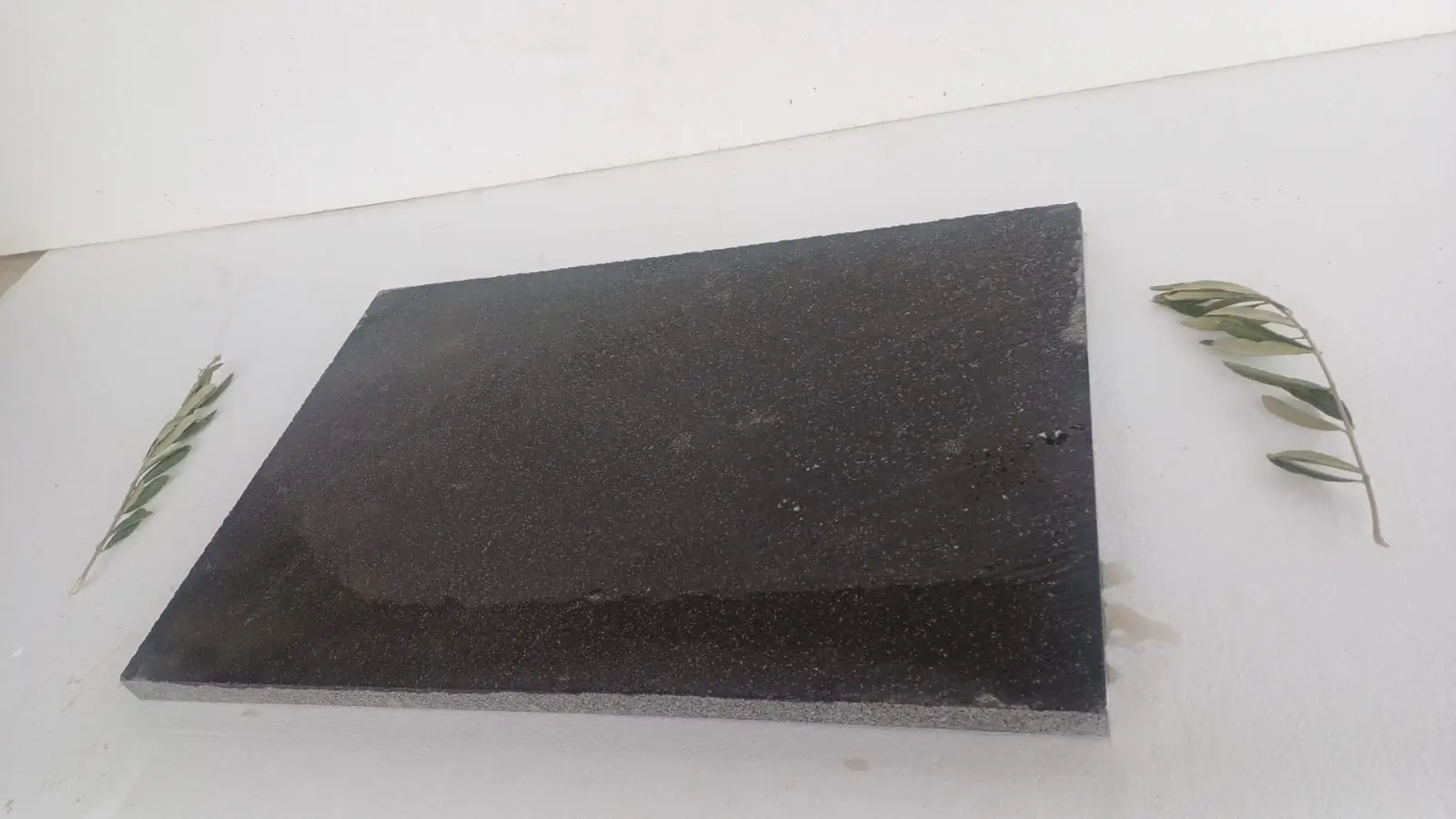
Sealing blue limestone paving slabs in Arizona affects drainage behavior in ways that aren’t always intuitive. A penetrating impregnator sealer fills the micro-pores in the stone’s surface without bridging across joint gaps — which means it preserves the drainage pathway through the joints while protecting the stone face from moisture ingress and staining. A film-forming sealer, by contrast, creates a surface membrane that can actually reduce surface drainage speed on lower-slope areas by increasing the water’s tendency to sheet rather than infiltrate.
For blue paving slab drainage Arizona projects, penetrating silane-siloxane sealers in the 40% solids range give you the best combination of protection and drainage performance. Apply in two coats at 90-degree orientation to each other — the second pass fills any micro-channels the first coat missed. In Carefree’s climate, reapplication every 3–4 years is sufficient; the low humidity means UV degradation outpaces moisture-related wear as the primary failure mode for sealers here.
- Penetrating sealers: preserve joint drainage, protect stone body, require reapplication every 3–4 years
- Film-forming sealers: create a visible surface sheen, can trap moisture if applied over damp stone — not recommended for outdoor use in high-UV climates
- Color-enhancing sealers: deepen the blue-grey tones in the limestone, same penetrating chemistry as standard impregnators
- Apply sealer only when surface and air temperatures are between 50°F and 90°F — outside that range, cure times become unpredictable
Ordering, Logistics, and Project Scheduling
Timing your blue limestone paving slab order around Carefree’s monsoon window is a practical constraint that affects every project in this region. The monsoon season runs roughly June 15 through September 30, and scheduling installation during that window introduces real complications — not just from rainfall interrupting bedding sand screeding, but from elevated humidity affecting polymeric sand cure times and sealer application windows.
At Citadel Stone, we recommend confirming warehouse stock levels at least 4–6 weeks before your planned installation start. Blue limestone moves quickly during Arizona’s peak spring installation season (February through May), and waiting until the week before can leave you holding a committed labor crew with no material to install. Our team can also verify thickness consistency across your order batch — a detail worth confirming, since variation beyond ±3mm in 30mm nominal slabs creates surface lippage that no bedding adjustment fully corrects.
Truck delivery logistics for Carefree addresses deserve specific attention. Many of the area’s residential driveways and access roads aren’t rated for fully loaded articulated trucks, and requiring a tailgate delivery versus a crane-offload adds time to the delivery sequence. You’ll want to confirm your site’s truck access constraints early — weight restrictions on local roads or tight turning radii can shift you from a single-delivery schedule to a split load, which changes your warehouse lead time calculation.
Projects in Surprise and other rapidly growing western Phoenix communities often compete for the same delivery windows during peak season. Booking truck delivery slots two to three weeks in advance during March and April is standard practice — that window compresses fast once contractor demand peaks. Confirming warehouse availability alongside your truck scheduling prevents the common mismatch between material readiness and site readiness.
What Matters Most for Blue Limestone Drainage Carefree Success
Blue limestone drainage Carefree planning ultimately comes down to three decisions made early in the design process: slope geometry, sub-base drainage capacity, and perimeter outlet design. Get those three right and the material performs reliably through decades of monsoon seasons. Miss one of them and no amount of premium stone or careful installation recovers the performance deficit. The material itself is forgiving — blue limestone’s density and low absorption make it one of the better-performing natural stones for Arizona’s demanding climate — but the system surrounding it needs to be designed with the same precision you’d apply to any structural element.
Your drainage plan should be documented before any base preparation begins, with spot elevations at 5-foot intervals across the paved area confirming that your design slopes are achievable within the site’s existing grade constraints. If you find conflicts between desired finished elevations and required drainage slopes, resolve them at the plan stage — adjusting a concrete sub-slab or compacted base costs a fraction of what remediation work costs after slabs are down. For Arizona projects that involve complementary stone surfaces, How to Maintain 30mm Travertine Pavers in Arizona provides useful context on long-term stone maintenance practices that apply broadly across natural stone applications in this climate. Our blue black limestone paving slabs in Arizona create a sophisticated mood for evening entertainment areas.