
Batch-to-batch variation in blue limestone is the specification problem that derails large Glendale projects more than any other single factor — and it’s almost never caught until material is already on site. Blue limestone color consistency Glendale projects demand starts at the quarry, not at the job site, and understanding where tone drift originates gives you real leverage when you’re coordinating a 10,000-square-foot installation across multiple delivery windows. The stratified sedimentary layers that produce blue limestone’s characteristic steel-blue and charcoal hues vary naturally within a single quarry face, meaning two pallets pulled from different sections of the same stockpile can read noticeably different under Arizona’s high-angle sun.
What Actually Drives Color Variation in Blue Limestone
The iron and manganese mineral content locked inside blue limestone’s matrix is what gives each slab its signature tone — and those concentrations shift as quarry extraction moves deeper into the deposit. You’re dealing with a natural material formed over millions of years under different pressure and mineral saturation conditions, so expecting factory-level uniformity without deliberate batch management is setting yourself up for a visible mismatch. Projects that end up with a noticeably lighter section in the middle of an otherwise uniform field almost always trace back to material sourced from a second quarry run or a different storage bay.
The surface finish compounds this challenge. A flamed finish opens the material’s grain structure and tends to lighten the apparent color by 15 to 25 percent compared to a honed face. Your specification needs to lock in both the quarry batch reference and the finish type simultaneously — treating them as separate decisions creates a gap that shows up in the installed result. Achieving consistent coloring across a large field depends on controlling both of these variables from the start.
Batch Coordination for Arizona Large-Scale Projects
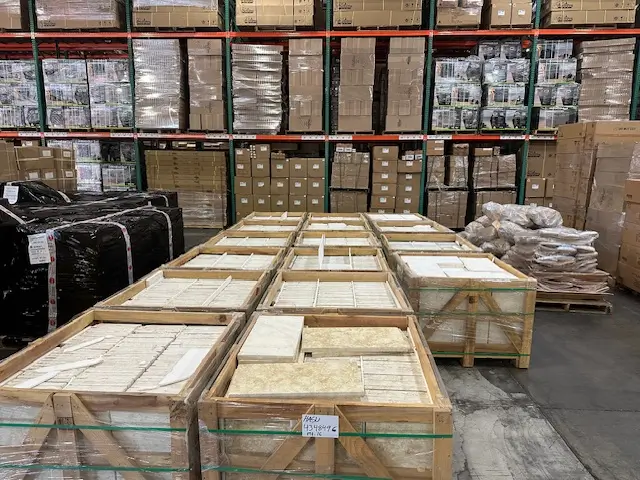
For any project exceeding 2,000 square feet, you need to treat Arizona batch coordination as a formal specification requirement — not an informal request to your supplier. Blue limestone color consistency Glendale specifications should require that all material for a single project be drawn from the same quarry extraction batch, documented by a lot number or batch certificate that travels with the delivery paperwork. Without that paper trail, you have no leverage if material arrives mismatched.
- Request a quarry batch reference number and confirm it appears on the packing list for every truck delivery
- Specify that no material substitutions from alternate batches are permitted without written approval and a physical sample comparison
- Require wet-sample mockups from each delivery lot — dry limestone can mask tone differences that become obvious after sealing
- Establish a tolerance threshold in your spec: a Delta E color difference value of 3.0 or less is a defensible standard for uniform appearance expectations
- Document your approved reference sample with a photograph under consistent lighting before any material leaves the warehouse
Arizona batch coordination for projects in the 5,000 to 15,000 square foot range often means coordinating two or three separate truck deliveries over a six-to-ten week window. The risk of batch drift increases with every additional delivery, which is why locking the lot reference early is non-negotiable on larger installations.
Specifying Blue Paving Shade Matching for Arizona Conditions
Blue paving shade matching in Arizona carries a climate-specific wrinkle that specifiers coming from cooler markets often miss: the state’s intense UV load actively bleaches surface treatments and accelerates the natural weathering of iron minerals in the stone. A freshly installed paver and one that’s been sitting exposed for eight months in Phoenix can already show measurable tone divergence — which means phased installations need to account for accelerated weathering on the earlier-placed sections.
Your specification should address this directly by requiring that all phases of a large installation be completed within a defined window — typically 90 days or less — to keep the weathering timeline consistent across the full field. For projects that genuinely can’t be completed in a single phase, specifying an initial penetrating sealer application on completed sections immediately after installation slows UV-driven color shift and buys you more time before visual divergence becomes obvious to the client.
- Apply a UV-stabilizing penetrating sealer within 72 hours of final installation on each completed phase
- Use the same sealer product across all phases — different sealer chemistries interact differently with limestone minerals and can create sheen variation even when the stone color is matched
- Schedule phased sections to be viewed together under full midday sun before client sign-off — morning and late afternoon light is forgiving and will hide mismatches that noon sun reveals
Blue paving shade matching across phased Arizona installations ultimately depends on how rigorously each of these sealer disciplines is enforced in the field — not just specified on paper.
Planning for Glendale Uniform Appearance Across Delivery Phases
Glendale uniform appearance across a multi-delivery project comes down to a staging discipline that most installation crews don’t practice by default. The standard approach — installing each pallet as it arrives and moving across the site linearly — almost guarantees visible banding if any batch variation exists. A much more reliable method is to blend material from multiple pallets simultaneously, pulling stones from at least three different pallets at any given moment during installation.
At Citadel Stone, we recommend that project managers request full project quantity from warehouse stock before the first delivery is dispatched, even if material will be delivered in stages. This approach lets our team pull all material from the same quarry lot and stage it in the warehouse under consistent storage conditions, rather than sourcing from rotating stock across multiple weeks.
- Never install directly from a single pallet — always blend from a minimum of three pallets per work zone
- Rotate your selection pattern: pull two stones from the first pallet, two from the second, two from the third, then repeat
- Lay out a dry-run section of at least 50 square feet before setting begins, and photograph it for client approval
- If a particular pallet shows noticeably cooler or warmer tones, distribute it evenly across the full installation area rather than concentrating it in one zone
The consistent coloring result you’re targeting isn’t achieved by finding perfectly matched stone — it’s achieved by distributing the natural variation so the human eye perceives a unified field rather than distinct zones. Glendale uniform appearance standards on high-visibility projects make this blending discipline especially important during the final field sections near entryways and pool surrounds.
How Thickness Calibration Affects Visual Consistency
Here’s what gets overlooked on a surprising number of specifications: calibration tolerance directly affects how color reads across an installed field. Blue limestone supplied to a 20mm nominal thickness with a ±2mm calibration tolerance means individual pavers can vary from 18mm to 22mm in actual thickness. On a honed surface, this thickness variation changes how light reflects off the face — thinner stones tend to show slightly more translucency through the surface layer, which shifts the apparent color toward the lighter end of the material’s range.
For projects where blue limestone color consistency Glendale clients will scrutinize closely — entries, feature courtyards, pool surrounds — you should specify a ±1mm calibration tolerance and confirm that your supplier’s warehouse stock meets that standard before you commit to a quantity. Not all imported blue limestone is calibrated to the same tolerance, and the difference between ±1mm and ±3mm stock is visible in the installed result.
Our technical team at Citadel Stone conducts thickness spot-checks across warehouse stock before fulfilling large orders, specifically because we’ve seen calibration drift create color-perception problems that frustrate clients and specifiers alike. It’s a detail that separates a controlled supply chain from a commodity one.
Selecting Charcoal Blue Tones for Large Field Applications
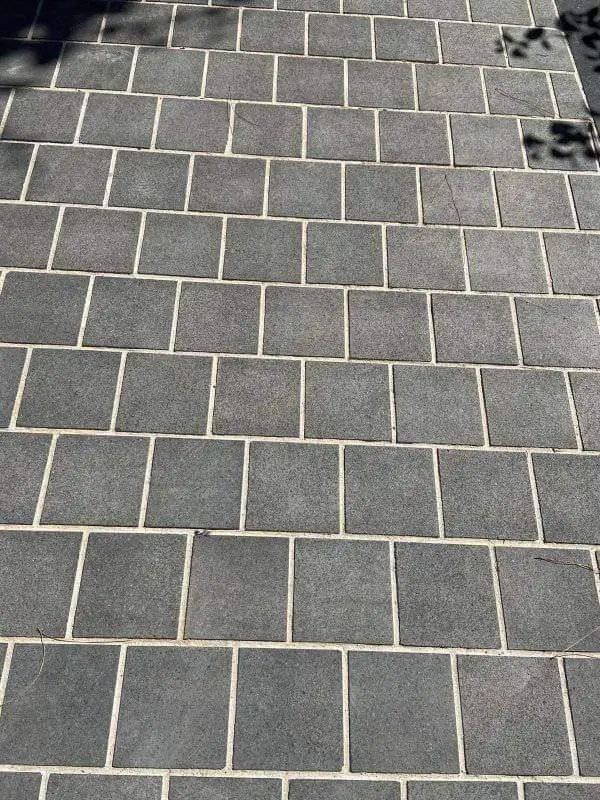
The charcoal-to-mid-blue spectrum within blue limestone paving is wider than most product photography suggests. Material described as “charcoal blue” can range from a deep graphite with almost no warm undertone to a medium blue-grey that reads more neutral in full sun. For large field applications in Glendale, you want to be working with actual physical samples under Arizona sky conditions before finalizing your selection — not relying on product shots taken in a studio under controlled lighting.
Specifying charcoal blue limestone paving slabs from a documented quarry source with a consistent iron mineral index gives you the best baseline for predictable large-format results. The deeper charcoal end of the spectrum is generally more stable across batches than mid-blue material, because the higher iron concentration that produces darker tones tends to be more consistent within a given quarry stratum.
Climate Performance Factors in Glendale’s Desert Conditions
Blue limestone performs reliably in Glendale’s climate profile, but thermal cycling between summer highs above 110°F and cool winter nights creates an expansion-contraction cycle that accumulates stress at joints over time. The material’s thermal expansion coefficient sits around 4.5 to 5.0 × 10⁻⁶ per °F — lower than concrete, which is part of why it performs well — but joint spacing still needs to respect that movement. Specifying joints at 3mm minimum for field pavers and 8mm for perimeter expansion joints keeps the color-consistent field intact as the installation moves through seasonal cycles.
In Scottsdale, projects on east-facing exposures experience particularly aggressive morning thermal shock during summer months, when cool overnight temperatures are followed by rapid solar heating. That cycling is harder on grout and joint material than on the stone itself — so your color consistency plan should include grout color specification that remains stable under UV and thermal stress, because a grout that fades from charcoal to light grey will visually fragment even a perfectly color-matched stone field.
- Specify a polymer-modified grout with UV-stable pigments for all blue limestone installations in Arizona
- Match grout color to the mid-tone of your stone selection — not the darkest or lightest point, which will make the grout visually dominant
- Allow a minimum 28-day cure period before sealing grout joints to prevent moisture entrapment that causes efflorescence and disrupts color uniformity
- In covered outdoor areas, resealing every three years maintains color depth; in full-sun exposures, move to a biennial schedule
Ordering, Logistics, and Lead Time Planning
Coordinating blue limestone color consistency Glendale projects across multiple truck deliveries requires earlier planning than most project timelines allocate. Imported blue limestone from Vietnam or Portugal — the two dominant source regions for quality material — carries a 10 to 14 week lead time from order to Arizona delivery when sourced directly. Domestically warehoused stock cuts that to two to four weeks, but you need to confirm that available warehouse inventory is sufficient to cover your full project quantity from a single lot before placing the order.
For projects in Tucson and the greater Phoenix metro area, Citadel Stone maintains stocked warehouse inventory of blue limestone that allows same-lot order fulfillment for projects up to approximately 8,000 square feet from existing stock. Beyond that threshold, coordinating with our team four to six weeks ahead of your installation start date gives us enough lead time to confirm lot availability and, if necessary, bring in additional material from the same quarry batch to cover the full scope.
- Place your full project order in a single transaction — split orders placed weeks apart almost always draw from different warehouse lots
- Request a hold confirmation in writing: the supplier should document that your full quantity is reserved from the same batch
- Build a 5 to 8 percent overage into your order for cuts, waste, and future repairs — sourcing matching material two years later is significantly harder than having surplus from the original batch on hand
- Confirm truck delivery scheduling to allow proper site staging — material arriving faster than the crew can install it leads to outdoor storage exposure that accelerates weathering on waiting stock
Specifications That Protect Blue Limestone Color Consistency
Blue limestone color consistency Glendale specifications succeed or fail based on decisions made weeks before the first paver is set. Your batch documentation, finish specification, calibration tolerance, and delivery staging plan are the four variables that determine whether a large installation reads as a unified, intentional surface or a collection of slightly mismatched zones. None of those variables are difficult to manage when they’re addressed in the specification — they only become problems when they’re left to chance on the job site.
For installation-phase specifics that complement your color consistency planning, Blue Limestone Paving Installation Techniques for Tempe Professionals covers the setting bed and jointing practices that protect your color work through the construction process. Bringing those two dimensions of the project together — specification precision and installation discipline — is what separates a large blue limestone installation that holds its appearance over decades from one that starts showing problems in the second Arizona summer. Our blue black natural limestone paving in Arizona is a favorite among Tucson custom home designers.